How to be photogenic, measured rather than posed
·8 min read
Search this and you get posing tips: find your angle, tilt your chin, relax your jaw. They are not wrong, but they skip the part that explains why the problem exists. Four variables change how your face measures in a photograph, all four are outside your face, and three of them can be fixed by moving rather than by posing.
This is worth stating precisely because the effects are measurable. Every one of the variables below changes numbers that the free analysis tools on this site report — and if you run the same face twice under two of these conditions, the results move. That is not a flaw in the measurement. It is the measurement telling you the photograph changed.
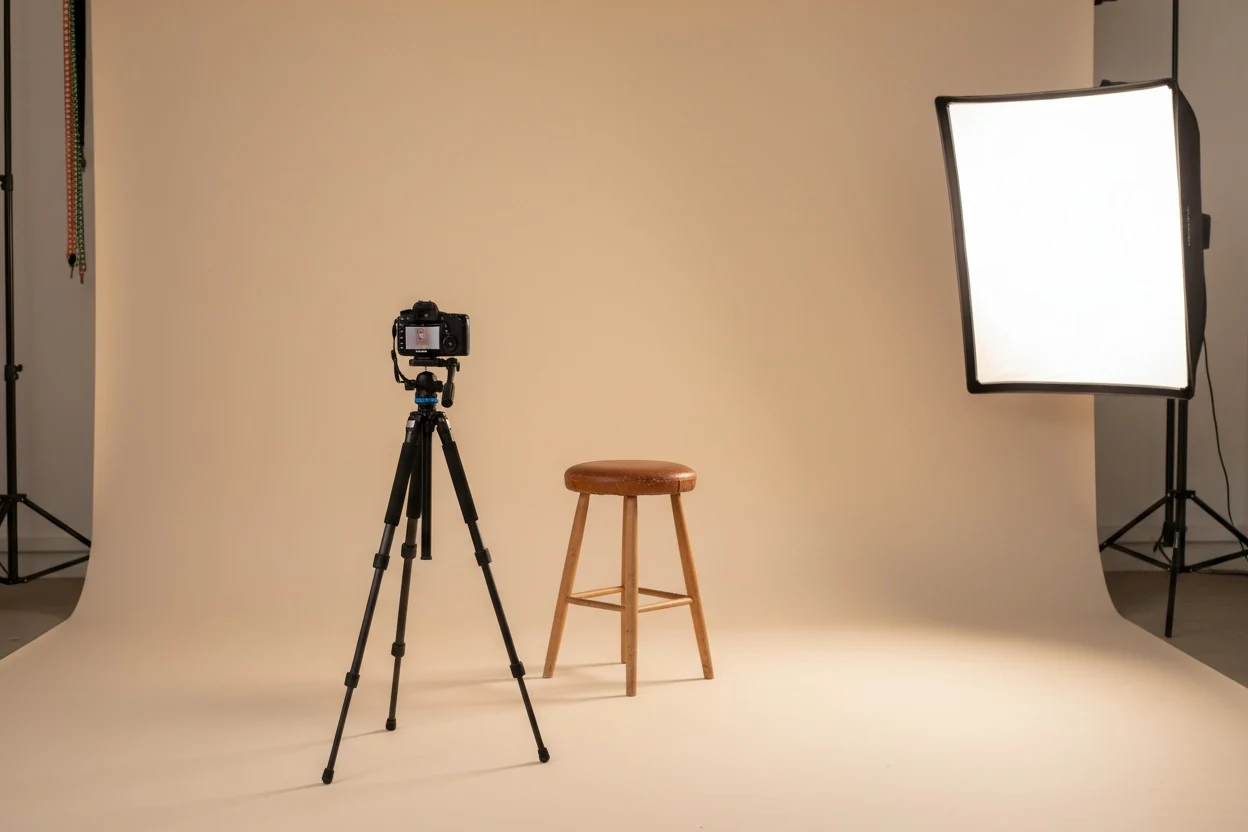
Lens distance: the one that actually deserves the blame
A phone held at arm's length puts the lens roughly 40 to 50 centimetres from your face. A person having a conversation with you stands at about a metre and a half. That difference is the single largest cause of the gap between how you look and how you photograph.
The mechanism is perspective, not optics. At close range the difference in distance between your nose and your ears is large as a proportion of the total distance, so the nose is enlarged relative to everything behind it. The face reads wider in the middle, the nose reads bigger, and the ears recede. At a metre and a half that proportional difference is small and the face flattens out into what people actually see.
Camera height: what it does to your facial thirds
Hold a camera above eye level and it looks slightly down at you: the forehead is nearer the lens and enlarges, and the lower face foreshortens. Hold it below and the reverse happens — the jaw and chin come forward, the nostrils show, and the forehead shrinks.
This is not a subjective impression. It changes the facial thirds measurably: a raised camera shortens the lower third and a lowered one lengthens it. It also changes how any nose type reads, because tip rotation is the trait most distorted by camera position — a lens below eye level makes almost any nose read as upturned.
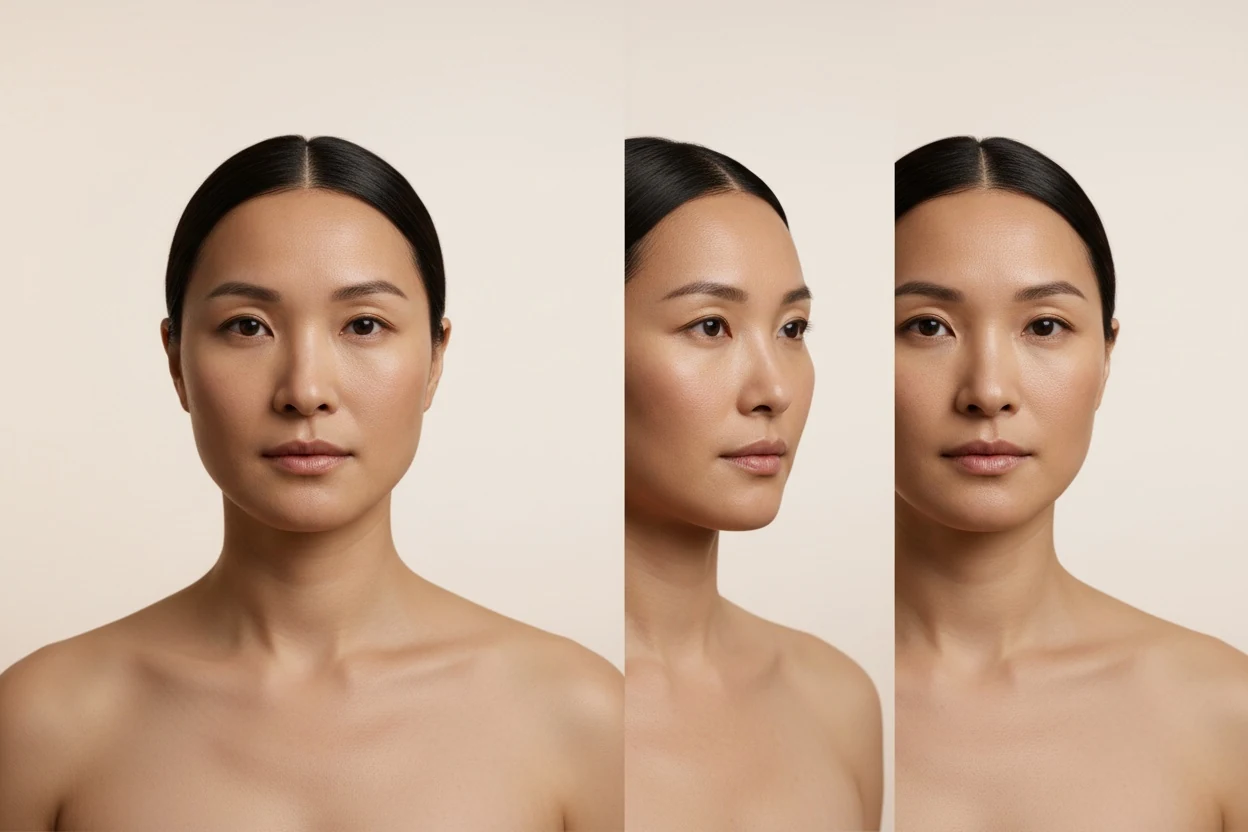
Rotation belongs in the same category. Turn your head ten degrees and every horizontal width on your face compresses on the far side while the vertical measurements stay put. That pushes a face shape result toward oval and oblong, and it is the most common reason a detector gives someone an answer they did not expect.
The mirror flip: why your own photos look wrong to you specifically
You have looked at your face tens of thousands of times, and almost every one of those was in a mirror — which shows it reversed. That flipped version is the one you have learned. A photograph shows the unflipped one, which is what everyone else has been looking at all along.
The consequence is asymmetric and it is the reason this is worth knowing. Your friends see nothing unusual in a photograph of you, because it matches the version they know. You see something subtly and unplaceably wrong, because it does not match yours. Nobody is wrong; you are comparing against different references.
Test it in ten seconds: take a photo of yourself and flip it horizontally in any editor. Most people find the flipped copy immediately more familiar and more flattering, and it is the same face. If you want the number behind it, the symmetry test reports how far your two sides differ — and the larger that figure, the more the flip will bother you.
Light: the variable that does the most and gets the least credit
Light decides which features are visible at all. A hard light from the side traces every edge — it carves a jaw, deepens the eye sockets, and produces the strong cheekbone that people credit to bone structure. Flat frontal light does the opposite: it erases the same edges and flattens the face, which is why passport photographs are unflattering by design.
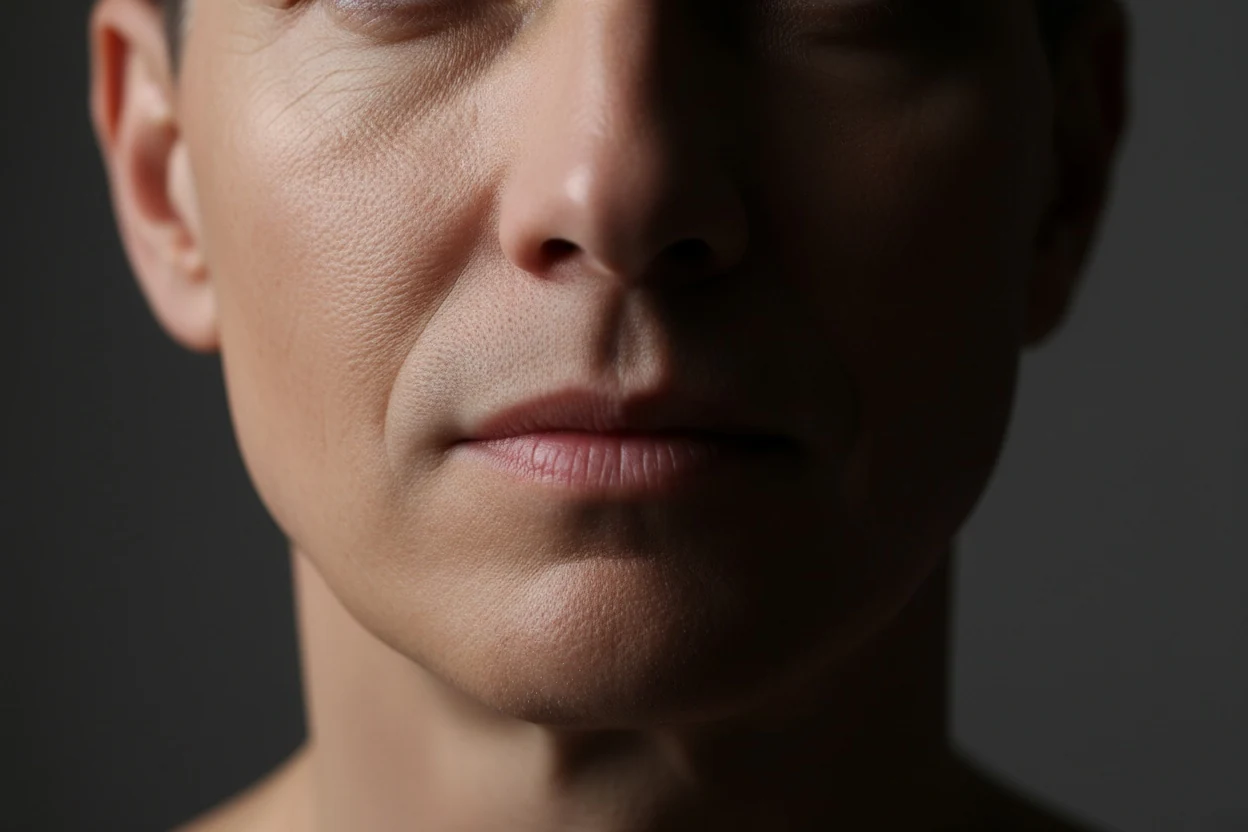
This matters beyond photography because it is why so much of what circulates about face shape is unreliable. A celebrity credited with a square jaw or deep-set eyes is frequently being credited with a lighting setup. The deep-set eyes page makes the same point from the measurement side: shadow around the eye is a lighting effect at least as often as it is anatomy.
For a photograph you want to like, the reliable arrangement is a large soft source in front of you and slightly to one side — a window on an overcast day is the classic version, and it is free. Overhead light is the one to avoid, because it drops shadows into exactly the places that read as tiredness.
What is left after the four variables
Once distance, height, flip and light are controlled, what remains is smaller than most people expect — and it is mostly not geometry. The research that exists on rated attractiveness points at skin condition doing more work than the popular accounts allow: Fink, Grammer and Matts found that changing skin colour distribution alone shifted ratings of age, health and attractiveness with the underlying shape untouched.
Expression is the other half, and it is the part a still photograph is worst at. A face is read in motion; a photograph catches one arbitrary frame out of thousands, very often not one you would have chosen. This is why burst mode flatters people and single shots do not, and it has nothing to do with being photogenic in any innate sense.
| Variable | What it changes | The fix |
|---|---|---|
| Lens distance | Enlarges whatever is nearest — usually the nose — and widens the midface | Step back and zoom in; use the rear camera |
| Camera height | Shifts the balance between your facial thirds and the read of your nose tip | Lens at eye level, chin level |
| Head rotation | Compresses every horizontal width on the far side; moves face shape results | Square to the camera, within about ten degrees |
| The mirror flip | Nothing about your face; changes only how familiar it looks to you | Flip the image and compare — the discomfort is unfamiliarity |
| Light direction | Which edges exist at all — jaw, cheekbone, eye socket | Large soft source in front and slightly to one side |
How to test your own best setup
Being systematic about this for ten minutes beats years of accidental photographs. The point is to change one variable at a time, which is exactly what nobody does when they take twenty selfies in a row.
- 1Find one light: a window on an overcast day, or a bright room with no direct sun. Face it.
- 2Take one photo at arm's length with the front camera. This is your baseline and it is the worst case.
- 3Take one with the rear camera at arm's length, then one from about a metre and a half away with the same framing. Compare the three: the difference is lens distance alone.
- 4At the best distance, take three at different camera heights — below eye level, at eye level, slightly above. This is the variable people most often have wrong.
- 5Finally, flip your favourite horizontally and look again. If the flipped version looks better to you, that is the mirror effect and not a fault in the photograph.
If you want to see how much the variables above are moving the numbers, run the same face under two of these conditions. The analysis is free, needs no account, and never uploads your photo — so you can take as many attempts as it takes.
Run the measurementsWhat being photogenic is not
It is not a property of a face. It describes how well a particular face survives being flattened into two dimensions, under one light, at one instant, at whatever distance the lens happened to be. Faces that read well in motion and faces that read well in stills are different sets, and being in one is not a verdict on being in the other.
It also is not fixed. Four of the five variables above are things you move rather than things you are, and the fifth — expression — is a matter of how many frames you take. If you want an actual measurement of your face rather than an impression from a photograph of it, that is what the tools here are for, and they will tell you which of their numbers a photograph cannot be trusted to report.
Frequently asked questions
Why am I not photogenic?
Almost always because of how the photographs are taken rather than what your face is. A phone at arm's length sits far closer than a person talking to you, which enlarges whatever is nearest the lens. The camera is usually held below or above eye level, which changes the proportion between the thirds of your face. And you know your face flipped, from mirrors, so the unflipped version reads as subtly wrong.
Does the camera really add ten pounds?
Not weight, but width — and only at close range. Perspective distortion at a short lens distance enlarges the nearest parts of the face and compresses the rest, which broadens the middle of the face relative to the edges. Step back and zoom in and the effect disappears entirely, because it was distance rather than the camera.
What is the best angle for photos?
Camera at eye level or very slightly above, face turned no more than about ten degrees, and the light coming from in front and slightly to one side. Beyond that, the honest answer is that your best angle is specific to your face and the only way to find it is a series of photographs taken deliberately rather than accidentally.
Is being photogenic the same as being attractive?
No, and the gap between the two is the whole point of the word. Photogenic describes how a face survives being flattened into two dimensions under one light at one moment. Faces that read well in motion and faces that read well in stills are not the same set, which is why plenty of people are one and not the other.
Does the front camera distort my face?
The front camera on most phones has a wider lens and is used closer, so yes — it distorts more than the rear camera at the same framing. Using the rear camera at arm's length, or better still stepping back and asking someone else, removes most of the difference people attribute to the camera itself.
References
- Langlois, J. H., & Roggman, L. A. (1990). Attractive faces are only average. Psychological Science, 1(2), 115–121.
- Grammer, K., & Thornhill, R. (1994). Human (Homo sapiens) facial attractiveness and sexual selection: the role of symmetry and averageness. Journal of Comparative Psychology, 108(3), 233–242.
- Fink, B., Grammer, K., & Matts, P. J. (2006). Visible skin color distribution plays a role in the perception of age, attractiveness, and health in female faces. Evolution and Human Behavior, 27(6), 433–442.
Tools mentioned in this article
Attractiveness Test
Your score out of ten, with every measurement behind it.
Face Shape Detector
Oval, round, square, heart, oblong, diamond or triangle.
Facial Thirds Calculator
Upper, middle and lower thirds as percentages — and which one not to trust.
Canthal Tilt Test
Your tilt in degrees, each eye separately.
Symmetry Checker
Left against right across six landmark pairs.
Measurements on this site are for information only. Nothing here is medical advice, and no result is a diagnosis. Talk to a qualified clinician before making any decision about a procedure.