Rhinoplasty Before and After: See a Nose Job on Your Own Face
Rhinoplasty reshapes the bone and cartilage of the nose — the bridge, the tip and the width. Here is what each change looks like in before and after photos, what the operation typically costs in the US, how recovery actually runs, and a render of the direction on your own photo before a consultation.
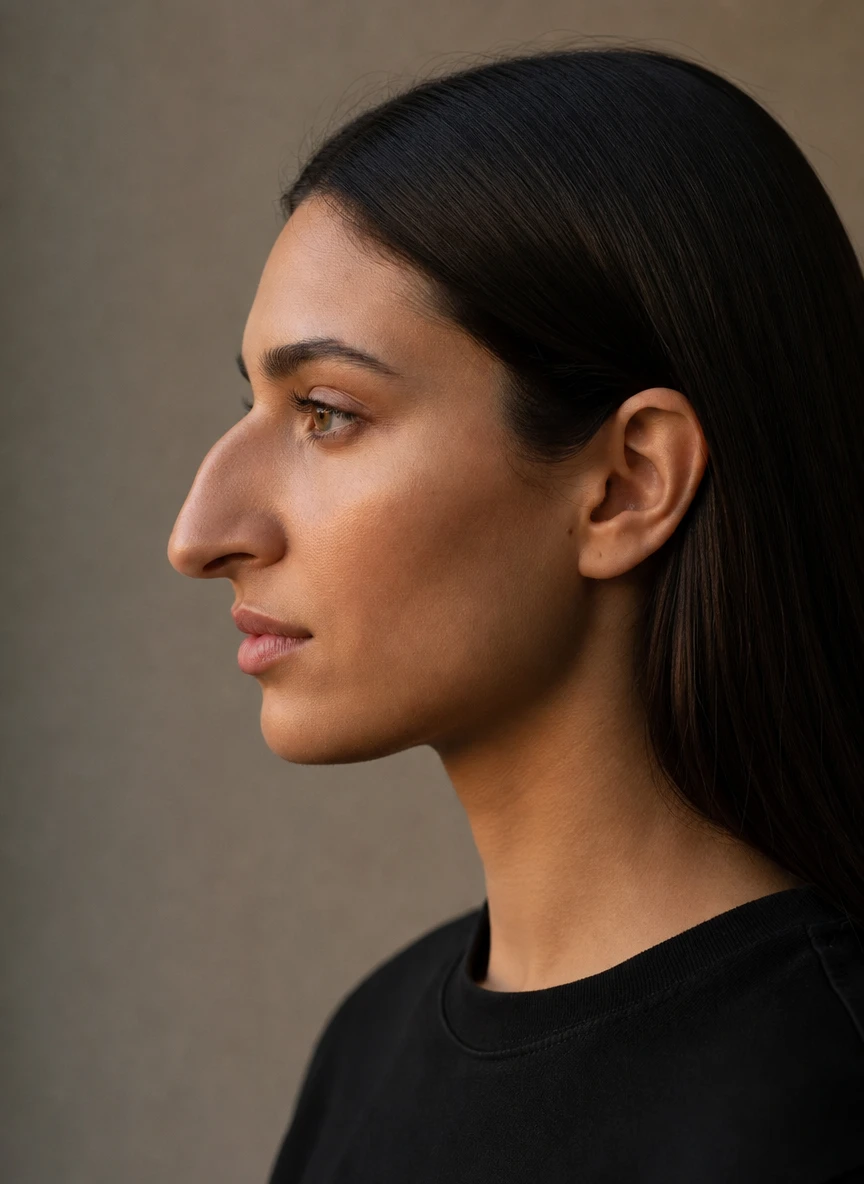
Rhinoplasty simulator — example render

- Type
- Surgical, permanent
- Typical US cost
- Commonly $6,000–$15,000
- Back to desk work
- Usually 1–2 weeks
- Final result
- A year or more for the tip
- Upload one front-facing photo
- The render changes the bridge, tip and nostril width of your nose — and leaves the rest of your face alone
- Compare your before and after side by side
1 render = 1 credit
5 credits $4.99, no subscription · or Starter $7.99/month for 10. The face analysis is free.
What a rhinoplasty changes: bridge, tip and width
Most rhinoplasty is about three things. The bridge (dorsum) — taking down a hump or building up a low or dipped line. The tip — its size, definition and how far it points up or down. And the width — of the bony bridge, the nostrils, or both. A single operation often touches all three.
| Change | How it is usually done | Where it shows |
|---|---|---|
| Hump reduction | Shaving or lowering bone and cartilage on the bridge | Profile, above all |
| Bridge augmentation | Cartilage grafts, from the septum, ear or rib | Profile and front |
| Tip refinement | Reshaping or suturing the tip cartilages | Front and three-quarter view |
| Tip rotation | Changing the angle the tip sits at | Profile |
| Narrowing the bridge | Controlled breaks of the nasal bones (osteotomies) | Front view |
| Nostril narrowing | Small wedge removed at the nostril base (alar base reduction) | Front view |
A nose job can also be functional. Straightening a deviated septum is a septoplasty; combined with cosmetic work it is usually called a septorhinoplasty.
Types of rhinoplasty: open, closed, preservation and revision
| Type | What it means | Trade-off commonly described |
|---|---|---|
| Closed rhinoplasty | All incisions inside the nostrils | No external scar and often less swelling; less direct view of the tip |
| Open rhinoplasty | A small incision across the columella, the strip between the nostrils | Full view for complex tip or graft work; a fine scar that usually fades well |
| Preservation rhinoplasty | Lowers the bridge by working beneath it instead of shaving the hump | Suits some hump shapes; not every surgeon offers it |
| Septorhinoplasty | Cosmetic change plus septum correction for breathing | The functional part is sometimes billed or insured separately |
| Revision rhinoplasty | A second operation to correct a previous one | Scar tissue and less available cartilage make it harder and more expensive |
Which approach a surgeon picks depends on what is being changed, not on which sounds less invasive. Asking why they chose it for your nose is one of the more informative questions in a consultation.
Rhinoplasty before and after: how to read the photos
Rhinoplasty before and after galleries are the most searched part of this topic and the easiest to be misled by. Nose job before and after photos are clinical marketing — honest ones exist, but the flattering choices are consistent and easy to spot once you know them.
- Same lens distance. A nose photographed from closer looks bigger. An after shot taken a step further back shrinks the nose without surgery.
- Same head angle. Tilting the chin down lengthens the nose and exaggerates a hump; tilting it up shortens the nose and shows more nostril.
- Profile views. The bridge change lives there. A gallery of front views only is showing you the least of the result.
- Time since surgery. A photo at three months still carries swelling, particularly in the tip. Look for results at one year.
- Expression and makeup. Smiling can pull the tip down, and contour makeup narrows a nose on its own. Neutral expression and bare skin in both frames.
Rhinoplasty for different nose shapes
Searches for rhinoplasty are often shape-specific, and the shape decides what is realistic. None of these is a reason anyone should have surgery — they are the conversations surgeons commonly have for each.
Rhinoplasty for a bulbous nose
A bulbous tip is usually refined by reshaping or suturing the tip cartilages. Skin thickness sets the ceiling: thick skin drapes over refined cartilage and hides much of the change, and it takes longest to settle.
Rhinoplasty for a hump or hooked nose
A dorsal hump, typical of a Roman nose, is taken down by shaving or lowering the bridge. Over-reduction — a scooped, too-small bridge — is the recognized failure, and it is harder to fix than the original hump.
Rhinoplasty for a big or wide nose
A nose that reads as big is often wide rather than long. Narrowing uses osteotomies for the bridge and alar base reduction for the nostrils. The nose shape tool measures width against face width, which is the proportion those steps act on; a wide nose can also be a perfectly balanced one.
Rhinoplasty for a crooked nose
A crooked nose usually involves the septum as well as the outside shape, which is why it is often a septorhinoplasty. Surgeons commonly describe a fully straight result as harder to guarantee here than with other shapes.
Male rhinoplasty vs female rhinoplasty
The operation is the same; the goals usually are not. Male rhinoplasty tends to keep a straighter, stronger bridge and avoids rotating the tip upward, because an upturned tip reads as feminine. Female rhinoplasty more often allows a slight curve below the bridge and a little more tip rotation. The recognizable failure in men is a result that looks feminized — which is why before and after photos of male patients are worth seeing specifically.
Before — generatedAfter · AI glow-upSee a rhinoplasty on your own face
Run this simulationRhinoplasty cost: what the price includes
Rhinoplasty cost is commonly quoted at roughly $6,000–$15,000 in the United States, with revision and complex cases above that. Headline figures you see quoted are often the surgeon's fee alone, so the number on a quote can look very different.
| Cost factor | Why it moves the price |
|---|---|
| Surgeon's fee | Experience and demand; often the figure quoted in averages |
| Anesthesia | Usually a separate fee from the anesthesiologist |
| Facility | Hospital or accredited surgical center |
| Complexity | Grafts — especially rib cartilage — and open approaches take longer |
| Revision | Commonly priced well above a first operation |
| Septum work | Functional portions are sometimes covered by insurance; cosmetic ones rarely are |
Price differences between countries are a large part of why cost searches are so common. A lower quote abroad does not include the follow-up visits, and revision after a disappointing result costs more than a first operation wherever it happens. Many US practices offer financing, which changes how the cost is paid, not what it is.
Rhinoplasty recovery timeline, week by week
| When | What is commonly reported |
|---|---|
| Days 1–7 | Splint on the nose, swelling and bruising around the eyes, congestion; sleeping with the head raised |
| End of week 1 | Splint removed; external stitches out after an open approach |
| Weeks 2–3 | Most bruising gone; many people are back at desk work and in public |
| Weeks 4–6 | Surgeons commonly clear harder exercise around here; contact sports and glasses resting on the bridge often wait longer |
| Months 3–6 | Most visible swelling gone; the bridge looks close to final |
| 12 months and beyond | The tip keeps refining, longer with thick skin or after revision |
The tip is the last part of the nose to settle, which is why surgeons ask patients not to judge the result early. Numbness of the tip and some stiffness when smiling are commonly reported in the first months.
Rhinoplasty risks and downsides
Rhinoplasty is a routine operation with the risks of any surgery, plus a few particular to the nose. The commonly listed ones:
- Bleeding, infection and the risks of anesthesia.
- Breathing that is worse rather than better, especially if the internal structure is narrowed.
- Asymmetry or irregularities along the bridge that show once swelling goes down.
- Persistent tip swelling or numbness.
- A result that is technically fine but not what the patient pictured — the most common reason for revision requests.
That last one is where a render helps most: agreeing on a direction before surgery is cheaper than disagreeing about it afterwards.
Nose job simulator: see a rhinoplasty on your own face
The rhinoplasty simulation refines the nose on your photo — a straighter bridge and a slightly lifted, more defined tip, kept in proportion with the rest of your face. Everything outside the nose is meant to stay as it was, so the difference you see is the nose alone.
Read it as a direction. It works from the photo you give it, so a front photo shows the width and tip and very little of the profile, where most of the change would be. It cannot see your skin thickness, your cartilage or your breathing, and it cannot promise any surgeon could build the nose it draws. If you want the proportion rather than the picture, the nose shape tool measures your nose against your face in the browser. If you only want a hump camouflaged, liquid rhinoplasty is the non-surgical comparison.
Nose width against face width, length against width and nostril width against eye spacing — the proportions a rhinoplasty consultation talks about, measured from one photo.
Measure your nose shapeQuestions to ask your surgeon before rhinoplasty
- Do you plan an open or closed approach for my nose, and what does that choice change about swelling and scarring?
- How thick is my skin, and how much tip refinement can it realistically show?
- Is any of my breathing complaint structural, and would you address it in the same operation?
- Can I see before and after photos of noses like mine, in profile, at a year or more?
Alternatives to rhinoplasty
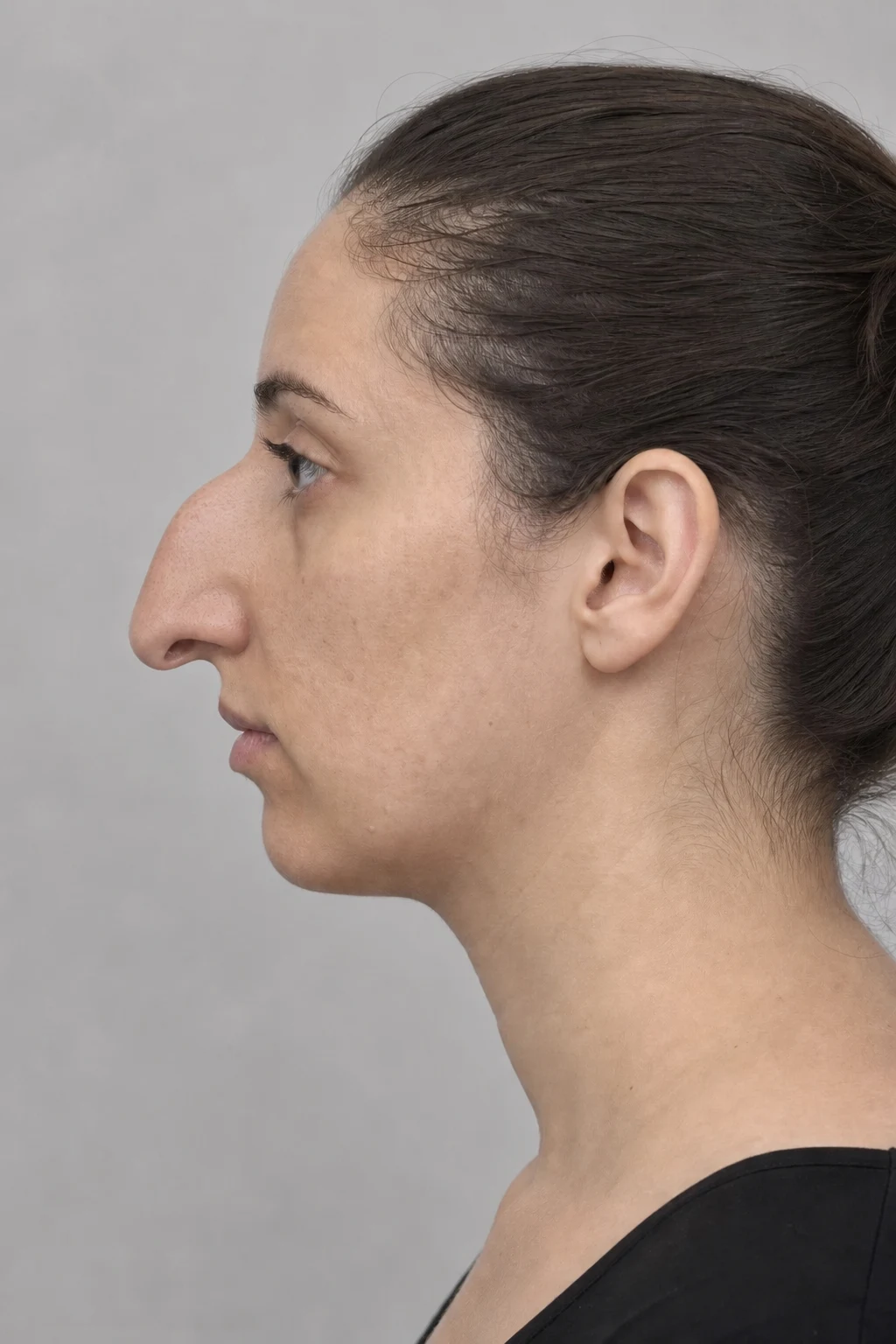
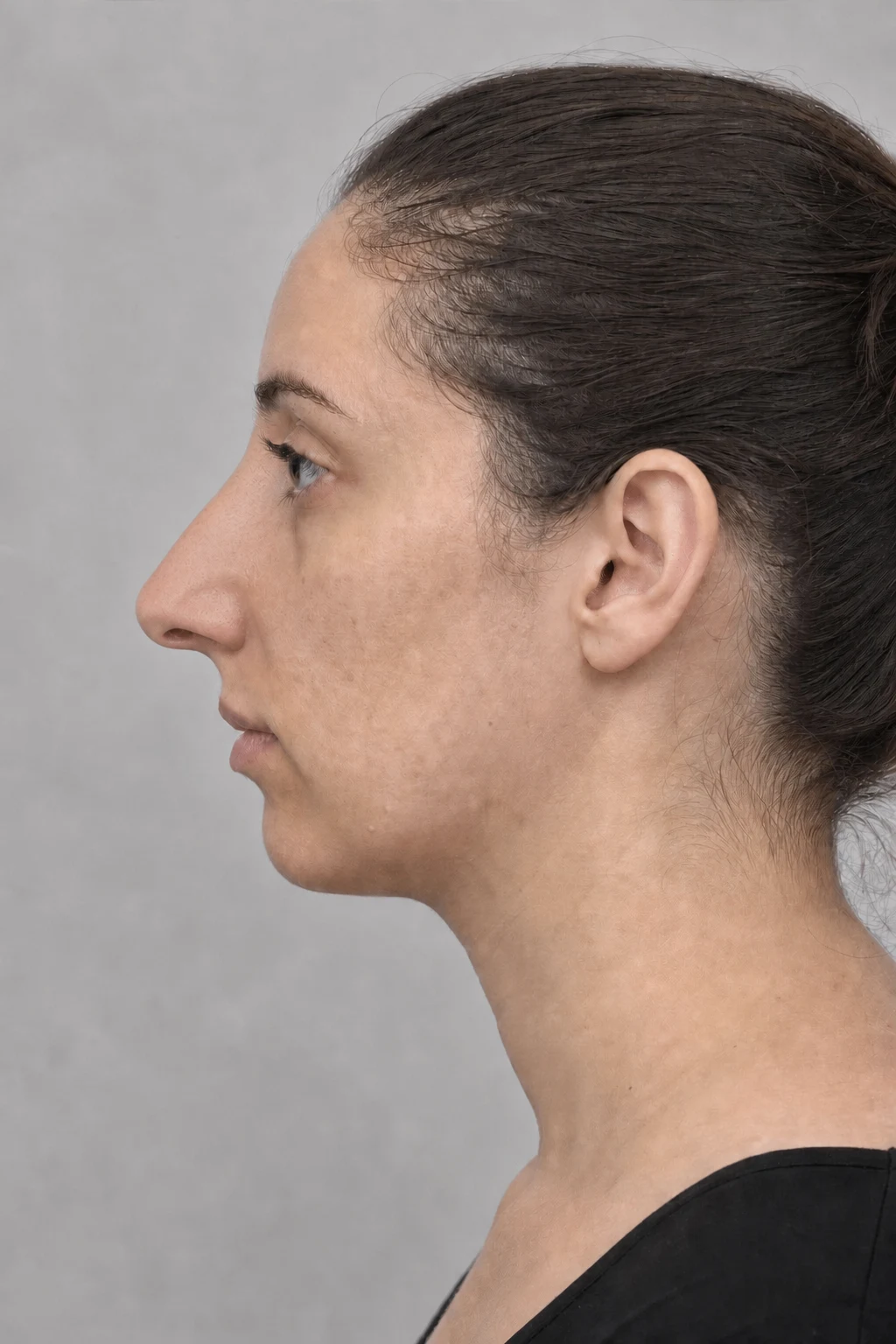
How the rhinoplasty simulation works
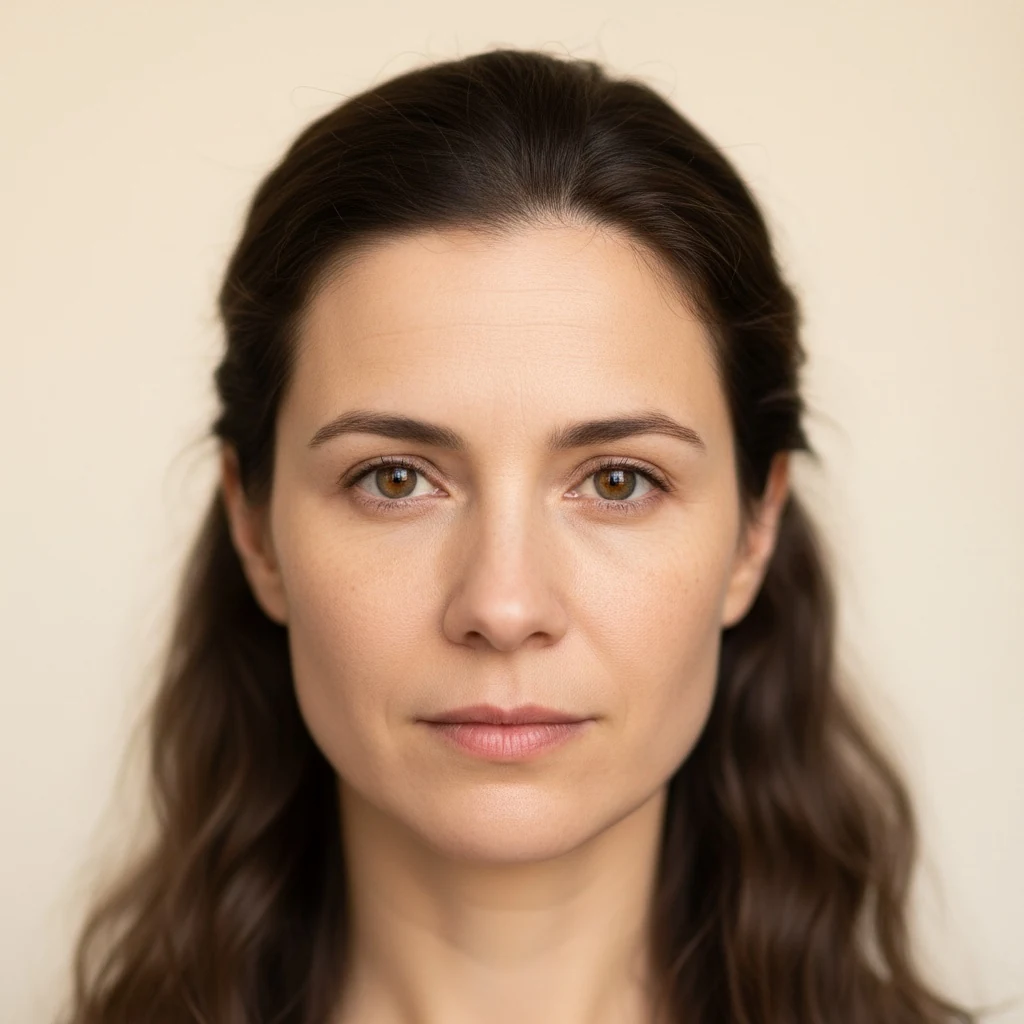
Your photo is analysed for the landmarks that matter to this procedure, and the render changes the bridge, tip and nostril width of your nose while leaving the rest of your face alone. That constraint is the hard part — a generic image model will happily redraw your whole face and hand you a stranger who looks better.
The render changes the shape you see from the front. It cannot show you the profile change, which is usually the point of the operation, and it cannot predict how your skin thickness will drape over a refined tip — the single biggest reason real results differ from expectations.
It is an illustration of a plausible direction, not a prediction of your result and not a medical opinion. What it is genuinely good for is finding out whether you want the change at all — plenty of people render one, find the difference smaller than they imagined, and stop there.
Measure your face before a rhinoplasty simulation
The free analysis tools measure symmetry, facial proportion and face shape, and tell you which measurements sit outside the reference range. Choosing a procedure from that is a much better starting point than choosing one from a photo you saved.


Rhinoplasty simulator — frequently asked questions
How long does a rhinoplasty last?
The structural change is permanent. The nose still ages with the rest of the face — skin thins and the tip can droop slightly over decades — but it does not return to its original shape.
What happens 10 years after rhinoplasty?
For most people, very little changes beyond normal aging. Problems that appear late, such as a pinched tip or a collapsing side wall, are usually linked to how much cartilage was removed, which is why current technique favors reshaping and support over removal.
What age can you have a rhinoplasty?
Surgeons usually wait until the nose has finished growing, which happens in the teens and tends to be later in boys than girls. There is no upper age limit; general health matters more than age.
What is the hardest nose to fix?
Surgeons most often name revision noses, where scar tissue and missing cartilage limit the options, and noses with very thick skin, which hides refinement. Severely crooked noses are also commonly described as difficult.
What is the regret rate for nose jobs?
There is no single reliable figure. Studies measure satisfaction in different ways and in different groups, and the numbers they report vary widely. What is consistently described is that unrealistic expectations and judging the result before swelling settles are linked to dissatisfaction.
Does insurance cover rhinoplasty?
Cosmetic rhinoplasty is generally not covered. Work done to correct a breathing problem, such as a deviated septum, sometimes is, which is why functional and cosmetic parts of one operation can be billed separately.
Is the rhinoplasty simulator free?
The face analysis is free and needs no account. A rendered simulation costs credits because it runs on a GPU — $4.99 buys five and does not require a subscription.
How accurate is an AI rhinoplasty simulation?
It is an illustration of a plausible outcome, not a prediction of your result. Real outcomes depend on your anatomy, the facial plastic surgeon and how you respond. Treat it as a conversation starter for a consultation, not a promise.
Do you keep my photo?
The free measurements never leave your browser. A simulation does send the photo to a rendering service, which is why it asks for explicit consent first, and you can delete the result from your dashboard at any time.
Can I show this to a facial plastic surgeon?
Yes, and that is the most useful thing to do with it. Bringing a picture of the direction you want is far more precise than describing it in words.
Other nose simulations
This page is not medical advice and we are not clinicians. A simulation cannot tell you whether a procedure is appropriate for you, what it costs, or what the risks are. Those questions belong with a qualified facial plastic surgeon.