Face Shape
Seven face shapes, decided by four measurements: face length and the widths of the forehead, cheekbones and jaw. This detector takes all four from 478 landmarks and calls a face oblong from 1.23× length to cheekbone width. On the 102 adults of the Face Research Lab London Set its readings were 38 oval, 13 round, 12 heart, 10 square, 10 oblong, 10 triangle and 9 diamond.
- 7
- face shapes
- 4
- measurements
- 478
- landmarks
- 1.18×
- median length ÷ cheekbones
- Free
- no signup, photo not uploaded
Face Research Lab London Set: 102 adults, neutral front photos. The face shape thresholds were set on this set, so the split shows how the detector divides faces, not how common each shape is. How these numbers were made
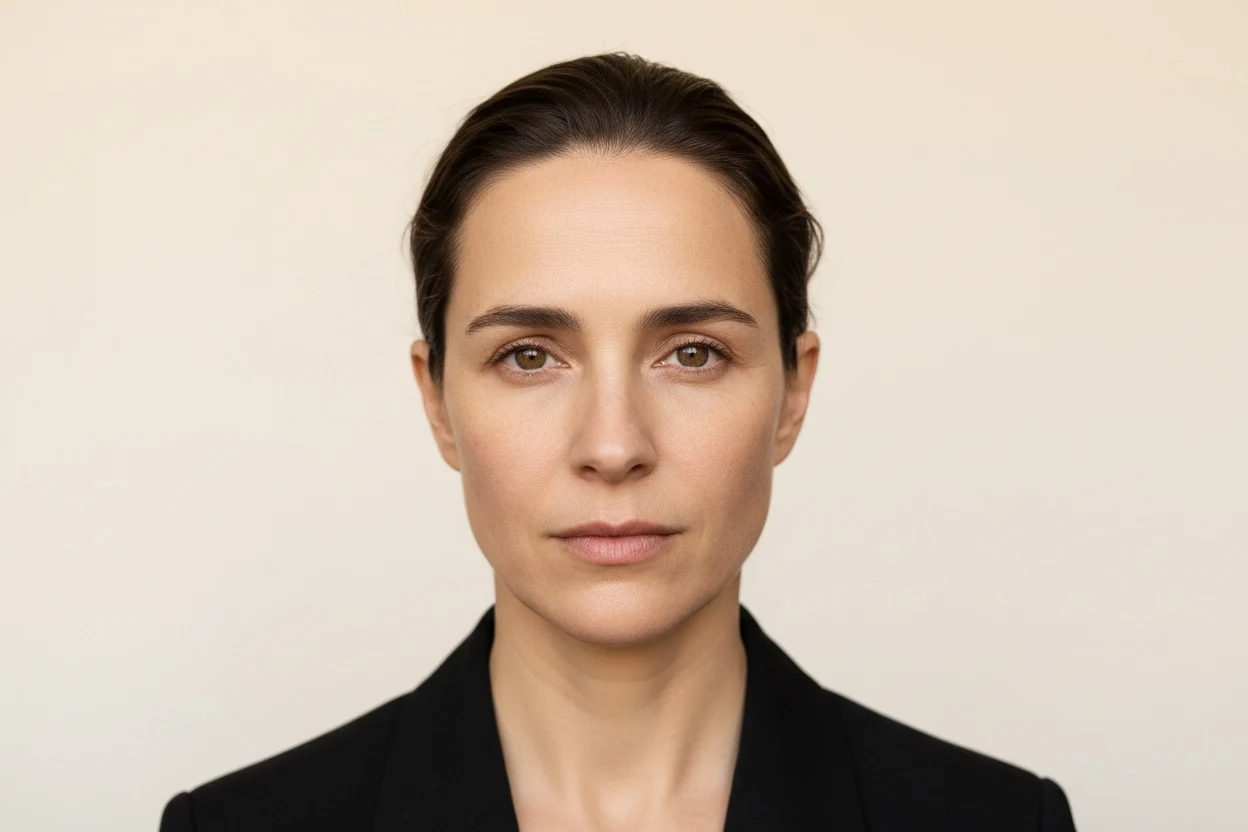
Drop a photo into the panel and it will take all four measurements and name the shape. Nothing is uploaded — the model runs in this tab.
 Example
Choose your own photo
Discover your face shape and proportions.
Choose your own photoClick to choose a photo, or drop one here
Front-facing · Even lightingStraight-on, even lighting, at arm's length gives the most comparable reading.
Runs in your browser. Your photo is not uploaded.
The 7 face shapes
Diamond face shape
Full guide →A diamond face is widest at the cheekbones and tapers in both directions: a narrow forehead above, a narrow chin below. It is the least common of the seven and the one most often misread as heart or oval.
≤ 0.93×temples ÷ cheekbones9 of 102research faces · 9%0.94×median temples ÷ cheekbonesKey characteristics
- Cheekbones are the widest point of the face
- Forehead is narrower than the cheekbones
- Jaw narrows to a defined, often pointed chin
- Face length is usually greater than face width
What works
- ✓Side-swept fringes and curtain bangs, which add width where the forehead is narrow
- ✓Chin-length bobs that put volume at the jaw
- ✓Layers starting below the cheekbone rather than at it
Glasses
Oval and rimless frames
Oval face shape
Full guide →An oval face is longer than it is wide, with a jaw that curves rather than corners. It is the most commonly assigned shape, partly because it is genuinely frequent and partly because it is where borderline measurements land.
< 1.23×length ÷ cheekbones38 of 102research faces · 37%1.18×median length ÷ cheekbonesKey characteristics
- Face length noticeably greater than width
- Forehead slightly wider than the jaw
- Jawline rounded, without a defined corner
- No single dominant widest point
What works
- ✓Almost anything — this is the shape stylists treat as the default
- ✓Blunt fringes, which shorten a long face if you want that
- ✓Mid-length layers that keep width at the cheekbone
Glasses
Almost any frame shape
Round face shape
Full guide →A round face is close to as wide as it is long, with a soft jawline and full cheeks. It is frequently confused with square, and the measurement that separates them is jaw definition rather than proportion.
≤ 1.16×length ÷ cheekbones13 of 102research faces · 13%1.18×median length ÷ cheekbonesKey characteristics
- Face width and length close to equal
- Cheeks are the fullest part of the face
- Jawline soft, with no sharp corner
- Chin rounded rather than pointed
What works
- ✓Long layers that fall past the jaw, adding vertical line
- ✓Side partings, which break the symmetry that reads as round
- ✓Volume at the crown to add height
Glasses
Rectangular and square frames
Heart face shape
Full guide →A heart face is widest at the forehead and tapers to a narrow, often pointed chin. A widow's peak is common but not required — the shape is defined by the forehead-to-jaw ratio, not the hairline.
≥ 1.24×forehead ÷ jaw12 of 102research faces · 12%1.19×median forehead ÷ jawKey characteristics
- Forehead is the widest part of the face
- Cheekbones sit close to forehead width
- Jaw narrows sharply toward the chin
- Chin often pointed
What works
- ✓Styles with volume at or below the jaw, to balance the narrow chin
- ✓Side-swept fringes that reduce apparent forehead width
- ✓Long bobs ending just below the jawline
Glasses
Frames that are wider at the bottom
Square face shape
Full guide →A square face has a jaw nearly as wide as the cheekbones and a defined angle where the jaw turns. Forehead, cheekbones and jaw sit close in width, giving the face a straight-sided outline.
≥ 0.80×jaw ÷ cheekbones10 of 102research faces · 10%0.79×median jaw ÷ cheekbonesKey characteristics
- Jaw almost as wide as the cheekbones
- Defined angle at the jaw corner
- Forehead width close to jaw width
- Face length close to face width
What works
- ✓Soft layers and waves that break the straight sides
- ✓Side partings, which introduce a diagonal
- ✓Length past the jaw to lengthen the outline
Glasses
Round and oval frames
Oblong face shape
Full guide →An oblong face is a long rectangle: the three widths are similar, and the length is what sets it apart. It is often called long face, and the styling problem is always the same — reduce apparent height, add width.
≥ 1.23×length ÷ cheekbones10 of 102research faces · 10%1.18×median length ÷ cheekbonesKey characteristics
- Face clearly longer than wide
- Forehead, cheekbones and jaw similar in width
- Often a taller forehead or longer chin
- Straight sides rather than a taper
What works
- ✓Blunt or curtain fringes, which cut the vertical
- ✓Volume at the sides, especially at cheekbone level
- ✓Waves and curls, which add width
Glasses
Deep frames that cover more vertical space
Triangle face shape
Full guide →A triangle face — sometimes called pear-shaped — is widest at the jaw and narrowest at the forehead. It is the inverse of a heart face and needs the opposite styling.
≥ 0.79×jaw ÷ cheekbones10 of 102research faces · 10%0.79×median jaw ÷ cheekbonesKey characteristics
- Jaw is the widest part of the face
- Forehead narrower than the cheekbones
- Width increases steadily downward
- Jawline often strong and defined
What works
- ✓Volume at the crown and temples to widen the top
- ✓Shorter layers around the cheekbone
- ✓Side-swept styles that add apparent forehead width
Glasses
Cat-eye and browline frames
See what a change would actually look like
These are the renders that act on what this page measures. Each one below was generated by the same model that runs on your own photo — labelled examples on another face, so you can see what the procedure changes before you spend anything.
Buccal Fat Removal
Buccal Fat Removal · AI example
Buccal Fat Removal. A different possibility.
Tap the photo to enlarge. AI visualisation, not a prediction.
Changes cheek fullness below the cheekbone.
What it does →Jawline Filler
Jawline Filler · AI example
Jawline Filler. A different possibility.
Tap the photo to enlarge. AI visualisation, not a prediction.
Changes definition along your jaw.
What it does →Cheek Filler
Cheek Filler · AI example
Cheek Filler. A different possibility.
Tap the photo to enlarge. AI visualisation, not a prediction.
Changes cheekbone projection and midface volume.
What it does →
Every “after” above is an AI simulation on a sample face, not a photograph of a surgical result — it shows the direction a procedure moves a face, not an outcome anyone achieved and not a prediction of yours. Run one on your own photo.
How to determine your face shape
Four measurements settle it: the width of your forehead at its widest, the width across your cheekbones, the width of your jaw at the angle, and the length from hairline to chin. Every shape is a specific relationship between those numbers — a round face has length and width nearly equal, an oblong has length above 1.6 times width, a diamond has cheekbones wider than both other widths. You need a mirror and a soft tape measure.
- Pull all of your hair back off your face and stand square to a mirror, with your eyes level with the glass.
- Measure across your forehead at its widest point, roughly halfway between your brows and your hairline.
- Measure across your cheekbones, from the outer corner of one eye straight across to the outer corner of the other.
- Measure your jaw from the point below one ear across to the point below the other, following the bone rather than the soft tissue under it.
- Measure face length from your hairline straight down to the base of your chin.
- Divide the length by the cheekbone width, then compare the three widths to each other. Those two comparisons decide all seven shapes.
Face shape comparison chart
All seven side by side, on the measurements that separate them. Reading down the columns also shows where the categories overlap: round and square share a length-to-width ratio and differ only in the jaw, while oval and oblong differ only in whether the jaw tapers.
| Shape | Widest point | Length : width | Jaw | Chin | How often |
|---|---|---|---|---|---|
| Diamond | Cheekbones | ~1.45 : 1 | Narrow | Pointed | Least common |
| Oval | Cheekbones | ~1.5 : 1 | Rounded, gentle taper | Rounded | Assigned most often |
| Round | Cheekbones | under 1.2 : 1 | Soft curve, no corner | Rounded | Common |
| Heart | Forehead | ~1.4 : 1 | Narrow, tapered | Pointed | Moderate |
| Square | Near-equal across | under 1.2 : 1 | Angular, visible corner | Square or flat | Common, under-reported by tools |
| Oblong | Near-equal across | over 1.6 : 1 | Straight sides | Flat | Common |
| Triangle | Jawline | ~1.25 : 1 | Wide, prominent | Flat or wide | Second least common |
The three pairs people mix up
Almost all misidentification comes from three pairs, and each one turns on a single measurement. If your result surprised you, the answer is usually in one of these.
Oval vs Oblong
Oval and oblong are both longer than they are wide, and the difference is where the width sits. An oblong face keeps roughly the same width from forehead to jaw — a rectangle. An oval face narrows at the jaw. This test, though, checks length first: at 1.32 times cheekbone width or longer, measured from the top of the forehead, it calls the face oblong whatever the jaw does. If your result sits near that line, the taper you can see in a mirror is the better guide.
Round vs Square
The proportions are nearly identical — both are close to as wide as they are long. What differs is the jaw. In a mirror the difference is the jaw corner — a visible angle below the ear on a square face, a curve on a round one — and a front-facing photo reads that corner poorly. So this test separates them by length instead: a wide-jawed face no more than 1.16 times as long as its cheekbone width is called round, and a longer one with three close widths is called square.
Heart vs Triangle
These two are exact inverses, which makes them easy to separate and easy to confuse in words. A heart face is wide at the top and narrow at the bottom; a triangle face is narrow at the top and wide at the jaw. Every styling recommendation for one is reversed for the other.
Why face shape quizzes disagree
The seven categories are not mutually exclusive across their whole range — they are cut points on continuous measurements, and the cut points are conventions. Round and square share the same proportions and are separated only by whether the jaw turns a corner. Oval and oblong are both long, and are separated only by whether the jaw tapers. A face sitting in one of those bands can be labelled either way without either label being wrong.
Photo angle does the rest of the damage. A head turned ten degrees compresses the far side of the face, and every horizontal width on this page shrinks with it while the length stays put — which pushes the result toward oval and oblong. This is why the tool asks for a straight-on photo, and why it is worth taking a second one if a result surprises you.
Face shape — frequently asked questions
What are the seven face shapes?
Oval, round, square, heart, oblong, diamond and triangle. Charts vary — some merge triangle into pear, some split rectangle out of oblong — but these seven cover the standard set.
What is the most common face shape?
Oval is assigned most often, partly because it is genuinely frequent and partly because it is where borderline measurements land when no other shape's conditions are clearly met.
How do I find my face shape?
Four measurements settle it: forehead width, cheekbone width, jaw width and face length. The detector takes all four from a photo in your browser.
Can my face shape change?
The underlying bone structure is fixed after growth, but facial fat distribution changes with age and weight, which can shift a face between round and oval readings over years. A receding hairline does it too, because face length is measured from the hairline.
What are the most attractive face shapes?
No published work ranks facial outlines, and any list that does is quoting a styling convention as a finding. Oval is named most often, which reflects how often it is assigned rather than how it is rated. What the research does support — averageness and symmetry — is indifferent to which of the seven you are.
Why do two face shape quizzes give me different answers?
Because the categories overlap. Round and square share the same proportions and differ only in jaw definition; oval and oblong are both long and differ only in taper. A face sitting in one of those overlap bands can legitimately be labelled either way, and different tools break the tie differently.
Do I measure my face length from the hairline or the top of my head?
From the hairline. Every ratio on this page assumes it, and using the top of the skull inflates the length figure enough to move a round result to oval. If your hairline has receded, use where it sits now — that is what the measurement means.
What is the rarest face shape?
Diamond, followed by triangle. Diamond needs cheekbones measurably wider than both the forehead and the jaw, and triangle needs the three widths to increase steadily from top to bottom. Both are narrower conditions than the other five.