Facial Thirds Calculator
The facial thirds are three horizontal bands: hairline to brow line, brow line to the base of the nose, and the base of the nose to the bottom of the chin. The classical canon holds that each is a third of the face (33.3%). This calculator measures each band's share and calls the face balanced when all three sit within 2.5 points of 33.3% (30.8–35.8%). It is a drawing convention, not a population norm.
- 3
- bands measured
- 33.3%
- classical canon
- ±2.5 pts
- counts as balanced
- Free
- photo not uploaded
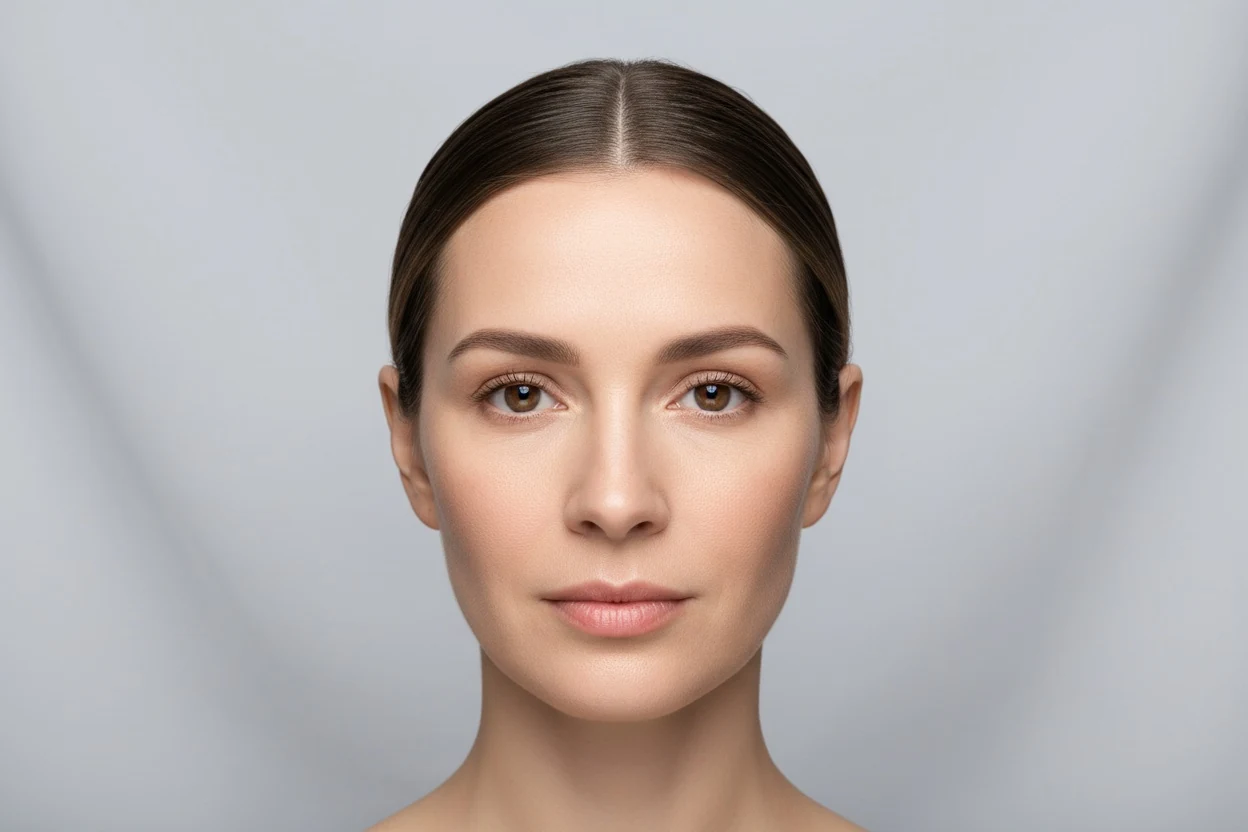
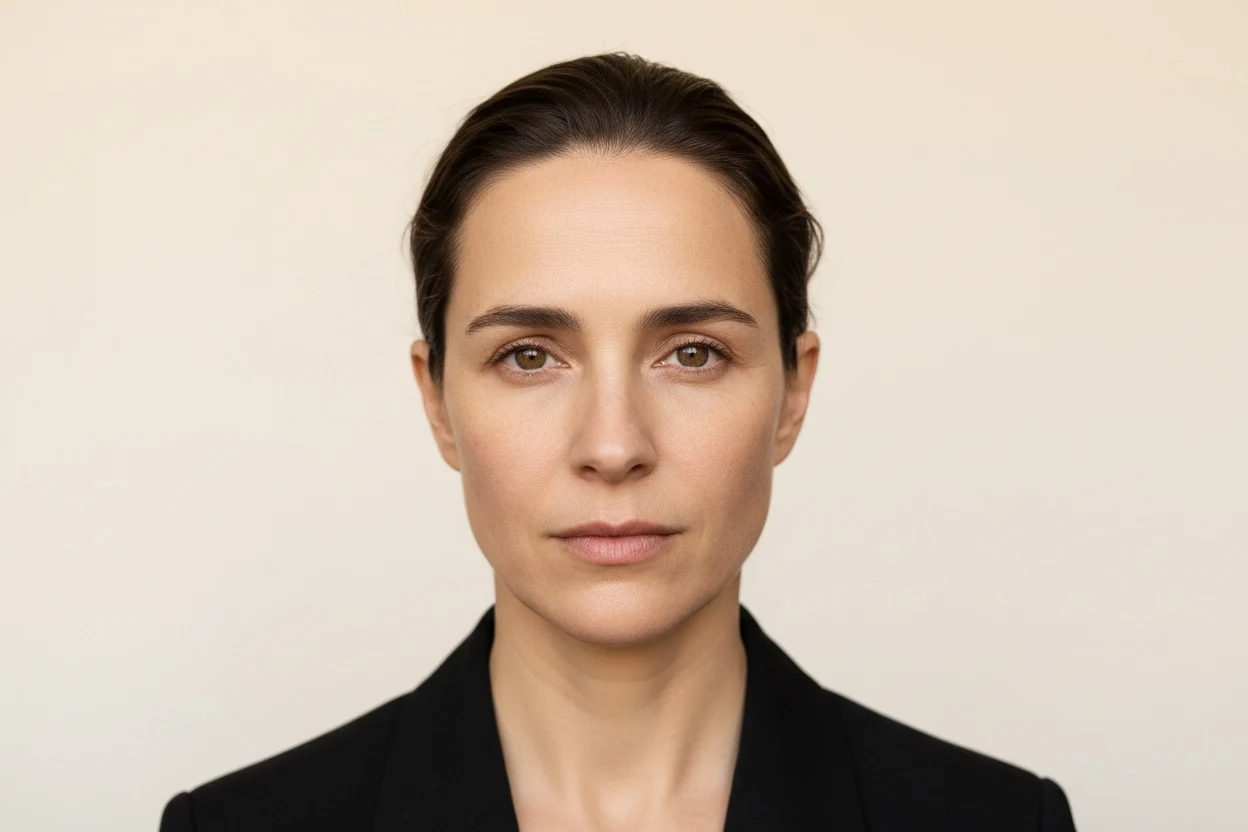 Example
Choose your own photo
See how your facial thirds compare.
Choose your own photoClick to choose a photo, or drop one here
Front-facing · Even lightingStraight-on, even lighting, at arm's length gives the most comparable reading.
Runs in your browser. Your photo is not uploaded.
What are the facial thirds?
- The rule comes from Renaissance drawing manuals, not from measurement of populations.
- The upper third is bounded by a hairline, which makes it the least reliable of the three.
- The lower third has its own internal division: nose base to lip line is about a third of it, lip line to chin the other two.
- The lower third lengthens across adulthood as the upper lip descends.
See what a change would actually look like
These are the renders that act on what this page measures. Each one below was generated by the same model that runs on your own photo — labelled examples on another face, so you can see what the procedure changes before you spend anything.
Chin Augmentation
Chin Augmentation · AI example
Chin Augmentation. A different possibility.
Tap the photo to enlarge. AI visualisation, not a prediction. Both images are AI generated.
Changes chin projection and length.
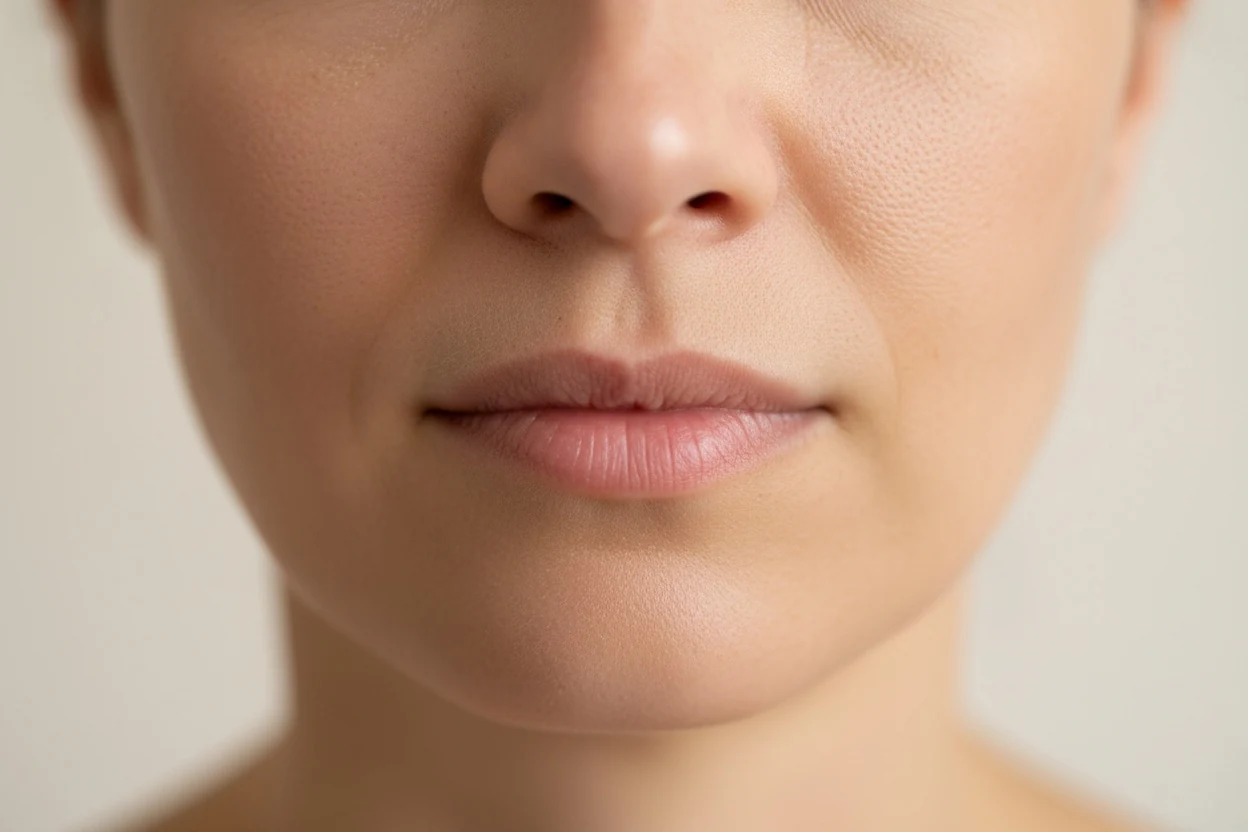
What it does →Lip Lift
Lip Lift · AI example
Lip Lift. A different possibility.
Tap the photo to enlarge. AI visualisation, not a prediction. Both images are AI generated.
Changes the distance between your nose and upper lip.
What it does →Genioplasty
Genioplasty · AI example
Genioplasty. A different possibility.
Tap the photo to enlarge. AI visualisation, not a prediction. Both images are AI generated.
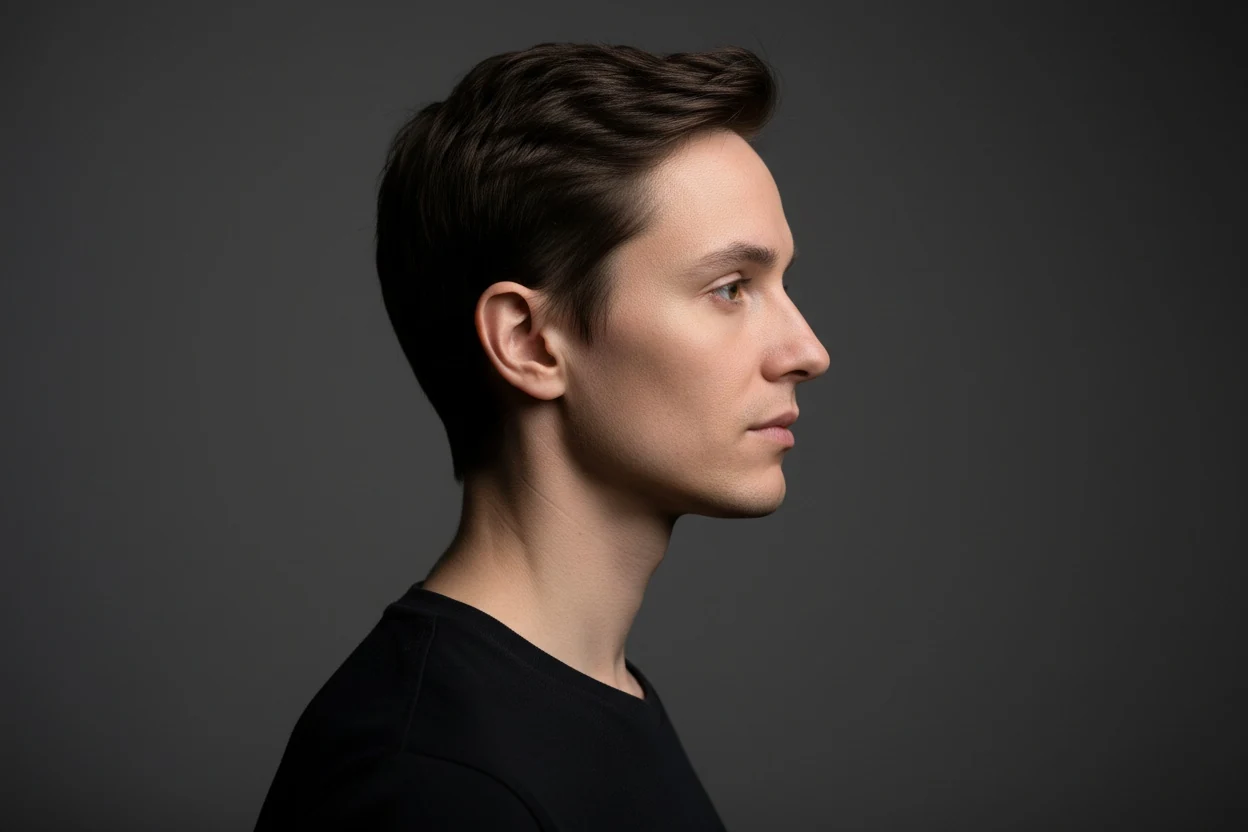
Changes the position of your chin bone.
What it does →
Every “after” above is an AI simulation on a sample face, not a photograph of a surgical result — it shows the direction a procedure moves a face, not an outcome anyone achieved and not a prediction of yours. Where a frame reads “Before · AI example”, the before image is generated too: the same portrait with the condition that procedure treats added, because none of the source photographs had it. Run one on your own photo.
How facial thirds are measured
Four landmarks decide the three bands: the trichion at the hairline, the glabella at the brow line, the subnasale where the base of the nose meets the upper lip, and the menton at the bottom of the chin. The gaps between them are the upper, middle and lower thirds, and the rule says all three should be about the same.
This tool takes those points from a 478-point face mesh in your browser and reports each band as a percentage of total face height, so a perfectly balanced face reads 33.3, 33.3, 33.3. It also reports the largest deviation from 33.3 in percentage points, which is a more useful single number than a pass or fail — a face that is off by one point and a face that is off by six are both unequal, and only one of them is visible.
Why the upper third cannot be trusted
The landmark model that runs on your photo maps the face. It does not map hair, so it has no way of finding your real hairline — the topmost point it returns is the upper edge of the forehead as the model estimates it. If your hairline has receded, if you have a fringe, or if you have simply pulled your hair forward, the number this band produces will not describe the distance the canon means.
Every facial thirds calculator has this problem, and most of them report all three bands with equal confidence anyway. This one flags it, and gives you a second figure alongside: the middle third divided by the lower third. Both of those boundaries sit on bone and soft tissue, so that ratio is independent of your hair and is the one to read if the three percentages disagree with your eyes.
What a dominant lower third means
A lower third larger than the other two is the most common imbalance, and the most common reason for it is ordinary: the lower third is the band that grows across adulthood. Soft tissue descends, the upper lip lengthens and the philtrum stretches, so the same face measures a longer lower third at fifty than at twenty.
It is also the band with the most internal structure. Within it, the distance from the base of the nose to the lip line should be about a third of the band and the lip line to the chin the other two thirds. If your lower third reads long, that internal split usually says where the length is — a long philtrum and a short chin produce the same total by different routes and are addressed by different procedures.
What a dominant middle third means
A long middle third puts more distance between the brow line and the base of the nose. Practically it usually reflects nose length rather than anything about the eyes, since the lower boundary of the band is the subnasale — the point where the nose meets the lip.
This is one place where the measurement points somewhere useful: if the middle band is long and the nose measurement on the nose type page also reads long, those are the same fact seen twice, and it is the length rather than the width that is driving the proportion.
Do balanced thirds mean an attractive face?
Weakly at best, and the honest answer is smaller than the internet suggests. The thirds are a drawing convention formalised in Renaissance manuals, and no published work establishes them as a threshold for attractiveness. What the research does support is broader: averageness and symmetry both correlate modestly with rated attractiveness, and skin condition often outperforms geometry in the same studies.
There is also a threshold problem. A face that misses equal thirds by three per cent is a face nobody describes as disproportionate, because three per cent is below what anyone sees. The measurement is worth having because it tells you where your proportions actually sit, not because a particular number is a verdict.
Facial thirds in surgical planning
Where the thirds genuinely get used is planning, not judging. A surgeon assessing a chin augmentation, a lip lift or a rhinoplasty is looking at how one change moves the balance between bands — shortening a philtrum shortens the lower third, lengthening a nose lengthens the middle one.
That is also why the brow-down measurements matter more in practice than the full three. Surgeons who use thirds often work from the brow line down for exactly the reason above: the upper boundary is hair, and hair is not a landmark.
Tips for an accurate facial thirds reading
- Pull your hair back off your forehead. It will not fix the hairline problem, but it stops hair from covering the forehead edge the model does use.
- Camera at eye level. A raised camera shortens the lower third and a lowered one lengthens it — this measurement is more sensitive to camera height than to anything else.
- Chin level and mouth closed. A tilted chin foreshortens the lower band directly.
- Relaxed expression: a smile shortens the lower third by moving the lip line.
Facial Thirds Calculator — frequently asked questions
What are ideal facial thirds?
Equal ones — each band a third of face height. It is a convention from classical drawing rather than a measured norm, and populations vary around it considerably. Anything within about two or three percentage points of a third is indistinguishable by eye.
How do I measure my facial thirds at home?
With a mirror and a soft tape: measure hairline to brow, brow to the base of your nose, and the base of your nose to your chin, then compare the three. Keep your head level and your expression relaxed, since both move the lower band.
Why is my upper third so different from the other two?
Usually the hairline. It is the only one of the four landmarks that is not anatomical, so it is the one that recession, a fringe or hair position changes. Read the middle-to-lower ratio instead, which does not depend on hair at all.
Can facial thirds be changed?
The lower third can, because procedures act on it — a lip lift shortens the philtrum, a chin augmentation lengthens the band, jaw surgery changes it substantially. The middle third moves mainly with nose length. The upper third is skull and hairline, and only the hairline is addressable.
Do facial thirds change with age?
Yes, mostly in the lower band. Soft tissue descends and the upper lip lengthens, so the lower third grows relative to the other two across adulthood. It is one of the more reliable signals of the change.
Is this the same as the golden ratio?
No. The thirds are an equal division — 1:1:1. The golden ratio is an unequal one, 1:1.618. They come from different centuries and make different claims, and they get quoted together as though they were one system.
References
- 1.Rhodes, G. (2006). The evolutionary psychology of facial beauty. Annual Review of Psychology, 57, 199–226. PMID 16318594.
- 2.Holland, E. (2008). Marquardt's Phi mask: pitfalls of relying on fashion models and the golden ratio to describe a beautiful face. Aesthetic Plastic Surgery, 32(2), 200–208. PMID 18175168.