Canthal Tilt Test
Canthal tilt is the angle from the inner corner of the eye to the outer corner, in degrees. This test measures each eye separately from a front photo: below 0° reads as negative, 0° up to +5° as neutral, and +5° and above as positive, the same cut at which the eye shape detector reads an eye as upturned. The angle is set by where the lateral canthal tendon anchors to the orbital rim, so it stays stable through most of adult life.
- < 0°
- negative
- 0° to +5°
- neutral
- ≥ +5°
- positive
- 2
- eyes, measured separately
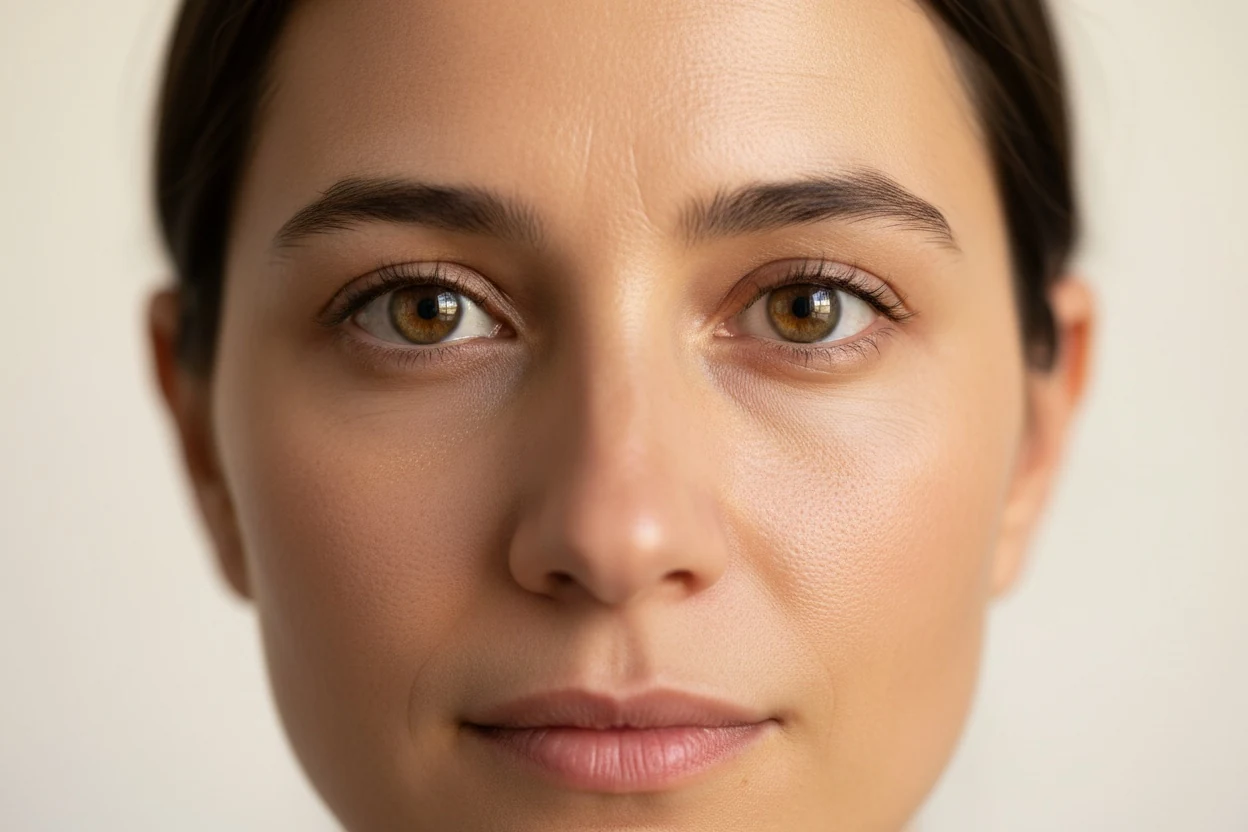
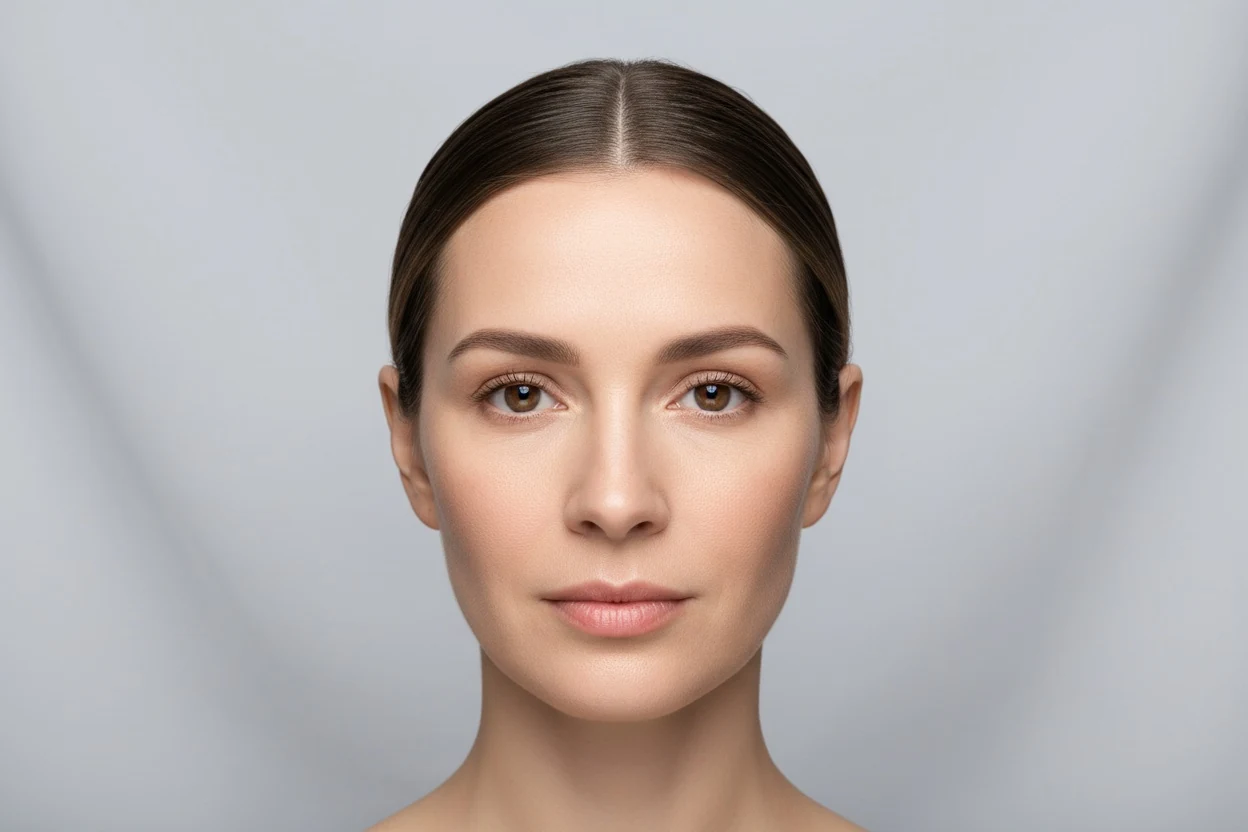
 Example
Choose your own photo
Measure the angle of each eye.
Choose your own photoClick to choose a photo, or drop one here
Front-facing · Even lightingStraight-on, even lighting, at arm's length gives the most comparable reading.
Runs in your browser. Your photo is not uploaded.
What is canthal tilt and how is it measured?
- This test reads below 0° as negative, 0° to under +5° as neutral, and +5° and above as positive — each eye separately.
- In 76 Korean patients with a mean age of 23, the mean tilt was about +8.4° on each side; averages differ between populations and methods.
- Only a canthopexy or canthoplasty changes the angle itself, because it is set by a tendon attachment.
- A camera below eye level, or a raised chin, is the most common cause of a false negative reading.
- A two-to-three degree difference between a person's two eyes is ordinary.
See what a change would actually look like
These are the renders that act on what this page measures. Each one below was generated by the same model that runs on your own photo — labelled examples on another face, so you can see what the procedure changes before you spend anything.
Canthopexy
Canthopexy · AI example
Canthopexy. A different possibility.
Tap the photo to enlarge. AI visualisation, not a prediction. Both images are AI generated.
Changes the tilt of your outer eye corner.
What it does →Fox Eye Lift
Fox Eye Lift · AI example
Fox Eye Lift. A different possibility.
Tap the photo to enlarge. AI visualisation, not a prediction.
Changes the outer corner angle of your eyes.
What it does →Canthoplasty (Bella Eyes)
Canthoplasty (Bella Eyes) · AI example
Canthoplasty (Bella Eyes). A different possibility.
Tap the photo to enlarge. AI visualisation, not a prediction. Both images are AI generated.
Changes the tilt of your outer eye corners, by reattaching the lateral canthal tendon higher.
What it does →
Every “after” above is an AI simulation on a sample face, not a photograph of a surgical result — it shows the direction a procedure moves a face, not an outcome anyone achieved and not a prediction of yours. Where a frame reads “Before · AI example”, the before image is generated too: the same portrait with the condition that procedure treats added, because none of the source photographs had it. Run one on your own photo.
What is canthal tilt? The medial canthus, the lateral canthus and the angle between them
Canthal tilt is the angle of the line running from the inner corner of your eye to the outer corner. The two corners have anatomical names: the inner one is the medial canthus, the outer one is the lateral canthus, and 'canthal' simply means 'of the canthus'. The tilt is how much higher the lateral canthus sits than the medial one, expressed in degrees.
The angle is not a matter of soft tissue. The outer corner is held by the lateral canthal tendon, a band of dense fibrous tissue that joins the eyelid plates to a small point just behind the bony rim of the orbit. That is why the angle stays stable through weight change and through most of adult life, and why the list of things that genuinely alter it is very short.
| Term | What it means |
|---|---|
| Medial canthus | The inner corner of the eye, next to the nose |
| Lateral canthus | The outer corner of the eye, toward the temple |
| Canthal tilt | The angle of the line from the medial to the lateral canthus |
| Palpebral fissure | The opening between the upper and lower lids; its slant is the same angle under a clinical name |
| Intercanthal line | The line through both inner corners, which this test uses as its level reference |
How to measure canthal tilt: the mirror check and the calculator
Hold a straight edge — a pen, the edge of a card — horizontally between your two inner corners, and look at where the outer corners fall relative to it. Above the line is positive, below is negative, level is neutral. That is the whole method, and it works.
What it does not give you is a number, and at the boundary the number is the only thing that settles it. A tilt of +1° and a tilt of −1° look identical in a mirror and are on opposite sides of the label.
One mistake dominates all the others: the camera below eye level. The outer eye corner sits further back in the head than the inner one, so when the camera looks up at your face — or you raise your chin — the outer corner drops in the photo and a negative tilt appears on a face that does not have one.
- Face a window or a soft light so both eye corners are lit, with no shadow in the inner corners.
- Hold the phone at eye height, arm's length away, and keep your chin level — not raised, not tucked.
- Relax your face. Look into the lens, not at the screen.
- Take the photo, press measure, and read both eyes, not just the average.
- If either eye lands within a degree of 0° or +5°, take a second photo on another day and compare.
How this canthal tilt calculator works
The test runs a face-mesh model in your browser that places 478 landmarks on the photo. Four of them matter here: the inner and outer corner of each eye. Before any angle is taken, the whole set of points is rotated so the line through your two inner corners is level. That is the reference a clinician uses, and it means leaning your head toward one shoulder no longer adds tilt to one eye and subtracts it from the other.
Each eye's tilt is then the angle from its inner corner up (or down) to its outer corner. The result reports both eyes, their average, and the gap between them. None of this is a language model guessing; the same photo returns the same number every time.
| What you see | How it is computed | When the card warns you |
|---|---|---|
| Your canthal tilt (large number) | Average of the two eyes, rounded to 0.1° | — |
| Left and right eye | Each eye's angle, named as they sit in the photo | When they differ by 3° or more |
| Label | Negative below 0°, neutral 0° to under +5°, positive +5° and above | — |
| Head roll | Angle of the inner-corner line before levelling | When the head leans more than 2° (the tilt is already corrected for it) |
Automated periorbital measurement is not automatically reliable. A 2025 validation study compared tools that measure the eye area, canthal tilt included, from front-facing photos against manual measurement: one automated tool agreed with the manual readings on most measurements, while another was reliable on only two. That is why this page shows you the angle per eye and tells you how the photo was taken matters, rather than presenting one number as final.
Canthal tilt chart: what your number means
Because tilt is a continuous measurement rather than three kinds of eye, the labels are cut points on a scale. Someone at +0.5° and someone at −0.5° have essentially the same eyes and different labels. The chart below is the one this test applies.
| Your reading | Label on this test | What it describes |
|---|---|---|
| Below 0° | Negative | Outer corner below the inner corner — the same measurement beauty writing calls downturned eyes |
| 0° to under +5° | Neutral | Corners level or only slightly raised; the difference from level is smaller than a photo can reliably separate |
| +5° and above | Positive | Outer corner visibly above the inner corner; the eye shape detector labels the same eye upturned unless the lid reads as hooded first |
Each band has its own page: negative canthal tilt, neutral canthal tilt and positive canthal tilt cover what the reading means, what changes it and how photos distort it, in more depth than fits here.
An 'extreme' tilt in either direction is rare in straight-on photos. If yours reads far outside the chart, check the photo before the face: a raised or tucked chin is the usual cause.
Which is better, negative or positive canthal tilt? What the studies found
Neither, in any sense the evidence supports. Online, positive tilt is treated as the goal and negative as a flaw. The studies behind that belief are few, small or narrow, and they do not agree with one another on direction, let alone on a number.
| Study | What was tested | What it found |
|---|---|---|
| Kempa et al. 2025 — 2,081 raters | Outer-corner height raised on an edited unisex face | Raising the outer corner lowered attractiveness, femininity and trustworthiness ratings, and raised dominance, threat and disgust |
| Rhee et al. 2012 | Composite faces of seven ethnic groups | Attractive Caucasian and African composites had a steeper eye slant than average ones; attractive Asian composites had a less steep one |
| Liu et al. 2023 — 42 celebrities | Frontal photos of 21 female and 21 male Caucasian celebrities | The women had a greater canthal tilt than the men |
| Bashour & Geist 2007 | Inner-corner (medial) tilt accentuated on female faces | The edited faces were preferred 93% of the time — a finding about the inner corner, not the outer one |
Read together, the direction of preference changes with the population, the sex of the face and the way the image was edited, and the largest of these studies found that lifting the outer corner made a face read as more threatening, not more attractive. A canthal tilt is a fact about your face, not a ranking of it.
Average canthal tilt: what published measurements show
There is no single normal value, and the figures that circulate online rarely come with a method. The published ones do, and they vary with the population and the way the angle is taken.
- In 76 Korean patients with a mean age of 23, measured for orbital analysis, the mean canthal tilt was +8.45° on the right side and +8.42° on the left, with a standard deviation of about 3.5° to 3.8°.
- A three-dimensional study of 147 adults aged 18 to 30 found larger canthal tilt in Caucasian men and women than in Chinese men and women of the same sex — the opposite of what many people assume.
- In the celebrity study above, attractive women measured a greater tilt than attractive men.
The practical reading: an average from someone else's sample tells you little about where your own face sits. The measurement worth having is yours, from a level photo, per eye.
Can you change your canthal tilt? Surgery, makeup and myths
Two procedures move the angle itself. A canthopexy suspends the lateral canthal tendon higher without detaching it, giving a smaller change and a shorter recovery. A canthoplasty detaches and reattaches it higher on the orbital rim, giving a larger one. Both are eyelid surgery with the ordinary risks of eyelid surgery, and whether either suits anyone is a question for an oculoplastic surgeon after an examination.
Makeup, brow shaping and lash direction change how the angle reads without changing the angle. That is a real effect and worth knowing, and it is not the same thing.
Mewing does not change canthal tilt. Tongue posture does not act on the lateral canthal tendon, and no evidence supports the claim that it does. Neither do facial exercises, squint training or massage. And the deliberate facial trauma that circulates in some looksmaxxing communities causes fractures and permanent asymmetry — it does not produce tilt, and it is not a grey area.
If you want to see what a surgical change to the corner would look like before taking the idea any further, the canthopexy and canthoplasty simulations render it on your own photo. They are simulations, not predictions of a result.
Canthal tilt, hunter eyes and looksmaxxing: one trait, not the whole thing
Positive canthal tilt is one of the components of what gets called hunter eyes, alongside a compact upper lid, a horizontally long opening and an eye that sits deep under a projecting brow bone. A strong positive tilt on its own is not the same thing, and the opposite label, prey eyes, is the same scales read the other way.
The hunter eyes test scores three of those components separately and says plainly which one a front-facing photo cannot measure. The prey eyes page does the same for the inverse, and the eye shape detector places tilt alongside lid, aperture and spacing.
Eye tilt in photos and filters: why the camera changes the angle
A clinical photography study photographed the same twelve women with the head tipped between 15° forward and 15° back. As the head tipped forward, the tilt between the corners became more pronounced, the eye read more angular, and blinded evaluators rated it more attractive. Nothing about the anatomy changed; the camera did.
That is most of what online eye-tilt comparisons are measuring. Selfies are taken from below, portraits from above, and celebrity photos from wherever the photographer stood. Beauty filters go further and warp the eye region directly, so a canthal tilt read from a filtered image is the filter's number, not yours. Measure an unfiltered photo taken at eye level.
Tips for an accurate canthal tilt measurement
- Chin level and camera at eye height. This matters more than everything else combined — a phone held low, or a raised chin, is the most common cause of a false negative reading.
- Look straight into the lens, not slightly above or below it.
- Relaxed brows and a neutral expression. Squinting or smiling pulls the outer corner.
- No glasses and no filters — frames, lens distortion and beauty filters all move the corner landmarks.
- Even light on both eyes, with no shadow in the inner corners.
- Measure on two or three separate photos and take the middle value if you are near 0° or +5°.
Canthal Tilt Test — frequently asked questions
Is it spelled canthal or cantal tilt?
Canthal, from canthus, the anatomical name for the corner of the eye. Cathal, cantal, canthil, cantil, cantle and canthel tilt are all common misspellings of the same term, and so is candle tilt. They all mean the angle from the inner to the outer eye corner, which is what this test measures.
What does canthal mean?
It means relating to the canthus, the corner where the upper and lower eyelids meet. Each eye has two: the medial canthus by the nose and the lateral canthus toward the temple. A canthal eye measurement is one taken between those points.
Is this canthal tilt test free?
Yes. The measurement is free, needs no account, and runs entirely in your browser, so the photo is not uploaded. Only the optional simulations further down the page use credits.
Is there a canthal tilt app, or does this work online?
It works online in any modern phone or desktop browser, with no app to install. You can take a photo with the camera or upload one you already have.
Is this an AI canthal tilt calculator?
It uses a machine-learning face-mesh model to find the eye corners, then plain geometry to compute the angle. No language model is involved, and the same photo always returns the same number.
How accurate is this canthal tilt calculator?
The angle is computed from landmark positions, so it is precise to a fraction of a degree for the photo you gave it. Head position is the limiting factor, not the maths. Leaning toward one shoulder is corrected for; tipping the chin up or down, or holding the camera above or below eye level, is not, and at an angle this small it can change the label.
What is a good canthal tilt?
There is no measured threshold that makes one good. Published averages differ between populations and methods, and studies disagree on whether lifting the outer corner helps or hurts ratings. It is one measurement among many.
What is the difference between neutral and high canthal tilt?
This test has no separate high band: neutral is 0° up to just under +5°, and everything from +5° reads as positive, which the eye shape detector also calls upturned. A few degrees separate a neutral reading from a clearly lifted one — visible side by side, but small enough that camera height can move a face across the line.
What counts as an extreme canthal tilt?
There is no clinical cut point for extreme, and this test does not label one: anything from +5° reads as positive and any value below 0° is negative. Readings far outside the usual range in either direction are most often caused by a raised or tucked chin, so retake the photo at eye level first.
Is eye tilt the same as canthal tilt?
Usually, yes. Eye tilt, tilted eyes and eyelid tilt are everyday names for the same angle between the inner and outer corner. The clinical name for the slant of the eye opening is palpebral fissure inclination.
What is medial canthal tilt?
It is a different angle: the tilt at the inner corner of the eye, where the lower lid meets the corner. The best-known study on it edited that inner corner, not the outer one, so it is often quoted about the wrong feature. This test measures the ordinary canthal tilt, inner corner to outer corner.
Why do my two eyes have different canthal tilts?
Because most faces are slightly asymmetric. A difference of two or three degrees between sides is ordinary, and the result card flags it from 3°. The test reports each eye rather than averaging the difference away.
Can canthal tilt change over time?
The tendon attachment is stable, but the lower lid loosens over decades and can lower how the outer corner sits. A tilt that has changed noticeably over weeks or months, especially on one side, is worth mentioning to an eye doctor.
Does mewing change canthal tilt?
No. The angle is set by a tendon anchored to the orbital rim, and tongue posture does not act on it. This claim is widespread online and unsupported.
Is a negative canthal tilt the same as downturned eyes?
Yes. A negative canthal tilt and downturned eyes describe the same measurement — one term comes from looksmaxxing, the other from beauty writing.
What is the best canthal tilt for men?
No study establishes one. In a sample of attractive celebrities, women measured a greater tilt than men, and a 2,081-person rating study found that raising the outer corner made a face read as more dominant and threatening rather than more attractive. Your measurement describes your face; it is not a target.
Does a canthal tilt filter show my real tilt?
No. Beauty and face-shape filters warp the eye region, often lifting the outer corner, so any angle read from a filtered image belongs to the filter. Measure an unfiltered photo taken at eye level.
Does smiling change my canthal tilt reading?
It can. A smile lifts the cheeks and narrows the eye opening, which can shift where the corner landmarks land. For a reading you can compare over time, use a relaxed, neutral expression.
References
- 1.Gioia, V. M., Linberg, J. V., & McCormick, S. A. (1987). The anatomy of the lateral canthal tendon. Archives of Ophthalmology, 105(4), 529–532. PMID 3566607.
- 2.Vaca, E. E., Bricker, J. T., Mioton, L. M., Fagien, S., & Alghoul, M. S. (2022). The influence of sagittal head tilt on periorbital appearance: implications for clinical photography and the evaluation of postoperative results. Aesthetic Surgery Journal Open Forum, 4, ojab043. PMID 35156018.
- 3.Kempa, J., Kasielska-Trojan, A., Gabryszewski, M., Antoszewski, B., Biesman, B. S., Knoedler, L., Cotofana, S., & Alfertshofer, M. (2025). Understanding the impact of eyebrow and lateral canthal height on the perception of character traits: a rating-based analysis of 2081 participants. Journal of Plastic, Reconstructive & Aesthetic Surgery, 104, 417–425. PMID 40174260.
- 4.Rhee, S. C., Woo, K. S., & Kwon, B. (2012). Biometric study of eyelid shape and dimensions of different races with references to beauty. Aesthetic Plastic Surgery, 36(5), 1236–1245. PMID 22810555.
- 5.Bashour, M., & Geist, C. (2007). Is medial canthal tilt a powerful cue for facial attractiveness? Ophthalmic Plastic and Reconstructive Surgery, 23(1), 52–56. PMID 17237692.
- 6.Lee, J. Y., Choung, H. W., & Choung, P. H. (2020). Diagnostic analysis of vertical orbital dystopia and canthal tilt for surgical correction. Journal of the Korean Association of Oral and Maxillofacial Surgeons, 46(6), 379–384. PMID 33377462.
- 7.Gao, T., Guo, Y., Rokohl, A. C., Fan, W., Lin, M., Ju, S., Li, X., Ju, X., Hou, X., Rosenkranz, T. A., Zhang, G., Bai, H., Ni, K., Yao, K., & Heindl, L. M. (2025). Racial and sexual differences of eyebrow and eyelid morphology: three-dimensional analysis in young Caucasian and Chinese populations. Quantitative Imaging in Medicine and Surgery, 15(1), 882–897. PMID 39839011.
- 8.Liu, A. S., Salinas, C. A., & Sharaf, B. A. (2023). Using artificial intelligence to quantify sexual dimorphism in aesthetic faces: analysis of 100 facial points in 42 Caucasian celebrities. Aesthetic Surgery Journal Open Forum, 5, ojad046. PMID 37441561.
- 9.Peterson, J. C., Nahass, G. R., Lasalle, C., Bradley, D. C., Wu, D., Zorra, I., Nguyen, A., Choudhary, A., Heinze, K., Purnell, C. A., Setabutr, P., Yi, D., & Tran, A. Q. (2025). Development and validation of a semiautomated tool for measuring periorbital distances. Ophthalmology Science, 5(6), 100887. PMID 40917265.