PSL Scale Test
PSL is a facial attractiveness scale from looksmaxxing forums, named after the three forums it came from — PUAHate, SlutHate and Lookism. Forum versions usually run 1 to 8 with 4 as the midpoint. A PSL rating is a human vote in a thread, not a measurement; this tool's 1–10 number is a proportion index ranked against 102 research faces.
- 1–8
- forum PSL range
- 1–10
- this tool's index
- 102
- reference faces
- Free
- photo not uploaded
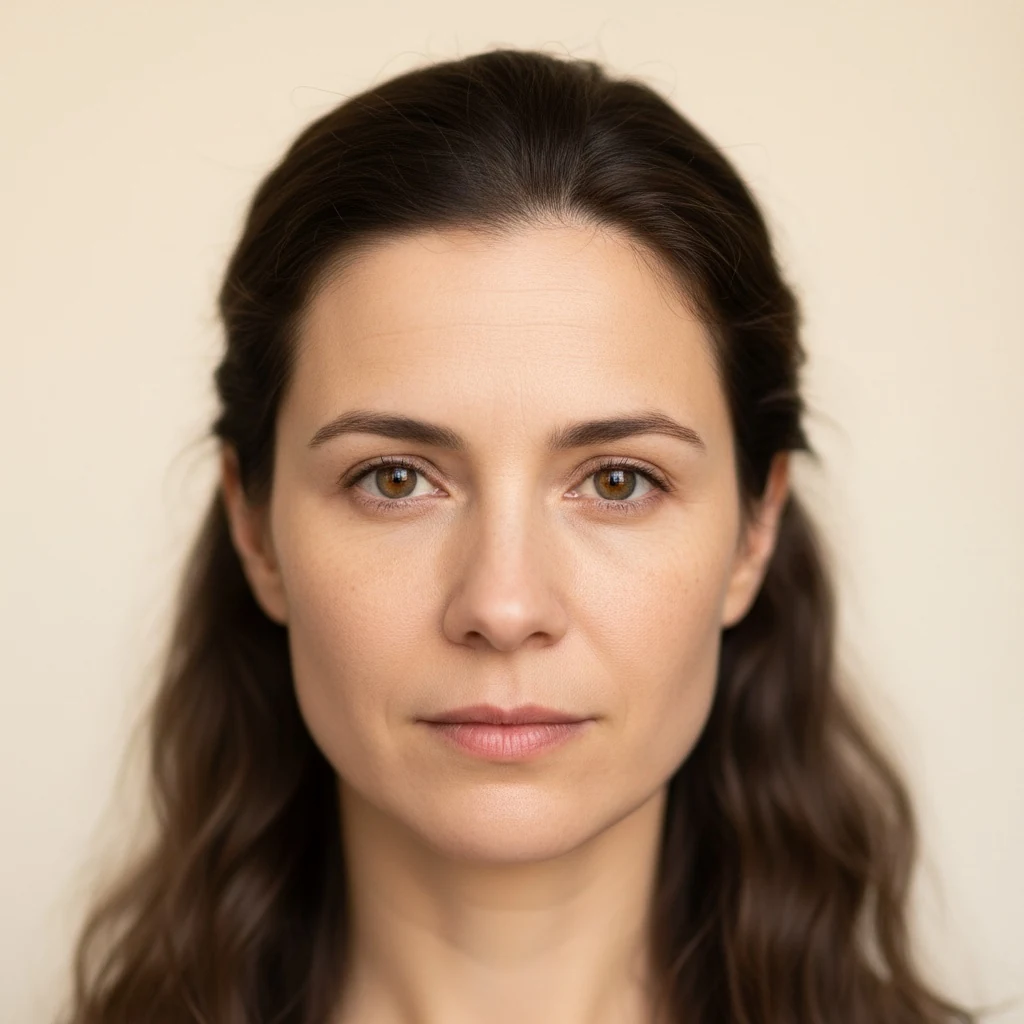
 Example
Choose your own photo
See your score and the proportions behind it.
Choose your own photoClick to choose a photo, or drop one here
Front-facing · Even lightingStraight-on, even lighting, at arm's length gives the most comparable reading.
Runs in your browser. Your photo is not uploaded.
What is the PSL scale?
- The tier vocabulary runs normie, high-tier normie (HTN), chadlite, chad and PSL god, with a set of derogatory labels below the midpoint.
- No version of the PSL scale has a published measurement procedure or a validation study.
- On the 102 faces of the Face Research Lab London Set, this tool's score and 2,513 people's attractiveness ratings were unrelated: Spearman ρ = −0.07 (95% CI −0.27 to +0.12).
- The score here is 1 + 9 × your percentile among those 102 faces, so the middle of the set scores 5.5.
See what a change would actually look like
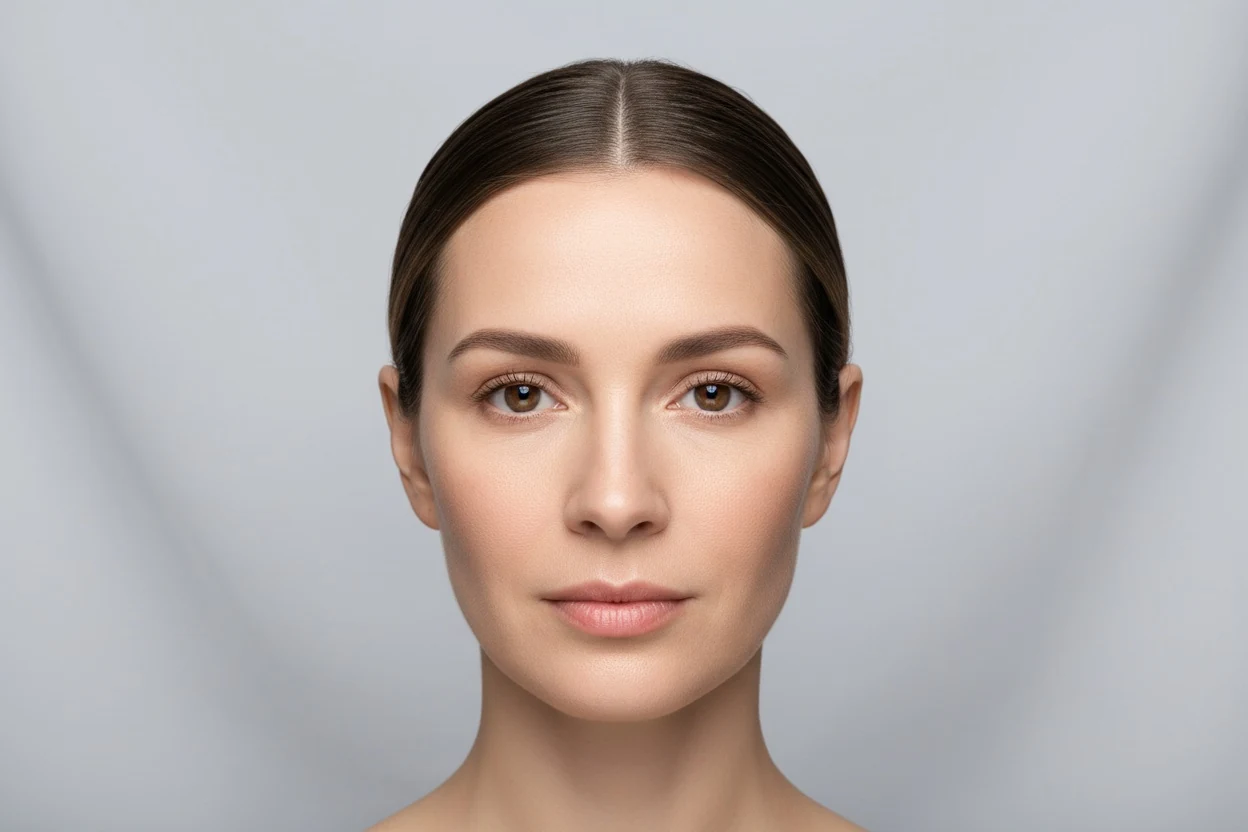
These are the renders that act on what this page measures. Each one below was generated by the same model that runs on your own photo — labelled examples on another face, so you can see what the procedure changes before you spend anything.
Looksmax Pack
Looksmax Pack · AI example
Looksmax Pack. A different possibility.
Tap the photo to enlarge. AI visualisation, not a prediction.
What Changed & Why · Annotated AI example
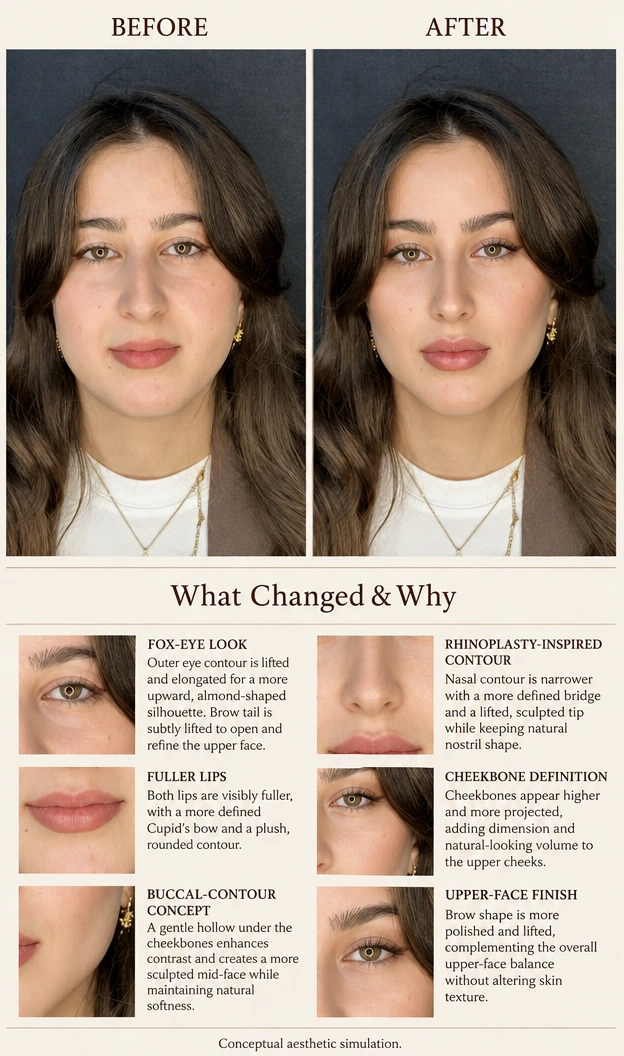
Conceptual aesthetic simulation. Another face, not your result.
Changes the full set of changes a looksmax plan would target.
What it does →Jawline Filler
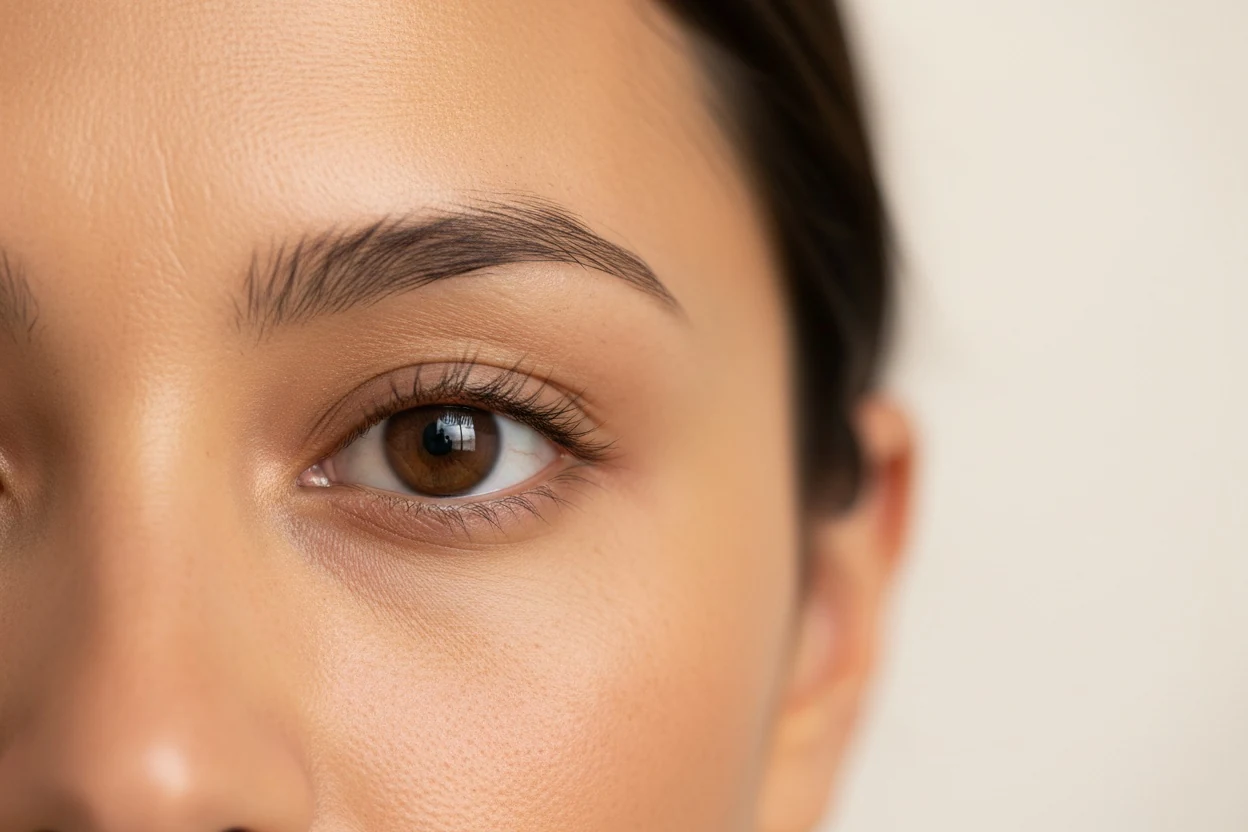
Jawline Filler · AI example
Jawline Filler. A different possibility.
Tap the photo to enlarge. AI visualisation, not a prediction.
Changes definition along your jaw.
What it does →Chin Augmentation
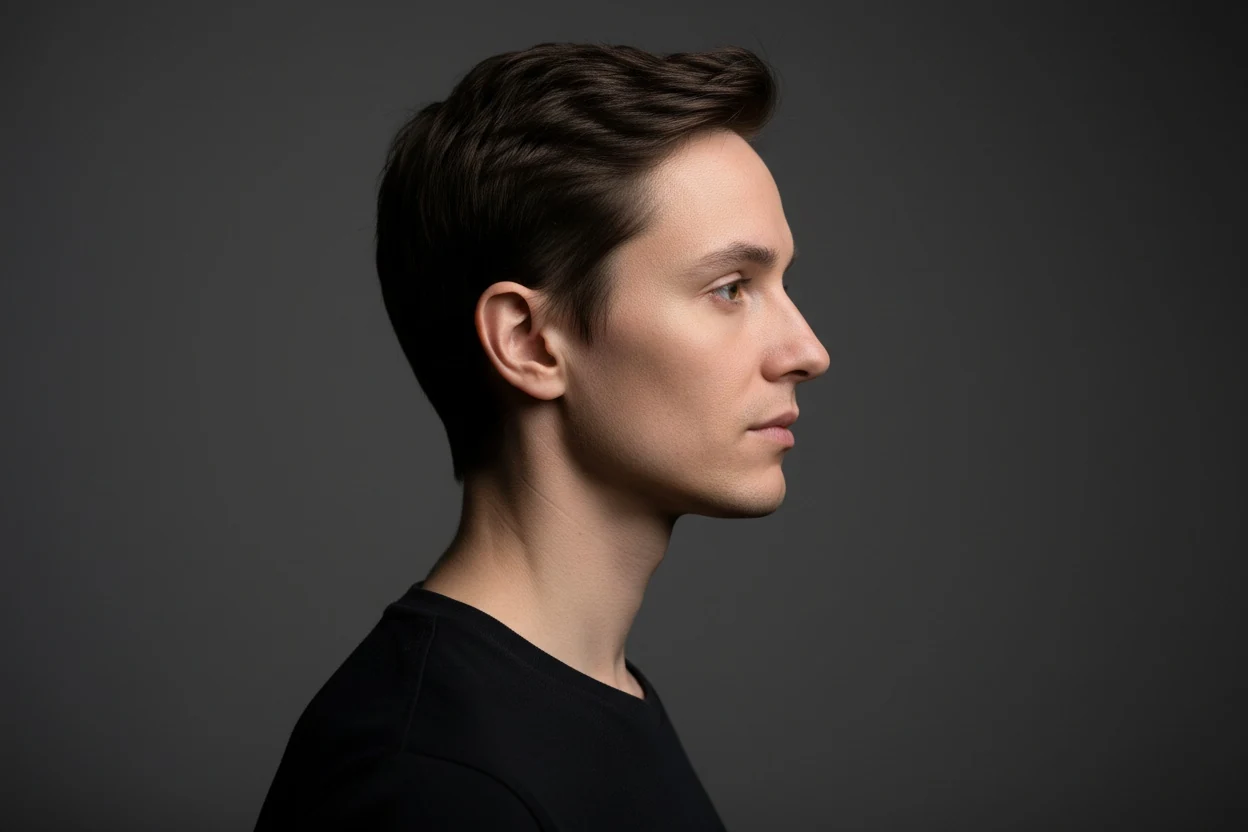
Chin Augmentation · AI example
Chin Augmentation. A different possibility.
Tap the photo to enlarge. AI visualisation, not a prediction. Both images are AI generated.
Changes chin projection and length.
What it does →
Every “after” above is an AI simulation on a sample face, not a photograph of a surgical result — it shows the direction a procedure moves a face, not an outcome anyone achieved and not a prediction of yours. Where a frame reads “Before · AI example”, the before image is generated too: the same portrait with the condition that procedure treats added, because none of the source photographs had it. Run one on your own photo.
What PSL means: PUAHate, SlutHate and Lookism
PSL — sometimes written P.S.L. — is a scale for rating facial attractiveness, used in looksmaxxing communities. The letters are the initials of three internet forums where it took shape: PUAHate, SlutHate and Lookism. That origin is not incidental. The scale was built inside communities organised around the belief that appearance determines life outcomes, and it carries that assumption in its structure.
Most forum descriptions run the scale from 1 to 8, with 4 as the midpoint and 8 as a ceiling reserved for a handful of celebrity faces; plenty of sites stretch it to 10 instead. The number of points is a convention, not a finding, which is part of why two PSL sites can give the same face different numbers.
Almost no page ranking for this term mentions where the name comes from. It is worth knowing, because it explains the scale's shape: fine gradations at the top, dehumanising labels at the bottom, and named tiers rather than a smooth continuum.
PSL vocabulary: LTN, MTN, HTN, chadlite, sub3
| Term | What it means in forum use |
|---|---|
| Normie | An ordinary-looking face; the scale's middle. |
| LTN / MTN / HTN | Low-, mid- and high-tier normie — the middle band split into three. |
| Chadlite / Stacylite | Clearly above the midpoint, one step under chad / Stacy. |
| Chad / Stacy | The forum's top band for men / women, usually argued with celebrity examples. |
| PSL god | A ceiling applied to a few named individuals, not a group anyone is sorted into. |
| Sub3, sub5 | Shorthand for ratings under 3 or 5 — part of the derogatory vocabulary below the midpoint. |
How this PSL score calculator works
A face mesh places 478 landmarks on your photo, in your browser. Facial symmetry is measured as the distance of six landmark pairs from your midline, and three proportion ratios are measured against phi: face length to width, eye spacing to nose width, and nose length to mouth width. Symmetry carries 40% of the weight and each ratio 20%, giving a 0–100 composite.
That composite is not shown to you as a 1–10 by dividing by ten. It is ranked against the same composite measured on the 102 faces of the Face Research Lab London Set, and the percentile is converted: score = 1 + 9 × percentile / 100. The middle of the set scores 5.5. The reason is practical — real faces bunch into a narrow band of the raw composite, and dividing by ten put most people in the same half-point.
Every component is shown separately next to the score, because a single number with no breakdown is not a measurement, it is a pronouncement.
| Your percentile among the 102 faces | Score shown (1–10) |
|---|---|
| 10th | 1.9 |
| 25th | 3.3 |
| 50th — the middle of the set | 5.5 |
| 75th | 7.8 |
| 90th | 9.1 |
The two heaviest inputs can be run on their own: the face symmetry test breaks down the left–right comparison, and the golden ratio face calculator isolates the phi measurements.
PSL rating vs PSL score: a human vote and a ratio index
A PSL rating is a human rating scale. Someone posts photographs and other users reply with numbers. Whatever else that process is, it is not a measurement procedure — there is no defined method, no calibration, and no reason to expect two threads to agree about the same face.
The score on this page is a ratio index: four geometric measurements, combined and ranked against 102 faces. It knows the geometry of the photo exactly and knows nothing about how people respond to a face. Skin, expression, grooming, hair, movement and voice are all absent from it, and they are not minor contributors.
So the number here tells you where your proportions sit in one research set. It is placed next to the PSL vocabulary for comparison, and it is a different quantity. Any site that presents a computed number as your PSL rating is eliding that difference — and the next section shows how large the difference turned out to be.
Does a PSL score predict attractiveness? Our test on 2,513 raters
The Face Research Lab London Set is a public research dataset of 102 adult faces (49 women, 53 men), each photographed under the same conditions and rated for attractiveness on a 1–7 scale by 2,513 people. We ran every face through the same engine this page uses and compared its numbers with the human ratings, using Spearman correlation with bootstrap 95% confidence intervals.
In these 102 faces we found no relationship between this tool's score and how attractive people rated the faces. Neither of its two main ingredients, golden-ratio fit and symmetry, showed one either. The best geometric signal was a measure the PSL score does not use at all — how close a face's proportions sit to the average for its sex — and even that was weak.
| Measurement × human rating | Spearman ρ | 95% CI | Reading |
|---|---|---|---|
| This page's score (the PSL-axis number) | −0.07 | −0.27 to +0.12 | No relationship |
| Golden-ratio fit | −0.10 | −0.28 to +0.09 | No relationship (women −0.04, men +0.03) |
| Facial symmetry | +0.09 | −0.12 to +0.28 | No relationship (women +0.11, men +0.10) |
| Closeness to the sex-specific average, 13 ratios — neutral photo | +0.21 | +0.01 to +0.39 | Weak, positive |
| Same, smiling photo | +0.11 | — | Weaker |
The one positive result lines up with the best-replicated finding in this literature: composite, average-looking faces tend to be rated as more attractive (Langlois & Roggman, 1990). A correlation of about +0.2 means averageness explains a small slice of why people rated these faces differently; most of the variation is elsewhere.
What else the London Set shows
- Symmetry is high almost everywhere: the median face measured 96.4% symmetric, with the 10th and 90th percentiles at 92.4% and 98.0%. There is not much room at the top for symmetry to separate faces.
- Golden-ratio scores bunch too: median 56.4, 10th percentile 52.6, 90th percentile 60.6.
- Human ratings on the 1–7 scale had a median of 2.96 (10th percentile 2.13, 90th percentile 3.95) — raters used the lower half of the scale for most faces.
- The same face, photographed neutral and then smiling, kept its rank on this tool's score only partly (ρ = 0.67), and smiling moved the median score from 5.5 to 7.4.
PSL scale for women and men
The forums rate women on the same scale with parallel labels — Stacy and Stacylite where men get chad and chadlite, Becky for the middle. The scale itself does not change between sexes; only the vocabulary does.
This tool does not ask your sex and applies no separate reference: your composite is ranked against all 102 London Set faces, women and men together. In that set the index behaved the same way for both — symmetry against human ratings was +0.11 for women and +0.10 for men, golden-ratio fit −0.04 and +0.03 — so neither sex's score tracked ratings better than the other's.
What does differ by sex is the average face. The one weak positive signal in our data, closeness to the average, only appeared when each face was compared with the average for its own sex — which is a good reason to be suspicious of any single universal ideal a PSL chart implies.
What the research says about attractiveness rating scales
The consistent findings in this literature are narrower than the internet's version of them. Averageness and symmetry are associated with higher rated attractiveness in lab studies, and both effects are modest. Agreement between raters is real but far from complete: Hönekopp (2006) found that each person's private taste contributes about as much to a rating as the taste people share. A twin study by Germine and colleagues (2015) found that these individual preferences come mostly from each person's own environment rather than from genes.
That matters for any 1–10 face rating. If a large share of every rating is the rater's own taste, a single number — whether a forum vote or a computed score — cannot be the fixed property of a face that a PSL scale implies.
The golden ratio claim, which several PSL guides lean on, comes largely from Marquardt's phi mask, which has been criticised for being derived from a narrow sample of fashion models rather than from any population. Our own London Set result points the same way: golden-ratio fit showed no relationship with ratings.
When a PSL score stops being a curiosity
Most people who look this up are curious, and curiosity is a fine reason to measure your own face. It is worth knowing that this particular scale sits inside a subculture that has attracted sustained attention from journalists and clinicians — the BBC, NPR and the Guardian have covered its effects on young men, and paediatric and maxillofacial journals now publish on looksmaxxing practices.
The signals that matter are behavioural rather than numerical: measuring repeatedly, avoiding photographs or mirrors, or planning procedures on the basis of a score. If any of that is familiar, the number is not the useful thing to be looking at, and talking to someone is a better next step than another test.
PSL scale chart — every tier, and where the measurements fall
The tier vocabulary runs, from the middle upward, normie, high-tier normie, chadlite, chad and PSL god. Below the middle the scale uses a set of labels that are dehumanising by design; they are named here rather than laid out as rungs, because there is no reason to present that end as a ladder.
The right-hand column is where a measured score lands, not what a forum thread would vote. The cut points are percentiles of 102 research faces (15th, 70th, 85th, 93rd, 98th) and they are conventions — nothing observable happens at any of them.
Below average
measured score under 2.35 (below the 15th percentile)
Your proportion index ranked below roughly 85 of the 102 reference faces. That is a statement about four ratios in one photo, not about how people see you — across those same faces the index showed no relationship with 2,513 people's attractiveness ratings. In the forum vocabulary this end of the scale carries a set of dehumanising labels, which is the part of the scale worth knowing about and not the part worth adopting.
Normie
measured score 2.35 – 7.3 (15th–70th percentile)
The widest band on purpose: 55 of every 100 reference faces land here, and the middle of the 102-face set scores 5.5. If you are here, your proportions sit where most measured faces sit, which is what the middle of a distribution means.
High-tier normie (HTN)
measured score 7.3 – 8.65 (70th–85th percentile)
Ranked above about 70 of the 102 reference faces on the proportion index, and below the top 15. The forum vocabulary treats HTN as a meaningful threshold; in the measurements it is a stretch of the same continuum, and a different photo of the same face can move across it.
Chadlite
measured score 8.65 – 9.37 (85th–93rd percentile)
Roughly the top 15 to the top 7 of every 100 reference faces on symmetry and the three ratios combined. The term is a diminutive of the tier above it, which tells you most of what you need to know about how the scale is constructed.
Chad
measured score 9.37 – 9.8 (93rd–98th percentile)
Around the top seven to top two of every 100 reference faces on the combined index. On 102 faces that is a handful of people, so a small change in pose or lighting is enough to move a reading in or out of this band.
PSL god
measured score 9.8 and above (about the 98th percentile and up)
At or above the top one or two of the 102 reference faces. The forums apply this tier to a few named individuals rather than to a population; here it only means your ratios ranked at the very top of one research set, which predicts nothing about ratings — the index and human ratings were unrelated in that set.
Tips for an accurate PSL scale measurement
- Straight on, camera at eye level, at arm's length. A low angle changes the jaw and face-length measurements substantially.
- Neutral expression. On the reference faces, smiling alone moved the median score from 5.5 to 7.4 — the reference set is neutral, so a smiling photo is not compared like for like.
- Even, flat lighting. Side lighting exaggerates asymmetry that is not there.
- Hair back off the forehead so the face length measurement has a clean reference.
- If you are comparing against an earlier reading, reproduce the same distance and lighting or you are measuring the photo rather than the face.
PSL Scale Test — frequently asked questions
What does PSL stand for?
PUAHate, SlutHate and Lookism — the three forums where the scale developed. In looksmaxxing, 'PSL' means that facial rating scale; it is unrelated to the other common uses of the acronym, such as the political party or the Pakistan Super League.
What is a PSL score?
In forum use, a PSL score is a number other users give a face, usually on a 1–8 scale with 4 as the midpoint. On this page, the PSL score is a measurement instead: your facial proportions ranked against 102 research faces and shown on a 1–10 axis, with every component listed.
Is the PSL scale 1 to 8 or 1 to 10?
Most forum descriptions use 1 to 8, with 4 as the middle and 8 as a celebrity-anchored ceiling, but many sites use 1 to 10. This tool uses 1 to 10 because it reports a percentile: 1 + 9 × your percentile among 102 faces, so the middle is 5.5. The two numbers are not interchangeable.
What is an average PSL score?
On this tool, the middle of the 102-face reference set scores 5.5 by construction, and the normie band covers the 15th to 70th percentile. On the forums, 4 out of 8 is the stated midpoint, but that is a convention rather than a measured average of any population.
What is a good PSL score?
The scale has no validated thresholds, so there is no defensible answer. What this tool can say is where your proportions rank among 102 research faces. In that same set, the score was unrelated to how attractive 2,513 people rated the faces, so a high number is a statement about ratios, not about how you come across.
What is chadlite on the PSL scale?
A forum tier conventionally placed around 6 to 6.5 on the 8-point scale, one step below chad. On this tool's chart it corresponds to the 85th to 93rd percentile of the reference faces, a score of 8.65 to 9.37. The name is a diminutive of the tier above it, which is a reasonable summary of how the scale is built.
What is a PSL god?
A tier the forums apply to a handful of named individuals rather than a category people are sorted into; it works as a rhetorical ceiling. On this tool's chart it means ranking at the 98th percentile or above among the 102 reference faces — the very top of one research set.
What do LTN, MTN and HTN mean?
Low-tier, mid-tier and high-tier normie: the forum's middle band split into three. This tool's chart shows normie and HTN as separate bands — normie for the 15th to 70th percentile, HTN for the 70th to 85th.
Is this a free PSL rater? Do I need to sign up?
Yes, the PSL test is free and needs no account. You add a photo, press measure, and the score, band and every component appear straight away. Sign-in is only needed for the paid AI simulations, not for the measurement.
Is this an AI PSL rating? How does the PSL scan work?
The AI part is the face scan: an on-device machine-learning face mesh finds 478 landmarks. The score itself is fixed arithmetic — symmetry and three proportion ratios, weighted and ranked against 102 faces — so the same photo returns the same number on the same engine version. No model is guessing how attractive you look.
Can ChatGPT give me a PSL rating?
A chatbot asked for a PSL rating has no fixed method, so it can return a different number for the same photo and cannot show you what the number is built from. This PSL scanner shows every measurement and is repeatable, but it is also not a rating of attractiveness — in our test on 102 faces the score did not track human ratings.
Is this PSL calculator accurate?
The measurements are exact for the photo you give it, and the ranking against the 102 reference faces is exact arithmetic. Whether it corresponds to a PSL rating is a different question: a PSL rating is a human vote, and on the London Set this score's correlation with 2,513 people's ratings was −0.07.
Why does my PSL score change from photo to photo?
Because the score measures the photo, and expression, head angle, lens distance and lighting all move landmarks. On the London Set, simply smiling moved the median score from 5.5 to 7.4, and the same faces kept their rank between neutral and smiling photos only partly (ρ = 0.67). Compare readings only across photos taken the same way.
Why is my PSL score lower than what friends rate me?
They are measuring different things. Your friends see skin, expression, style, voice and the person; this tool sees four ratios in one still photo. In our 102-face test the two were unrelated, so a mismatch in either direction is the expected result, not an error.
Is there a PSL scale for women?
The forums use the same scale for women with different labels — Stacy and Stacylite instead of chad and chadlite. This tool does not ask your sex and ranks every face against all 102 reference faces, women and men together; in that set the score behaved the same way for both.
Is the PSL scale scientific or legitimate?
As a shared vocabulary inside a community, it is real. As a measurement instrument it has no published method and no validation, and the research on facial attractiveness shows large individual differences in taste, which does not support a precise ranking of faces.
Can I raise my PSL score?
The measured score moves with photo conditions — straight-on, eye-level, neutral expression and even light give the most repeatable reading. Changing the underlying proportions is a different matter, and since the score did not predict human ratings in our test, raising it is not the same as looking better to anyone.
Is there a PSL app or PSL scanner online?
This page is the PSL scanner: it runs in a mobile or desktop browser with nothing to install. The face model loads into the page and the measuring happens on your device.
Does the photo get uploaded?
No. The model downloads into your browser and the measuring happens on your device. Nothing is transmitted and nothing is stored.
References
- 1.DeBruine, L., & Jones, B. (2021). Face Research Lab London Set [Data set]. figshare. doi:10.6084/m9.figshare.5047666.
- 2.Langlois, J. H., & Roggman, L. A. (1990). Attractive faces are only average. Psychological Science, 1(2), 115–121. doi:10.1111/j.1467-9280.1990.tb00079.x.
- 3.Grammer, K., & Thornhill, R. (1994). Human (Homo sapiens) facial attractiveness and sexual selection: the role of symmetry and averageness. Journal of Comparative Psychology, 108(3), 233–242. PMID 7924253.
- 4.Rhodes, G. (2006). The evolutionary psychology of facial beauty. Annual Review of Psychology, 57, 199–226. PMID 16318594.
- 5.Hönekopp, J. (2006). Once more: is beauty in the eye of the beholder? Relative contributions of private and shared taste to judgments of facial attractiveness. Journal of Experimental Psychology: Human Perception and Performance, 32(2), 199–209. PMID 16634665.
- 6.Germine, L., Russell, R., Bronstad, P. M., Blokland, G. A. M., Smoller, J. W., Kwok, H., Anthony, S. E., Nakayama, K., Rhodes, G., & Wilmer, J. B. (2015). Individual aesthetic preferences for faces are shaped mostly by environments, not genes. Current Biology, 25(20), 2684–2689. PMID 26441352.
- 7.Holland, E. (2008). Marquardt's Phi mask: pitfalls of relying on fashion models and the golden ratio to describe a beautiful face. Aesthetic Plastic Surgery, 32(2), 200–208. PMID 18175168.
- 8.Grillo, R., Fernandes, L. A., Rodrigues dos Santos, L. A., Lima, B. C., Brozoski, M. A., & Spagnol, G. (2026). Dangerous trends on social media related to facial esthetics: analysis of looksmaxxing and its softmaxxing and hardmaxxing practices. Journal of Stomatology, Oral and Maxillofacial Surgery, 127(5), 102971. PMID 42674114.
- 9.Mekhail, J., Howard, C., & Milanaik, R. (2026). From mewing to peptides: looksmaxxing as an emerging pediatric concern. Pediatrics, 158(3), e2026077705. PMID 42580741.