Lip Shapes
Lip shape is four measurements, not one label: fullness against mouth width, upper against lower lip, Cupid's bow depth and corner angle. On the 102 adults of the Face Research Lab London Set this test's readings were 57 average, 19 downturned, 12 thin, 10 full and 4 heart-shaped.
- 4
- lip measurements
- 478
- landmarks
- 0.34
- median lip height ÷ mouth width
- Free
- no signup, photo not uploaded
Face Research Lab London Set: 102 adults, neutral front photos. Counts show how this test reads those mouths, not how common each type is; the downturned threshold was itself set on this set. How these numbers were made
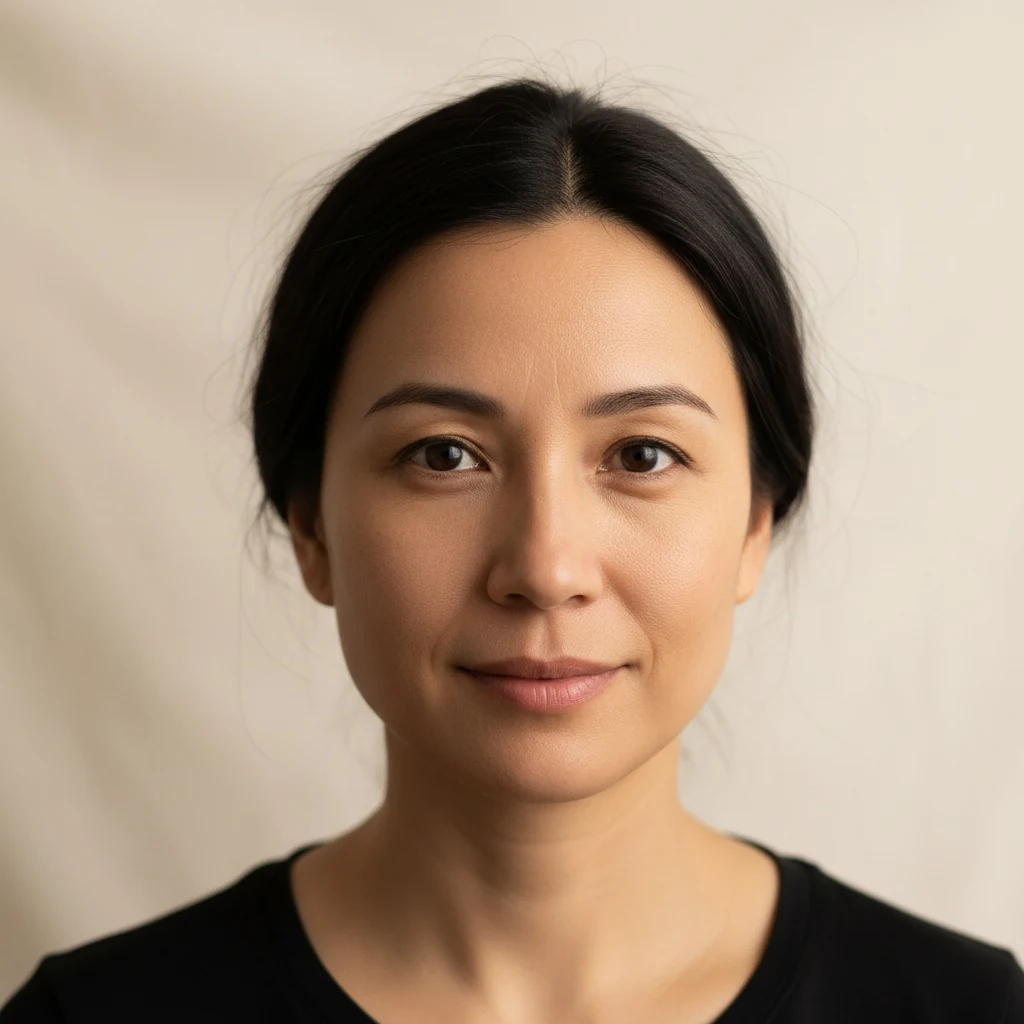 Example
Choose your own photo
Discover your lip shape and proportions.
Choose your own photoClick to choose a photo, or drop one here
Front-facing · Even lightingStraight-on, even lighting, at arm's length gives the most comparable reading.
Runs in your browser. Your photo is not uploaded.
What is my lip shape?
Four independent measurements decide it: total lip height against mouth width, the ratio between upper and lower lip, the height of your Cupid's bow peaks above the central dip, and the angle from the centre of your mouth to its corners. Named shapes are labels applied to combinations of those four.
- Total lip height of roughly 0.42 of mouth width or more reads as full; at or below 0.28 as thin.
- The upper-to-lower reference on the result is about 1:1.6, a proportion convention. In the largest rating study, a 1:2 ratio was preferred.
- Cupid's bow definition is independent of volume — a thin lip can have a sharply defined bow.
- Downturned corners are a negative corner angle, the mouth's equivalent of a negative canthal tilt.
- Lip projection is the one lip trait a front-facing photo cannot measure.
The lip shapes and the Cupid's bow
- Cupid's Bow →The Cupid's bow is the double curve along the top edge of your upper lip — two peaks with a dip between them, named after the shape of the bow the Roman god is drawn holding. Everyone has one; what varies is how sharply defined it is.≥ 0.035bow depth ÷ mouth width4 of 102research faces · 4%0.030median bow depth ÷ mouth width
- Thin Lips →Thin lips have a total lip height below roughly 0.28 of mouth width. It is a measurement, and worth saying plainly because most of what is written about it treats it as a problem: nearly every page ranking for this term is selling filler.≤ 0.28lip height ÷ mouth width17 of 102research faces · 17%0.34median lip height ÷ mouth width
- Full Lips →Full lips have a total lip height above roughly 0.42 of mouth width. Fullness is independent of every other lip measurement — a full pair can have a flat Cupid's bow, downturned corners, or an unbalanced upper-to-lower ratio, and often does.≥ 0.42lip height ÷ mouth width12 of 102research faces · 12%0.34median lip height ÷ mouth width
- Heart-Shaped Lips →Heart-shaped lips have a sharply defined Cupid's bow with pronounced peaks, giving the upper lip the two-lobed outline the name describes. It is the one lip label defined by the border rather than by volume, which is why it can coexist with thin lips or full ones.≥ 0.035bow depth ÷ mouth width4 of 102research faces · 4%0.030median bow depth ÷ mouth width
- Downturned Lips →Downturned lips have mouth corners sitting below the centre line of the mouth, giving the resting expression a slight droop. It is the mouth's version of a negative canthal tilt, and like that measurement it is an angle rather than a mood.< −6.5°corner angle19 of 102research faces · 19%−3°median corner angle
- Wide Lips →Width is a separate axis from fullness, and confusing the two is the most common mistake in lip charts. A wide mouth with average lip height reads as thin, and a narrow mouth with the same height reads as full — the height did not change.Ratiomouth width ÷ face length0.3median mouth width ÷ face length
Lip shape chart: 9 types and what defines each
Most lip charts list nine names. They are not nine alternatives: each describes one or two of the four measurements, which is why one mouth can match several at once. The drawing shows all nine at the same scale; the table says what defines each, which number on your result to look at, and whether the test on this page uses that name.
| Lip shape | Defined by | The number to check on your result | Does the test use the name? |
|---|---|---|---|
| Full | Total lip height large for the width of the mouth | Fullness 0.42 or above | Yes — "Full" |
| Thin | Total lip height small for the width of the mouth | Fullness 0.28 or below | Yes — "Thin" |
| Wide | A mouth that is wide for the size of the face | Not shown as a label — compare your mouth corners with the inner edges of your irises | No |
| Round | Tall lips on a comparatively short mouth, curving rather than tapering into the corners | Fullness toward the full end | No — usually reads as "Full" |
| Heart-shaped | A pronounced Cupid's bow on lips that are not thin | Cupid's bow "defined" with fullness above 0.28 | Yes — "Heart-shaped" |
| Bow-shaped | A sharply defined bow on a thin upper lip | Cupid's bow "defined" with fullness at or below 0.28 | No — reads as "Thin" |
| Downturned | Corners sitting below the centre line at rest | Corner angle below -6.5° | Yes — "Downturned" |
| Top-heavy | An upper lip as tall as the lower, or taller | Upper against lower at about 1× or above | No |
| Bottom-heavy | A lower lip clearly taller than the upper | Upper against lower well under 0.62×, toward 0.5× | No |
| Uneven | One side of the mouth higher or fuller than the other | None — the corner angle averages both corners | No — see the face symmetry test |
Round lips
Round lips are tall relative to a mouth that is not especially wide, and they curve into the corners rather than tapering. The test does not have a round label: a round mouth usually reads as full, because fullness is lip height divided by mouth width and a short mouth pushes that number up. If your result says full and your mouth is narrow, round is the name most charts would use.
Bow-shaped lips
Bow-shaped lips have a clearly defined Cupid's bow, with two distinct peaks, on a thin upper lip. The distinction from heart-shaped is fullness: the same bow on fuller lips reads as heart-shaped. On this test, a defined bow — peaks at least 0.035 of mouth width above the dip — combined with fullness at or below 0.28 reports "Thin", with the Cupid's bow row showing "defined". The Cupid's bow page covers the bow itself.
Top-heavy and bottom-heavy lips
These describe the ratio between the two lips. Bottom-heavy lips have a lower lip clearly taller than the upper; top-heavy lips have an upper lip as tall as the lower or taller. Neither is a label on the test, but the "Upper against lower lip" number answers it directly: well below the 0.62 reference, toward 0.5, is what charts call bottom-heavy, and around 1 or above is top-heavy. There is no agreed cut-off for either name, so the number is more useful than the word.
Uneven lips
Some left-right difference in the lips is normal, particularly in how the corners sit and how a smile lifts them. The test cannot show it: its corner angle is the average of both corners, so one corner higher than the other reads as a single middle value. A mirror at eye level with the mouth relaxed shows it better, and the face symmetry test compares the two sides of the whole face.
Lip anatomy: the parts every lip shape is named after
- Vermilion — the red part of the lips. Fullness is the height of the vermilion, top of the upper lip to the bottom of the lower, and it is what the test measures against mouth width.
- Vermilion border — the edge where the red lip meets the skin, sometimes called the white roll. A crisp border is what makes a lip read as defined; it softens with age.
- Cupid's bow — the double curve of the upper border: two peaks with a dip between them. The test measures how high the peaks sit above the dip.
- Philtrum and philtral columns — the groove above the upper lip and the two ridges that frame it, running down to the peaks of the bow. The philtrum page measures its length.
- Tubercle — the small fullness at the centre of the upper lip, just above where the lips meet. It is part of what gives a lip a pout, and it is a depth trait the front photo does not measure.
- Commissures — the corners of the mouth. Their height relative to the centre of the mouth is the corner angle, and the distance between them is mouth width.
Upper lip vs lower lip: the ratio behind top- and bottom-heavy lips
The upper-to-lower ratio is the lip number people most often quote as an "ideal", and three very different kinds of number get quoted under that word. It helps to keep them apart.
| Reference | Upper : lower | What kind of number it is |
|---|---|---|
| The reference on this test's result | About 1 : 1.6 (0.62) | A proportion convention, borrowed from golden-ratio writing. Not a measurement of anyone |
| Popenko et al., 2017 | 1 : 2 rated most attractive; 2 : 1 least | Ratings of digitally altered photos of 20 white women aged 18–25, by several hundred raters |
| Penna et al., 2015 | No single ratio | Ratings of 176 real photos: lips rated attractive had more upper-lip height relative to the distance from nose to mouth, in women and in men |
Read together, they say something useful. The 1:1.6 figure is a convenient reference and nothing more. The best-known preference study picked a lower lip twice the height of the upper — but only for one narrow group of faces, altered on a computer. And a study of real faces found that how much upper lip shows relative to the space above it mattered more than any fixed ratio. None of these is a target for your own mouth.
See what a change would actually look like
These are the renders that act on what this page measures. Each one below was generated by the same model that runs on your own photo — labelled examples on another face, so you can see what the procedure changes before you spend anything.
Lip Filler
Lip Filler · AI example
Lip Filler. A different possibility.
Tap the photo to enlarge. AI visualisation, not a prediction. Both images are AI generated.
Changes the volume and shape of your lips.
What it does →Lip Reduction
Lip Reduction · AI example
Lip Reduction. A different possibility.
Tap the photo to enlarge. AI visualisation, not a prediction. Both images are AI generated.
Changes reduced lip volume.
What it does →Corner Lip Lift
Corner Lip Lift · AI example
Corner Lip Lift. A different possibility.
Tap the photo to enlarge. AI visualisation, not a prediction. Both images are AI generated.
Changes the upward angle of your mouth corners.
What it does →
Every “after” above is an AI simulation on a sample face, not a photograph of a surgical result — it shows the direction a procedure moves a face, not an outcome anyone achieved and not a prediction of yours. Where a frame reads “Before · AI example”, the before image is generated too: the same portrait with the condition that procedure treats added, because none of the source photographs had it. Run one on your own photo.
How to tell your lip shape in a mirror
- Relax your mouth completely and look straight on in flat, even light. Pressing your lips together or smiling changes every one of the four measurements.
- Compare the total height of both lips against the width of your mouth. That is fullness, and it is the measurement most charts stop at.
- Look at the upper and lower separately. A thin upper with an average lower is the most common configuration and it is not the same as thin lips.
- Trace the top edge of your upper lip. Two distinct peaks with a dip between them is a defined Cupid's bow; a single gentle curve is a soft one.
- Hold a straight edge horizontally across the centre of your mouth and see where the corners fall relative to it.
What is the most attractive lip shape?
No study ranks named lip shapes. What researchers test is individual proportions — area, the upper-to-lower ratio, heights relative to the rest of the lower face — and the results depend heavily on whose faces were used and who rated them.
| Study | What was varied | Raters | Finding | Limit |
|---|---|---|---|---|
| Popenko et al., 2017 | Lip area, then upper-to-lower ratio, on morphed photos | 150, then 428, mostly online | The preferred area was about 53.5% larger than the original lips; a 1:2 ratio was preferred and 2:1 was least preferred | Only white women aged 18–25; computer-altered images |
| Penna et al., 2015 | Nothing — real standardised photos were rated | 250 volunteers online | A taller upper lip relative to the nose-to-mouth distance was rated more attractive in both sexes | Lip and chin region only, not whole faces |
| Wong et al., 2010 | Nothing — 3D scans of 197 people were rated | 20 raters | The most attractive lips were smaller than average on several measures, and lips mattered less to whole-face attractiveness than expected | Small rater group; three population groups only |
The one consistent message is the last finding: when the whole face is rated, lips carry less weight than lip-focused writing suggests. The fuller-is-better idea comes mostly from the first study, which tested only young women and asked about lips in isolation.
Which lip shape is most common, and which is rarest?
Nobody has counted. There is no population survey of lip shape names, and this site does not have one either: the test runs in your browser and the photo never leaves your device, so there is nothing to tally. Lists of the "rarest lip shape" are built from celebrity photos or impressions. What can be said is that most mouths sit in the middle of each measurement — neither full nor thin, a moderately defined bow, corners close to level — so a mouth that sits at the end of two axes at once, like a bow-shaped mouth, is less common simply because it needs both.
How lips change with age
The measurements move in the same direction for most people. The best-studied change is in the upper lip: in a study combining standardised photos of 182 people with MRI scans of younger and older women, the upper lip got longer with age, showed less of its red vermilion, and became thinner from front to back — but a loss of volume could not be shown. The skin between nose and lip lengthens at the vermilion's expense. The border also loses definition, so the Cupid's bow flattens, and the corners tend to drop.
That finding is why the same researchers concluded that adding volume alone does not address what actually changed, and can produce an overfilled look. Mouth width is the exception to all of it: it is one of the most stable measurements on the face. If you want to track change over time, the philtrum measurement tends to move earlier and more clearly than fullness does.
What else changes lip shape
- Teeth and jaw position. The lips rest on the teeth, so orthodontic treatment, tooth loss or dentures can change how far they project and how much vermilion shows.
- Dryness. Dry, chapped lips tend to be held pressed and slightly rolled inward, which reads thinner in photos than the same lips relaxed and hydrated.
- Scars and injury. A scar across the vermilion border interrupts the line and can change how the Cupid's bow reads.
- Filler over time. Filler can spread beyond where it was placed, softening the border or creating a ridge above it — a question for whoever injected it.
- Sudden swelling. Lips that swell over minutes or hours are a medical matter, not a shape. Swelling with any difficulty breathing or swallowing needs emergency help.
Can you change your lip shape?
Each option moves some of the four measurements and leaves the others alone, which is a more useful way to compare them than by procedure name. None of them is necessary; a thin, bow-shaped or downturned mouth is a measurement, not a defect.
| Option | Fullness | Upper : lower | Cupid's bow | Corners | Lasts |
|---|---|---|---|---|---|
| Liner on or just over the natural border | Reads slightly fuller | Can shift slightly | Can sharpen | Can lift the read | A day |
| Gloss or a lighter shade | Reads fuller | Can shift where applied | — | — | A day |
| Plumping gloss or suction device | Brief swelling | — | — | — | Hours |
| Lip filler | Yes | Yes, depending on placement | Can define | Can support | Months |
| Lip lift | Shows more upper lip | Raises the upper | Can accentuate | — | Long-term |
| Lip reduction | Reduces | Yes | — | — | Long-term |
| Corner lip lift | — | — | — | Raises | Long-term |
Lipstick and liner by lip shape
| Lip shape | Where the liner goes | Finish | Avoid |
|---|---|---|---|
| Full | Precisely on the border | Matte or satin; gloss adds more volume | Heavy overlining |
| Thin | Just onto the border, matched to your lip colour | Light, warm shades in satin or gloss | Dark matte shades edge to edge |
| Wide | Slightly soft at the outer corners | Most shades work | Overlining at the corners |
| Round | Slightly past the corners to lengthen | Satin, with colour carried outward | A central highlight, which rounds further |
| Heart-shaped | Around each peak separately | Matte holds the peaks | Rounding across the notch |
| Bow-shaped | Peaks drawn crisply, lower lip lined just on the border | Satin on the upper lip | Gloss that blurs the notch |
| Downturned | Stopped short of the corner, lifted slightly | Any; highlight the lower-lip centre | Dark colour into the corners |
| Top-heavy | Just outside the lower border | A lighter shade on the lower lip | Overlining the upper lip |
| Bottom-heavy | Just outside the upper border | A lighter shade on the upper lip | Gloss only on the lower lip |
Lip shapes in men and women
Lip shapes female and male are described with the same names, and the test applies the same ratios to everyone, because every measurement is relative to your own mouth. What differs is what raters prefer and what is visible. In the study of real lip photographs above, attractive female lip regions had a taller lower lip relative to the chin than attractive male ones, while a taller upper lip relative to the nose-to-mouth distance was rated higher in both. For men, a moustache covers the upper border and the philtrum, so the mirror check and the test both work best clean-shaven or with the upper lip visible.
Lip shapes — frequently asked questions
How many lip shapes are there?
Charts list between six and eleven, and nine is the most common set. The number is a naming convention: lips vary along four independent measurements, and the named shapes are labels put on combinations of them.
Can I have more than one lip shape at once?
Yes, and most people do. The four measurements are independent — fullness, upper-to-lower ratio, Cupid's bow definition and corner angle — so a mouth can be full, heart-shaped and downturned simultaneously. Each named shape describes one axis, not the whole mouth.
Why do lip shape quizzes give different answers?
Because each reports one label from one of those four axes, and they do not all pick the same one. A lip that is thin, heart-shaped and downturned is all three at once, and a single-label quiz has to discard two.
What is the ideal lip ratio?
There is no single ideal. The reference on this test's result, about 1:1.6, is a proportion convention. The best-known rating study preferred 1:2 — a lower lip twice the height of the upper — but it used computer-altered photos of young white women only. A study of real photographs found no single ratio at all.
Which lip measurement is the most stable?
Mouth width. It is set by bone and muscle attachment and barely moves across adulthood, while visible lip height, bow definition, philtrum length and corner angle all change. If you want a measurement that means the same thing at twenty and at sixty, that is the one.
What shape are my lips if my top lip is bigger than my bottom?
Charts call that top-heavy. It is less often pictured than the opposite, and it is not a label on this test — check the upper against lower number on your result: around 1 or above means the upper lip is as tall as the lower or taller.
Are my lips big?
Big is an absolute size, and a photo has no millimetre scale, so the test answers a different question: how tall your lips are relative to the width of your own mouth. That is what makes lips read as full or thin. A wide mouth can have large lips that still read as average.
Is there a lip shape chart by ethnicity?
This site does not publish one. Lip measurements do differ between populations on average, as they do for every facial feature, but a chart that assigns lip shapes to ancestries turns averages into stereotypes and says nothing about any individual mouth.
Can a lip shape test work from a selfie?
Yes, better than for most features, because lips are measured from the front. A straight-on photo with a relaxed mouth gives all four measurements. The one thing it cannot give is projection — how far the lips stand forward — which needs a side view. The test runs in your browser and nothing is uploaded.
References
- 1.Popenko, N. A., Tripathi, P. B., Devcic, Z., Karimi, K., Osann, K., & Wong, B. J. F. (2017). A quantitative approach to determining the ideal female lip aesthetic and its effect on facial attractiveness. JAMA Facial Plastic Surgery, 19(4), 261–267. PMID 28208179.
- 2.Penna, V., Fricke, A., Iblher, N., Eisenhardt, S. U., & Stark, G. B. (2015). The attractive lip: a photomorphometric analysis. Journal of Plastic, Reconstructive & Aesthetic Surgery, 68(7), 920–929. PMID 25921652.
- 3.Wong, W. W., Davis, D. G., Camp, M. C., & Gupta, S. C. (2010). Contribution of lip proportions to facial aesthetics in different ethnicities: a three-dimensional analysis. Journal of Plastic, Reconstructive & Aesthetic Surgery, 63(12), 2032–2039. PMID 20133215.
- 4.Iblher, N., Kloepper, J., Penna, V., Bartholomae, J. P., & Stark, G. B. (2008). Changes in the aging upper lip — a photomorphometric and MRI-based study (on a quest to find the right rejuvenation approach). Journal of Plastic, Reconstructive & Aesthetic Surgery, 61(10), 1170–1176. PMID 18639513.