Face Measurement Statistics 2026
Updated · 102 faces · photos taken April 2012 · original data
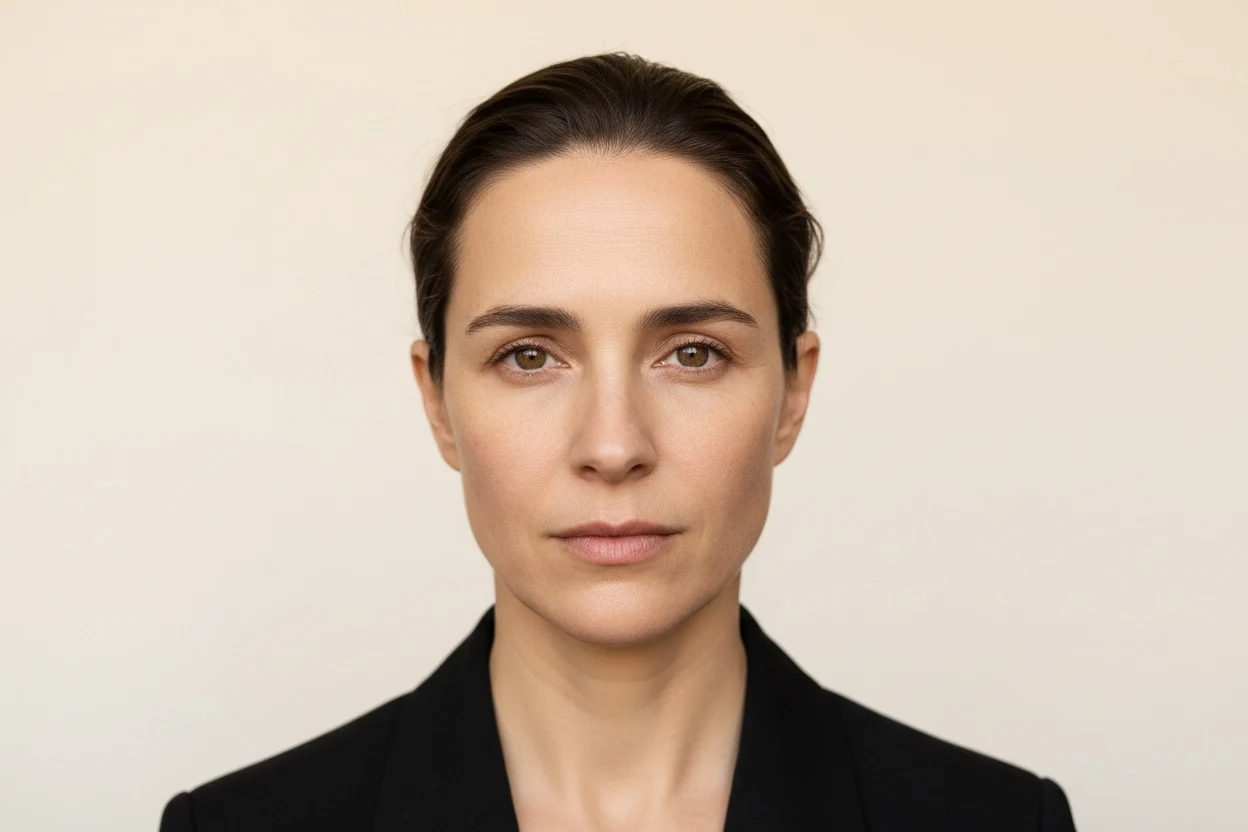
We measured 102 adult faces (49 women, 53 men) from the Face Research Lab London Set with this site's own 478-landmark code on 6 October 2026. The median face has a canthal tilt of +3.7°, an fWHR of 1.78, a midface ratio of 1.06, a pupillary distance of 61.9 mm and 96.4% left-right symmetry; 49 of 102 read as almond eyes and 38 as an oval face. Our 1-10 attractiveness score did not predict 2,513 people's ratings of the same faces (Spearman ρ = −0.07).
102
faces measured, 49 women and 53 men
+3.7°
median canthal tilt
1.78
median fWHR (face width ÷ upper-face height)
61.9 mm
median pupillary distance
96.4%
median left-right symmetry
ρ −0.07
our score vs 2,513 human raters
Face Research Lab London Set, 102 adults, neutral front photos. Splits show how this site's detectors read these faces, not how common a type is. How these numbers were made
Face shape statistics: how 102 faces split, women and men
The detector read 38 oval, 13 round, 12 heart, 10 square, 10 triangle, 10 oblong and 9 diamond faces. Women: 24 oval, 11 heart and 5 oblong. Men: 14 oval, 9 square, 9 triangle and 9 round. The median face is 1.18× as long as it is wide at the cheekbones (middle half 1.15 to 1.21).
Seven shapes come from four measurements: face length and the widths of the forehead, cheekbones and jaw. A face reads as oblong from 1.23× length to cheekbone width. Men read square and triangle far more often than women because their jaws measure wider against the cheekbones; women read heart more often for the same reason in reverse.
- Women
- Men
| Face shape | All 102 | Women (49) | Men (53) |
|---|---|---|---|
| Oval | 38 (37%) | 24 (49%) | 14 (26%) |
| Round | 13 (13%) | 4 (8%) | 9 (17%) |
| Heart | 12 (12%) | 11 (22%) | 1 (2%) |
| Square | 10 (10%) | 1 (2%) | 9 (17%) |
| Triangle | 10 (10%) | 1 (2%) | 9 (17%) |
| Oblong | 10 (10%) | 5 (10%) | 5 (9%) |
| Diamond | 9 (9%) | 3 (6%) | 6 (11%) |
Eye shape statistics: almond, upturned, round, hooded and downturned
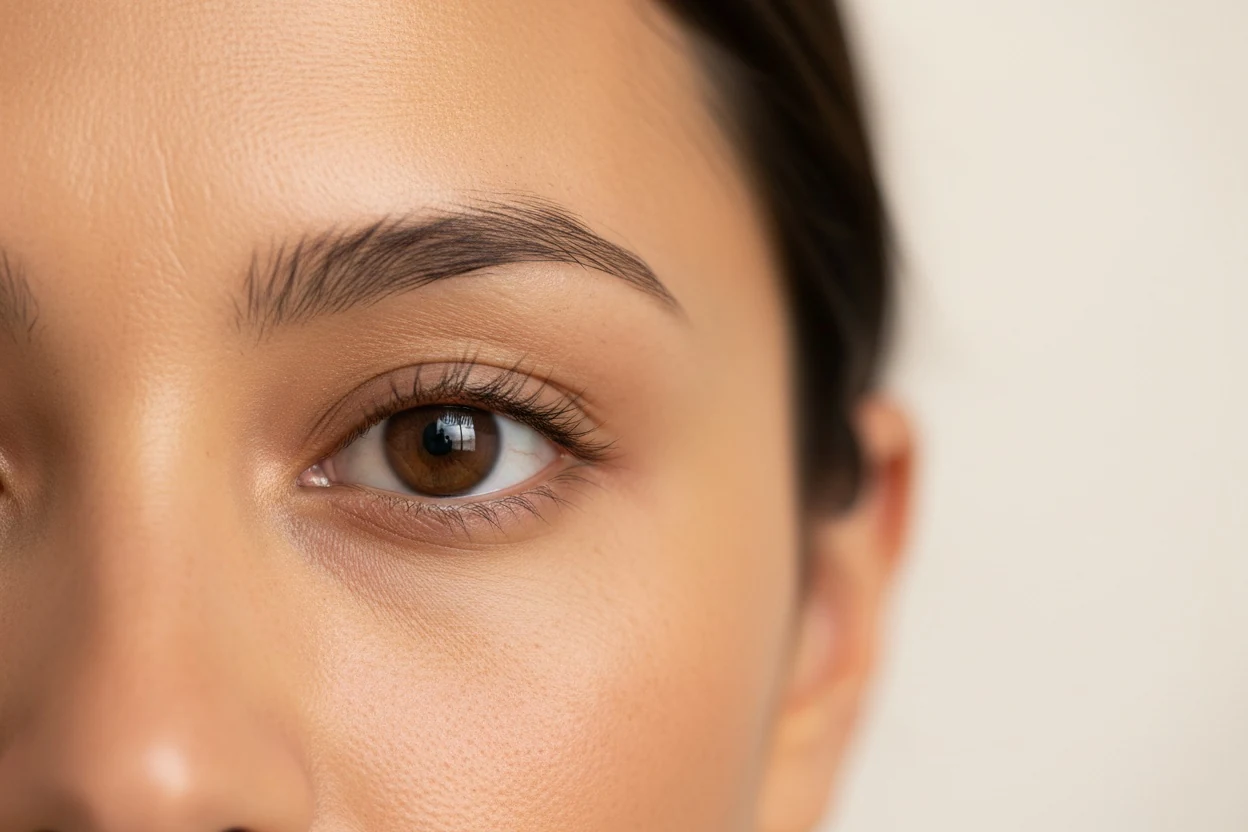
Of 102 faces, this site's eye shape test read 49 almond, 22 upturned, 14 round, 13 hooded and 4 downturned. Women: 19 upturned, 15 almond and 13 round. Men: 34 almond, 11 hooded and 4 downturned.
Upturned uses the same +5° cut as a positive canthal tilt, and a hooded lid is read before the tilt, so a hooded eye with a high outer corner counts as hooded. The median eye is 0.35 times as tall as it is wide.
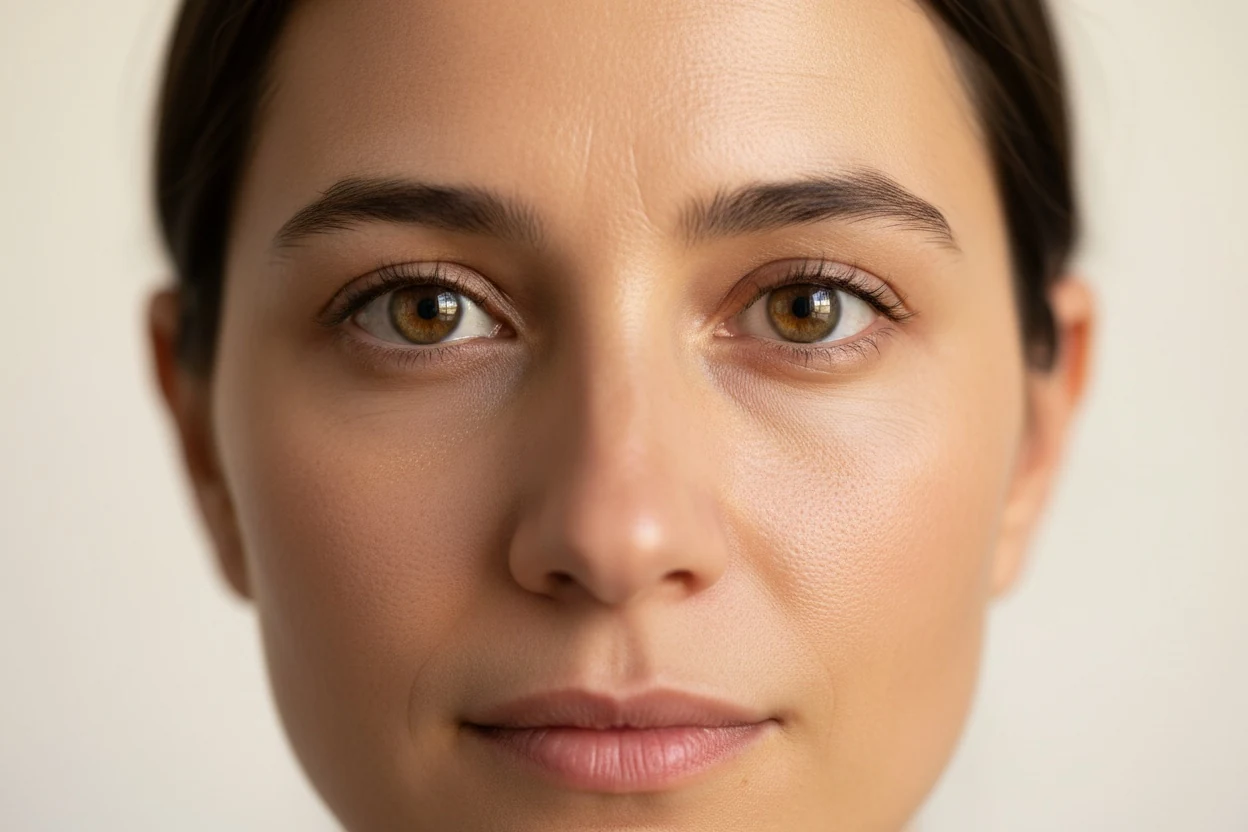
Eye spacing, measured as the inner-corner gap in eye widths, has a median of 1.17, above the one-eye-width drawing rule. 14 faces read as wide-set (above 1.27) and 13 as close-set (below 1.1); those two cut-offs were taken from this set. Monolid, deep-set and protruding eyes are not measurable from a front photo, so no number is given for them.
- Women
- Men
| Eye shape | All 102 | Women (49) | Men (53) |
|---|---|---|---|
| Almond | 49 (48%) | 15 (31%) | 34 (64%) |
| Upturned | 22 (22%) | 19 (39%) | 3 (6%) |
| Round | 14 (14%) | 13 (27%) | 1 (2%) |
| Hooded | 13 (13%) | 2 (4%) | 11 (21%) |
| Downturned | 4 (4%) | 0 (0%) | 4 (8%) |
| Eye spacing | All 102 | Women (49) | Men (53) |
|---|---|---|---|
| Average | 75 (74%) | 34 (69%) | 41 (77%) |
| Wide-set | 14 (14%) | 8 (16%) | 6 (11%) |
| Close-set | 13 (13%) | 7 (14%) | 6 (11%) |
Average canthal tilt: the distribution on 102 faces
The median canthal tilt is +3.7° (middle half +2.1° to +5.1°): +4.4° in women and +2.6° in men. 27 of 102 faces measured +5° or more, 71 sat between 0° and +5°, and 4 were below 0°.
Tilt is the angle of the line from the inner to the outer eye corner, averaged over both eyes and corrected for head roll. Women's eyes tilted upward more than men's: 19 of 49 women and 8 of 53 men reached the positive cut, and all 4 negative tilts were men. The +5° cut is a convention set before this measurement, not fitted to the set.
- Women
- Men
| Canthal tilt | All 102 | Women (49) | Men (53) |
|---|---|---|---|
| −2° to 0° | 4 | 0 | 4 |
| 0° to +2° | 18 | 2 | 16 |
| +2° to +4° | 37 | 19 | 18 |
| +4° to +6° | 32 | 19 | 13 |
| +6° to +8° | 10 | 8 | 2 |
| +8° to +10° | 1 | 1 | 0 |
Lip shape statistics: fullness, corners and Cupid's bow
Of 102 mouths, this site's lip shape test read 57 average, 19 downturned, 12 thin, 10 full and 4 heart-shaped. The median lip height is 0.34 of mouth width, and the median corner angle is −3.0° (women −2.0°, men −4.0°).
A relaxed mouth measures a few degrees below level, so downturned starts below −6.5°; that cut was chosen from this set, so its count of 19 is there by construction. Only 4 of 102 had a Cupid's bow at least 0.035 of mouth width deep, the cut for a defined bow.
- Women
- Men
| Lip shape | All 102 | Women (49) | Men (53) |
|---|---|---|---|
| Average | 57 (56%) | 38 (78%) | 19 (36%) |
| Downturned | 19 (19%) | 1 (2%) | 18 (34%) |
| Thin | 12 (12%) | 4 (8%) | 8 (15%) |
| Full | 10 (10%) | 5 (10%) | 5 (9%) |
| Heart-shaped | 4 (4%) | 1 (2%) | 3 (6%) |
Nose shape statistics: width and length from a front photo
The median nose base is 0.25 of face width, and the median nose is 1.17× as long as its base is wide (women 1.23, men 1.11). By width 11 noses read as wide and 1 as narrow; by length 48 read as short and 17 as long.
Wide means a base of 0.28 of face width or more, narrow 0.22 or less; short means a length of 1.15× the base or less, long 1.28× or more. The long cut was chosen from this set. The two sexes had the same median base width, but long readings were almost all women (16 of 49, against 1 of 53 men) and most short readings were men (38 of 53). Roman, Greek and snub noses are profile traits a front photo cannot show, so no number is given for them.
- Women
- Men
| Nose length | All 102 | Women (49) | Men (53) |
|---|---|---|---|
| Short | 48 (47%) | 10 (20%) | 38 (72%) |
| Average | 37 (36%) | 23 (47%) | 14 (26%) |
| Long | 17 (17%) | 16 (33%) | 1 (2%) |
| Nose width | All 102 | Women (49) | Men (53) |
|---|---|---|---|
| Narrow | 1 (1%) | 1 (2%) | 0 (0%) |
| Average | 90 (88%) | 44 (90%) | 46 (87%) |
| Wide | 11 (11%) | 4 (8%) | 7 (13%) |
Average fWHR, midface ratio, facial thirds, symmetry and PD
Median fWHR 1.78 (women 1.72, men 1.82), midface ratio 1.06, middle-to-lower third 0.94, symmetry 96.4%, golden ratio fit 56.4% and pupillary distance 61.9 mm (women 61.3, men 62.2). The table gives the middle 80% of faces for each.
fWHR is cheekbone width divided by the height from brow to upper lip; the midface ratio is pupil-to-pupil distance divided by the height from the pupils to the upper lip. Men's faces were wider for their height; the midface ratio barely differed between the sexes.
Facial thirds are given as middle third ÷ lower third only. The top landmark of the face mesh is the upper edge of the forehead, not the hairline, so the upper third cannot be measured reliably and no number is given for it.
Pupillary distance is the only measurement here in millimetres. It is scaled by the iris, whose visible width is about 11.7 mm in adults, and the iris landmarks were corrected against this set's hand-marked irises. A realistic error band for a single photo is ±3 mm.
- Women
- Men
- Women
- Men
| Measure | Median, all 102 | Middle 80% | Women (49) | Men (53) |
|---|---|---|---|---|
| fWHR (cheekbone width ÷ brow-to-lip height) | 1.78 | 1.64 to 1.95 | 1.72 | 1.82 |
| Midface ratio (pupil gap ÷ pupil-to-lip height) | 1.06 | 0.96 to 1.15 | 1.07 | 1.06 |
| Middle third ÷ lower third | 0.94 | 0.81 to 1.07 | 1.00 | 0.87 |
| Left-right symmetry | 96.4% | 92.4% to 98.0% | 96.4% | 96.5% |
| Golden ratio fit (three proportions vs 1.618) | 56.4% | 52.6% to 60.6% | 55.2% | 57.2% |
| Pupillary distance | 61.9 mm | 59.4 mm to 65.1 mm | 61.3 mm | 62.2 mm |
| Canthal tilt | +3.7° | +1.3° to +6.0° | +4.4° | +2.6° |
| fWHR | All 102 | Women (49) | Men (53) |
|---|---|---|---|
| 1.5 to 1.6 | 7 | 7 | 0 |
| 1.6 to 1.7 | 13 | 10 | 3 |
| 1.7 to 1.8 | 38 | 17 | 21 |
| 1.8 to 1.9 | 28 | 13 | 15 |
| 1.9 to 2.0 | 10 | 1 | 9 |
| 2.0 to 2.1 | 5 | 0 | 5 |
| 2.1 to 2.2 | 1 | 1 | 0 |
| Pupillary distance | All 102 | Women (49) | Men (53) |
|---|---|---|---|
| 56 to 58 mm | 2 | 1 | 1 |
| 58 to 60 mm | 16 | 10 | 6 |
| 60 to 62 mm | 33 | 18 | 15 |
| 62 to 64 mm | 27 | 10 | 17 |
| 64 to 66 mm | 17 | 10 | 7 |
| 66 to 68 mm | 6 | 0 | 6 |
| 68 to 70 mm | 1 | 0 | 1 |
Attractiveness score distribution, tested against 2,513 raters
The raw composite behind our attractiveness score ran only from 68.6 to 76.8 out of 100 on these faces (median 72.1), so the 1-10 score is reported as a percentile of them: 5.5 is the middle face by construction. Against 2,513 people's attractiveness ratings of the same faces the score showed no relationship (Spearman ρ = −0.07, 95% CI −0.27 to +0.12).
Every face in the set was rated by 2,513 people on a 1-7 scale (median face 2.96). The composite is symmetry at 40% plus three proportions measured against the golden ratio at 20% each; neither part predicted the ratings. The one weak signal was closeness to the average face of the person's own sex, the averageness effect, which this tool does not score because it would have to ask your sex. A landmark score describes proportions; it does not predict how attractive people find you.
| Measurement | Spearman ρ | 95% CI | Reading |
|---|---|---|---|
| Overall composite score (the 1-10 score is its percentile) | −0.07 | −0.27 to +0.12 | No relationship |
| Golden ratio fit | −0.10 | −0.28 to +0.09 | No relationship |
| Left-right symmetry | +0.09 | −0.12 to +0.28 | No relationship |
| Closeness to own-sex average (13 ratios) | +0.21 | +0.01 to +0.39 | Weak, positive |
How to cite these face statistics
The aggregate numbers on this page are free to reuse under CC BY 4.0: credit The Face Analysis, link this page, and credit the photo set.
The Face Analysis (2026). Face Measurement Statistics 2026: 102 faces measured with MediaPipe. Updated 6 October 2026. https://thefaceanalysis.com/face-measurement-statistics
Photos: DeBruine, L. & Jones, B. (2017). Face Research Lab London Set. figshare. doi:10.6084/m9.figshare.5047666.v5 (CC BY 4.0).
Face measurement statistics: frequently asked questions
What is the most common face shape?
Oval, on this detector: 38 of 102 research faces (37%), 24 of 49 women and 14 of 53 men. The face shape thresholds were set on this same set, so that share shows how the detector divides faces, not how common oval is in the population.
What is the average canthal tilt?
+3.7° is the median on 102 adult faces, with the middle half between +2.1° and +5.1°. Women's median was +4.4° and men's +2.6°. 27 faces reached +5° or more and 4 were below 0°.
What is the average fWHR?
1.78 is the median facial width-to-height ratio on 102 faces: 1.72 for women and 1.82 for men, with the middle 80% between 1.64 and 1.95. Published averages differ because studies measure the height from different points.
What is the average pupillary distance?
61.9 mm is the median on 102 adults: 61.3 mm for women and 62.2 mm for men, with the middle 80% between 59.4 and 65.1 mm. Measured from a photo, a single PD is good to about ±3 mm.
How symmetrical is the average face?
96.4% on this site's symmetry measure, the median of 102 faces; the middle 80% ran from 92.4% to 98.0%. No face was perfectly symmetrical, and symmetry did not predict attractiveness ratings (ρ = +0.09).
What is the most common eye shape?
Almond: 49 of 102 faces on this site's eye shape test, then upturned (22), round (14), hooded (13) and downturned (4). Monolid, deep-set and protruding eyes cannot be measured from a front photo.
Is an AI attractiveness score accurate?
Ours is not, as a predictor. On 102 faces rated by 2,513 people its 1-10 score correlated with the ratings at ρ = −0.07, which is no relationship. It measures proportions precisely and reports where they sit among these faces.
Can I use these numbers in my own work?
Yes. The aggregate numbers on this page are licensed CC BY 4.0: cite The Face Analysis and link this page, and credit the Face Research Lab London Set (DeBruine & Jones, CC BY 4.0) as the source of the photos.
Measure your own face with the same free tools
No signup. The photo stays in your browser, and each result shows where you sit among these 102 faces.