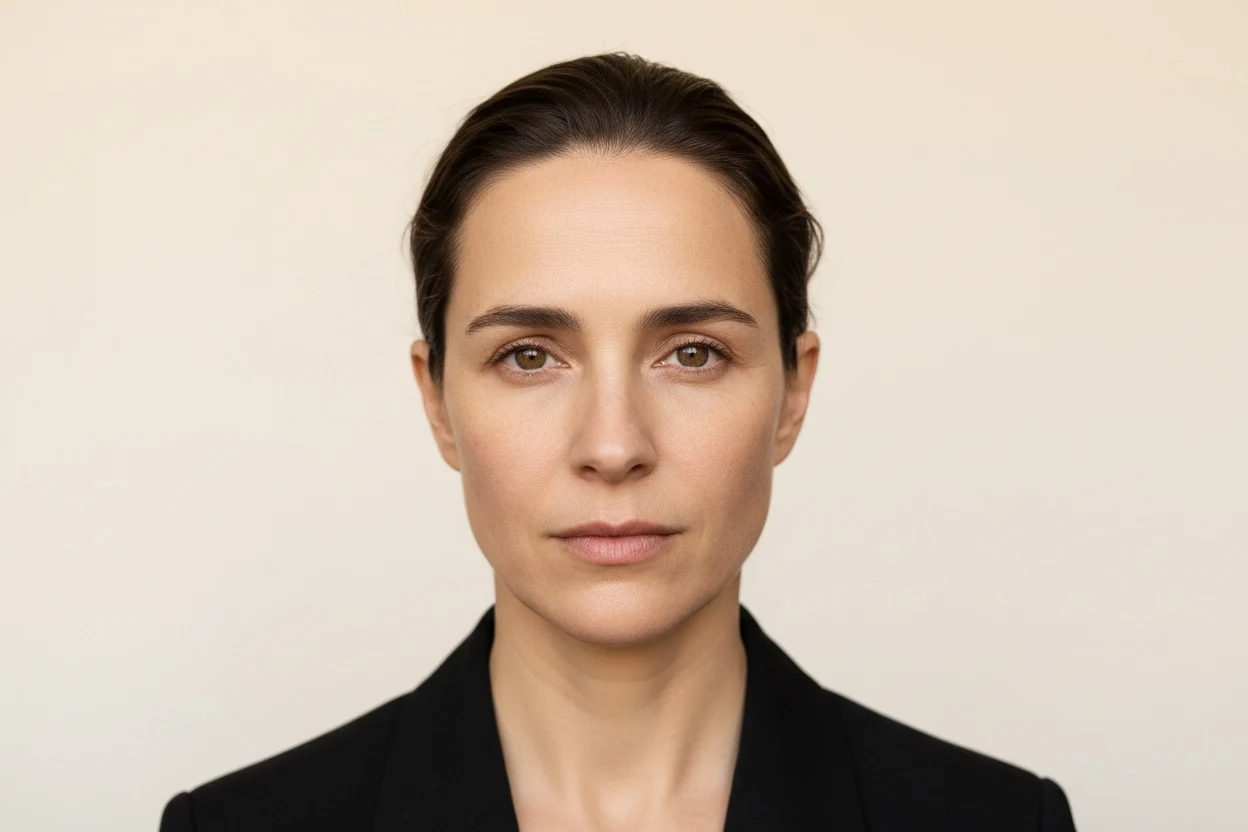
Face Symmetry Test
Close to symmetrical, never perfectly. Measured by comparing six left–right landmark pairs against the facial midline, 102 adult research faces had a median of 96.4% symmetry, with 80% between 92.4% and 98.0%. None reached 100%, and in that set symmetry did not predict how attractive raters found the face.
- 6
- left–right landmark pairs
- 102
- reference faces
- 478
- landmarks
- Free
- photo not uploaded
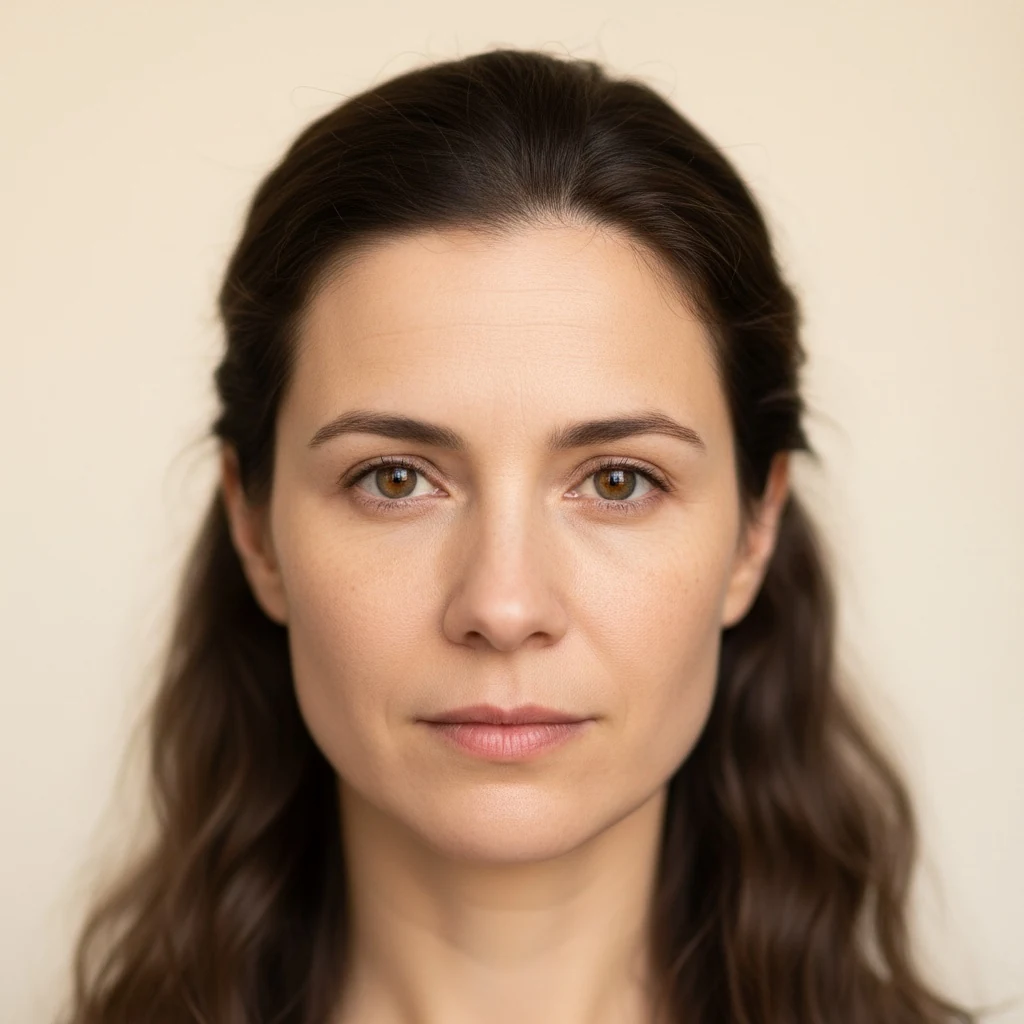 Example
Choose your own photo
See your facial symmetry and balance.
Choose your own photoClick to choose a photo, or drop one here
Front-facing · Even lightingStraight-on, even lighting, at arm's length gives the most comparable reading.
Runs in your browser. Your photo is not uploaded.
How symmetrical is a normal face?
- Median facial symmetry across the 102-face London Set: 96.4% (p10 92.4%, p90 98.0%).
- Symmetry vs. rated attractiveness in the same faces: Spearman ρ = +0.09, 95% CI −0.12 to +0.28.
- The score averages six pairs: eye corners (inner and outer), brow ends, nostril edges, mouth corners and face edges.
See what a change would actually look like
These are the renders that act on what this page measures. Each one below was generated by the same model that runs on your own photo — labelled examples on another face, so you can see what the procedure changes before you spend anything.
Jawline Filler
Jawline Filler · AI example
Jawline Filler. A different possibility.
Tap the photo to enlarge. AI visualisation, not a prediction.
Changes definition along your jaw.
What it does →Rhinoplasty
AI glow-up · nose + styling
Rhinoplasty. A different possibility.
Tap the photo to enlarge. AI visualisation, not a prediction. Includes makeup, brow styling, hair and outfit changes. Both images are AI generated.
Changes the bridge, tip and nostril width of your nose.
What it does →Canthopexy
Canthopexy · AI example
Canthopexy. A different possibility.
Tap the photo to enlarge. AI visualisation, not a prediction. Both images are AI generated.
Changes the tilt of your outer eye corner.
What it does →
Every “after” above is an AI simulation on a sample face, not a photograph of a surgical result — it shows the direction a procedure moves a face, not an outcome anyone achieved and not a prediction of yours. Where a frame reads “Before · AI example”, the before image is generated too: the same portrait with the condition that procedure treats added, because none of the source photographs had it. Run one on your own photo.
How this facial symmetry test measures your face
The test first finds 478 points on your face with MediaPipe Face Mesh, running inside your browser. It then draws a midline from the top of your forehead to the lowest point of your chin. Because that line is built from your own face rather than the edges of the photo, a slightly tilted head does not bend the result — the midline tilts with you.
Six left–right pairs are measured against that line: the outer eye corners, the inner eye corners, the outer ends of the eyebrows, the edges of the nostrils, the corners of the mouth, and the edge of the face at cheekbone level, where it is widest. For each pair the test takes the perpendicular distance of each point from the midline, subtracts one from the other and divides by their average. That gives a relative difference, so a large photo and a small one of the same face give the same answer.
The six differences are averaged and subtracted from 100. A result of 96% means the six pairs were, on average, 4% further out on one side than the other. The number is rounded to a whole percentage on the result card, and it is shown next to your face shape and the three proportion measurements that the site's overall score also uses.
| Pair | Where it sits | What a gap in this pair usually reflects |
|---|---|---|
| Outer eye corners | Lateral canthus, both eyes | Eye position or one eye sitting slightly wider; also head turn |
| Inner eye corners | Medial canthus, both eyes | The pair least moved by expression — a gap here is usually real |
| Eyebrows | Outer end of each brow | Brow grooming, a habitually raised brow, or brow position |
| Nostril edges | Left and right ala of the nose | A nose that deviates to one side, or the nostril shape |
| Mouth corners | Left and right commissure | Resting expression — a slight smile on one side moves this pair most |
| Face edge | Widest point, level with the cheekbones | Jaw and cheek width, hair covering one side, or head turn |
One limit worth knowing: the test measures distance across the face, not height. If one eyebrow sits higher than the other but both are the same distance from the midline, the percentage does not drop. Vertical differences of that kind are what the asymmetrical face guide walks through by eye.
How symmetrical is a normal face? What we measured on 102 faces
To give the percentage a reference point, we ran this exact measurement on the Face Research Lab London Set — 102 adult faces (49 women, 53 men) photographed front-on under the same studio light with a neutral expression, each rated for attractiveness on a 1–7 scale by 2,513 people. The photos are published by DeBruine and Jones under a CC BY 4.0 licence.
The median face measured 96.4% symmetrical. One face in ten measured below 92.4%, and one in ten above 98.0%. No face reached 100. Those are controlled studio photographs; a phone selfie, with its closer lens and less even light, will usually read a little lower than the same face would have in that set.
| Where the face sits in the set | Symmetry reading |
|---|---|
| Lowest 10% | below 92.4% |
| Middle (median) | 96.4% |
| Highest 10% | above 98.0% |
| Faces at 100% | none of 102 |
The spread is narrow. The whole middle 80% of the set sits inside about six percentage points, which is why a reading of 94% and one of 97% describe two ordinary faces rather than a lopsided one and a balanced one. Clinical studies say the same thing in their own units: in 52 faces chosen specifically for being exceptionally well balanced, every one still showed measurable skeletal asymmetry (Peck and colleagues, 1991), and in 80 healthy young adults measured in 3D the two halves of the face differed in shape but not in size (Ferrario and colleagues, 1995).
Is my face symmetrical? Reading your symmetry percentage
Yes, in the only sense that applies to people: your face is almost certainly within the ordinary range, and it is not perfectly symmetrical, because nobody's is. The useful question is where your number falls against faces measured the same way.
Take the reading from a straight-on photo at eye level and compare it with the table below. A low result from a selfie taken at an angle is a statement about the photo first. Retake it before you read anything into it.
| Your reading | Compared with the 102 research faces | What it usually means |
|---|---|---|
| 98% or higher | Top 10% of the set | Very close left–right match in this photo |
| 96–97% | Around the middle | Typical — the median face read 96.4% |
| 92–95% | Lower half, within the usual range | Ordinary variation; check head turn and light before anything else |
| Below 92% | Below 9 in 10 of the set | Usually one pair far out, often from pose, hair or a half-smile. Retake straight-on |
How much of that difference would another person notice? In a study that altered one face in small steps, observers who did not know what they were looking for needed at least 3 mm of change at the brow or mouth corner before they noticed it (Chu and colleagues, 2011). If a 4% difference were spread evenly across an adult face, most pairs would differ by around 2 mm or less — which is why differences at the scale this test measures are usually visible only to the person who owns the face.
Does a symmetrical face make you attractive? Symmetry and beauty research
This is the question behind searches for a beauty symmetry test, and the published answer is less tidy than the internet suggests. Grammer and Thornhill (1994) were the first to report that measured facial symmetry had a positive effect on attractiveness ratings. Perrett and colleagues (1999) found that making the shape of a face more symmetrical, with skin texture held constant, raised ratings for both men's and women's faces.
Other studies pull the other way. Swaddle and Cuthill (1995) made faces more symmetrical without changing the size of any feature, and raters found them less attractive. Kowner (1996) showed people natural portraits beside perfectly symmetrical composites: the composites won only for older faces with a neutral expression, and lost when the faces showed emotion, apparently because they looked less natural. Scheib and colleagues (1999) found that the link between symmetry and attractiveness survived even when raters saw only half of each face — so something that travels with symmetry, not symmetry itself, was doing part of the work.
A 2011 meta-analysis by Van Dongen found signs of publication bias in this literature. Correcting for it cut effect sizes by 30–50%, and among the few studies with samples of more than 100, the effect was close to zero.
What our 102-face check found
We compared this page's symmetry reading with the average attractiveness rating each London Set face received from 2,513 raters. Across the 102 faces we found no relationship between symmetry and rated attractiveness: a Spearman correlation of +0.09, with a 95% confidence interval from −0.12 to +0.28. It was similar within each sex, +0.11 for women and +0.10 for men. One small sample cannot settle the question. What it does say is that, among ordinary faces photographed well, a few points of measured symmetry did not predict how attractive people found them.
| Measurement on the same 102 faces | Correlation with human rating (ρ) | 95% interval |
|---|---|---|
| Symmetry (this test) | +0.09 | −0.12 to +0.28 |
| Closeness to the average face for your sex (13 ratios) | +0.21 | +0.01 to +0.39 |
| Golden ratio match | −0.10 | −0.28 to +0.09 |
The only measurement that leaned positive was averageness — how close a face's proportions sat to the typical face of its sex — and even that was weak. It is in line with Langlois and Roggman's 1990 finding that averaged faces are rated attractive. If you want a single number that tries to describe the whole face, the attractiveness test is built for that; the golden ratio face calculator shows the same null result for phi.
Check facial symmetry — why your result changes between photos
Head rotation is the biggest source of variation. A few degrees of turn brings one side of the face closer to the camera and shortens the other in the image, and the test measures the image, not the skull. Tilting your head sideways matters much less, because the midline is drawn through your own forehead and chin and tilts with you.
If you use the camera, the framing guide tells you when to turn left or right, move closer or level your head, and says “Framed” once you are straight on — wait for it before you take the shot. An uploaded photo is measured as it is, so choose one taken front-on, at eye level, from arm's length or further. A selfie taken close up from below and to one side can read several points lower than the same face shot straight on.
Face symmetry mirror, true mirror and symmetry filters
Most people meet their own asymmetry in an unflipped photo. The mirror shows your face reversed, and that reversed version is the one you are used to; a photo, or a true mirror that does not reverse, shows the face everyone else sees. Every small asymmetry is on the other side from where you expect it, so the photo looks slightly off. In a study of 214 women in a plastic surgery department, 73% preferred the mirror-reversed photo of themselves over the standard one (de Runz and colleagues, 2016).
A symmetry filter, or the mirror test, works differently from this checker. It copies one half of the face onto the other to build a perfectly symmetrical face from two left halves or two right halves. That is a picture, not a measurement, and it tends to exaggerate: two left halves double whatever the left side does. This page does not build mirrored half-faces; it measures the photo you give it and returns a number. If you want the mirror view as well, most phone photo editors can flip and crop an image into halves in a minute.
Do the perfectly symmetrical versions look better? Not reliably. In Kowner's experiments people preferred the natural portrait over the symmetrical composite whenever the face carried an expression, and Swaddle and Cuthill's symmetrised faces were rated less attractive than the originals. The facial symmetry exercises guide covers the two-photo test for telling muscular from skeletal asymmetry.
How to check face symmetry at home, with or without this test
You can do a rough version by eye. The steps below are the same ones the checker follows, done with a photo and a straight line instead of 478 landmarks.
- Take a photo facing the camera squarely, phone at eye level and at least arm's length away, in even light. Pull hair back from the face and keep a neutral expression.
- Open it in any editor that lets you draw a line. Draw one from the centre of your hairline through the tip of your nose to the centre of your chin.
- Compare pairs across that line: the outer corners of the eyes, the inner corners, the ends of the brows, the edges of the nostrils, the corners of the mouth and the widest point of the face.
- Note which pair is furthest from matching. That is the one worth looking at — and it is usually a pair you have never noticed in the mirror.
- For a number instead of an impression, run the same photo through the test above. It measures the same six pairs from landmark coordinates and averages them.
Asymmetrical face test: what lowers the reading
The same measurement works as an asymmetry test read from the other side: 96% symmetrical means 4% average asymmetry across the six pairs. What pushes it down in a real photo is, in rough order of how often: head turn, a half-smile or one raised brow, hair covering one side of the face, uneven light that hides one edge, and then anatomy.
The anatomical part is ordinary. The two halves of the face grow semi-independently and never finish identically. Sleeping on one side and habitual expressions leave small differences. The bite sets the position of the lower face, and in a 3D study of 748 adults in the Northern Finland Birth Cohort, preferred chewing side had no significant effect on facial asymmetry — missing teeth decided which side people chewed on. At the clinical end, a review of 1,460 patients at a university dentofacial clinic found clinically apparent asymmetry in 34%, and when it was present the chin was involved in 74% of cases (Severt and Proffit, 1997). That is a clinic population, not the general public, but it shows where larger asymmetry tends to sit.
Every cause, the specialist who assesses it and what each one responds to are covered in asymmetrical face: causes, fixes and when it is medical.
Can your face symmetry percentage change?
The photo-to-photo part changes easily: a straighter pose, even light and a relaxed mouth can move the reading by several points. The anatomical part mostly does not. The differences this test picks up are largely skeletal — one side of the jaw grew slightly differently, one orbit sits marginally wider — and facial exercises do not move adult bone.
If you track your reading over time, keep the conditions identical: same camera, same distance, same light, same expression. A change between mismatched photos says more about the photos than the face.
When facial asymmetry is worth mentioning to a doctor
Asymmetry you have always had is anatomy. Asymmetry that has appeared or increased is a different question. A new droop on one side of the face, a change in how one eye closes, or asymmetry that comes with weakness, numbness or difficulty speaking is a reason to seek medical attention rather than to run a test — a sudden one-sided facial droop is a stroke symptom and is treated as an emergency.
Slower changes matter too. An asymmetry that has developed over months, or one accompanied by jaw pain or a change in bite, is worth raising with a clinician or dentist. This site measures a photograph; it does not know what your face looked like last year, and that comparison is the one that carries the information.
Tips for an accurate symmetry reading
- Head rotation is the single biggest source of error. A few degrees of turn shortens one side of the face in the image.
- Keep the camera at eye level and at least arm's length away. A close front camera exaggerates whatever is nearest the lens.
- Even light on both sides — a shadow on one cheek can hide the face edge on that side.
- Neutral expression. Almost everyone smiles asymmetrically, and the mouth-corner pair will faithfully report it.
- Hair back and glasses off, so the face edges and eye corners are visible on both sides.
Face Symmetry Test — frequently asked questions
Is this face symmetry test free and online?
Yes. It runs in your browser on a phone or a computer, with no account and nothing to install. The symmetry percentage and the measurements behind it are free, and your photo is analysed on your device rather than uploaded.
What is facial symmetry?
Facial symmetry is how closely the left side of a face matches the right when compared across a vertical midline. No human face is perfectly symmetrical; small differences in the eyes, brows, nose, mouth and jaw are normal on every face.
How does this face symmetry checker work?
It finds 478 facial landmarks, draws a midline from forehead to chin, and measures how far six matched pairs sit from that line on each side: outer and inner eye corners, brow ends, nostril edges, mouth corners and the widest point of the face. The average left–right difference is subtracted from 100 to give the percentage.
What is a good face symmetry score?
Against the 102 research faces we measured with this code, the median was 96.4%, the lowest tenth read below 92.4% and the highest tenth above 98.0%. So anything in the mid-nineties is typical. Nobody in the set reached 100.
What percentage of symmetry is normal for a face?
Very close to 100, but never exactly 100. In the Face Research Lab London Set, measured with this test, the middle 80% of faces read between 92.4% and 98.0%. Studies of faces chosen for being exceptionally well balanced still found measurable asymmetry in every one.
How can I tell if my face is symmetrical without an app?
Take a straight-on photo at eye level, draw a line from the centre of your hairline through your nose to the centre of your chin, and compare the eye corners, brow ends, nostrils, mouth corners and face edges on each side. The test on this page does the same comparison and puts a number on it.
Does a symmetrical face mean you are attractive?
Only weakly, if at all. Some studies found that more symmetrical faces were rated more attractive, others found the opposite, and a meta-analysis found the effect shrinks close to zero in larger studies. In our check of 102 rated faces, symmetry and attractiveness ratings were unrelated (ρ = +0.09).
Is this a beauty symmetry test?
It measures symmetry, not beauty. The percentage tells you how closely your left and right sides match in the photo. It does not rate how attractive you are, and in the 102 faces we tested, the symmetry reading did not predict how attractive people found each face.
Is this an AI face symmetry test?
Partly. A trained neural network (MediaPipe Face Mesh) locates the landmarks on your face. The symmetry score itself is plain geometry — distances from a midline — and this page explains every step of it, so nothing about the number is a black box.
Can a face be perfectly symmetrical?
No. Perfect bilateral symmetry does not occur in human faces, including faces picked for their balance. A perfectly symmetrical face only exists as an edited image made by mirroring one half, and people often rate those composites as less natural than the real face.
Is my face asymmetrical, or is it just the camera?
Often it is partly the camera. A phone held close exaggerates whatever is nearest the lens, and a few degrees of head turn makes one side look narrower. Retake the photo straight-on from arm's length in even light; if the same pair still stands out, that part is your face.
Why does my face look different in photos than in the mirror?
The mirror shows your face reversed, and that is the version you are used to. A photo shows it the right way round, so every small asymmetry appears on the opposite side. In one study, 73% of 214 women preferred the mirror-reversed photo of themselves.
Is a symmetry filter or mirror test the same as this?
No. A symmetry filter copies one half of your face onto the other to make a perfectly symmetrical picture. This test does not alter your photo; it measures the actual left–right difference and returns a percentage. It does not produce mirrored half-faces.
Can I use this as an asymmetrical face test?
Yes — it is the same measurement read from the other side. A reading of 95% symmetrical means the six landmark pairs differ by 5% on average. Head turn, a half-smile and hair over one side lower it most, so rule those out before reading the result as anatomy.
Why is my face symmetry score different each time?
Mostly head rotation. A few degrees of turn changes the measured distances on both sides. Face the camera squarely, keep a neutral expression and use even light for readings you can compare.
Does hair, glasses or a smile affect the result?
Yes. Hair over one side can hide the face edge, glasses can shift the eye-corner landmarks, and almost everyone smiles slightly unevenly, which moves the mouth-corner pair. Pull hair back, take glasses off and keep a relaxed, neutral mouth.
How do I get a more symmetrical face?
Most measured asymmetry is skeletal and does not change with exercise. What you can change is the photo: a straight-on pose, even light and a neutral mouth usually raise the reading. Asymmetry that is new or getting worse should be seen by a doctor rather than measured.
Is there a face symmetry app or calculator to download?
You do not need one. This page is the calculator: it works on a phone browser with the camera or a saved photo, and gives the same result it would in an app, without installing anything or creating an account.
Is my photo uploaded or stored?
No. The landmarks and the symmetry percentage are calculated in your browser, and the photo is not sent to a server for the free test. It is only uploaded if you choose to go on to a paid AI simulation.
References
- 1.DeBruine, L., & Jones, B. (2021). Face Research Lab London Set [Data set]. figshare. CC BY 4.0. doi:10.6084/m9.figshare.5047666.
- 2.Grammer, K., & Thornhill, R. (1994). Human (Homo sapiens) facial attractiveness and sexual selection: the role of symmetry and averageness. Journal of Comparative Psychology, 108(3), 233–242. PMID 7924253.
- 3.Perrett, D. I., Burt, D. M., Penton-Voak, I. S., Lee, K. J., Rowland, D. A., & Edwards, R. (1999). Symmetry and human facial attractiveness. Evolution and Human Behavior, 20(5), 295–307. doi:10.1016/S1090-5138(99)00014-8.
- 4.Swaddle, J. P., & Cuthill, I. C. (1995). Asymmetry and human facial attractiveness: symmetry may not always be beautiful. Proceedings of the Royal Society B: Biological Sciences, 261(1360), 111–116. PMID 7644543.
- 5.Kowner, R. (1996). Facial asymmetry and attractiveness judgment in developmental perspective. Journal of Experimental Psychology: Human Perception and Performance, 22(3), 662–675. PMID 8666958.
- 6.Scheib, J. E., Gangestad, S. W., & Thornhill, R. (1999). Facial attractiveness, symmetry and cues of good genes. Proceedings of the Royal Society B: Biological Sciences, 266(1431), 1913–1917. PMID 10535106.
- 7.Van Dongen, S. (2011). Associations between asymmetry and human attractiveness: possible direct effects of asymmetry and signatures of publication bias. Annals of Human Biology, 38(3), 317–323. PMID 21271817.
- 8.Rhodes, G. (2006). The evolutionary psychology of facial beauty. Annual Review of Psychology, 57, 199–226. PMID 16318594.
- 9.Langlois, J. H., & Roggman, L. A. (1990). Attractive faces are only average. Psychological Science, 1(2), 115–121. doi:10.1111/j.1467-9280.1990.tb00079.x.
- 10.Chu, E. A., Farrag, T. Y., Ishii, L. E., & Byrne, P. J. (2011). Threshold of visual perception of facial asymmetry in a facial paralysis model. Archives of Facial Plastic Surgery, 13(1), 14–19. PMID 21242426.
- 11.de Runz, A., Boccara, D., Chaouat, M., Locatelli, K., Bertheuil, N., Claudot, F., Bekara, F., & Mimoun, M. (2016). Female plastic surgery patients prefer mirror-reversed photographs of themselves: a prospective study. Journal of Plastic, Reconstructive & Aesthetic Surgery, 69(1), 122–127. PMID 26428387.
- 12.Peck, S., Peck, L., & Kataja, M. (1991). Skeletal asymmetry in esthetically pleasing faces. The Angle Orthodontist, 61(1), 43–48. PMID 2012321.
- 13.Ferrario, V. F., Sforza, C., Miani, A. Jr., & Serrao, G. (1995). A three-dimensional evaluation of human facial asymmetry. Journal of Anatomy, 186(Pt 1), 103–110. PMID 7649806.
- 14.Severt, T. R., & Proffit, W. R. (1997). The prevalence of facial asymmetry in the dentofacial deformities population at the University of North Carolina. International Journal of Adult Orthodontics and Orthognathic Surgery, 12(3), 171–176. PMID 9511487.
- 15.Heikkinen, E. V., Vuollo, V., Heikkinen, T., & Harila, V. (2024). Chewing side preference, facial asymmetry and related factors in the Northern Finland Birth Cohort 1986. Acta Odontologica Scandinavica, 83, 500–506. PMID 39291747.