Asymmetrical face: why one side differs, and what each cause responds to
·18 min read
An asymmetrical face is the normal case. In a study of 52 faces chosen because they were exceptionally well balanced, all 52 had measurable skeletal asymmetry, and in a separate experiment observers needed around 3 mm of difference at the mouth corner or brow before they noticed any at all. So the real question is rarely "is my face asymmetrical?" It is which part is, why, and whether that particular cause responds to anything.
That last part is where most advice goes wrong. Asymmetry is not one condition with one fix — it is a description that covers bone, teeth, muscle, fat, habits and, occasionally, disease. Exercises cannot move a jaw that grew longer on one side; surgery is absurd for a mouth corner that lifts less when you smile. This guide goes cause by cause: how to tell what you are looking at, who assesses it, what each option actually acts on, and the handful of signs that make an uneven face a medical matter rather than a cosmetic one.
Is an asymmetrical face normal? What the measurements say
Peck and colleagues took posteroanterior X-rays of 52 white adults whose faces had been selected as exceptionally well balanced, and measured three bilateral skeletal lines at the eye sockets, cheekbones and jaw corners. Every subject showed measurable asymmetry. The asymmetry was smallest near the skull and grew toward the jaw, and a slight tendency for the right side to be larger was not statistically significant.
Ferrario's group found the same thing in soft tissue. Using infrared 3D photogrammetry on 80 healthy young adults with no dental or jaw problems, they compared 16 facial landmarks on each side. The two halves of the average face differed significantly in shape, but not in size — the sides are not one big and one small, they are differently arranged.
At the other end of the spectrum, asymmetry large enough to be clinically obvious is common in people who seek treatment for jaw and bite problems. Severt and Proffit reviewed 1,460 patients at a university dentofacial clinic and found 34% had clinically apparent facial asymmetry. When it was present it involved the chin in 74% of cases, the midface (mostly the nose) in 36%, and the upper face in just 5%. That pattern — least at the top, most at the chin — matches the healthy-face X-rays, and it is the most useful single fact about where asymmetry lives.
How much asymmetry other people can see
Chu and colleagues digitally altered a photograph of one face in small steps, changing the brow, the mouth corner or both on one side the way facial paralysis does, and showed the series to observers who did not know what the study was about. At least 3 mm of asymmetry was needed before anyone detected it, and people spotted smaller differences when the images stayed on screen longer. That second finding explains the gap between how your face looks to you and how it looks to others: you study your own face for minutes at a time, from centimetres away, and nobody else ever does. The facial asymmetry exercises guide goes further into the threshold and what it means for small changes.
Are famous faces asymmetrical too?
Yes, and there is no need to name anyone to show it: the 52 faces in the Peck study were chosen precisely because they were the kind of face people hold up as a standard, and not one was symmetrical. Lists of celebrities with "asymmetrical faces" are built from press photos taken at unknown angles and lens lengths, which is exactly the kind of image that manufactures asymmetry — the next section explains how. This site does not publish one.
Why your face looks lopsided in pictures but not in the mirror
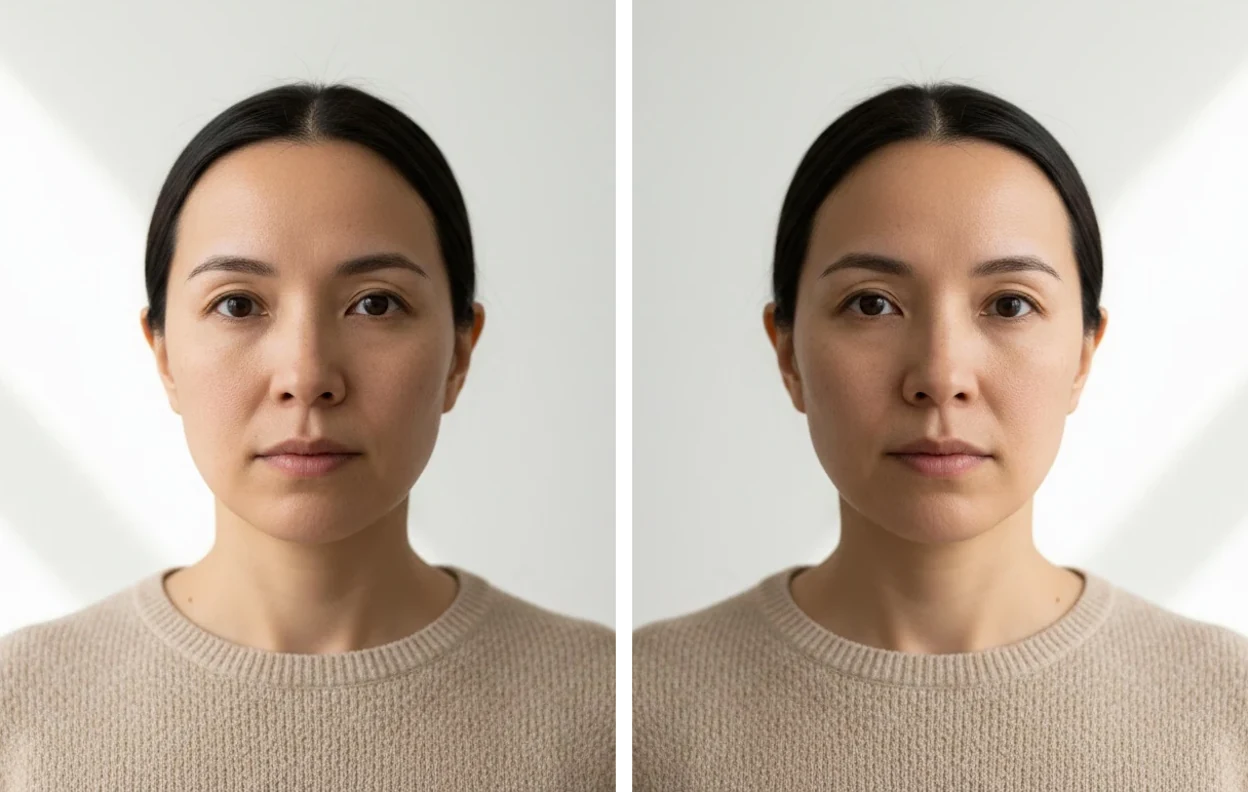
A mirror reverses left and right, so the face you know best is not the face everyone else sees. A photograph shows the unflipped version, and because every face is asymmetrical, the two are genuinely different images. Familiarity then does the rest: people tend to prefer what they have seen most. In de Runz and colleagues' 2016 study, 214 women admitted for plastic surgery chose between a standard and a mirror-reversed photo of themselves, and 73% preferred the mirror-reversed one — 84% among those having facial surgery.
So the sense that a photo makes your face look crooked is, first, a real difference between two views and, second, a preference for the one you are used to. Camera conditions then add distortions of their own, and those can create the appearance of asymmetry in a face that measures as balanced.
| Photo artefact | How it creates asymmetry | How to remove it |
|---|---|---|
| Mirror flip (or its absence) | Shows you the unfamiliar, unflipped arrangement of your features | Compare photos with photos, never a photo with the mirror |
| Head turned a few degrees | The side turned away shortens, the near side widens | Face the lens squarely; line your nose up with the camera |
| Head tilted | One eye and one mouth corner sit visibly higher | Keep both pupils level; use the grid on your camera |
| Phone held close | Features nearest the lens enlarge, so any turn exaggerates one side | Arm's length or further; zoom in slightly rather than stepping closer |
| Light from one side | Shadow flattens one half and models the other | Face a window or use light from directly in front |
| Hair parting and fringe | Covers one brow or cheek edge more than the other | Pull hair back for any comparison photo |
The mechanics of lens distance and light are covered in more depth in how to be photogenic. For the purposes of this guide the rule is simple: no judgement about your face's symmetry should be made from a close-up selfie.
What causes an asymmetrical face: seven causes, by tissue
The review most cited on this topic, Thiesen and colleagues' 2015 paper for orthodontists, describes facial asymmetry as common and often subclinical, and says that when it is significant its cause should be investigated before any treatment is planned, because treatment depends on the patient's age, the cause and the degree. That is the logic of the table below: each cause lives in a different tissue, shows up differently, and is assessed by a different specialist.
| Cause | Typical sign | Onset | Who assesses it |
|---|---|---|---|
| Normal developmental variation | Small differences in eye height, cheek width or jaw length that you have always had | Present since adolescence, stable | No one needs to; a dentist or orthodontist if it bothers you |
| Teeth and bite | Tilted smile line, chin off-centre, jaw that drifts sideways as it opens; missing teeth or dentures | Develops with dental changes | Dentist, orthodontist |
| One-sided jaw joint overgrowth (condylar hyperplasia) | Chin moving steadily to one side, bite changing, one side of the jaw lengthening | Progressive, usually from the teens onward | Oral and maxillofacial surgeon |
| Congenital (e.g. hemifacial microsomia) | One side of the lower face and often the ear underdeveloped | Present from birth | Craniofacial team |
| Muscle and nerve | One side moves less when you smile, raise your brows or close your eyes | Lifelong, or sudden if due to a nerve problem | GP or neurologist if new; physiotherapist for rehabilitation |
| Soft tissue and volume | One cheek fuller, one fold deeper, uneven sagging | Gradual; increases with age and weight change | Dermatologist or aesthetic clinician |
| Injury and neck posture | Asymmetry after a fracture; head habitually tilted from a tight neck muscle | After trauma, or from infancy (torticollis) | Maxillofacial surgeon; physiotherapist |
Two of those rows deserve a sentence each, because they are the ones where timing matters. Hemifacial microsomia is the second most common congenital facial difference, at roughly 1 in 3,000 to 5,600 live births according to a 2020 review, and it ranges from a minor asymmetry with a differently formed ear to significant underdevelopment of the jaw. Unilateral progressive condylar growth — overgrowth of the joint at the top of the jawbone on one side — produces a facial asymmetry that keeps increasing, and a 2026 review concluded that early intervention may control progression and reduce the need for later jaw surgery. An asymmetry that is still getting bigger is the one to have looked at.
Facial asymmetry from sleeping on one side
The best evidence comes from identical twins, who share genes, so differences between them point at environment. Liu and colleagues photographed 147 pairs at a twins festival and compared their habits. Twins who slept mostly face-down had greater nasal midline deviation and mouth-corner asymmetry. Tooth extractions were linked to a tilted bite plane, dentures to nose and mouth-corner asymmetry, and smoking to a tilted bite plane and upper eyelid droop. Separate biomechanical work by Anson, Kane and Lambros describes the compression and shear forces the face takes for hours a night in side and front sleeping positions.
Can it be reversed? Nobody has tested it. The twin study was observational and measured association, not what happens after a change. Sleeping on your back costs nothing and harms nothing, so it is worth doing, but the realistic expectation is a small effect on soft tissue, and none on bone.
Does chewing on one side cause it? The evidence says no
This is one of the most repeated claims about asymmetry, and the two best studies both contradict it. Heikkinen and colleagues compared chewing side preference with 3D facial scans in 748 adults from the Northern Finland Birth Cohort and found no statistically significant effect of chewing side on facial asymmetry; what predicted which side people chewed on was missing teeth. And in a randomised trial, Jung and colleagues had 58 adults chew gum three times a day for six months: bite force rose, but masseter thickness and jaw shape did not change. If anything, dental problems change how you chew, not the other way round.
Asymmetry and age: the 3D measurement
Linden and colleagues used 3D photogrammetry to measure 191 volunteers aged from a few months to 88 years, calculating how far each face deviated from its own plane of best symmetry. The typical deviation was under a millimetre — between 0.4 and 1.3 mm — but it correlated strongly with age (r = 0.66), and it increased in all three thirds of the face, most in the middle and lower thirds. The authors suggest uneven skeletal remodelling and uneven deflation and descent of soft tissue as causes, which fits what imaging shows about the midface: facial fat sits in separate compartments that shift downward with age, and nothing requires them to do so evenly on both sides.
How to tell which kind of asymmetry you have
The most useful first test needs two photos. Take one with your face completely relaxed and one mid-expression — a wide smile, then raised brows — in the same light at arm's length. If the sides match at rest and diverge in movement, the asymmetry is in how muscles move. If they differ at rest and the difference stays the same size in movement, it is structure: bone, teeth or volume. The full version of the test, with a diagram, is in the two-photo test section of the exercises guide.
Then look at where it is. Differences concentrated at the chin and jaw point toward the bite and the jaw joint; a difference that appears only when you smile points toward muscle; one cheek fuller than the other points toward soft tissue. And ask the question that matters most: has it changed? A photo from five years ago is more informative than any measurement of a photo from today.
How clinicians assess facial asymmetry
Thiesen's review describes assessment as an interview, an examination of the face and the inside of the mouth, and then supplementary imaging. The common methods each see something the others miss, and a front photo — including the one you would upload to a symmetry test — sits at the bottom of the list for depth.
| Method | What it can see | What a front photo misses |
|---|---|---|
| Clinical examination | How the face moves, how the jaw opens, the bite, the jaw joint, soft tissue feel | Movement, the bite and anything you can only feel |
| Standardised front and underside photos | Chin position, nose deviation, soft tissue from below | The underside view, which shows chin and jaw deviation clearly |
| Posteroanterior X-ray | Skeletal lines across the eye sockets, cheekbones and jaw | Bone, as opposed to the soft tissue over it |
| Cone-beam CT | The jaw joint and jaw in three dimensions | Depth, and the condyles themselves |
| 3D surface photogrammetry | Sub-millimetre soft tissue asymmetry, measured against a best-fit plane | Depth, and asymmetry that is small but real |
Six landmark pairs, left against right, measured in your browser with no upload. The number that matters is which pair is furthest apart, not the total.
See which pair is furthest apartHow to fix an asymmetrical face without surgery, matched to the cause
"Fix" means three different things, and it helps to decide which you want. You can change the asymmetry, which only works when the cause is something non-surgical options reach. You can camouflage it, which works on almost everything. Or you can stop measuring it, which — given that everyone's face is asymmetrical and the threshold for anyone else noticing is around 3 mm — is sometimes the most accurate response.
| Option | Cause it matches | What it changes | Best available evidence | Who does it |
|---|---|---|---|---|
| Sleeping on your back | Soft tissue; habit-linked | Removes one compressive force | Association only (Liu 2014 twin study) | You |
| Targeted facial exercise | Muscle movement differences only | How evenly muscles move | No controlled trials in healthy faces (Van Borsel 2014 review) | You, ideally guided by a physiotherapist |
| Orthodontics or dental work | Teeth and bite | Tooth position, bite plane, sometimes chin position | Standard of care for bite problems (Thiesen 2015) | Orthodontist, dentist |
| Toxin on one side | Overactive muscle on one side | Relaxes that muscle for months | Clinical option, not trial-graded for this use | Qualified clinician |
| Filler on the flatter side | Volume difference | Adds volume to camouflage | No asymmetry-specific trials | Qualified clinician |
| Physiotherapy for neck posture | Head tilt from a tight neck | Head position in daily life and photos | Limited | Physiotherapist |
| Hair, beard, brows, glasses, photo technique | Any | How visible it is | None needed: it is framing and optics | You |
Exercise is the option most people reach for first and the one with the narrowest match. It can only act on how muscles move, the 2014 systematic review of facial exercise found no controlled evidence even for its most studied use, and the moves, routine and safety limits are covered in detail in facial asymmetry exercises. If your two-photo test shows a difference at rest that stays the same in movement, exercise is aimed at the wrong tissue.
Camouflage that costs nothing: hair, beard, brows and glasses
- Hair parting. A side part draws the eye across the face; parting on the side opposite the fuller or higher feature makes the hair fall over it. A fringe that sweeps across hides a brow height difference completely.
- Beard. A beard redraws the jaw line. Kept slightly fuller on the shorter or flatter side of the jaw, it evens out the outline that people read as the jaw.
- Brows. Brow height differences are among the most visible and the easiest to change: shaping or filling the lower brow a little higher at its peak evens them out without anyone knowing.
- Glasses. A frame sets a strong horizontal line across the face. A frame with a straight, solid top line hides small differences in eye and brow height; thin or rimless frames reveal them.
- Photos. Your better side is real, because the sides are different. Turn your head a few degrees toward the side you prefer, keep the camera at eye level and at arm's length, and use light from the front.
Which hairstyles and frames suit your outline depends on your face shape as well as your asymmetry; the face shape pages cover both.
What only surgery changes in an asymmetrical face
When asymmetry is skeletal and large — a chin that sits well off-centre, a bite plane tilted across the mouth, one side of the jaw longer than the other — nothing short of surgery changes the bone. The options belong to oral and maxillofacial surgeons and craniofacial teams, and they are planned together with orthodontists, usually with 3D imaging:
- Orthognathic surgery repositions the upper jaw, the lower jaw or both, and can level a tilted bite and centre the chin.
- Genioplasty moves the chin bone itself, sideways, forward or vertically.
- Condylar surgery treats active overgrowth of the jaw joint, sometimes combined with jaw surgery.
- Implants and bone grafts add volume on an underdeveloped side, as in some congenital differences.
- Jaw contouring reduces bone on a wider or more prominent side.
The Severt and Proffit data explain why these procedures are planned around asymmetry rather than added afterwards: in their clinic population, when the chin deviated sideways, it went to the left 80% of the time, and the authors stressed that asymmetry must be identified before any treatment starts. If you want to see what a change to chin position or jaw width would look like on your own face, the genioplasty simulation and jaw reduction simulation render it from a photo — as an illustration of an idea, not a prediction of any surgeon's result.
When facial asymmetry is a medical question
Almost all facial asymmetry is anatomy. The exceptions are recognisable by one thing: change. Asymmetry you have always had is information about how you grew. Asymmetry that has appeared, or is growing, is information about something happening now.
| Sign | Why it matters | Where to go |
|---|---|---|
| Sudden droop of one side of the face, with arm weakness, numbness, confusion or slurred speech | Signs of stroke; treatment is time-critical | Emergency services, immediately |
| One side of the face suddenly weak or unable to move, eye will not close, without other symptoms | May be Bell's palsy or another facial nerve problem, which needs prompt assessment | Urgent same-day medical care |
| Chin or jaw steadily moving to one side over months; bite changing | May be progressive growth at the jaw joint, where earlier treatment can limit the deformity | Dentist, then oral and maxillofacial surgeon |
| A lump, swelling or numbness on one side | Needs examination to find the cause | GP or dentist |
| Jaw pain, clicking, locking or limited opening with asymmetry | Can involve the jaw joint | Dentist |
| Asymmetry after a facial injury | Can mean a fracture that healed out of position | Maxillofacial surgeon |
When the asymmetry is small but the worry is large
There is one more situation worth naming without judgement. If an asymmetry that others do not notice takes up hours of your day — checking mirrors, retaking photos, avoiding being seen from one side — the distress is the thing to address, not the millimetres. Body dysmorphic disorder is a recognised, treatable condition, and it is common among people seeking appearance changes: a 2022 meta-analysis of 48 studies and nearly 15,000 people requesting cosmetic surgery put its prevalence at about 19%. A GP can refer you to someone who treats it, and a procedure is unlikely to resolve it.
What an asymmetrical face does and does not cost you
Symmetry does relate to how attractive faces are rated — Grammer and Thornhill's 1994 work is a standard reference — but the relationship is modest, and it sits alongside other cues that carry at least as much weight. In Fink and colleagues' 2006 study of female faces, the evenness of skin colour alone changed how old, healthy and attractive they were judged. The faces in the Peck study were selected as exceptional and were still measurably asymmetrical. A face does not need to be symmetrical to be considered attractive; it needs its asymmetry to stay below the level that draws attention, and for nearly everyone it already does.
The practical conclusion of all the evidence above is short. Take a proper photo before judging. Find out which kind of asymmetry you have and whether it has changed. Match any fix to the cause. And if you want a measured sense of how your features work together, rather than a verdict on one side of your face, the attractiveness test and how to know if you are attractive put symmetry in its place among the other things that count.
Asymmetry at the chin and jaw is the most common kind. Jawline rating measures how far each jaw corner sits from your midline, from one front photo in your browser.
Check your jaw cornersFrequently asked questions
Is it normal to have an asymmetrical face?
Yes — it is the only kind of face there is. When researchers X-rayed 52 adult faces chosen specifically for being exceptionally well balanced, every one of them had measurable skeletal asymmetry. A 3D study of 80 healthy young adults found the average left and right halves differed significantly in shape. What varies between people is how much, and where.
Can you fix an asymmetrical face without surgery?
It depends entirely on the cause. Differences in how muscles move can respond to targeted work or, in a clinician's hands, to toxin; volume differences can be camouflaged with filler; a bite that tilts the lower face is a question for orthodontics. Skeletal differences, which every face has, cannot be changed without surgery, but hair, beard, brows and how you are photographed change how visible they are, at no cost.
What causes facial asymmetry?
Mostly ordinary development: the two halves of the face grow semi-independently and never finish identically. On top of that come the bite and teeth, uneven soft tissue and volume, habits such as sleeping face-down, and ageing. Less commonly the cause is a condition: one-sided overgrowth of the jaw joint, a congenital difference such as hemifacial microsomia, an injury, or a problem with the facial nerve.
Does facial asymmetry get worse with age?
On average, yes. A 3D photogrammetry study of 191 people aged from a few months to 88 years found asymmetry increased steadily with age, in every third of the face, with the largest increase in the middle and lower face. The authors pointed to uneven bone remodelling and uneven loss and descent of soft tissue as likely reasons.
Do other people actually notice facial asymmetry?
Much less than you do. In a study that altered photographs of a face step by step, naive observers needed at least 3 mm of difference at the brow or mouth corner before they noticed anything. They caught smaller differences when they looked for longer — which is exactly what you do with your own face and nobody else does.
Can sleeping on one side make your face asymmetrical, and can it be reversed?
It is associated with it. In a study of 147 pairs of identical twins, the twin who slept mostly face-down had more nasal midline deviation and mouth-corner asymmetry than their sibling. The study did not test whether changing sleep position reverses it. Sleeping on your back is free and harmless to try; expect a small effect at most, and on soft tissue rather than bone.
Why does my face look more lopsided in photos than in the mirror?
Because the mirror shows you a flipped face and the camera does not. You have seen your mirror image thousands of times and the unflipped version rarely, and people tend to prefer what is familiar: in one study of 214 women, 73% preferred a mirror-reversed photo of themselves to the standard one. Close phone distance, a slight head turn and light from one side then exaggerate whatever asymmetry is there.
When should I see a doctor about an uneven face?
Immediately, by calling emergency services, if one side of the face droops suddenly — especially with arm weakness, numbness or slurred speech, which are signs of stroke. The same day if one side of your face has become weak or will not move without other symptoms, which may be Bell's palsy. And at a routine appointment with a dentist or maxillofacial surgeon if an asymmetry is getting larger over months, or comes with jaw pain, clicking or a change in your bite.
References
- Peck, S., Peck, L., & Kataja, M. (1991). Skeletal asymmetry in esthetically pleasing faces. The Angle Orthodontist, 61(1), 43–48. PMID 2012321.
- Ferrario, V. F., Sforza, C., Miani, A. Jr., & Serrao, G. (1995). A three-dimensional evaluation of human facial asymmetry. Journal of Anatomy, 186(Pt 1), 103–110. PMID 7649806.
- Chu, E. A., Farrag, T. Y., Ishii, L. E., & Byrne, P. J. (2011). Threshold of visual perception of facial asymmetry in a facial paralysis model. Archives of Facial Plastic Surgery, 13(1), 14–19. PMID 21242426.
- Severt, T. R., & Proffit, W. R. (1997). The prevalence of facial asymmetry in the dentofacial deformities population at the University of North Carolina. International Journal of Adult Orthodontics and Orthognathic Surgery, 12(3), 171–176. PMID 9511487.
- Linden, O. E., He, J. K., Morrison, C. S., Sullivan, S. R., & Taylor, H. O. B. (2018). The relationship between age and facial asymmetry. Plastic and Reconstructive Surgery, 142(5), 1145–1152. PMID 30511968.
- de Runz, A., Boccara, D., Chaouat, M., Locatelli, K., Bertheuil, N., Claudot, F., Bekara, F., & Mimoun, M. (2016). Female plastic surgery patients prefer mirror-reversed photographs of themselves: a prospective study. Journal of Plastic, Reconstructive & Aesthetic Surgery, 69(1), 122–127. PMID 26428387.
- Thiesen, G., Gribel, B. F., & Freitas, M. P. M. (2015). Facial asymmetry: a current review. Dental Press Journal of Orthodontics, 20(6), 110–125. PMID 26691977.
- Liu, M. T., Iglesias, R. A., Sekhon, S. S., Li, Y., Larson, K., Totonchi, A., & Guyuron, B. (2014). Factors contributing to facial asymmetry in identical twins. Plastic and Reconstructive Surgery, 134(4), 638–646. PMID 25357025.
- Heikkinen, E. V., Vuollo, V., Heikkinen, T., & Harila, V. (2024). Chewing side preference, facial asymmetry and related factors in the Northern Finland Birth Cohort 1986. Acta Odontologica Scandinavica, 83, 500–506. PMID 39291747.
- Jung, H. J., Hwangbo, N. K., Park, Y., & Ahn, H. J. (2024). Effects of gum chewing training on occlusal force, masseter muscle thickness and mandibular shape: a randomised controlled clinical trial. Journal of Oral Rehabilitation, 51(12), 2529–2536. PMID 39215439.
- Anson, G., Kane, M. A., & Lambros, V. (2016). Sleep wrinkles: facial aging and facial distortion during sleep. Aesthetic Surgery Journal, 36(8), 931–940. PMID 27329660.
- Paul, M. A., Opyrchał, J., Knakiewicz, M., Jaremków, P., Bajtek, J., & Chrapusta, A. (2020). Hemifacial microsomia review: recent advancements in understanding the disease. Journal of Craniofacial Surgery, 31(8), 2123–2127. PMID 33136839.
- Olate, S., Ravelo, V., Parra, M., & Rana, M. (2026). Decision-making in unilateral progressive condylar growth of the mandible: biological insights and the role of proportional condylectomy. Journal of Clinical Medicine, 15(12), 4654. PMID 42355823.
- Van Borsel, J., De Vos, M. C., Bastiaansen, K., Welvaert, J., & Lambert, J. (2014). The effectiveness of facial exercises for facial rejuvenation: a systematic review. Aesthetic Surgery Journal, 34(1), 22–27. PMID 24327764.
- Salari, N., Kazeminia, M., Heydari, M., Darvishi, N., Ghasemi, H., Shohaimi, S., & Mohammadi, M. (2022). Body dysmorphic disorder in individuals requesting cosmetic surgery: a systematic review and meta-analysis. Journal of Plastic, Reconstructive & Aesthetic Surgery, 75(7), 2325–2336. PMID 35715310.
- Rohrich, R. J., & Pessa, J. E. (2007). The fat compartments of the face: anatomy and clinical implications for cosmetic surgery. Plastic and Reconstructive Surgery, 119(7), 2219–2227. PMID 17519724.
- Gierloff, M., Stöhring, C., Buder, T., Gassling, V., Açil, Y., & Wiltfang, J. (2012). Aging changes of the midfacial fat compartments: a computed tomographic study. Plastic and Reconstructive Surgery, 129(1), 263–273. PMID 21915077.
- Grammer, K., & Thornhill, R. (1994). Human (Homo sapiens) facial attractiveness and sexual selection: the role of symmetry and averageness. Journal of Comparative Psychology, 108(3), 233–242. PMID 7924253.
- Fink, B., Grammer, K., & Matts, P. J. (2006). Visible skin color distribution plays a role in the perception of age, attractiveness, and health in female faces. Evolution and Human Behavior, 27(6), 433–442. doi:10.1016/j.evolhumbehav.2006.08.007.
Tools mentioned in this article
Measurements on this site are for information only. Nothing here is medical advice, and no result is a diagnosis. Talk to a qualified clinician before making any decision about a procedure.