The eyebrow shape for your face shape, starting with round faces
·13 min read
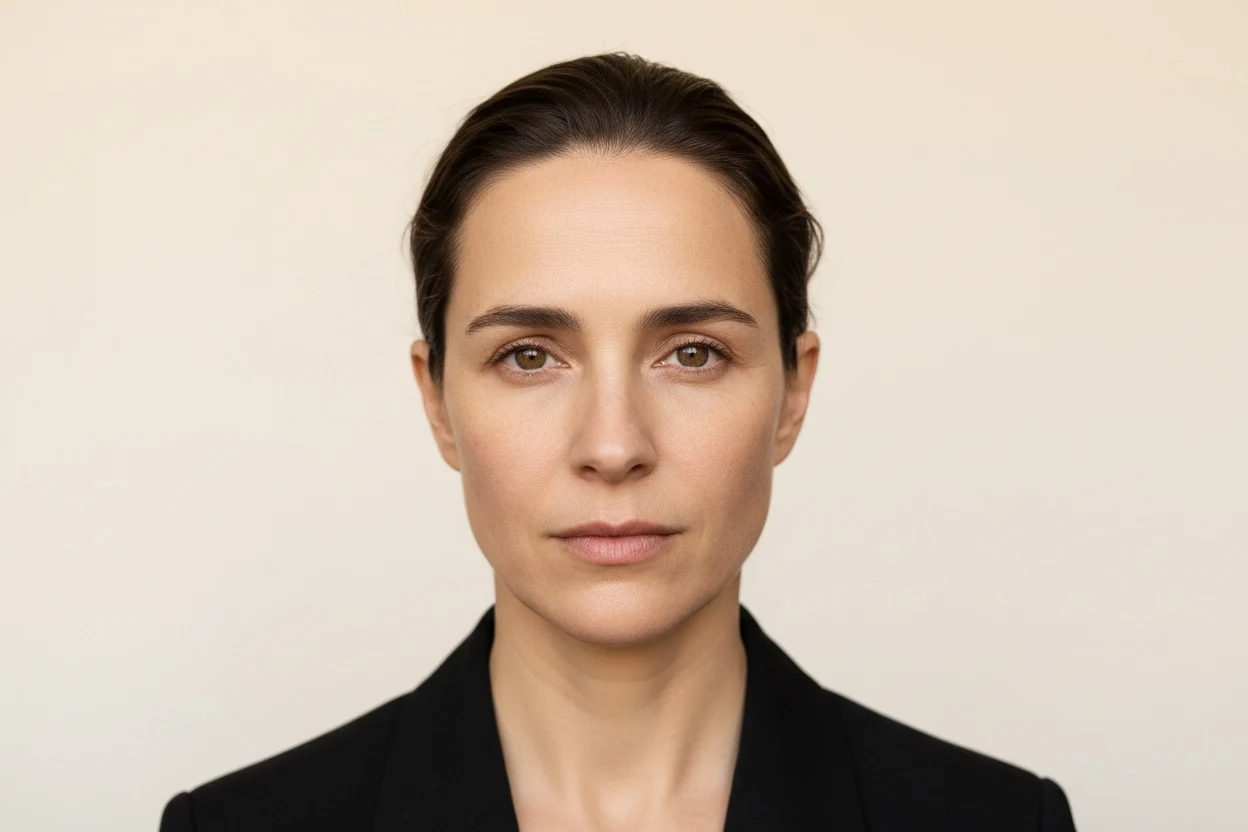
Those answers all come from one principle, and knowing it is more useful than memorising the list: brows add what the face shape lacks. A round face is short and wide, so the brow adds lift. A long face is the reverse, so the brow flattens. The rest of this guide explains each shape, how to map your brows in three lines, why eye shape and age change the answer, and what brows can and cannot actually do.
Face shape is decided by comparing forehead, cheekbone and jaw widths with face length. One photo, measured in your browser, no upload.
Check your face shape firstWhat eyebrows can and cannot change about a face
No brow shape changes the width of your cheekbones or the length of your face. What brows change is how the upper third of the face is read, and they carry more weight in perception than their size suggests. Sadr, Jarudi and Sinha showed people familiar faces with either the eyes or the eyebrows digitally removed. Recognition dropped more without the eyebrows than without the eyes. Brows are one of the main things a viewer's eye uses to organise a face.
They also change neighbouring features. Morikawa and colleagues moved the eyebrows up and down on realistic faces and measured perceived eye size: lower brows, closer to the eyes, made the eyes look larger, an illusion of the same kind as a well-known geometric one. And brows are a large part of facial contrast — the darkness of the features against the skin — which studies link to how feminine, masculine or youthful a face looks. So brow shape is a real lever, just not a structural one.
Brow shape vs brow position
Two different things get called brow shape. Shape is the curve: where the brow peaks and how sharply. Position is how high the brow sits above the eye. You can change shape with grooming. Position is mostly anatomy and changes with age — and not in the direction people assume, as the section on age explains. When a guide says a brow is too high or too low, it is usually talking about position, which tweezers cannot move.
Eyebrow shape for a round face
A round face measures close to as wide as it is long, with soft angles at the jaw. Every styling recommendation for it works in one direction — add vertical, reduce horizontal — and the brow is part of that: an arched brow rather than a flat one adds height to the upper third. Here is how common brow shapes rank for a round face, and why.
| Brow shape | On a round face | Why |
|---|---|---|
| Soft to moderate arch | Best all-round choice | Lifts the upper face without looking severe |
| High arch | Works if kept soft at the peak | Adds the most height; can look surprised if the peak is sharp |
| Angled | Works for defined looks | A clear peak breaks the width; keep the angle gentle |
| S-shaped (curved start, arched peak) | Works on fuller brows | Adds movement and lift, but needs natural fullness |
| Straight | Least flattering for most | Draws a horizontal line across the widest part of the upper face |
| Rounded | Usually avoid | Repeats the curve of the face |
Best eyebrow shape for a round face: arch, peak and tail
- Arch: soft to moderate. The goal is a visible upward line, not drama.
- Peak: roughly two-thirds of the way from the start of the brow, around the outer edge of the iris or a little further out. A peak placed too far in, over the pupil, looks harsh; too far out and the brow reads flat.
- Tail: ending slightly past the outer corner of the eye, angled up rather than dropping. A short or drooping tail makes the upper face look wider and heavier.
- Start: not too far apart. Brows that start well outside the inner eye corner widen the space between them, which adds width.
Eyebrow shape for a chubby face
A chubby face and a round face are not the same thing: round is a proportion of the bones, while fullness is soft tissue that can sit on any face shape. The brow advice is the same, though, for the same reason — a soft arch and a lifted tail add vertical line where fullness reads as width. Keep the brow full rather than thin; a thin line on a full face tends to look smaller still.
Eyebrow mistakes that make a round face rounder
| Mistake | What it does | Fix |
|---|---|---|
| Over-plucking into a thin line | Makes the face look larger around a small brow | Let them grow out for several weeks, then shape from the full brow |
| Flat, straight brows | Adds a horizontal line at the widest part | Keep or pencil a soft arch |
| A rounded, curved brow | Echoes the curve of the face | Move the peak outward so the brow has a clear high point |
| A short or drooping tail | Makes the upper face look wider | Extend the tail slightly past the outer eye corner, angled up |
| Starting the brows too far apart | Widens the centre of the face | Start in line with the inner eye corner |
The rest of the styling for a round face — haircuts, contour, glasses — follows the same vertical principle; the round face shape page covers it.
Eyebrow shape for an oval face
An oval face is longer than it is wide with a forehead slightly wider than the jaw and no strong angles, so it needs very little correcting. The best eyebrow shape for an oval face is a soft, natural arch, following your own brow. The one thing to avoid is a heavy, high arch: it shortens the upper third visually and can make a balanced face look surprised. Straight brows also work on oval faces, especially if the face is on the longer side. More on styling an oval face is on the oval face shape page.
Eyebrow shape for a square face
A square face has similar widths at the forehead, cheekbones and jaw, with a strong, angular jaw line. Brows work against the angles here: a rounded or softly curved arch repeats a curve against the corners of the jaw, while straight or sharply angled brows add more lines to a face that already has them. Keep the brows full and the arch gentle, with the peak toward the outer third. The square face shape page covers the rest.
Eyebrow shape for a heart-shaped face
A heart-shaped face is widest at the forehead and narrows to a smaller chin. The brow's job is to avoid drawing more attention to the width above: softer, less arched brows with a low, rounded peak do that. High, dramatic arches pull the eye up to the broadest part of the face. Brows that are neither too thin nor too heavy keep the top of the face in proportion with the chin. See the heart face shape page for hair and glasses.
Eyebrow shape for a long (oblong) face
A long face is noticeably longer than it is wide, with forehead, cheekbones and jaw at similar widths. Here the principle reverses: a flatter, more horizontal brow draws a line across the face and cuts the length of the upper third. A high arch does the opposite and makes a long face look longer. A slight softness at the peak keeps a straight brow from looking stern. The oblong face shape page has the rest.
Eyebrow shape for a diamond face
A diamond face is widest at the cheekbones, with a narrower forehead and a narrow jaw. The brows can widen the top of the face: brows extended a fraction wider than usual, with a soft arch, add width where the forehead is narrow. Avoid sharp, high peaks, which emphasise the narrow brow area and the width below it. The diamond face shape page goes further.
Eyebrow shape for a triangle face
A triangle face — sometimes called pear-shaped — has a jaw wider than the forehead. The upper face needs width and presence to balance the jaw: fuller, slightly wider brows with a gentle arch broaden the narrow upper third. Thin or sharply arched brows make the forehead look narrower against the jaw. The triangle face shape page covers the rest.
Eyebrow shape by face shape: the chart
| Face shape | Brow shape that suits | Arch | Tail | Avoid | Why |
|---|---|---|---|---|---|
| Round | Soft to moderate arch | Medium, peak toward the outer third | Slightly past the eye corner, angled up | Flat or very rounded brows | Adds vertical line to a short, wide face |
| Oval | Soft natural arch | Low to medium | Natural length | Heavy, high arches | The face needs little correction |
| Long (oblong) | Flatter, horizontal | Low | Natural, level | High arches | Cuts the length of the upper third |
| Square | Rounded, softened arch | Medium, curved | Natural | Straight or sharply angled brows | Repeats a curve against the angles |
| Heart | Softer, less arched | Low, rounded | Natural | High dramatic arches | Keeps attention off the wide forehead |
| Diamond | Slightly longer, soft arch | Low to medium | A fraction longer | Sharp, high peaks | Widens a narrow forehead |
| Triangle | Fuller, slightly wider | Gentle | Natural to slightly long | Thin, sharp brows | Balances a wider jaw |
How to map your eyebrows in three lines
- Start. Hold a pencil or ruler against the outer edge of your nostril, pointing straight up past the inner corner of your eye. Where it crosses your brow is where the brow starts. Mark it lightly.
- Peak. Look straight ahead and pivot the pencil from the same point on the nostril so it passes through the outer edge of your iris. Where it crosses the brow is a common place for the peak. Mark it.
- End. Pivot again so the pencil passes the outer corner of your eye. Where it crosses the brow line is where the tail ends. Check the start and end sit at roughly the same height, or the end slightly higher.
Where the arch goes: there is more than one convention
Brow-mapping guides do not agree on the peak. Some place it over the outer edge of the iris, some over the outer edge of the pupil, some further out toward the tail. There is no single rule because preference varies: when Feser and colleagues showed 357 people aged 12 to 85 the same faces with three brow variations, people under 30 preferred lower brows peaking in the outer third and ruled out arched brows in the middle, while people over 50 preferred the opposite. Use the lines as a frame, then decide where within it looks like you.
Adjusting the map for your face shape
- Round: keep the peak toward the outer third and let the tail run slightly past the end line.
- Long: lower the peak so the brow reads more horizontal; keep the start and end level.
- Square: soften the peak into a curve rather than a point.
- Heart: keep the peak low and rounded.
- Diamond: let the tail run a fraction beyond the end line.
- Triangle: keep the brow full along its whole length.
Eyebrow shape for your eye shape
Eye shape changes the answer at the edges. Brows and eyes are read together, which is why the same brow can look lifted on one face and heavy on another.
- Hooded eyes: a brow with a lifted tail and a little space above the lid keeps the eye area open; a low, heavy brow can make hooded eyes look more covered.
- Deep-set eyes: a thinner, slightly higher brow avoids adding more shadow to a brow bone that already projects; see deep-set eyes.
- Downturned eyes: a tail angled up rather than following the eye down counteracts the downward line of downturned eyes.
- Close-set eyes: starting the brows a touch further apart widens the space between the eyes; see close-set eyes.
- Wide-set eyes: starting the brows a touch closer together, in line with the inner corners, pulls the centre in; see wide-set eyes.
Brow height matters too, because low brows make eyes look larger. The eye shape detector measures how much space sits between your brow and your upper lid as part of classifying your eye shape — it does not measure brow shape itself.
Men's eyebrows and face shape
For most men the right brow is the natural one, kept tidy. Brows are a large part of how masculine a face reads — research on facial contrast finds men's brows tend to contrast more strongly with the skin than women's — so thinning or arching them changes the whole face. The practical guide: clean up the space between the brows and the stray hairs below the line, trim long hairs so they lie flat, and leave the shape alone. For a round face, avoid trimming the outer third flat; for a long face, a straight natural brow already does the work.
Eyebrows and age
The usual assumption is that brows drop with age. In women, at least, the evidence says otherwise. Matros and colleagues photographed women aged 20 to 30 and 50 to 60 who had never had brow surgery, plucked brows or toxin, and measured the brow above the inner corner, the pupil and the outer corner of the eye. The brow sat higher in the older group at all three points, significantly so at the inner and middle brow. In the younger women the outer brow sat clearly higher than the middle; in the older women the two were level — the arch toward the tail had flattened.
That has two practical consequences. A brow that looks tired with age is often one that has lost its outer lift, not one that has fallen, so keeping or pencilling a gentle lift at the tail usually helps more than raising the whole brow. And a very thin, sharply arched brow can look harsher on an older face. Brows also tend to thin; filling with fine strokes in a shade slightly lighter than the hair looks softer than a solid line.
Frequently asked questions
Which eyebrows are best for a round face?
A soft to moderate arch with the peak about two-thirds of the way along the brow, and a tail that ends a little past the outer corner of the eye. An arched brow adds vertical interest to the upper third of the face, which is the direction styling for a round face works in. Very rounded or completely flat brows tend to repeat the width instead.
What is the perfect eyebrow shape for my face shape?
There is no single perfect shape, but there is a consistent principle: brows that add what the face shape lacks. Round faces suit an arch, long faces a flatter line, square faces a softer curve, heart-shaped faces a soft, lower arch, oval faces a gentle natural arch, and diamond and triangle faces brows kept a little longer or fuller to widen the upper face.
How do I know what eyebrow shape is best for me?
Start with two things you can check: your face shape, which decides the direction, and your natural brow, which decides what is realistic. Map where your brow should start, peak and end with a pencil held from the side of your nose, then shape within that frame. The face shape detector on this site measures your face shape from one photo; no tool here measures brow shape.
Should round faces have arched or straight eyebrows?
Arched, in most styling guidance. A straight brow draws a horizontal line across the widest part of the upper face, which reinforces width, while an arch breaks that line upward. A very high or sharply angled arch can look severe, so a soft to moderate arch is the usual compromise.
What is the rule for eyebrow shape?
The most common rule is three lines from the outer edge of the nostril: straight up past the inner corner of the eye for the start, through the outer edge of the iris for the peak, and past the outer corner of the eye for the end. Mapping guides differ on exactly where the peak goes, so treat the lines as a frame to adjust, not a measurement to hit.
Can eyebrows change the shape of your face?
They cannot change the measurements, but they change how the upper face reads. Brows matter to perception more than people expect: in one study, familiar faces were harder to recognise with the eyebrows removed than with the eyes removed. In another, lower brows made the eyes look larger. Shape moves where the eye travels; it does not move bone.
Should your brows be lighter or darker than your hair?
Stylists commonly suggest brows within a shade or two of your hair colour, going slightly darker for very light hair and slightly lighter for very dark hair. There is no study behind a specific rule. What research does show is that the contrast of the brows and eyes against the skin affects how a face is perceived, so very pale or very heavy brows change the look of the whole face.
What eyebrow shape suits a man with a round face?
Mostly the natural brow, kept tidy: clean up between the brows and stray hairs under the line, and avoid thinning or arching. A straight brow is fine for most men, but if a round face is the concern, leaving the natural lift toward the outer third intact — rather than trimming it flat — keeps some vertical line.
References
- Sadr, J., Jarudi, I., & Sinha, P. (2003). The role of eyebrows in face recognition. Perception, 32(3), 285–293. PMID 12729380.
- Morikawa, K., Matsushita, S., Tomita, A., & Yamanami, H. (2015). A real-life illusion of assimilation in the human face: eye size illusion caused by eyebrows and eye shadow. Frontiers in Human Neuroscience, 9, 139. PMID 25852522.
- Matros, E., Garcia, J. A., & Yaremchuk, M. J. (2009). Changes in eyebrow position and shape with aging. Plastic and Reconstructive Surgery, 124(4), 1296–1301. PMID 19935315.
- Feser, D. K., Gründl, M., Eisenmann-Klein, M., & Prantl, L. (2007). Attractiveness of eyebrow position and shape in females depends on the age of the beholder. Aesthetic Plastic Surgery, 31(2), 154–160. PMID 17235461.
- Russell, R. (2009). A sex difference in facial contrast and its exaggeration by cosmetics. Perception, 38(8), 1211–1219. PMID 19817153.
- Jones, A. L., Russell, R., & Ward, R. (2015). Cosmetics alter biologically-based factors of beauty: evidence from facial contrast. Evolutionary Psychology, 13(1), 210–229. PMID 25725411.
Tools mentioned in this article
Measurements on this site are for information only. Nothing here is medical advice, and no result is a diagnosis. Talk to a qualified clinician before making any decision about a procedure.