Downturned Eyes
A downturned eye has an outer corner that sits level with or below the inner corner, giving a soft, slightly droopy line. This test calls an eye downturned when its canthal tilt is below 0°, so the outer corner sits lower than the inner one.
- < 0°
- canthal tilt
- 4
- eye measurements per photo
- Yes
- readable from a front photo
- Free
- photo not uploaded
Drop a photo into the panel and it will say whether your measurement reads as downturned, with the numbers behind it.
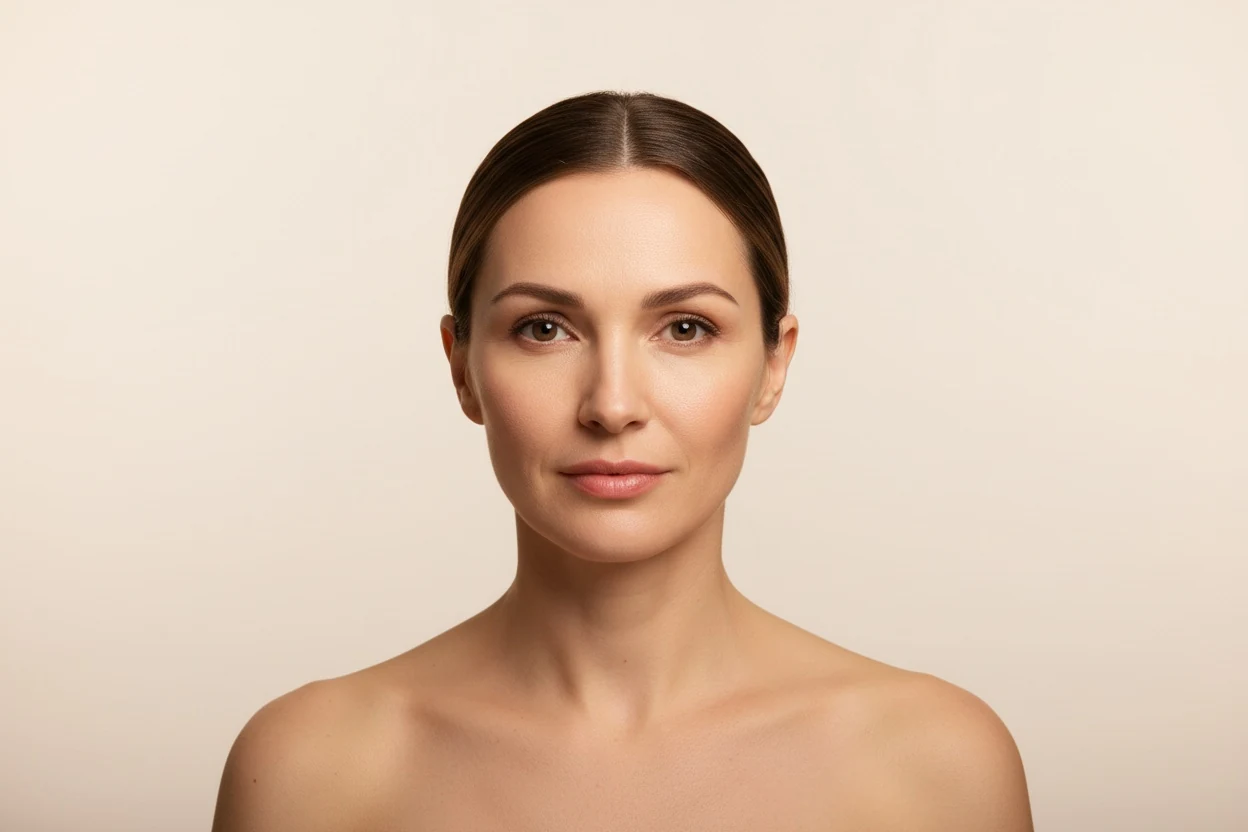 Example
Choose your own photo
Discover your eye shape and proportions.
Choose your own photoClick to choose a photo, or drop one here
Front-facing · Even lightingStraight-on, even lighting, at arm's length gives the most comparable reading.
Runs in your browser. Your photo is not uploaded.
What are downturned eyes, and how are they measured?
The angle of the line from the inner corner to the outer corner, in degrees. In a 102-adult research set measured with this test, the middle 80% of faces sat between +1.3° and +6.0° (median +3.7°). A downturned eye reads at or below zero — the outer corner sits level with or under the inner corner. This is the same measurement as canthal tilt.
- Outer corner level with or lower than the inner corner
- The lower lash line slopes gently downward at the outer third
- Often reads as soft or approachable rather than sharp
- Frequently paired with visible lower lid show
Downturned describes an angle, not an outline: the outer corner sits level with or below the inner corner. It is one of the four independent axes on this page, so a downturned eye can also be almond, hooded or round at the same time. It is also the trait most often read into a face from a tired or unlit photograph.
How to tell if you have downturned eyes
- Hold a straight edge — a pen, a card — horizontally across from one inner corner to the other. If your outer corners fall below that line, they are downturned.
- Do it relaxed and straight on. Raising your chin, or looking down into a mirror held low, drops the outer corners and manufactures a downturn that is not there.
- Check both sides separately. Small asymmetries between eyes are normal, and a single label averages them away.
Downturned eyes vs upturned eyes
One number separates them and it is measurable to a tenth of a degree: the angle from inner corner to outer corner. On this test +5° or more reads as upturned; below zero reads as downturned; the wide middle is where most people are. Because it is a continuous measurement, the labels are cut points on a scale rather than two different kinds of eye.
Downturned eyes vs hooded eyes
These get conflated constantly because both make the outer eye look heavy. They are different measurements on different axes: hooded is about how much mobile lid is visible, downturned is about the angle between the two corners. A hooded eye can have a positive canthal tilt, and a downturned eye can have a fully visible crease. The test above reports both separately, which is why it sometimes gives you two labels at once.
Makeup for downturned eyes
All downturned technique does one thing: it moves the visual endpoint of the eye upward from where the anatomy puts it.
Works
- Lift the wing from a point slightly inside the outer corner rather than from the corner itself
- Keep the lower liner to the outer third at most, stopping before the corner
- Shadow slightly above the outer corner to draw the line upward
- Curl and lengthen the outer lashes
Fights the shape
- Liner that follows the natural corner outward, which extends the downturn
- Full lower lash line liner, which weighs down the outer edge
Eyeliner for downturned eyes
Every technique here moves the visual endpoint of the eye upward from where the anatomy puts it — and the leverage point is where the wing starts, not how long it is.
- Start the wing from a point slightly inside the outer corner, so the line leaves the eye before the downturn does
- Keep the wing's angle shallow and its base thick; a long thin flick emphasises the corner it comes from
- Stop the lower line before the outer corner — carrying it to the corner draws the downturn outward
- A small amount of shadow lifted above the outer corner gives the wing somewhere to point
Eyelashes for downturned eyes
Lash placement can lift an outer corner more convincingly than liner, because it works in three dimensions.
- Longest lashes in the outer third, curled firmly upward
- Individual clusters at the outer corner rather than a full strip
- Avoid heavy lower lashes at the outer corner, which pull the eye down
Downturned eyes celebrities
Downturned eyes are frequently listed as a celebrity trait and just as frequently mis-assigned, because canthal tilt is measured in single degrees and a tilted head changes it in a photograph. This site measures the angle from your own straight-on photo, per eye, and does not publish lists.
Downturned eyes — frequently asked questions
Are downturned eyes the same as negative canthal tilt?
Essentially yes — they are the same measurement described in two vocabularies, one from beauty writing and one from the looksmaxing community.
How do I know if I have downturned eyes?
Line up your two inner corners horizontally. If the outer corners sit at or below that line, they are downturned.
Is canthal tilt as important as the internet says?
It is one angle among many facial measurements, and the confidence with which it is discussed online is far ahead of what the evidence supports. It is worth measuring; it is not worth agonising over.
Can downturned eyes change?
The tilt is set by where the tendons anchor the lid corners, so it is stable. Lower lid laxity with age can increase apparent downturn.
What actually changes a downturned eye, and what only changes how it reads?
The angle is set by where the tendons anchor the lid corners, so makeup, lashes and brow shape move where the eye is read from without moving the measurement by a degree. The operations that do change it are canthoplasty and canthopexy, which reposition the outer corner — eyelid surgery with a real complication profile rather than a cosmetic touch-up. This page measures the angle. It does not tell you to change it.
Is it normal for one eye to be more downturned than the other?
Yes, and small left-right differences are the usual case rather than the exception, which is why the tool reports each eye separately. Leaning your head toward one shoulder does not create that gap in this test, because each eye is measured against the line through your inner corners rather than the edge of the photo. A camera above or below eye level does still shift both eyes together.
Are downturned eyes attractive?
Beauty writing and looksmaxing content answer this in opposite directions, which is a fair sign that neither is measuring anything. What the measurement gives you is an angle of a few degrees. Preferences about that angle are not stable across cultures or across decades, and the same corner one piece of writing calls droopy another calls soft.