Round Eyes
A round eye is nearly as tall as it is wide, with a curved rather than tapered outer corner, and usually some visible white above or below the iris. This test calls an eye round when its height is 0.36 of its width or more, with a visible lid and a canthal tilt between 0° and +5°.
- ≥ 0.36
- height ÷ width
- 4
- eye measurements per photo
- Yes
- readable from a front photo
- Free
- photo not uploaded
Drop a photo into the panel and it will say whether your measurement reads as round, with the numbers behind it.
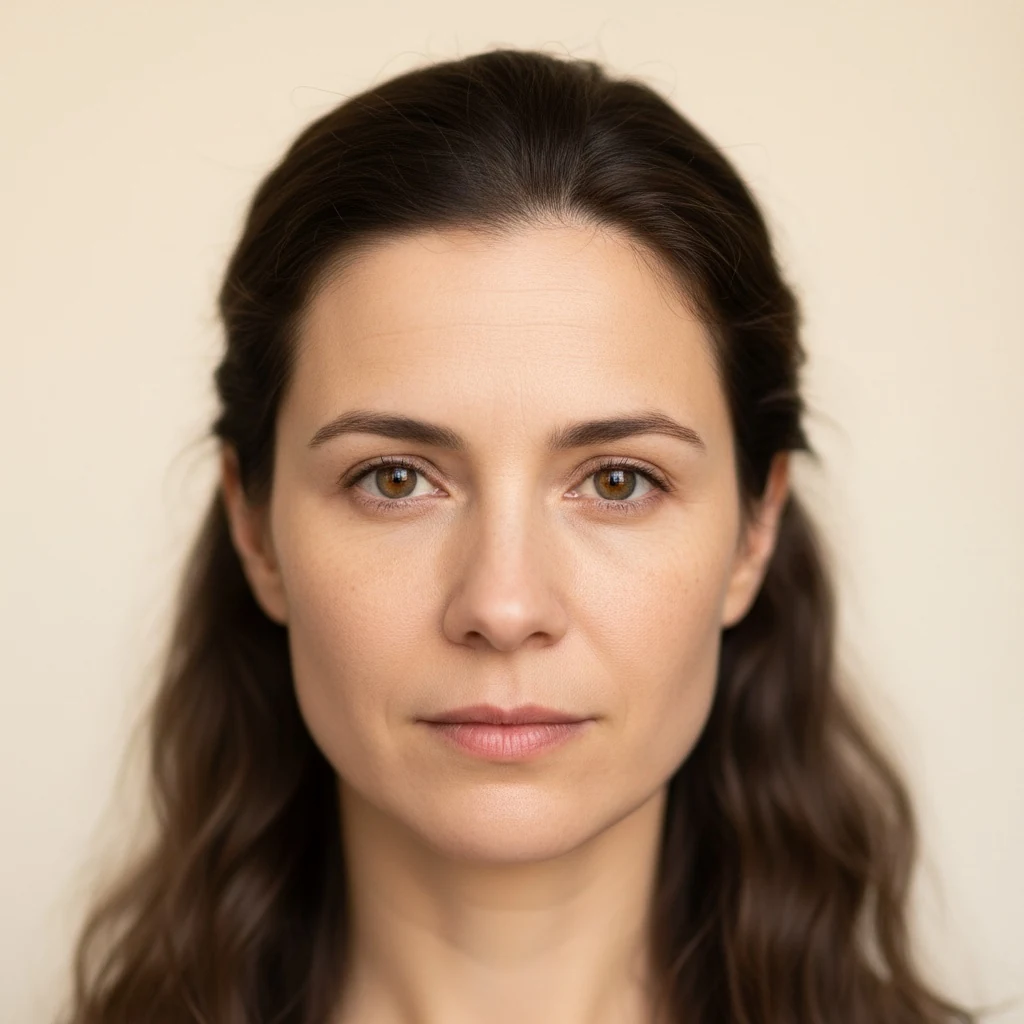 Example
Choose your own photo
Discover your eye shape and proportions.
Choose your own photoClick to choose a photo, or drop one here
Front-facing · Even lightingStraight-on, even lighting, at arm's length gives the most comparable reading.
Runs in your browser. Your photo is not uploaded.
What are round eyes, and how are they measured?
Eye height divided by eye width, at or above roughly 0.36. A round eye is close enough to as tall as it is wide that white shows above or below the iris when you look straight ahead.
- Height close to width, giving a circular rather than elongated opening
- White visible above or below the iris looking straight ahead
- The outer corner stays curved instead of coming to a point
- A visible crease, usually with generous lid space
A round eye is close to as tall as it is wide, so white is often visible above or below the iris when the face is relaxed. It is a proportion, not a defect, and it is the shape most affected by how wide someone happens to be holding their eyes open in a given photograph — which is worth remembering before trusting any single image, including your own.
How to tell if you have round eyes
- Look straight ahead and check for white above or below the iris. Present means round; absent means almond.
- Trace the outer corner with your eye. Curved into the corner is round; tapered to a point is almond.
- Keep the expression neutral. Widening your eyes even slightly manufactures the exact trait you are checking for.
Round eyes vs almond eyes
Height against width, and nothing else. Round eyes sit at or above roughly a 0.36 ratio and show white around the iris; almond eyes sit below it and taper. Both can be hooded, both can be upturned, both can be wide-set — which is why a single-label eye chart gives different answers on different sites for the same face.
Round eyes vs protruding eyes
Both get described as big eyes, and they are different measurements on different planes. Round is a ratio in the plane of the photograph — height against width. Protruding is about depth: how far forward the eye sits in the socket. A round eye can sit deep, and a protruding eye can be long and narrow. A front photo can decide the first and cannot decide the second, which is why this page reports one and not the other.
Makeup for round eyes
Round-eye technique is almost entirely about lengthening — moving the visual endpoint outward from a shape that is already tall.
Works
- A horizontal wing extending outward rather than upward
- Depth concentrated in the outer corner and blended sideways
- Liner thickest at the outer third, thinning toward the inner corner
Fights the shape
- Liner all the way round the eye, which emphasises the circle
- Heavy inner-corner highlight, which widens rather than lengthens
Eyeliner for round eyes
Round-eye liner is almost entirely about lengthening: moving the visual endpoint outward from a shape that is already tall.
- A horizontal wing extending outward rather than upward
- Thickest at the outer third and thinning toward the inner corner
- Tightline the upper lash line to reduce apparent height without adding a visible band
- Lower liner, if used, kept to the outer corner only
Eyelashes for round eyes
Lash length distribution changes the read of a round eye more than volume does.
- Longest at the outer corner, tapering inward — this lengthens rather than opens
- Avoid uniform very long lashes across the whole lid, which exaggerate the height
- A softer curl; a dramatic curl opens a shape that is already open
Round eyes celebrities
Round eyes are assigned in celebrity commentary almost entirely from expression — a wide-open frame reads round, a relaxed one does not. Since the measurement is a height-to-width ratio taken with the face at rest, a photograph chosen for its expressiveness is close to the worst possible input. No lists here.
Round eyes — frequently asked questions
Can round eyes be made to look almond?
In photographs and in person, largely yes: a horizontal wing, depth concentrated at the outer corner and lashes that get longer toward the outside all lengthen the read. What they do not change is the height-to-width ratio the label is based on.
Why do my eyes look rounder in some photos?
Because the measurement is taken with the eye at rest and a camera catches whatever you were doing at that moment. Widening the eyes slightly — which most people do when a lens points at them — raises the height and pushes the ratio toward round.
Do round eyes suit different glasses?
Angular frames give a round eye the straight lines it does not have, and a frame that sits wider than the eye lengthens the read. Small round frames repeat the shape, which is fine if that is the intent.
How do I know if I have round eyes?
Look straight ahead. If white shows above or below the iris and the outer corner is curved rather than pointed, they are round.
Are round eyes and big eyes the same?
No. Round is a ratio between height and width; big is absolute size. A small eye can be round and a large eye can be almond.
Do round eyes look younger?
The association exists in beauty writing because eye-to-face proportion is larger in children. It is a perception, not a measurement of the eye itself.