Almond Eyes
An almond eye is longer than it is tall, tapers at both corners, and has a visible crease with the iris slightly touched by the upper and lower lids. This test calls an eye almond when the lid is visible, the canthal tilt sits between 0° and +5°, and the eye's height is under 0.36 of its width.
- < 0.36
- height ÷ width
- 0° to +5°
- canthal tilt
- Yes
- readable from a front photo
- Free
- photo not uploaded
Drop a photo into the panel and it will say whether your measurement reads as almond, with the numbers behind it.
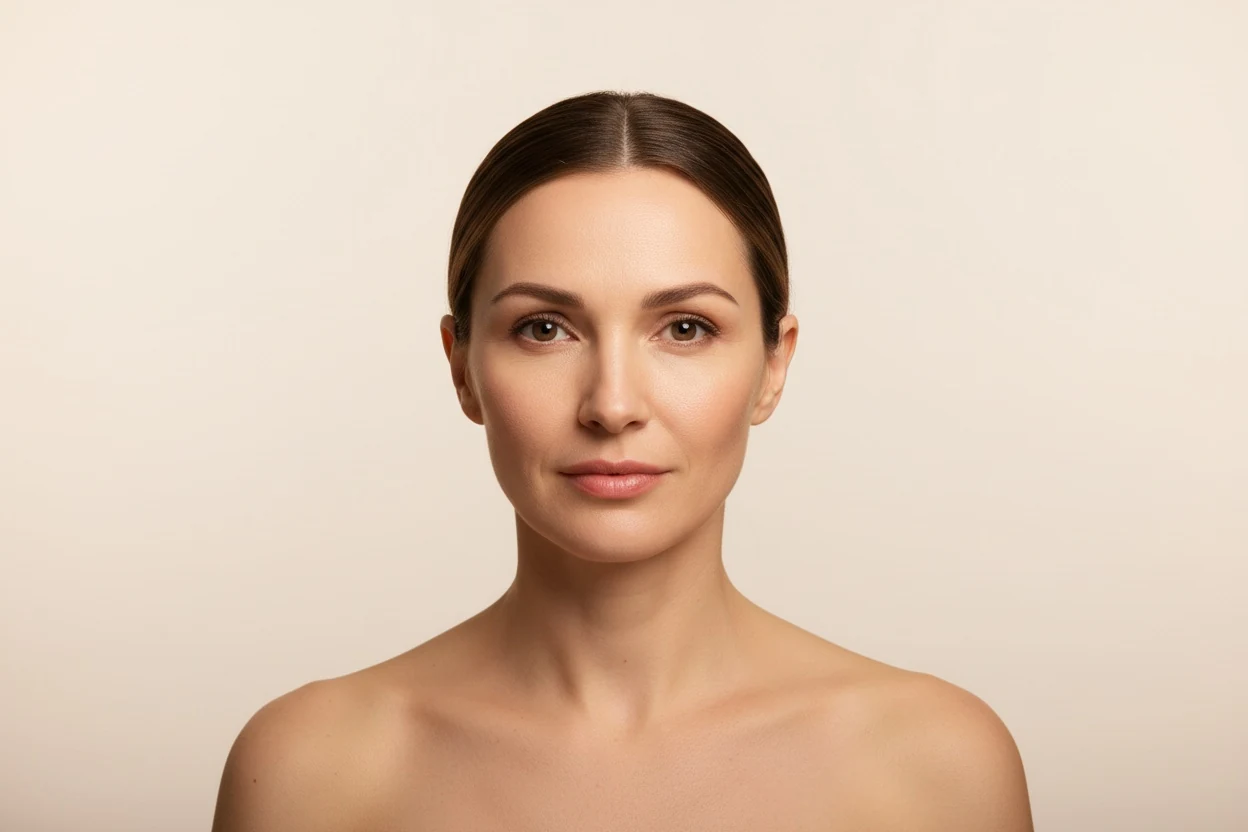 Example
Choose your own photo
Discover your eye shape and proportions.
Choose your own photoClick to choose a photo, or drop one here
Front-facing · Even lightingStraight-on, even lighting, at arm's length gives the most comparable reading.
Runs in your browser. Your photo is not uploaded.
What are almond eyes, and how are they measured?
Eye height divided by eye width, with a visible crease and a mild upward tilt. An almond eye sits below roughly 0.36 on that ratio — longer than it is tall — and tapers to a point at both corners.
- Width clearly greater than height, with a pointed outer corner
- A visible crease with mobile lid space showing
- The upper and lower lids just touch the iris, rather than cutting across it or leaving white above and below
- A slight upward tilt at the outer corner in most cases
Almond is the shape most makeup technique is written for, and it is also the default label when nothing else applies clearly — which inflates how often it is assigned. The name describes the outline, not the angle or the spacing, so an almond eye can also be upturned, close-set or hooded at the same time without contradiction.
How to tell if you have almond eyes
- Look straight ahead and check whether any white shows above or below your iris. If it does, the eye is likelier to be round or protruding than almond.
- Trace the outline. An almond taper comes to a point at the outer corner; a round eye stays curved into the corner.
- Confirm there is a visible crease with lid space showing. Without it you are looking at a hood or a monolid, whatever the outline does.
Almond eyes vs round eyes
The separation is one measurement: height against width. A round eye is close to as tall as it is wide, so white often shows above or below the iris and the outer corner stays curved. An almond eye is longer, and the corner comes to a point. Nothing else about the two shapes needs to differ — the crease, the tilt and the spacing are independent of it.
Makeup for almond eyes
Almond eyes are the shape most technique is written for, so the useful advice here is mostly about what to leave alone.
Works
- A wing that follows the natural upward angle of the outer corner
- Depth in the outer third and the crease, which the shape already reads
- Even lid colour, since the lid space is visible and does not need rescuing
Fights the shape
- Heavy liner all the way round, which shortens the eye and works against the taper
- Overcorrecting toward roundness with white inner-corner highlight if you like the taper
Eyeliner for almond eyes
There is no correction to make here, so the useful instruction is about restraint: almost every liner style works, and the ones that fail do so by fighting the taper the shape already has.
- A wing that continues the natural upward angle of the outer corner rather than setting its own
- Line thickening gradually from the inner third outward, following the shape of the eye
- A classic thin line with a short flick, which is the style this shape is the reference case for
- Lower liner in the outer third only, if at all
Eyelashes for almond eyes
As with liner, the shape supports most options and the choice is aesthetic rather than corrective.
- Graduated lengths — shorter inner, longest at the outer third — repeat the natural outline
- Uniform-length strips flatten the taper and make an almond eye read rounder
- A moderate curl; a very dramatic curl pushes the shape toward round
Almond eyes celebrities
Almond appears on more celebrity lists than it should, for the same reason oval does among face shapes: it is where uncertain classifications land. This site does not assign an eye shape to anyone it has not measured.
Almond eyes — frequently asked questions
What makes an eye almond rather than round?
One ratio: height against width. Below roughly 0.36 the eye is longer than it is tall and reads almond; above it, white tends to show above or below the iris and the eye reads round. Nothing else in the outline decides it.
Can almond eyes be downturned?
Yes, and often are. Almond describes the outline, downturned describes the angle between the corners, and the two are measured independently. A single eye can be almond, downturned and close-set at once, which is why one-label quizzes give inconsistent answers.
Do almond eyes suit every makeup style?
Close to it, which is why so much technique is written using this shape as the reference case. The two things that fight it are liner carried all the way round, which shortens the eye, and heavy inner-corner highlight, which pushes it toward round.
Are almond eyes the most attractive eye shape?
Beauty writing repeats this, but it is a convention rather than a finding. What the measurements show is a proportion, and proportion preferences are not stable across cultures or across decades.
Are almond eyes rare?
No — almond is the most commonly assigned shape, partly because it is genuinely frequent and partly because it is where borderline measurements land when nothing else is clearly met.
Can you have almond eyes and hooded eyes?
Yes. Almond describes the outline, hooded describes lid coverage. They are measured separately here for exactly that reason.
How do I know if my eyes are almond shaped?
Longer than tall, tapered to a point at the outer corner, visible crease, and the iris touched by both lids rather than floating in white.