Hunter Eyes Test
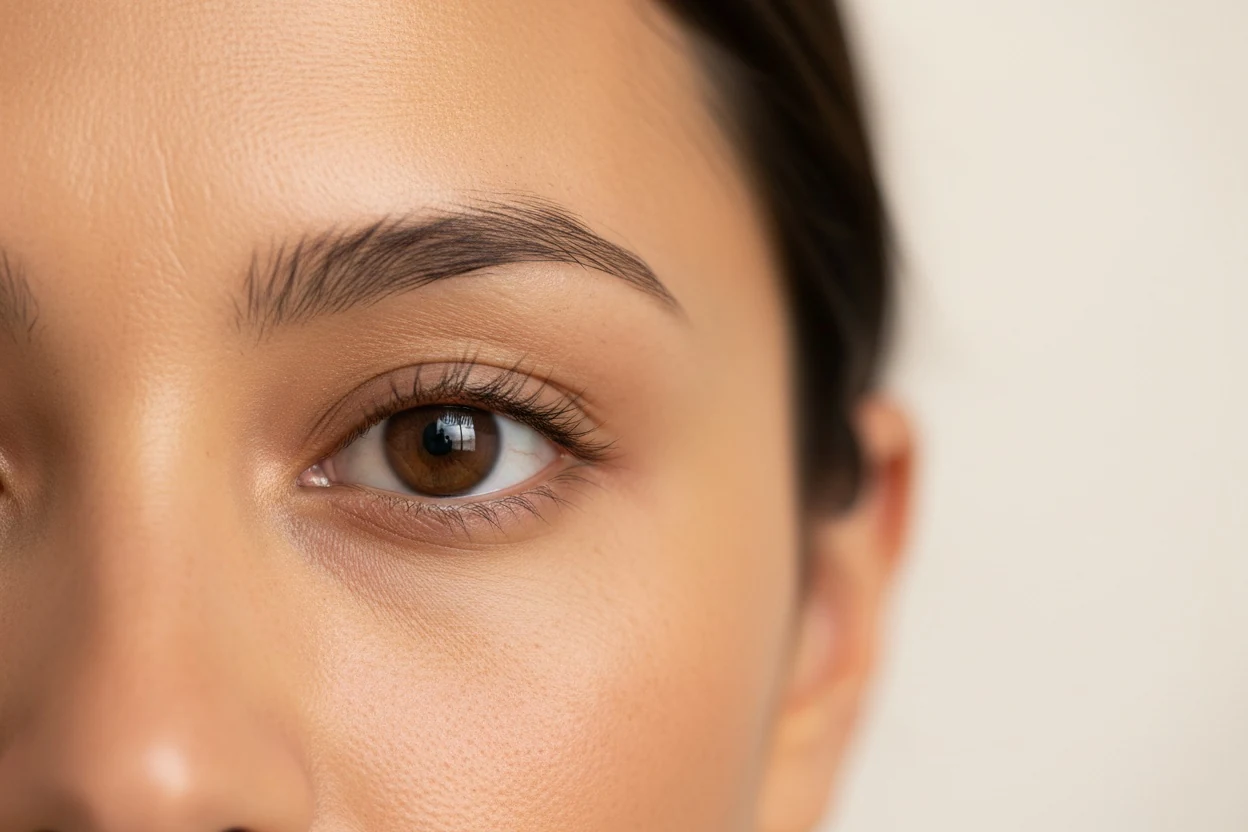
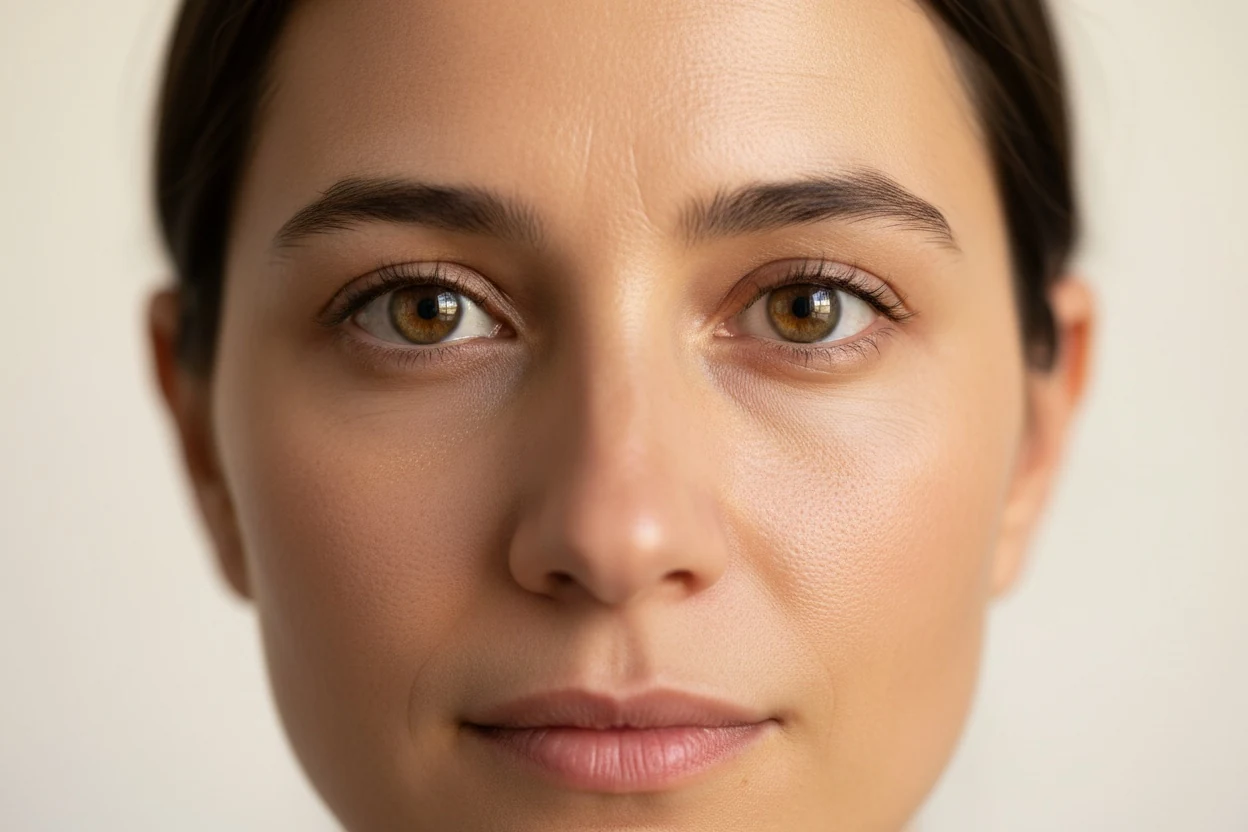
Hunter eyes is a looksmaxxing term for 4 traits at once: a positive canthal tilt (+5° and above on this test), a compact upper lid with little visible lid space, a horizontally long and narrow opening, and an eye set deep under a projecting brow bone. This test scores the first 3 from a front photo and says plainly that the 4th, depth, needs a profile view. It is a community coinage, not a clinical category.
- 3 of 4
- traits measured
- ≥ +5°
- positive tilt
- Free
- photo not uploaded
 Example
Choose your own photo
Explore your eye angles and proportions.
Choose your own photoClick to choose a photo, or drop one here
Front-facing · Even lightingStraight-on, even lighting, at arm's length gives the most comparable reading.
Runs in your browser. Your photo is not uploaded.
What does having hunter eyes mean?
- Three of the four traits are measurable from a front-facing photo; orbital depth is not and needs a profile view.
- Canthal tilt can only be changed by a canthopexy or canthoplasty; lid space by an upper blepharoplasty or brow lift.
- In a 2025 study of 2,081 raters, raising the outer eye corner lowered attractiveness ratings and raised ratings of dominance and threat.
- Mewing and eye exercises do not change the tendon or the bone that set these traits.
See what a change would actually look like
These are the renders that act on what this page measures. Each one below was generated by the same model that runs on your own photo — labelled examples on another face, so you can see what the procedure changes before you spend anything.
Fox Eye Lift
Fox Eye Lift · AI example
Fox Eye Lift. A different possibility.
Tap the photo to enlarge. AI visualisation, not a prediction.
Changes the outer corner angle of your eyes.
What it does →Canthopexy
Canthopexy · AI example
Canthopexy. A different possibility.
Tap the photo to enlarge. AI visualisation, not a prediction. Both images are AI generated.
Changes the tilt of your outer eye corner.
What it does →Blepharoplasty
Blepharoplasty · AI example
Blepharoplasty. A different possibility.
Tap the photo to enlarge. AI visualisation, not a prediction. Both images are AI generated.
Changes upper and lower eyelid skin.
What it does →
Every “after” above is an AI simulation on a sample face, not a photograph of a surgical result — it shows the direction a procedure moves a face, not an outcome anyone achieved and not a prediction of yours. Where a frame reads “Before · AI example”, the before image is generated too: the same portrait with the condition that procedure treats added, because none of the source photographs had it. Run one on your own photo.
The four hunter eyes traits
Hunter eyes is a looksmaxxing term for a particular combination of eye-area anatomy, usually described as four things at once: a positive canthal tilt, a compact upper lid with little visible lid space, a horizontally long and narrow opening, and an eye that sits deep under a projecting brow bone.
This is a community coinage rather than a clinical category. No anatomy textbook contains it. What the term picks out is real anatomy — every one of those four traits is a genuine measurable feature — but the bundling of them into a single label, and the ranking that comes with it, is internet convention. Taking the traits one at a time is more useful than arguing about the package, because they differ in whether a photo can read them and in whether anything changes them.
| Trait | What it is | Read from a front photo? | What can change it |
|---|---|---|---|
| Positive canthal tilt | The outer eye corner sits higher than the inner corner, measured as an angle in degrees | Yes — this panel measures it against the line through your inner corners | Only surgery on the lateral canthal tendon (canthopexy, canthoplasty) |
| Compact upper lid | Little mobile lid shows between the lash line and the crease | Yes — though a monolid gives the same low reading | Upper blepharoplasty or a brow lift; age and swelling change how it reads |
| Horizontally long opening | Eye height is small relative to eye width | Yes — and it is sensitive to how wide you open your eyes | Nothing lasting; squinting is a momentary expression |
| Orbital depth | The eye sits back under a projecting brow bone | No — depth needs a profile view | No eyelid procedure; it is bone |
Hunter eyes anatomy: tendon, orbit and brow
The traits behave differently because they are anchored to different structures. That is the whole reason some of them respond to surgery, some only to makeup, and one to nothing at all.
The lateral canthal tendon, and why tilt is fixed
The outer corner of the eye is held by the lateral canthal tendon, a band of dense fibrous tissue joining the eyelid plates to the bone of the orbit. In a dissection study of sixteen cadaver orbits it inserted on a small bony point just behind the orbital rim, and in living adults the corner moved only about two millimetres sideways when the eye turned outward. A corner anchored to bone does not move up or down with muscle work, which is why canthal tilt is a fixed part of your anatomy rather than something trained.
Orbital depth and the brow ridge
Depth describes how far the front of the eye sits behind the brow bone and the cheekbone below it. It is what gives a deep-set eye its shadow, and it is the one hunter eyes trait that no eyelid operation touches. The face mesh this test uses does report a depth coordinate, but it is relative to the camera and not on the same scale as width and height, so a depth figure from a selfie would look precise and mean nothing. A mirror and a side view are the honest method — see deep-set eyes for what to look for.
Brow position and upper lid show
How much lid shows depends partly on the lid and partly on where the brow sits above it. A lower, heavier brow presses skin down toward the lash line; raising your brows lifts it away. That is why a relaxed face matters for the reading, and why a brow lift appears on the list of procedures that change this component. The same lid band decides whether this site calls an eye hooded.
Do I have hunter eyes? What this test measures
Three of the four traits can be measured from a straight-on photo, and the score above is built from those three, shown separately rather than folded into one number.
Canthal tilt is the angle from your inner corner to your outer corner, in degrees, measured against the line through your inner corners so that a head leaning toward one shoulder does not push one eye up and the other down. Upper lid compactness is the band between your lash line and your crease, measured against your eye width. Horizontal length is eye height divided by eye width — the lower that ratio, the longer and narrower the opening.
How the hunter eyes score is calculated
Each component is turned into 0–100 points with a straight line between two end values, and the score is the average of the three. No other hunter eyes test publishes its formula, so here is this one in full:
| Component | Input | 0 points at | 100 points at | Label on your result |
|---|---|---|---|---|
| Positive canthal tilt | Average tilt of both eyes | 0° | +10° | Your tilt in degrees |
| Compact upper lid | Lid band ÷ eye width | 0.30 | 0.12 | “hooded” below 0.20, otherwise “visible crease” |
| Horizontally long shape | Eye height ÷ eye width | 0.40 | 0.24 | “round” at 0.36 or above, otherwise “almond” |
| Orbital depth | — | — | — | Listed as not measurable |
Why a score is not a yes-or-no answer
Every one of the three inputs is continuous, and most faces sit in the middle of at least one of them. A face with a strong positive tilt and a visible crease scores around the middle, and so does a face with a neutral tilt and a very compact lid — two different eye areas with the same number. Read the three bars, not the total. If you want the tilt alone, the canthal tilt test reports it for each eye.
Are hunter eyes attractive? What the research actually tested
No published study tests hunter eyes as a package. What exists are studies that altered one eye-area feature and asked people to rate the result — and read carefully, they do not support the simple claim that a higher outer corner is more attractive.
| Study | What was changed | What it found | What it does not show |
|---|---|---|---|
| Kempa et al. 2025 — 2,081 raters | Eyebrow height and lateral canthus height on an edited unisex face | Raising the outer corner lowered ratings of attractiveness, femininity and trustworthiness, and raised dominance and threat | Anything about a real face, or about the other three traits |
| Bashour & Geist 2007 | Medial canthal tilt — the inner corner — accentuated on female faces | The altered faces were preferred 93% of the time | The outer-corner tilt the hunter eyes term is about, or male faces |
| Rhee et al. 2012 | Composite faces of seven ethnic groups, attractive against average | Attractive Caucasian and African composites had a steeper eye slant than average; attractive Asian composites had a less steep one | A single ideal angle — the direction differed by group |
| Vaca et al. 2022 | Head tilted forward and back in standardised photos | A lowered chin made the outer corners read higher and the eye more angular, and was rated more attractive | Anything about anatomy — it is a camera-angle effect |
Two things follow. First, the most direct test of a raised outer corner found the opposite of the forum claim: it read as more dominant and threatening, and less attractive. Second, the photograph matters as much as the face — a chin tipped slightly down manufactures the look, which is why comparison photos online are close to useless as evidence. Beyond single features, the wider research on facial attractiveness keeps finding that averageness and symmetry carry more weight than any individual measurement.
Are hunter eyes genetic, and how rare are they?
The traits that define the term are skeletal or tendon-based: where the lateral canthal tendon inserts, the shape of the orbit and the projection of the brow ridge. Those are set as the face grows, which is why they run in families the way other facial structure does. What changes over a lifetime is the soft tissue on top — lid skin, fat, and swelling — and that changes how the eye area reads rather than the underlying anatomy.
There is no reliable figure for how many people have hunter eyes, because the term has no agreed thresholds and nobody has measured a population against them. Any single trait on its own is ordinary. Requiring all four at once narrows the field by definition, which is the honest version of saying they are uncommon. This site does not have scan data to offer instead — the analysis runs in your browser and your photo is not uploaded, so there is nothing to count.
Hunter eyes vs prey eyes: the same three measurements, inverted
Prey eyes is the opposing term: a neutral or negative canthal tilt, generous visible lid space, and a rounder opening with white showing above or below the iris. The two are the ends of the same three scales rather than two kinds of person, and most faces measure somewhere in the middle of all three.
The framing itself deserves a note. Naming one configuration predator and the other prey imports a hierarchy that the measurements do not contain — these are ordinary variations in eyelid and orbital anatomy, distributed across everyone. The full comparison, trait by trait, is on the prey eyes page.
How to get hunter eyes: what works, what does not, and what is dangerous
Sort the options by what they touch. Surgery can change two of the three measured traits. Grooming, makeup and photography change how the area reads without changing a measurement. Exercises change nothing. And one practice that circulates in looksmaxxing communities is simply injury.
What changes the measurements: surgery
A canthopexy suspends the lateral canthal tendon higher; a canthoplasty detaches and reattaches it. Both change the tilt component. An upper blepharoplasty removes lid skin and a brow lift raises the brow, and both change how much lid shows. All are eyelid surgery with the ordinary risks of eyelid surgery, and none of them changes orbital depth. You can see a render of canthopexy, canthoplasty or a brow lift on your own photo — a simulation, not a prediction of a result.
What changes how the eye area reads
- Brow grooming. A straighter, slightly lower brow shape frames the eye as more horizontal. It changes the frame, not the corner.
- Makeup and lashes. Liner extended outward and upward at the outer corner, and lashes curled toward the outer edge, lift the apparent angle. This is the basis of the fox-eye makeup trend.
- Sleep and allergy care. Puffiness makes the lid read fuller. Treating it can change how compact the lid looks on a given morning, not the lid itself.
- Photography. A camera at eye height and arm's length gives the truest reading. A camera below the face, or a chin tipped down, makes the corners look higher — useful to know before comparing yourself with anyone's photos.
Body fat is sometimes suggested, because leaner faces show the orbital rim more clearly. It does not change canthal tilt or the tendon, and losing weight to chase an eye label is not advice this page gives.
Hunter eyes exercises and mewing: why they do not work
The tilt is set by a tendon attached to bone, and the depth is bone. Eye exercises, squint training and facial massage act on muscle and skin, so they cannot move either. Squint training in particular teaches an expression — narrowing the eyes on purpose — which disappears the moment you stop. Mewing is a tongue posture; it does not act on the orbit or the canthal tendon at all.
Bone smashing is injury, not training
Deliberately striking the face to reshape bone spread through short-form video, and a 2026 analysis of looksmaxxing content found searches for it up by around 5,000% in a year, with the content around it overwhelmingly male. There is no clinical evidence that it reshapes bone the way those videos claim, and repeated blows to the face are an injury risk in their own right. Paediatricians have described looksmaxxing practices as an emerging concern in adolescents. If you are considering it, don't.
Hunter eyes in men
The term is searched overwhelmingly in a male context, and it sits inside a broader online culture that ranks faces on single measurements. That culture gets one thing right — these features are measurable — and one thing badly wrong, which is the weight it puts on any of them.
The research on facial attractiveness consistently finds that no single measurement predicts much on its own, that averageness and symmetry account for more than any individual feature, and that preferences vary between raters, populations and decades. The largest recent rating study of the outer eye corner found that raising it made a face read as more dominant and more threatening rather than more attractive. A canthal tilt is a fact about your face. It is not a verdict on it.
Hunter eyes in women
The measurements are identical: the same tilt, the same lid band, the same opening ratio, read the same way on any face. What differs is how the look is usually pursued. On women the equivalent aesthetic travels as fox eyes — a lifted, elongated outer corner — and most of it is makeup: winged liner that extends outward rather than following the lower lash line, and shadow placed high at the outer edge.
The name is also sold as a procedure, and that is where care is needed: fox eye covers thread lifts, brow lifting and canthal surgery under one label, with durability that differs by years between them. A thread lift changes how the corner reads while it lasts; canthal surgery moves the tendon itself. Ask which one you are being offered. The [fox eye lift simulation](/simulations/fox-eye) renders that change on your own photo so you can look at it before anyone quotes a price.
Hunter eyes and hooded eyes
The compact upper lid component and the hooded eye label come from the same measurement: the band between lash line and crease, against eye width. When that band drops below a fifth of the eye's width, the hunter eyes result labels the lid hooded, and the eye shape detector calls the eye hooded. The looksmaxxing vocabulary treats a compact lid as desirable while makeup guides treat it as something to work around — the lid is the same either way. The difference between a hooded lid and a monolid, which gives the same reading, is on the hooded eyes page.
Tips for an accurate hunter eyes reading
- Camera at eye height, arm's length away. Close up, lens perspective distorts the eye area; below the face, the corners read higher than they are.
- Chin level. Tipping the chin down makes the outer corners look higher and the eye more angular in photographs, which inflates the tilt component.
- Relaxed brows. Raising them lifts the lid and changes the lid-space component.
- Neutral expression — squinting narrows the opening and inflates the shape component.
- Even lighting so the crease is visible on both sides, and glasses off.
- Check your profile separately for the fourth trait. The test cannot do it and does not pretend to.
Hunter Eyes Test — frequently asked questions
Where does the term hunter eyes come from?
It is a looksmaxxing coinage that spread through forums and short-form video, built on a predator-and-prey framing rather than on anatomy. No clinical literature uses it, which is why the definition drifts between sources and why this page measures the traits separately instead of the label.
Can I tell if I have hunter eyes from a selfie?
Partly. A straight-on selfie at eye height can give you the tilt, the lid band and the opening ratio, which is what the test above reads. It cannot give you orbital depth, and a selfie taken from below or with the chin tipped down makes the corners look higher than they are.
Can you get hunter eyes naturally?
The canthal tilt and orbital depth components are set by tendon attachment and bone, so no. Lid show changes somewhat with swelling and age, and makeup and brow shape change how the area reads. Claims that mewing or facial exercises produce hunter eyes are unsupported.
What is the difference between hunter eyes and prey eyes?
They are opposite ends of the same three measurements: tilt, visible lid space and how round the opening is. Most people measure in the middle of all three.
Are hunter eyes rare?
There is no population figure, because the term has no agreed thresholds. Any one trait on its own is ordinary; requiring all four at once narrows the field by definition.
Is a hunter eyes surgery a real thing?
There is no single operation by that name. What people mean is some combination of canthoplasty or canthopexy, upper blepharoplasty and brow lift. Orbital depth is bone and is not addressed by any of them.
Do hunter eyes exercises work?
No. The tilt is held by a tendon anchored to bone and the depth is bone, so eye exercises, squint training and facial massage cannot change either. Squinting changes your expression for as long as you hold it.
Which celebrities have hunter eyes?
This page does not list any. Celebrity photos are taken from uncontrolled angles, and a clinical photography study found that tipping the head forward alone makes the outer corners read higher. A list built from red-carpet images measures camera angles as much as faces.
Do glasses or eyebrow shape change hunter eyes?
They change how the eye area reads, not what it measures. A straighter brow and frames with a strong top line make the eye look more horizontal; the tendon and the orbit are untouched. Take glasses off for the test.
References
- 1.Kempa, J., Kasielska-Trojan, A., Gabryszewski, M., Antoszewski, B., Biesman, B. S., Knoedler, L., Cotofana, S., & Alfertshofer, M. (2025). Understanding the impact of eyebrow and lateral canthal height on the perception of character traits: a rating-based analysis of 2081 participants. Journal of Plastic, Reconstructive & Aesthetic Surgery, 104, 417–425. PMID 40174260.
- 2.Bashour, M., & Geist, C. (2007). Is medial canthal tilt a powerful cue for facial attractiveness? Ophthalmic Plastic and Reconstructive Surgery, 23(1), 52–56. PMID 17237692.
- 3.Rhee, S. C., Woo, K. S., & Kwon, B. (2012). Biometric study of eyelid shape and dimensions of different races with references to beauty. Aesthetic Plastic Surgery, 36(5), 1236–1245. PMID 22810555.
- 4.Vaca, E. E., Bricker, J. T., Mioton, L. M., Fagien, S., & Alghoul, M. S. (2022). The influence of sagittal head tilt on periorbital appearance: implications for clinical photography and the evaluation of postoperative results. Aesthetic Surgery Journal Open Forum, 4, ojab043. PMID 35156018.
- 5.Gioia, V. M., Linberg, J. V., & McCormick, S. A. (1987). The anatomy of the lateral canthal tendon. Archives of Ophthalmology, 105(4), 529–532. PMID 3566607.
- 6.Grillo, R., Fernandes, L. A., Rodrigues dos Santos, L. A., Lima, B. C., Brozoski, M. A., & Spagnol, G. (2026). Dangerous trends on social media related to facial esthetics: analysis of looksmaxxing and its softmaxxing and hardmaxxing practices. Journal of Stomatology, Oral and Maxillofacial Surgery, 127(5), 102971. PMID 42674114.
- 7.Mekhail, J., Howard, C., & Milanaik, R. (2026). From mewing to peptides: looksmaxxing as an emerging pediatric concern. Pediatrics, 158(3), e2026077705. PMID 42580741.
- 8.Rhodes, G. (2006). The evolutionary psychology of facial beauty. Annual Review of Psychology, 57, 199–226. PMID 16318594.
- 9.Langlois, J. H., & Roggman, L. A. (1990). Attractive faces are only average. Psychological Science, 1(2), 115–121. doi:10.1111/j.1467-9280.1990.tb00079.x.
- 10.Grammer, K., & Thornhill, R. (1994). Human (Homo sapiens) facial attractiveness and sexual selection: the role of symmetry and averageness. Journal of Comparative Psychology, 108(3), 233–242. PMID 7924253.