Prey Eyes
They are opposite ends of the same 3 measurements rather than two kinds of eye. Hunter sits at the positive-tilt (+5° and above), compact-lid, narrow-opening end; prey at the neutral-or-negative tilt (below +5°), visible-lid, rounder-opening end. Most faces measure somewhere in the middle of all three.
- 3
- shared measurements
- < +5°
- prey-end tilt
- Free
- photo not uploaded
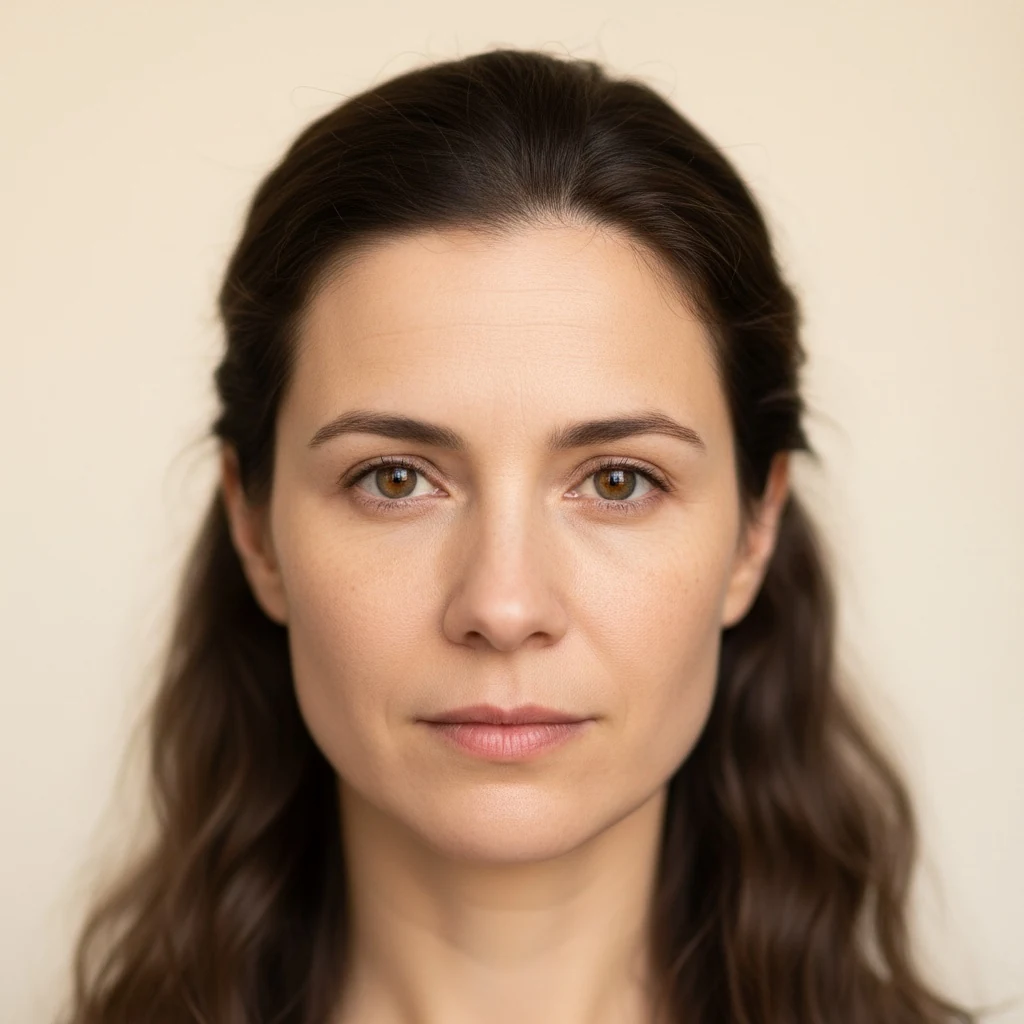 Example
Choose your own photo
Explore your eye angles and proportions.
Choose your own photoClick to choose a photo, or drop one here
Front-facing · Even lightingStraight-on, even lighting, at arm's length gives the most comparable reading.
Runs in your browser. Your photo is not uploaded.
What is the difference between hunter eyes and prey eyes?
- A fourth trait, orbital depth, separates them too and cannot be read from a front-facing photo.
- Because all three axes are continuous, a face can be strongly hunter on one and strongly prey on another.
- The predator/prey framing is a subculture convention, not a finding about faces.
See what a change would actually look like
These are the renders that act on what this page measures. Each one below was generated by the same model that runs on your own photo — labelled examples on another face, so you can see what the procedure changes before you spend anything.
Fox Eye Lift
Fox Eye Lift · AI example
Fox Eye Lift. A different possibility.
Tap the photo to enlarge. AI visualisation, not a prediction.
Changes the outer corner angle of your eyes.
What it does →Brow Lift
Brow Lift · AI example
Brow Lift. A different possibility.
Tap the photo to enlarge. AI visualisation, not a prediction.
Changes brow height and arch.
What it does →Canthopexy
Canthopexy · AI example
Canthopexy. A different possibility.
Tap the photo to enlarge. AI visualisation, not a prediction. Both images are AI generated.
Changes the tilt of your outer eye corner.
What it does →
Every “after” above is an AI simulation on a sample face, not a photograph of a surgical result — it shows the direction a procedure moves a face, not an outcome anyone achieved and not a prediction of yours. Where a frame reads “Before · AI example”, the before image is generated too: the same portrait with the condition that procedure treats added, because none of the source photographs had it. Run one on your own photo.
What are prey eyes?
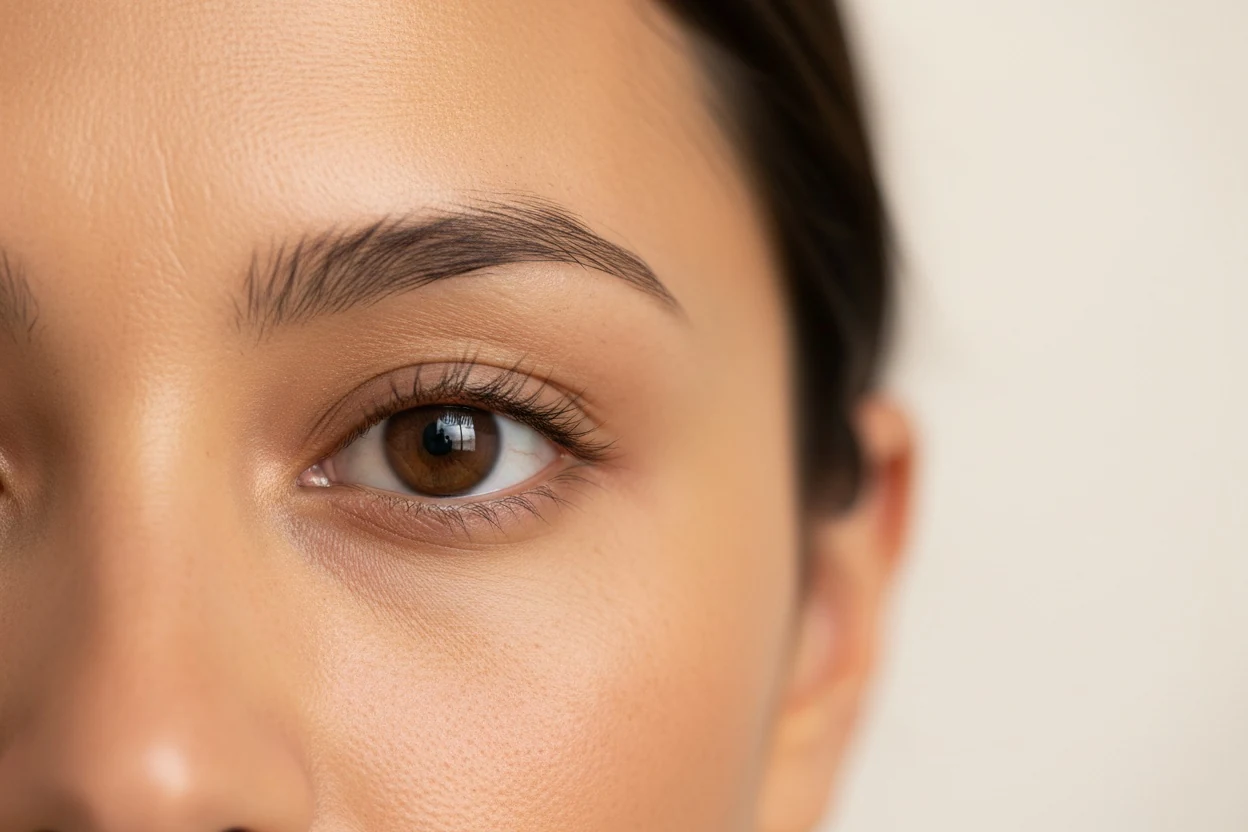
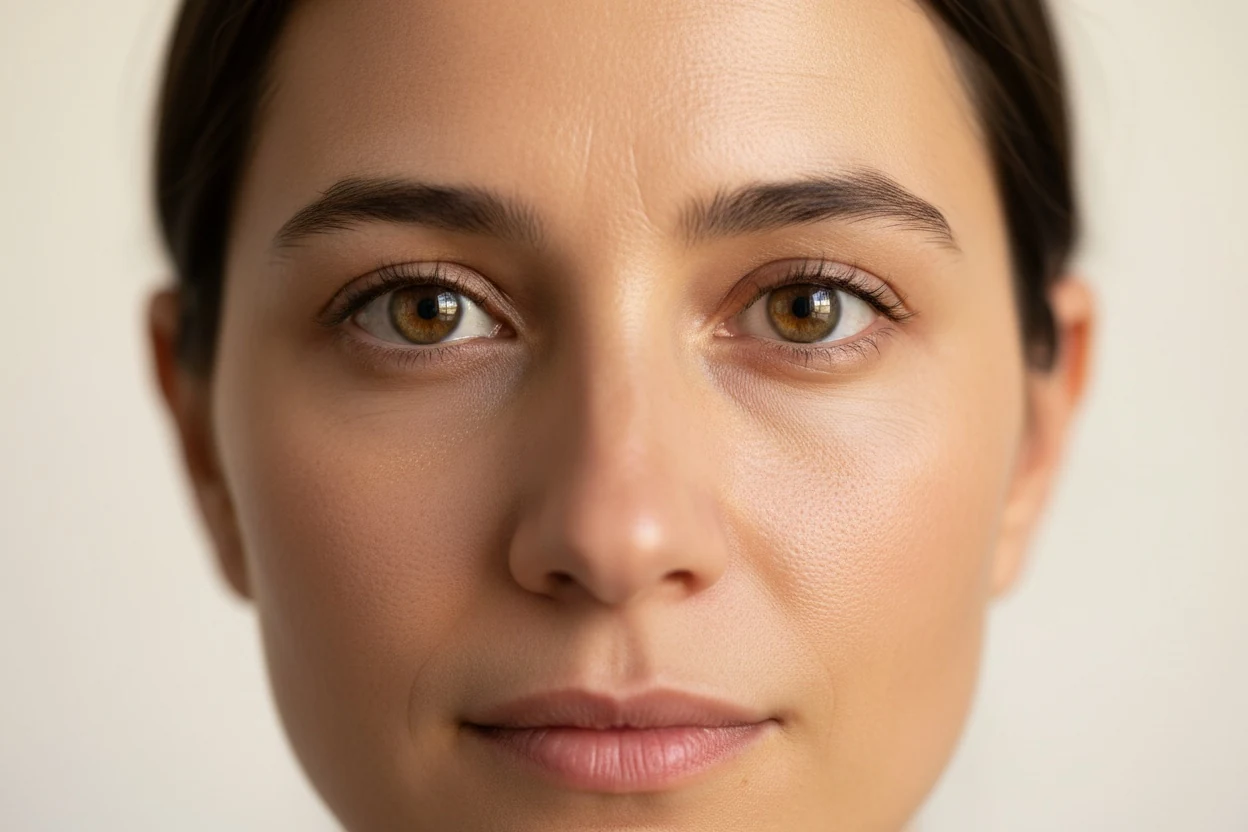
Prey eyes is a looksmaxxing term for an eye area with a neutral or negative canthal tilt, a generous amount of visible upper lid, and a rounder opening — often with some white showing above or below the iris. It is defined entirely by contrast with hunter eyes, which is why it is almost never searched without that comparison nearby.
Every trait it names is real and measurable. The framing around it is not a measurement. Calling one arrangement of eyelid anatomy predator and another prey imports a hierarchy that is a convention of one online subculture, not a finding about faces.
Hunter eyes vs prey eyes: the three measurements that separate them
Canthal tilt is the angle from the inner corner to the outer corner. Hunter is positive, often above +5°; prey is neutral or negative. In a 102-adult research set measured with this test, the middle 80% of faces sat between +1.3° and +6.0° (median +3.7°) — anatomically positive, but mostly under the +5° where this test starts the positive label, so on this one scale the typical eye is neither hunter nor prey.
Upper lid space is the band between the lash line and the crease. Hunter is compact, with little lid visible; prey shows more. Aperture is eye height against eye width. Hunter is horizontally long and narrow; prey is rounder, and roundness is what produces the visible white around the iris.
Because all three are continuous, the score above shows each component separately rather than announcing a category. A face can be strongly hunter on one axis and strongly prey on another, and many are.
The fourth prey eyes trait a photo cannot measure
The full comparison includes orbital depth: hunter eyes are described as sitting deep under a projecting brow bone, prey eyes as sitting more forward. That axis needs a profile view.
A front-facing photo has no reliable depth measurement — the face mesh's depth coordinate is relative to the camera and not on the same scale as the other two, so a number taken from it would be false precision. Look at your own profile in a mirror: a deep-set eye sits behind the plane of the brow bone, a prominent one sits forward of it.
Are prey eyes bad?
No measurement in this comparison predicts much on its own. The research on facial attractiveness has consistently found that averageness and symmetry account for more than any individual feature, and that preferences differ across raters, populations and time periods.
The one honest thing to say about a prey eyes reading is that it describes an eyelid and orbital configuration, common and ordinary, which a subculture has attached a name and a ranking to. The measurements are worth knowing. The ranking is not evidence.
Where the prey eyes term came from, and why it spread
The vocabulary is a looksmaxxing coinage built on a predator-and-prey framing rather than on anatomy. Hunter eyes came first as an ideal; prey eyes exists as its opposite, which is an unusual way for a category to be born — it is defined by what it is not.
That origin explains the two things people notice about it. The definition drifts between sources, because nothing anchors it, and it is used pejoratively far more often than descriptively. The three measurements underneath it are real and are reported on this page; the category stacked on top of them is a forum convention with no clinical or anthropometric use.
What the prey eyes reading is actually measuring
Three numbers, each independent of the others. Canthal tilt is the angle between your inner and outer corner, in degrees. Lid visibility is how much mobile upper lid shows with the eye open, as a ratio against eye width. Aperture is eye height against eye width, which is what makes an eye read round or long.
Because they are independent, most faces sit in the middle of at least one and at an end of another. That is the practical problem with both labels: a face with a neutral tilt, a visible lid and a long aperture satisfies part of each description, which means neither label describes it. The result card reports the three separately for exactly that reason, and the [canthal tilt test](/canthal-tilt) gives you the angle on its own if that is the number you came for.
Tips for an accurate prey eyes reading
- Chin level and camera at eye height — a phone held low or a raised chin drops the outer corners in the photo and pushes any face toward the prey end.
- Relaxed brows, since raising them exposes more lid.
- Neutral expression, because widening the eyes raises the aperture ratio.
- Check your profile separately for the depth trait.
Prey Eyes — frequently asked questions
Is prey eyes an insult?
It is used as one, frequently. The three measurements underneath it are neutral facts about eye geometry; the label stacked on them carries a judgement that no anatomical source supports.
Which measurement should I actually look at?
Canthal tilt, because it is a real angle measurable to a fraction of a degree and it is the one most often misjudged from photographs. The other two are ratios that vary with how wide your eyes happen to be open.
Are prey eyes a real classification?
No. It is an internet coinage defined only by contrast with hunter eyes, and no clinical or anthropometric source uses it. The three measurements underneath it are real and are reported here; the category on top of them is not.
Can one face have both hunter and prey traits?
Frequently, because the three measurements are independent. A positive canthal tilt with a visible upper lid and a round opening is an ordinary result, and it satisfies part of each description. That is a problem with the two labels, not with the face.
Are prey eyes common?
Each individual trait is ordinary. All three together are less common than the middle of the range, which is where most faces sit.
Can prey eyes become hunter eyes?
Canthal tilt changes only with a canthopexy or canthoplasty. Lid space can change with an upper blepharoplasty or brow lift. Orbital depth is bone and does not change. Mewing and facial exercises change none of them.
References
- 1.Langlois, J. H., & Roggman, L. A. (1990). Attractive faces are only average. Psychological Science, 1(2), 115–121. doi:10.1111/j.1467-9280.1990.tb00079.x.
- 2.Grammer, K., & Thornhill, R. (1994). Human (Homo sapiens) facial attractiveness and sexual selection: the role of symmetry and averageness. Journal of Comparative Psychology, 108(3), 233–242. PMID 7924253.
- 3.Rhodes, G. (2006). The evolutionary psychology of facial beauty. Annual Review of Psychology, 57, 199–226. PMID 16318594.