Eye Shape
10 named eye shapes, read from four measurements: lid space, canthal tilt, eye height against width, and spacing. On the 102 adults of the Face Research Lab London Set this test's readings were 49 almond, 22 upturned, 14 round, 13 hooded and 4 downturned; monolid, deep-set and protruding are not measurable from a front photo.
- 10
- eye shapes
- 4
- measurements
- 478
- landmarks
- +3.7°
- median canthal tilt
- Free
- no signup, photo not uploaded
Face Research Lab London Set: 102 adults, neutral front photos. Counts show how this test reads those faces, not how common each type is in the population. How these numbers were made
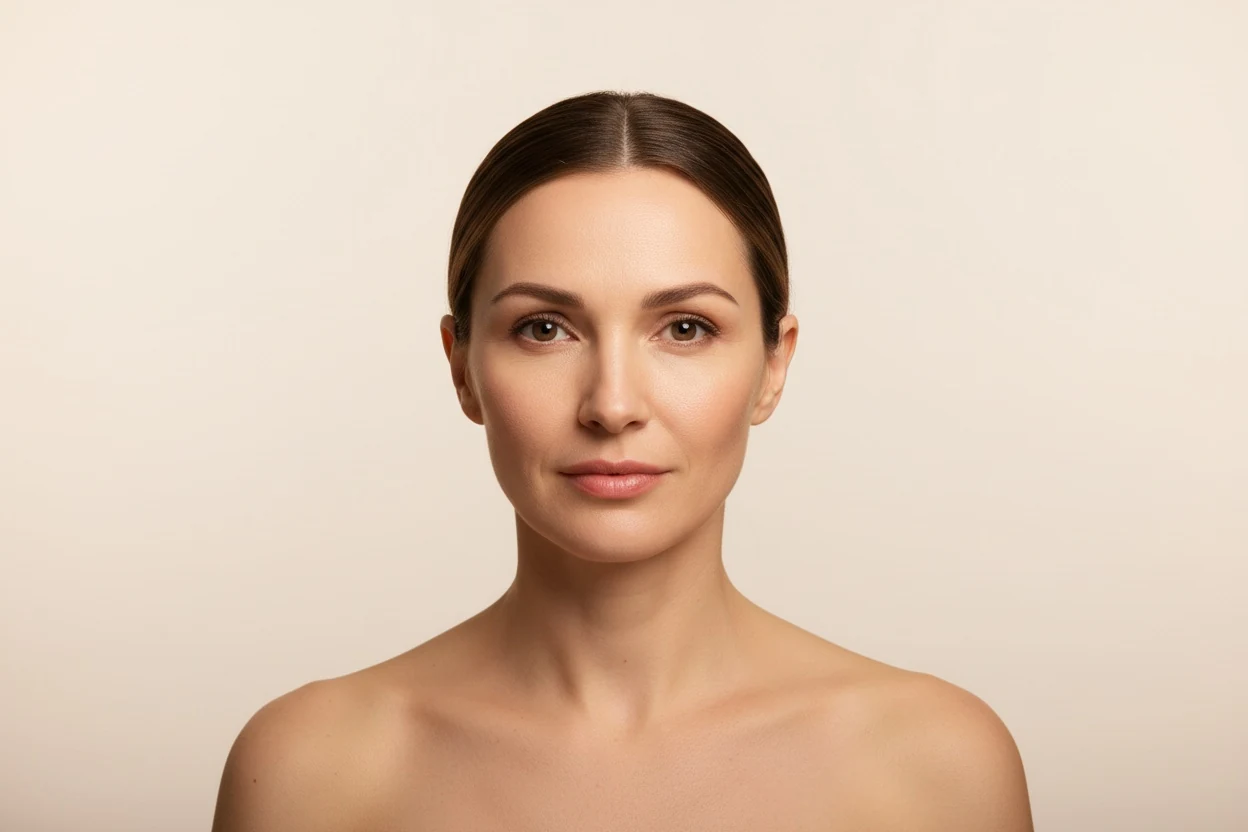 Example
Choose your own photo
Discover your eye shape and proportions.
Choose your own photoClick to choose a photo, or drop one here
Front-facing · Even lightingStraight-on, even lighting, at arm's length gives the most comparable reading.
Runs in your browser. Your photo is not uploaded.
The 10 eye shapes
Ordered by how often each is searched. The first four are the ones people actually come looking for; the rest are the traits that turn up once you start measuring.
- Hooded eyes →A hooded eye has a fold of skin from the brow bone that drops over the crease, so little or none of the mobile lid shows when the eye is open. It is the most searched eye shape by a wide margin, and the most often confused with two other things: a monolid, and a drooping upper lid that is actually ptosis.< 0.20lid space ÷ eye width13 of 102research faces · 13%0.24median lid space ÷ eye width
- Almond eyes →An almond eye is longer than it is tall, tapers at both corners, and has a visible crease with the iris slightly touched by the upper and lower lids. It is the shape most beauty writing treats as the default, which is why so much advice reads as though every other shape needs correcting toward it.< 0.36height ÷ width49 of 102research faces · 48%0.35median eye height ÷ width
- mirror testMonolid eyes →A monolid is an upper lid without a crease, so the lid runs in one smooth plane from lash line to brow bone. It is a common and entirely ordinary variation, most frequent in people of East and Southeast Asian descent, and it is regularly mislabelled as a hooded eye by tools and guides that only look at whether lid space is visible.Not measurable from a front photo
- mirror testDeep-set eyes →Deep-set eyes sit further back in the socket, so the brow bone projects over them and casts a natural shadow across the lid. The result looks similar to hooding from the front, which is why the two are so often mixed up — but the cause is bone depth rather than a skin fold.Not measurable from a front photo
- Downturned eyes →A downturned eye has an outer corner that sits level with or below the inner corner, giving a soft, slightly droopy line. It is the visible form of a negative or neutral canthal tilt, and it is the eye trait the looksmaxing community has made the most noise about — usually with more confidence than the underlying evidence supports.< 0°canthal tilt4 of 102research faces · 4%+3.7°median canthal tilt
- Upturned eyes →An upturned eye has an outer corner sitting clearly above the inner corner, producing a natural lift at the end of the eye. It is what a cat-eye liner imitates, which is why the shape needs less of it than any other.≥ +5°canthal tilt22 of 102research faces · 22%+3.7°median canthal tilt
- Round eyes →A round eye is nearly as tall as it is wide, with a curved rather than tapered outer corner, and usually some visible white above or below the iris. It reads as open and expressive, and it is the shape most often mistaken for merely large eyes.≥ 0.36height ÷ width14 of 102research faces · 14%0.35median eye height ÷ width
- Wide-set eyes →Wide-set eyes have clearly more than one eye's width of space between them. It is a spacing measurement rather than a shape one, which is why it can pair with any outline — an eye can be wide-set and almond, wide-set and round, wide-set and hooded.> 1.27eye widths apart14 of 102research faces · 14%1.17median eye widths apart
- mirror testProtruding eyes →A protruding eye sits forward in the socket, so the lid curves outward over the eyeball and the eye reads prominent from the side. As a lifelong feature it is ordinary anatomy. As a change, it is one of the few eye traits that genuinely warrants a doctor rather than a makeup guide.Not measurable from a front photo
- Close-set eyes →Close-set eyes have about one eye's width or less between the inner corners. Like wide-set, it is spacing rather than shape, and it pairs with any outline.< 1.1eye widths apart13 of 102research faces · 13%1.17median eye widths apart
See what a change would actually look like
These are the renders that act on what this page measures. Each one below was generated by the same model that runs on your own photo — labelled examples on another face, so you can see what the procedure changes before you spend anything.
Blepharoplasty
Blepharoplasty · AI example
Blepharoplasty. A different possibility.
Tap the photo to enlarge. AI visualisation, not a prediction. Both images are AI generated.
Changes upper and lower eyelid skin.
What it does →Epicanthoplasty
Epicanthoplasty · AI example
Epicanthoplasty. A different possibility.
Tap the photo to enlarge. AI visualisation, not a prediction. Both images are AI generated.
Changes the inner corner of your eyes.
What it does →Fox Eye Lift
Fox Eye Lift · AI example
Fox Eye Lift. A different possibility.
Tap the photo to enlarge. AI visualisation, not a prediction.
Changes the outer corner angle of your eyes.
What it does →
Every “after” above is an AI simulation on a sample face, not a photograph of a surgical result — it shows the direction a procedure moves a face, not an outcome anyone achieved and not a prediction of yours. Where a frame reads “Before · AI example”, the before image is generated too: the same portrait with the condition that procedure treats added, because none of the source photographs had it. Run one on your own photo.
How to tell your eye shape: the four measurements
Eye shape is treated as one label and it is really four independent readings. Each one has a mirror version you can do in ten seconds, and a numeric version the test above produces.
Lid space — hooded or crease visible
The band between your lash line and your crease, measured against your eye width. Below about a fifth of the eye's width, the brow-bone skin has folded over the crease and the eye reads as hooded.
Mirror version: look straight ahead without raising your brows and see whether any mobile lid shows.
Canthal tilt — upturned or downturned
The angle from your inner corner to your outer corner, in degrees. In a 102-adult research set measured with this test, the middle 80% of faces sat between +1.3° and +6.0° (median +3.7°). At or below zero is what beauty writing calls downturned and the looksmaxing community calls a negative canthal tilt.
Mirror version: hold a pen horizontally between your two inner corners and see where the outer corners fall.
Aperture ratio — round or almond
Eye height divided by eye width. At or above roughly 0.36 the opening is close enough to circular that white shows around the iris, and it reads as round; below that it tapers and reads as almond.
Mirror version: look straight ahead and check for white above or below the iris.
Spacing — wide-set or close-set
The gap between your inner corners divided by the width of one eye. The drawing rule says one eye-width, but measured faces sit a little above it; above 1.27 is wide-set and below 1.1 is close-set.
Mirror version: compare the gap between your inner corners against the width of one eye.
Eye shape chart: the ten types side by side
Read down the second column and the structure of the set becomes clear: these are not ten alternatives but four independent measurements with names attached to their ends. That is why a single eye can carry three of these labels at once.
| Eye shape | The measurement that defines it | From a front photo? |
|---|---|---|
| Hooded | The band between your lash line and the ring of landmarks just above it — where the crease sits — measured against your eye width. On a hooded eye that band falls below about a fifth of the eye's width, because the brow-bone skin folds down over it. Two limits come with that number. It is the average of both eyes, so a hood that is heavier on one side shows up only as a lower overall figure, not as a left-right difference. And a monolid produces the same low reading, because the landmarks see that no lid space shows but not whether a crease is hidden or absent — the closed-eye step in the mirror test below is what separates them. | ✓ Yes |
| Almond | Eye height divided by eye width, with a visible crease and a mild upward tilt. An almond eye sits below roughly 0.36 on that ratio — longer than it is tall — and tapers to a point at both corners. | ✓ Yes |
| Monolid | Not measurable from a front-facing photo, and this page says so rather than guessing. A monolid is defined by the absence of a crease. Landmark geometry can see that no lid space is visible, but it cannot tell a crease that is missing from a crease that is covered — the two produce the same measurement. The mirror test below is what separates them. | No — needs a profile view |
| Deep-set | A depth trait, and a front-facing photo cannot measure depth reliably. MediaPipe reports a z coordinate, but it is relative to the camera and not on the same scale as x and y, so using it to say how far back the eye sits would be a number with no meaning. The profile test below is the honest method. | No — needs a profile view |
| Downturned | The angle of the line from the inner corner to the outer corner, in degrees. In a 102-adult research set measured with this test, the middle 80% of faces sat between +1.3° and +6.0° (median +3.7°). A downturned eye reads at or below zero — the outer corner sits level with or under the inner corner. This is the same measurement as canthal tilt. | ✓ Yes |
| Upturned | The same inner-corner-to-outer-corner angle as downturned, read from the other end of the scale. From +5°, the cut point where this site's canthal tilt test starts calling a tilt positive, the eye reads as upturned. | ✓ Yes |
| Round | Eye height divided by eye width, at or above roughly 0.36. A round eye is close enough to as tall as it is wide that white shows above or below the iris when you look straight ahead. | ✓ Yes |
| Wide-set | The distance between your inner corners divided by the average width of one eye. The drawing rule says one eye-width of gap, but measured faces sit a little above it, so this test reads above 1.27 as wide-set. | ✓ Yes |
| Protruding | The opposite depth trait to deep-set, and unmeasurable from the front for the same reason: the face mesh's depth value is camera-relative and not on the same scale as the other two axes. Profile is the honest view. | No — needs a profile view |
| Close-set | The same inner-corner gap divided by average eye width, read from the low end. Below 1.1 eye-widths reads as close-set, which is still about one eye-width: measured faces sit above the drawing rule's 1.0. | ✓ Yes |
What an eye shape chart cannot tell you from a photo
Two of the ten are not readable from the front, and this site says so rather than guessing. Deep-set and protruding are depth traits, and a front-facing photo has no reliable depth axis — your profile in a mirror answers both in seconds. Monolid and hooded produce identical front measurements because both hide the crease; closing your eye separates them, since a hooded eye reveals a crease and a monolid has none to reveal.
Eye shape — frequently asked questions
How many eye shapes are there?
Most charts list somewhere between six and ten. This site uses ten, because the commonly searched terms map to ten distinct traits — but four of them are independent axes rather than alternatives, so a single face can legitimately carry several labels at once.
What is my eye shape?
Four measurements answer it: how much mobile lid shows, the angle from your inner corner to your outer corner, eye height against eye width, and the gap between your inner corners. The test above takes all four from a photo in your browser.
What is the most common eye shape?
Almond is assigned most often, partly because it is genuinely frequent and partly because it is the default label when no other condition is clearly met. Hooded is the most searched by a wide margin.
Why do eye shape quizzes disagree with each other?
Because each one reports a single label from a single axis, and they do not pick the same axis. A face that is both hooded and downturned gets called hooded by one quiz and downturned by another, and neither is wrong.
Can eye shape change over time?
The bone structure and corner tendons that set spacing and tilt are stable. Lid skin loses elasticity with age, so hooding tends to increase, and a crease can appear or shift.