How Old Do I Look?
No. A photograph supports an estimate of perceived age — how old a face reads — which is a different quantity from chronological age and routinely differs from it by 5 years or more in either direction. Perceived age tracks skin condition, soft-tissue position and lighting, and studies of it treat the gap between the two as the finding rather than as error. This page measures 4 age-related proportions free in your browser.
- 4
- age-related proportions, free
- 5+ yrs
- typical perceived-age gap
- 1 credit
- for the AI age read
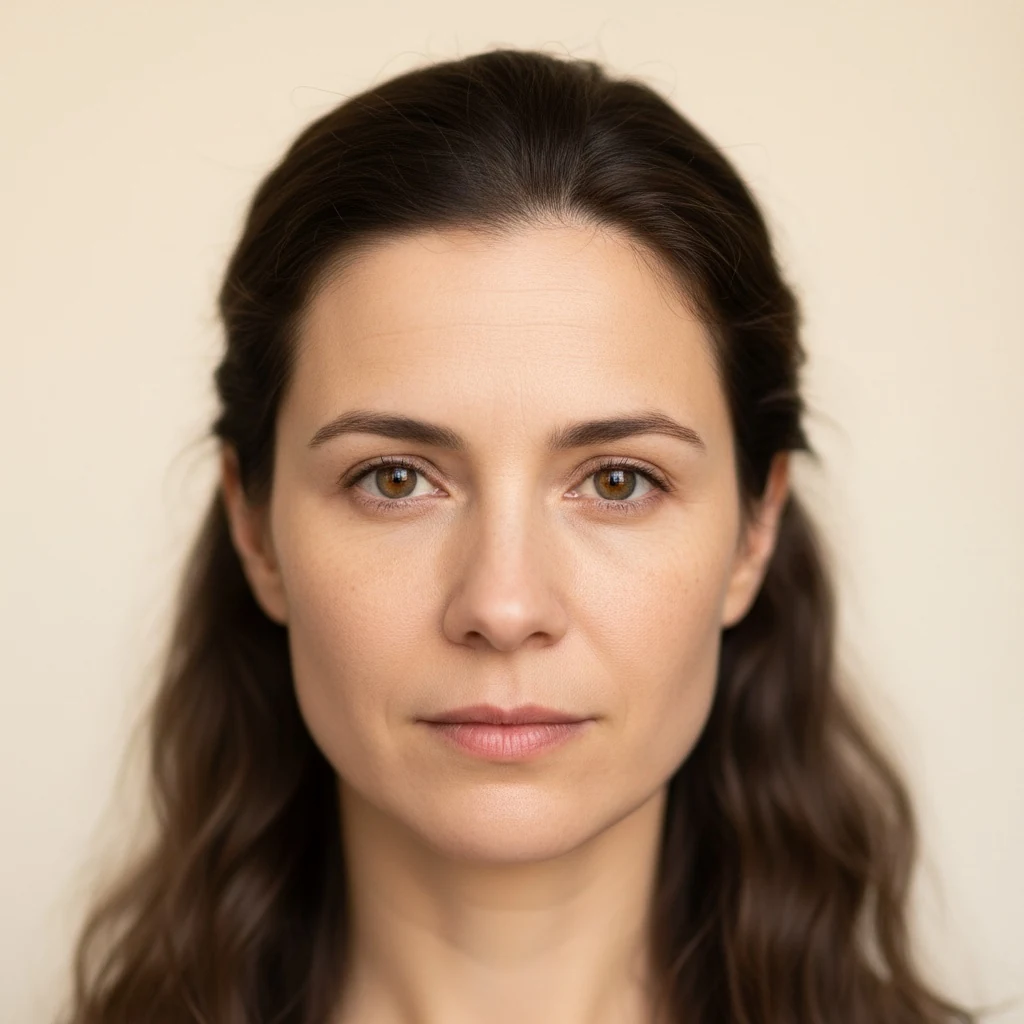 Example
Choose your own photo
Explore your facial thirds and proportions.
Choose your own photoClick to choose a photo, or drop one here
Front-facing · Even lightingStraight-on, even lighting, at arm's length gives the most comparable reading.
Runs in your browser. Your photo is not uploaded.
Can a photo tell you how old someone is?
- Perceived age and chronological age are separate measures; the difference between them is itself studied as a health signal.
- Skin surface condition affects perceived age independently of facial structure.
- The lower third of the face lengthens through adulthood as soft tissue descends and the upper lip stretches.
- Lighting, resolution and expression move a perceived-age reading by several years without anything about the face changing.
See what a change would actually look like
These are the renders that act on what this page measures. Each one below was generated by the same model that runs on your own photo — labelled examples on another face, so you can see what the procedure changes before you spend anything.
Facelift
Facelift · AI example
Facelift. A different possibility.
Tap the photo to enlarge. AI visualisation, not a prediction. Both images are AI generated.
Changes laxity across the lower face and jaw.
What it does →Thread Lift
Thread Lift · AI example
Thread Lift. A different possibility.
Tap the photo to enlarge. AI visualisation, not a prediction. Both images are AI generated.
Changes midface lift without surgery.
What it does →Botox
Botox · AI example
Botox. A different possibility.
Tap the photo to enlarge. AI visualisation, not a prediction. Both images are AI generated.
Changes forehead, glabella and crow's feet lines.
What it does →
Every “after” above is an AI simulation on a sample face, not a photograph of a surgical result — it shows the direction a procedure moves a face, not an outcome anyone achieved and not a prediction of yours. Where a frame reads “Before · AI example”, the before image is generated too: the same portrait with the condition that procedure treats added, because none of the source photographs had it. Run one on your own photo.
What a face age test can actually measure
Split the question in two and both halves become answerable. The first half is geometry: a handful of facial proportions have a known direction of travel across adulthood, and those can be measured from a single photo without any model at all. The lower third grows relative to the other two. The philtrum lengthens relative to the upper lip, not because the groove grows but because the vermilion above it thins. Lip volume falls. That is what the free tool on this page reports, in your browser, with nothing uploaded.
The second half is everything geometry cannot see: skin texture, fine lines, pigmentation, the position of soft tissue around the eyes and midface. Those carry most of the signal, and no arrangement of 478 landmark coordinates contains them. Reading them needs a model that looks at the image itself, which means the image has to leave your device — so that layer sits behind an account, an explicit upload and one credit rather than happening quietly on a public page.
Perceived age is not your age
Perceived age is how old a face reads to an observer. It is a real, studied quantity — used in research precisely because it diverges from chronological age, and the divergence is the interesting part. People whose faces read younger than their years tend to differ in measurable ways from people whose faces read older at the same age. That is the finding. It is not a compliment or an insult, and it is not a correction of the birth certificate.
This matters for reading your result. If the tool says a face reads thirty-four and you are twenty-eight, the honest interpretation is that the photograph reads six years above your age — which might be the light, the resolution, the expression, a late night, or something durable. Any single photo cannot separate those. Two photos taken in different conditions often differ by more than the gap you are trying to interpret.
Why age guessers disagree with each other
Run the same face through three of them and you will usually get three answers several years apart. Part of that is training data: a model learns the ages of the faces it was shown, and those sets differ by decade, by geography and by how the photographs were taken. Part is calibration — some tools deliberately skew young, because that is the answer people share.
The larger part is the photograph. Direct overhead light etches every line and adds years; flat frontal light removes them. A phone camera held close enlarges the lower face. Compression smooths skin texture, which is the single strongest visual age cue there is, so a heavily compressed image systematically reads younger. None of that is about the face. It is why the reading on this site comes back as a range with the reasons attached rather than as a number on its own.
The proportions that shift with age
The lower third is the most reliable of them. Measured from the base of the nose to the chin, it grows as a share of face height across adulthood — soft tissue descends, the upper lip lengthens, and the same face measures a longer lower third at fifty than at twenty. It is also the band most surgical and injectable work targets, which is not a coincidence.
The philtrum ratio moves for a related but distinct reason. The distance from the base of the nose to the lip line stays roughly put while the vermilion of the upper lip thins, so the ratio between them climbs even when nothing has moved. Lip fullness falls on the same schedule. Read together, these three say something specific about the lower face; read alone, each of them is also just a way some people are built, which is why the tool reports a direction rather than a verdict.
How to get an honest reading
Take the photo in indirect daylight facing a window, at arm's length, camera at eye level, with a relaxed expression and no filter. Every one of those is worth more than which tool you use. Beauty modes in particular smooth exactly the texture the reading depends on and will move the answer several years without asking.
If you want a number you can compare against later, the useful discipline is to fix the conditions and repeat them. Same window, same time of day, same distance, months apart. A single reading tells you about one photograph. Two readings taken the same way tell you about a change, and that is the only version of this question with a defensible answer.
Tips for an accurate face age reading
- Indirect daylight, facing a window. Overhead light carves shadows into every line and adds years that are not there.
- No filter, no beauty mode. They smooth skin texture, which is the strongest age cue in the image, and the reading drops several years for no reason.
- Relaxed expression, camera at eye level, arm's length. A smile shortens the lower third and a close-held phone enlarges it.
- If you want to track a change, fix the conditions and repeat them. One reading describes a photograph; two describe a difference.
How Old Do I Look? — frequently asked questions
How accurate are face age tests?
Against chronological age, not very — several years of error in either direction is normal, and the same face photographed differently can move by more than that. Against perceived age, which is what they actually estimate, they are reasonable. The two questions get conflated constantly.
Why does the free tool not give me an age?
Because the free layer runs on landmark geometry in your browser, and geometry contains no skin. Texture, pigmentation and fine lines carry most of what makes a face read old or young, and reading them requires sending the image to a model.
Does the photo get uploaded?
Not for the free measurement — that runs entirely in your browser and nothing leaves your device. The perceived-age read does upload the photo, which is why it sits behind an account and an explicit step rather than happening automatically.
Why did I get a different answer than my friend's app?
Different training data, different calibration, and above all a different photograph. Lighting and compression move these estimates more than most people expect — smoothing from compression alone tends to read younger.
Can I look younger than my age?
Perceived age routinely differs from chronological age in both directions; that gap is the whole reason perceived age is studied separately. Skin condition explains a large share of it, which is also the part most responsive to change.
What is the most reliable age signal in a face?
Skin surface condition, followed by soft-tissue position around the eyes and jaw. Bone proportions change much more slowly, which is why a purely geometric reading like the free one here can only point in a direction.
References
- 1.Fink, B., Grammer, K., & Matts, P. J. (2006). Visible skin color distribution plays a role in the perception of age, attractiveness, and health in female faces. Evolution and Human Behavior, 27(6), 433–442. doi:10.1016/j.evolhumbehav.2006.08.007.
- 2.Rhodes, G. (2006). The evolutionary psychology of facial beauty. Annual Review of Psychology, 57, 199–226. PMID 16318594.
- 3.Farkas, L. G. (1994). Anthropometry of the Head and Face (2nd ed.). Raven Press.