AI Attractiveness Test
The Face Analysis attractiveness test gives a 1-10 score in about ten seconds: symmetry (40%) and three proportion ratios (20% each) form a composite, and the score is where that composite falls among 102 research faces (5.5 is the middle of the set). It runs in your browser with no sign-up. On those 102 faces the score did not predict 2,513 people's ratings (ρ = −0.07), so read it as a measurement, not a beauty verdict.
- 102
- reference faces
- 478
- landmarks
- 40%
- symmetry weight
- ρ −0.07
- vs 2,513 raters
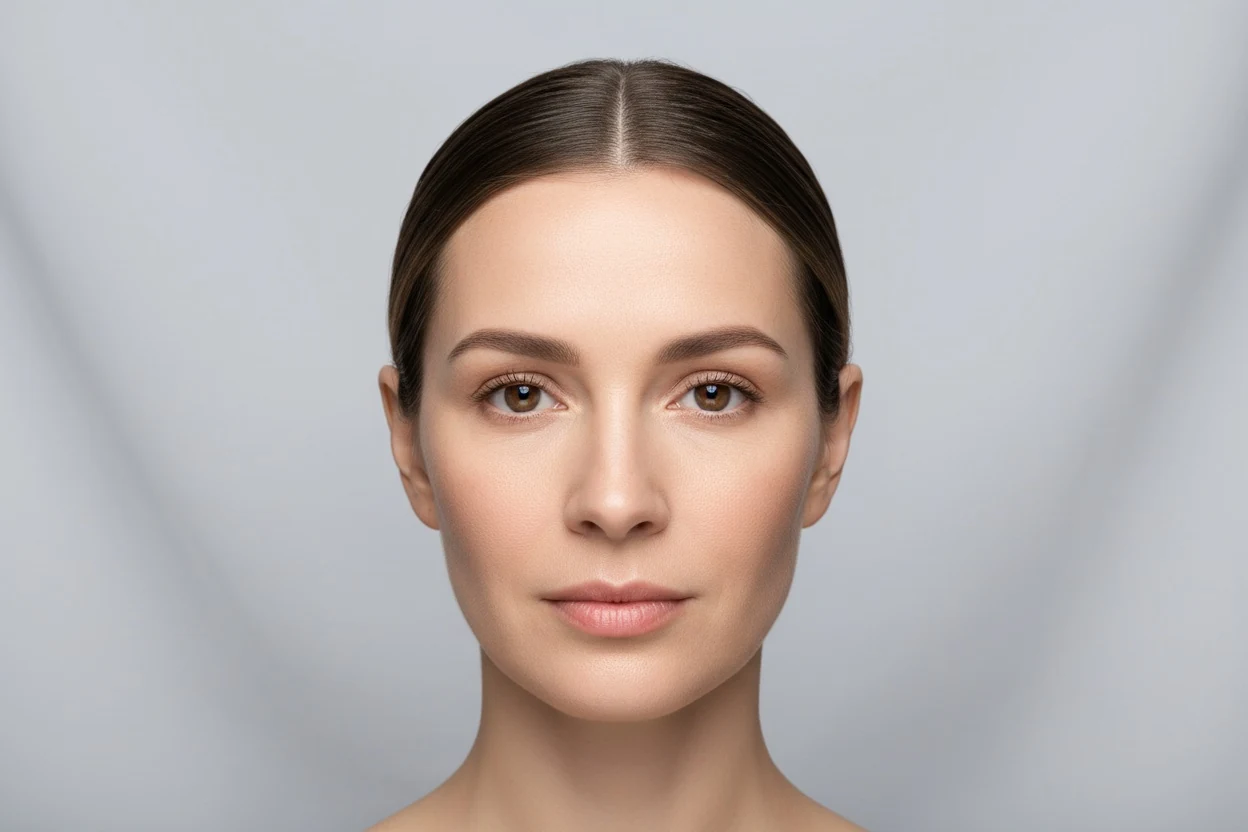
 Example
Choose your own photo
See your score, symmetry and proportions.
Choose your own photoClick to choose a photo, or drop one here
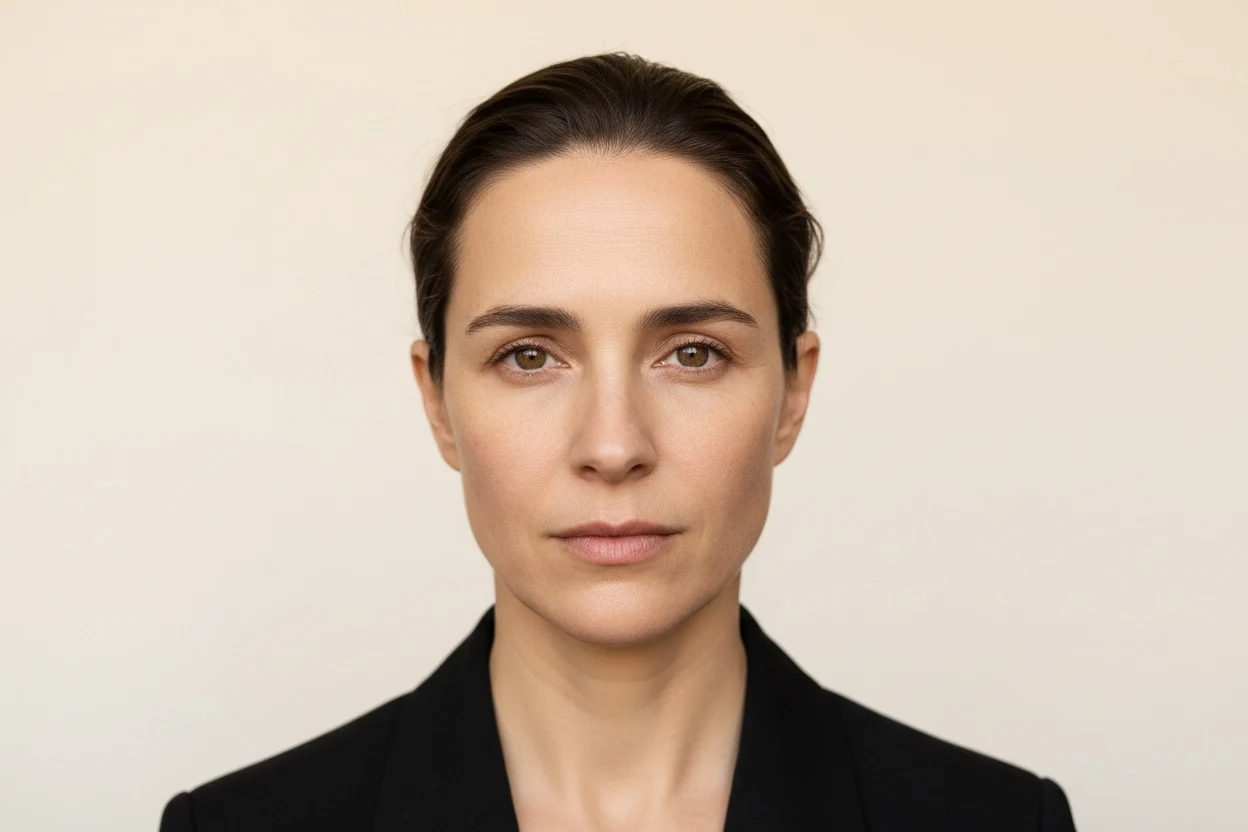
Front-facing · Even lightingStraight-on, even lighting, at arm's length gives the most comparable reading.
Runs in your browser. Your photo is not uploaded.
How does an AI attractiveness test actually score a face?
- 5.5 on the scale is the middle face of the 102-face Face Research Lab London Set.
- Symmetry, the golden ratio and the overall composite all correlated with human ratings at about zero in our test.
- Smiling raised the median score from 5.5 to 7.4 on the same 102 people.
- The measurement runs in the browser; the photo is not uploaded.
Why The Face Analysis?
Other face raters give you a number. The Face Analysis tells you where that number sits among 102 research faces, publishes how well its own score works, and names what a front photo cannot measure.
Every score has a reference: 102 research faces
The attractiveness score, symmetry, fWHR and midface ratio are placed against 102 adults from the Face Research Lab London Set, measured with the same code, so a number comes with where it sits.
We published how well our own score works
On those 102 faces our composite score did not predict 2,513 people's attractiveness ratings (ρ = −0.07). The weights are shown: symmetry 40%, three ratios 20% each.
Each tool names what it cannot measure
A front photo cannot read orbital depth, an eyelid crease hidden under the lid, nose projection or the gonial angle. The tools say so instead of guessing.
23 free tools, no account, numbers kept on your device
All 23 measurement tools are free and unlimited with no account. They run in your browser, the photo is not uploaded, and no score is saved on our servers.
Pupillary distance with no ruler or card
Your iris is the scale: its visible diameter averages about 11.7 mm, so one photo gives PD in millimetres, within an honest ±3 mm band.
40 procedures, rendered on your own photo
AI simulations of 40 cosmetic procedures use credits and upload the photo you choose when you start one. Each result is an illustration, not a surgical prediction.
One account with the Aesti app
The same sign-in and credit balance work in Aesti, the Android app built on the same system.
Who it is not for
Not for medical decisions or diagnosis, and not for anyone under 18. For any procedure, talk to a qualified clinician.
See what a change would actually look like
These are the renders that act on what this page measures. Each one below was generated by the same model that runs on your own photo — labelled examples on another face, so you can see what the procedure changes before you spend anything.
Looksmax Pack
Looksmax Pack · AI example
Looksmax Pack. A different possibility.
Tap the photo to enlarge. AI visualisation, not a prediction.
What Changed & Why · Annotated AI example
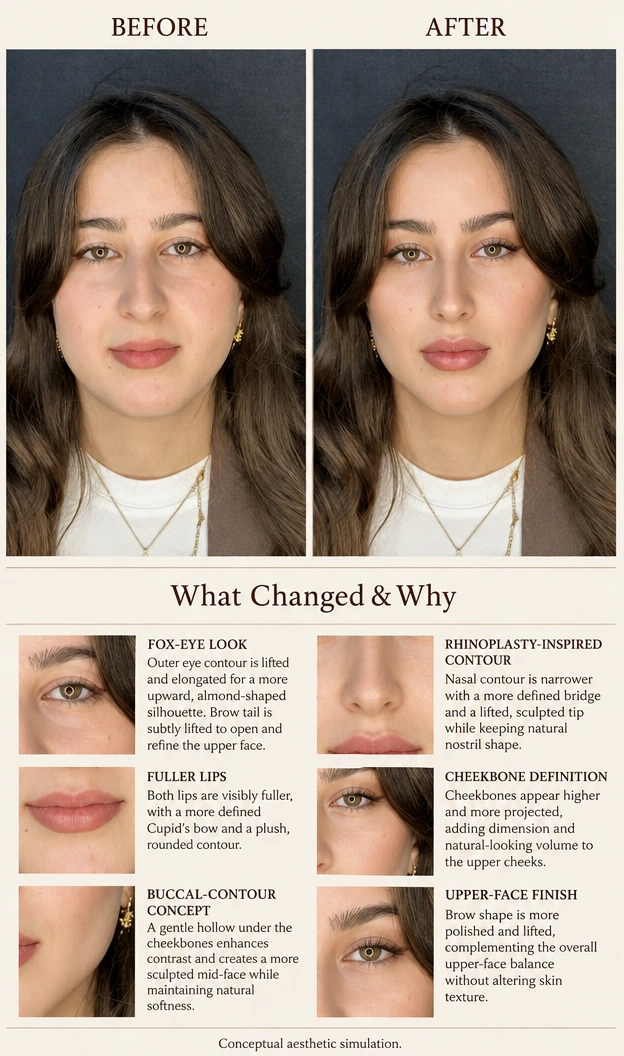
Conceptual aesthetic simulation. Another face, not your result.
Changes the full set of changes a looksmax plan would target.
What it does →Jawline Filler
Jawline Filler · AI example
Jawline Filler. A different possibility.
Tap the photo to enlarge. AI visualisation, not a prediction.
Changes definition along your jaw.
What it does →Rhinoplasty
AI glow-up · nose + styling
Rhinoplasty. A different possibility.
Tap the photo to enlarge. AI visualisation, not a prediction. Includes makeup, brow styling, hair and outfit changes. Both images are AI generated.
Changes the bridge, tip and nostril width of your nose.
What it does →
Every “after” above is an AI simulation on a sample face, not a photograph of a surgical result — it shows the direction a procedure moves a face, not an outcome anyone achieved and not a prediction of yours. Where a frame reads “Before · AI example”, the before image is generated too: the same portrait with the condition that procedure treats added, because none of the source photographs had it. Run one on your own photo.
How attractive am I? What this attractiveness test measures
The test places 478 landmark points on your face and computes four measurements from them. None of them is an opinion. Each is a distance or a ratio you can check on the result card, and each appears there with its own bar.
The four are weighted into one composite and then placed against a reference set of 102 adult faces photographed for research. Your 1-10 score is that placement: where your composite falls among those 102 faces. The table below lists what goes in.
| Measurement | What it compares | Weight |
|---|---|---|
| Facial symmetry | Six matched left–right landmark pairs against the facial midline | 40% |
| Face length to width | Forehead-to-chin height against cheekbone width, compared with 1.618 | 20% |
| Eye spacing to nose width | Outer eye corners against nostril width | 20% |
| Nose length to mouth width | Bridge-to-tip length against mouth width | 20% |
The attractiveness scale 1-10: what your score means
Your score is a percentile against the reference set, converted onto a 1-10 scale. 5.5 means your composite sits exactly in the middle of the 102 research faces. 7.75 means it is higher than about three quarters of them, and 3.25 means higher than about a quarter.
We switched to this scale because the raw composite is almost useless on its own. Across all 102 reference faces it only runs from 68.6 to 76.9 out of 100, so dividing it by ten put four in five faces between 7.0 and 7.5. That number looked flattering and told nobody anything. A percentile keeps the same measurements and makes the position readable.
The narrow range has one more consequence, and you should know it. A small change in the photo can move your percentile noticeably, because a single composite point is roughly an eighth of the whole range. The score is a reading of one photo, not a fixed property of your face.
| Score | Where your composite sits among the 102 reference faces |
|---|---|
| 1.0 – 3.2 | Bottom quarter |
| 3.3 – 5.4 | Second quarter |
| 5.5 | The middle face of the set |
| 5.6 – 7.7 | Third quarter |
| 7.8 – 10 | Top quarter |
We tested our face rater against 2,513 human ratings
A score that calls itself an attractiveness test should predict how attractive people find a face. So we checked. The Face Research Lab London Set is a public research dataset of 102 adults (49 women, 53 men) photographed under the same conditions, and 2,513 people rated every face for attractiveness on a 1-7 scale. We ran all 102 photos through this site's own measurement engine and compared each measurement with the average human rating.
The result is clear, and we are publishing it rather than burying it. Neither the composite score nor the classic geometric ideas behind it predicted the human ratings. For the composite, the golden ratio and symmetry, the Spearman correlations were close to zero and every 95% confidence interval crossed zero. The golden ratio did no better than symmetry, and symmetry did no better than chance.
One measurement showed a small, real signal: how close a face's proportions sit to the average face of its own sex. This is the "averageness" effect Langlois and Roggman described in 1990. It reached ρ = +0.21 on neutral photos. That is weak, and it dropped to +0.11 when the same people smiled. It also requires knowing the person's sex, which this tool does not ask.
| Measurement (this site's engine) | Correlation with 2,513 human ratings | 95% CI | Reading |
|---|---|---|---|
| Overall composite score | ρ = −0.07 | −0.27 to +0.12 | No relationship |
| Golden ratio fit | ρ = −0.10 | −0.28 to +0.09 | No relationship |
| Facial symmetry | ρ = +0.09 | −0.12 to +0.28 | No relationship |
| Closeness to own-sex average (13 ratios), neutral photo | ρ = +0.21 | +0.01 to +0.39 | Weak, positive |
| Same, smiling photo | ρ = +0.11 | crosses zero | Not reliable |
This matches the literature more than it contradicts it. Models that learn from human ratings do far better than fixed formulas: a 2006 study reached a correlation of 0.65 by training on rated faces, and large benchmark datasets such as SCUT-FBP5500 exist precisely because hand-picked ratios underperform. A 2019 comparison on 594 women's faces found single-trait theories — symmetry alone, averageness alone — "performed relatively poorly". The honest summary is that a landmark-geometry score describes proportions well and predicts attractiveness badly. That is why this page reports your measurements individually. The golden ratio calculator and the face symmetry test go deeper on those two components, and the face measurement statistics page lists every measurement on the same 102 faces.
Am I pretty? The pretty scale, the beauty test and this one
"Am I pretty", "how beautiful am I", "pretty scale" and "beauty test" are the same question in different words, and this tool gives each of them the same answer: a set of measurements, and your position against a reference set. There is no separate formula for pretty.
What no test can give you is a verdict. How attractive a face looks depends heavily on the person judging it. In a 2006 series of experiments, private taste turned out to be about as powerful as shared taste. A 2015 twin study found individual face preferences are shaped mostly by each person's environment, not their genes. Two raters disagreeing about you is the normal case, not the exception.
If the question you came with is closer to "am I ugly", that is a different search with a different answer, and we wrote it up separately: am I ugly? what a measurement can and can't tell you.
Rate my face: an AI face rater that shows its arithmetic
Most tools that "rate my face" or "rate my looks" send your photo to a model and print whatever number it returns. Ask a chatbot for a ChatGPT attractiveness test and you get a plausible figure with nothing underneath it: no landmarks, no reference set. Run the same photo again and the number often changes.
This face rater is arithmetic on distances. The same photo always returns the same numbers, the weights are published above, and every component is shown separately. That reproducibility is the difference between a measurement and a compliment. It does not make the measurement a good predictor of attractiveness, as the study above shows. It makes it honest about what it is.
Why your attractiveness score changes between photos
Expression moves the score more than people expect. In the London set, the same 102 people were also photographed smiling, and their median score on this scale rose from 5.5 on the neutral photo to 7.4 on the smiling one. That is the mouth corners and cheeks moving the proportion measurements. It happens to match what people report: in a 2014 experiment, a happy expression could make up for a face being rated less attractive.
The ranking is only partly stable across photos. The correlation between the same person's neutral and smiling percentile was 0.67. That is related, but far from identical. Camera distance matters too. A phone held close enlarges whatever is nearest, usually the nose, and a camera below eye level widens the jaw and shortens the midface.
The practical rule is simple. Compare like with like: neutral against neutral, arm's length against arm's length. Take two or three photos and read the spread as your real range.
What science says about facial attractiveness
A handful of findings replicate. Faces close to the population average tend to be rated more attractive, and a 2000 review of eleven meta-analyses found that raters agree about who is and is not attractive, both within and across cultures. Symmetry has a small positive relationship with ratings in many studies. Sexually typical features matter, and so does body fat visible in the face: a 2017 study found adiposity predicted lower ratings in both sexes.
Other popular claims hold up less well. The same 2017 study found skin colour did not predict attractiveness in either sex, even though earlier work had reported a role for skin tone distribution. The golden ratio is quoted everywhere and supported almost nowhere. Across the literature, the pattern is the one our own test found: single geometric rules explain little, and most of what people respond to in a face is not in a landmark mesh at all.
Rate my face without uploading it: how the privacy works
The face mesh model downloads to your browser and runs on your device. Your selfie is processed in local memory and is never sent to a server. There is no upload to intercept, no storage bucket to breach, and no copy of your face for us to keep.
You can check this yourself. Open your browser's network tab, run the test, and watch: the model file comes down, and nothing containing your image goes up.
What your attractiveness score does not tell you
It does not tell you how attractive other people find you. Our own test shows the composite does not predict that. Expression, grooming, skin, posture, style and simply liking someone all move real-world attraction further than a two-millimetre ratio does.
Read the number the way you would read a tape measure. It is an accurate report of one narrow thing: how four proportions of this photo compare with 102 research faces. It is not a verdict on you, and a low reading on one ratio is not a statement about your worth.
Tips for an accurate attractiveness score
- Keep a neutral expression. A smile raised the median score from 5.5 to 7.4 in our test, which is more than any other photo condition changed it.
- Shoot straight on. A few degrees of head rotation changes one side of every landmark pair and lowers symmetry.
- Hold the camera at arm's length, at eye level. Phone lenses are short and close, which enlarges whatever is nearest, usually the nose.
- Use even, front-facing light. Side light casts a shadow line that the mesh can read as an edge.
- Pull hair off the face and turn off beauty mode or filters. Many phones smooth skin and subtly reshape features by default.
- Run two or three photos and read the spread as your range. A single run is one photo, not your face.
AI Attractiveness Test — frequently asked questions
Is this AI attractiveness test free?
Yes. The score, the percentile and every measurement behind them are free and need no account. Paid credits exist only for the optional simulation feature, which renders a specific cosmetic change on your own photo.
Do I need to sign up or upload my photo?
Neither. The face mesh runs in your browser, so the photo stays on your device and is never transmitted. No account is needed to see your score.
Is this the same as a beauty test or a pretty test?
Yes. "Beauty test", "pretty test", "am I pretty test" and "attractiveness test" all run the same measurements here. There is no separate formula for pretty. You get your proportions and your position against 102 research faces, whatever you call it.
Can this rate my face out of 10?
Yes. The rating is a 1-10 scale where 5.5 is the middle of the reference set. Each step reflects your percentile, not a judgement. The full breakdown sits under the number, so you can see which measurement moved it.
Is this a face rater or looks rater, and can an AI rate me from a photo?
It is a face rater in the literal sense: it measures the photo and ranks the result. It does not use a model trained on human opinions. In our test on 102 research faces, its composite did not predict human attractiveness ratings, and this page says so plainly.
Am I hot? Am I handsome? Does the test work for men?
The test works on any adult face, men and women alike, with the same measurements and the same reference set of 49 women and 53 men. It cannot tell you whether you are hot or handsome to other people; those judgements vary a great deal from person to person.
What does the pretty scale 1-10 mean?
On this tool it is a percentile scale: 1 is the bottom of the reference set, 5.5 the middle, 10 the top. Other pretty scale sites use their own formulas, so their numbers are not comparable with this one.
Is this a face card rating?
"Face card" is slang for a face that gets you noticed. This tool measures proportions instead of rating that directly. Our own test found proportion scores do not predict how attractive people find a face, so treat any face card number with caution, including ours.
What is a good attractiveness score?
5.5 is exactly average for the reference set, and half of all faces score below it by definition. Anything between about 3 and 8 is ordinary. The breakdown is more useful than the total, because it shows which specific measurement sits furthest from the reference.
Why is my attractiveness score lower than I expected?
Usually the photo. A camera held low and close widens the jaw and shortens the midface, and head rotation lowers symmetry. Try a straight-on photo at arm's length in even light, with a neutral expression, and compare it with your first run.
Does smiling change my score?
Yes, by a lot. When the 102 research faces were photographed smiling, their median score rose from 5.5 to 7.4. Compare neutral photos with neutral photos, or the difference you see is mostly your expression.
How accurate is the attractiveness rating?
The measurements are precise and reproducible: the same photo always gives the same numbers. As a predictor of how attractive people find you, it is not accurate. On 102 faces rated by 2,513 people, the correlation was about zero.
How is this different from a ChatGPT attractiveness test?
A chatbot has no landmark detection and no reference set. It produces a plausible-sounding number that can change on a second run. This tool computes distances, publishes its weights and returns the same result for the same photo.
Is this a hotness AI or a beauty score AI?
It uses AI for one step only: the face mesh model that places 478 landmarks. Everything after that is fixed arithmetic, not a model that learned what hot looks like. The beauty score is a percentile of that arithmetic against 102 research faces.
Does the attractiveness test have racial or gender bias?
The reference set is 102 adults photographed in London, so it is not representative of every population. The golden ratio targets in the formula also come from a Western convention. That is one more reason to read your score as a comparison with a specific dataset, not a universal standard.
Can I improve my attractiveness score?
The measurements reflect bone structure and soft tissue, so most of them do not change quickly. What changes the reading most is the photo itself: angle, distance, light and expression. For changes to the face, the simulation feature shows a specific procedure on your own photo before you consider it.
Should I use this score to pick dating photos?
Not on its own. Photos that score higher here are often just smiling photos, and people do tend to find smiles more attractive. Picking the photo where you look relaxed and happy is better advice than picking the one with the best ratio.
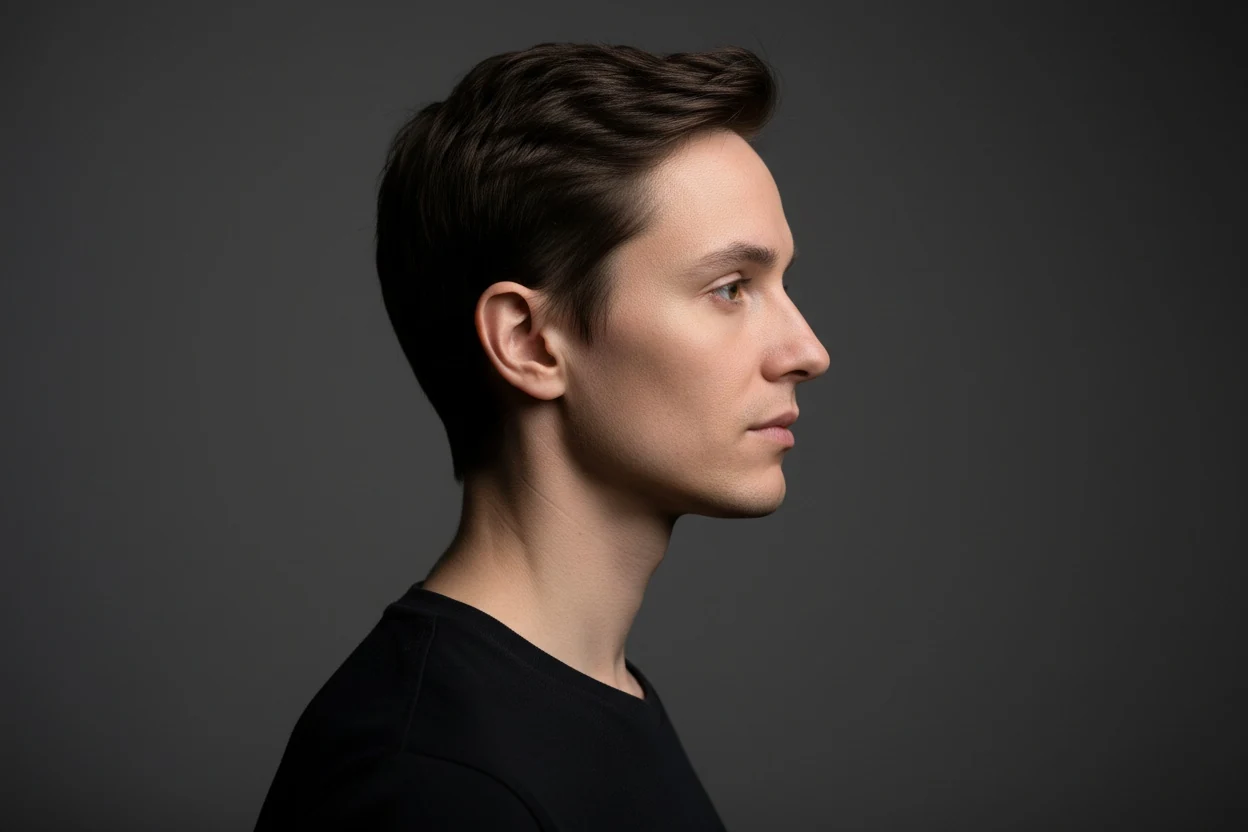
Can this test rate my side profile?
No. The measurements need a front-facing photo, because symmetry and the width ratios are read left against right. A profile photo will either fail to detect or give a meaningless score.
Can I rate someone else's face?
The tool will process any photo, but do not run someone else's photo without their knowledge. A face is personal data, and rating someone behind their back is not okay.
Is the attractiveness test suitable for teenagers?
The reference set is adults aged 18 to 54, and faces keep changing through the late teens. A teenager's score compares a still-developing face with adult faces, so it says even less than it does for an adult.
References
- 1.DeBruine, L., & Jones, B. (2021). Face Research Lab London Set [Data set]. figshare. doi:10.6084/m9.figshare.5047666.
- 2.Langlois, J. H., & Roggman, L. A. (1990). Attractive faces are only average. Psychological Science, 1(2), 115–121. doi:10.1111/j.1467-9280.1990.tb00079.x.
- 3.Langlois, J. H., Kalakanis, L., Rubenstein, A. J., Larson, A., Hallam, M., & Smoot, M. (2000). Maxims or myths of beauty? A meta-analytic and theoretical review. Psychological Bulletin, 126(3), 390–423. PMID 10825783.
- 4.Grammer, K., & Thornhill, R. (1994). Human (Homo sapiens) facial attractiveness and sexual selection: the role of symmetry and averageness. Journal of Comparative Psychology, 108(3), 233–242. PMID 7924253.
- 5.Rhodes, G. (2006). The evolutionary psychology of facial beauty. Annual Review of Psychology, 57, 199–226. PMID 16318594.
- 6.Hönekopp, J. (2006). Once more: is beauty in the eye of the beholder? Relative contributions of private and shared taste to judgments of facial attractiveness. Journal of Experimental Psychology: Human Perception and Performance, 32(2), 199–209. PMID 16634665.
- 7.Germine, L., Russell, R., Bronstad, P. M., et al. (2015). Individual aesthetic preferences for faces are shaped mostly by environments, not genes. Current Biology, 25(20), 2684–2689. PMID 26441352.
- 8.Holzleitner, I. J., Lee, A. J., Hahn, A. C., et al. (2019). Comparing theory-driven and data-driven attractiveness models using images of real women's faces. Journal of Experimental Psychology: Human Perception and Performance, 45(12), 1589–1595. PMID 31556686.
- 9.Foo, Y. Z., Simmons, L. W., & Rhodes, G. (2017). Predictors of facial attractiveness and health in humans. Scientific Reports, 7, 39731. PMID 28155897.
- 10.Fink, B., Grammer, K., & Matts, P. J. (2006). Visible skin color distribution plays a role in the perception of age, attractiveness, and health in female faces. Evolution and Human Behavior, 27(6), 433–442. doi:10.1016/j.evolhumbehav.2006.08.007.
- 11.Golle, J., Mast, F. W., & Lobmaier, J. S. (2014). Something to smile about: the interrelationship between attractiveness and emotional expression. Cognition and Emotion, 28(2), 298–310. PMID 23875865.
- 12.Eisenthal, Y., Dror, G., & Ruppin, E. (2006). Facial attractiveness: beauty and the machine. Neural Computation, 18(1), 119–142. PMID 16354383.
- 13.Liang, L., Lin, L., Jin, L., Xie, D., & Li, M. (2018). SCUT-FBP5500: A diverse benchmark dataset for multi-paradigm facial beauty prediction. 24th International Conference on Pattern Recognition (ICPR), 1598–1603. doi:10.1109/ICPR.2018.8546038.