Face Shape Detector
Four measurements: forehead width, cheekbone width, jaw width, and face length from the top of the forehead to the chin. This detector names one of 7 shapes from their ratios — oblong when length is at least 1.23× cheekbone width, heart when the forehead is at least 1.24× the jaw, round when length is at most 1.16× with a broad jaw — using thresholds set on 102 research faces.
- 7
- face shapes
- 4
- measurements
- 102
- calibration faces
- Free
- photo not uploaded
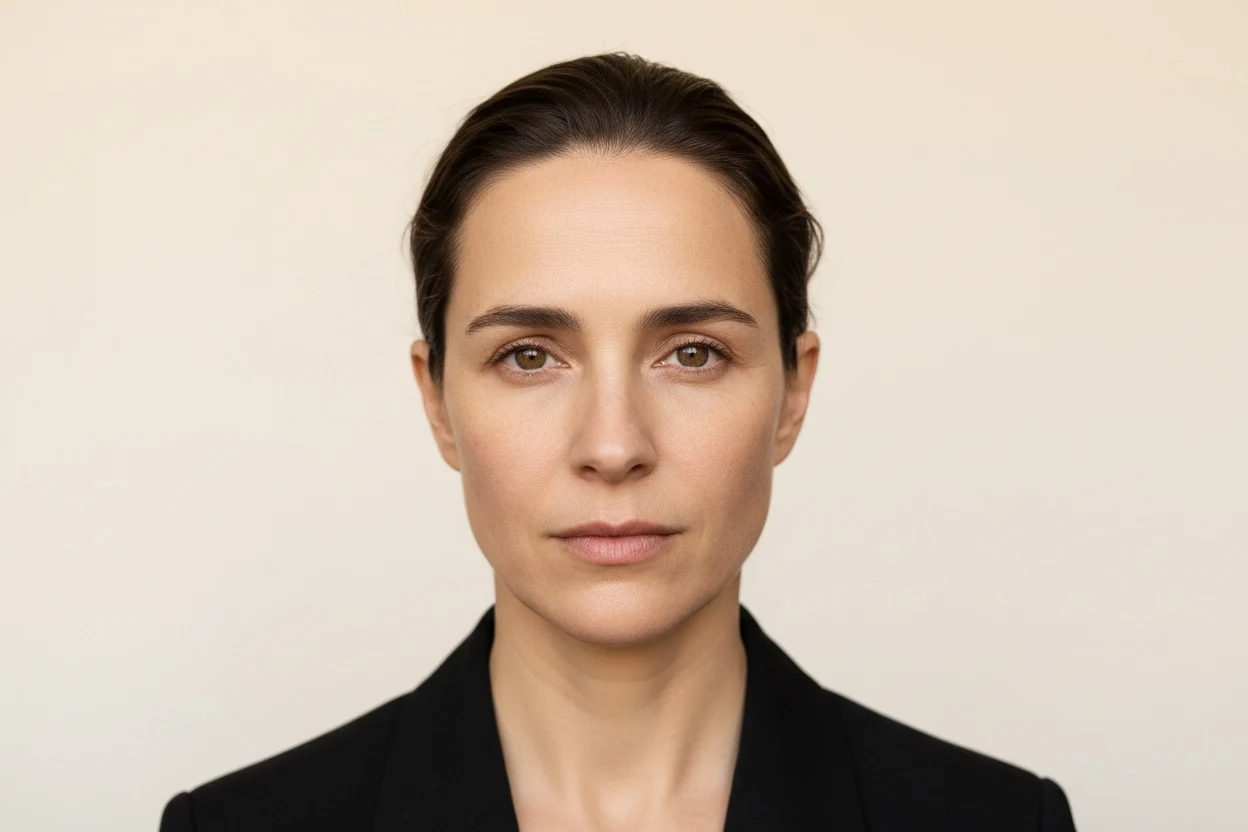 Example
Choose your own photo
Discover your face shape and proportions.
Choose your own photoClick to choose a photo, or drop one here
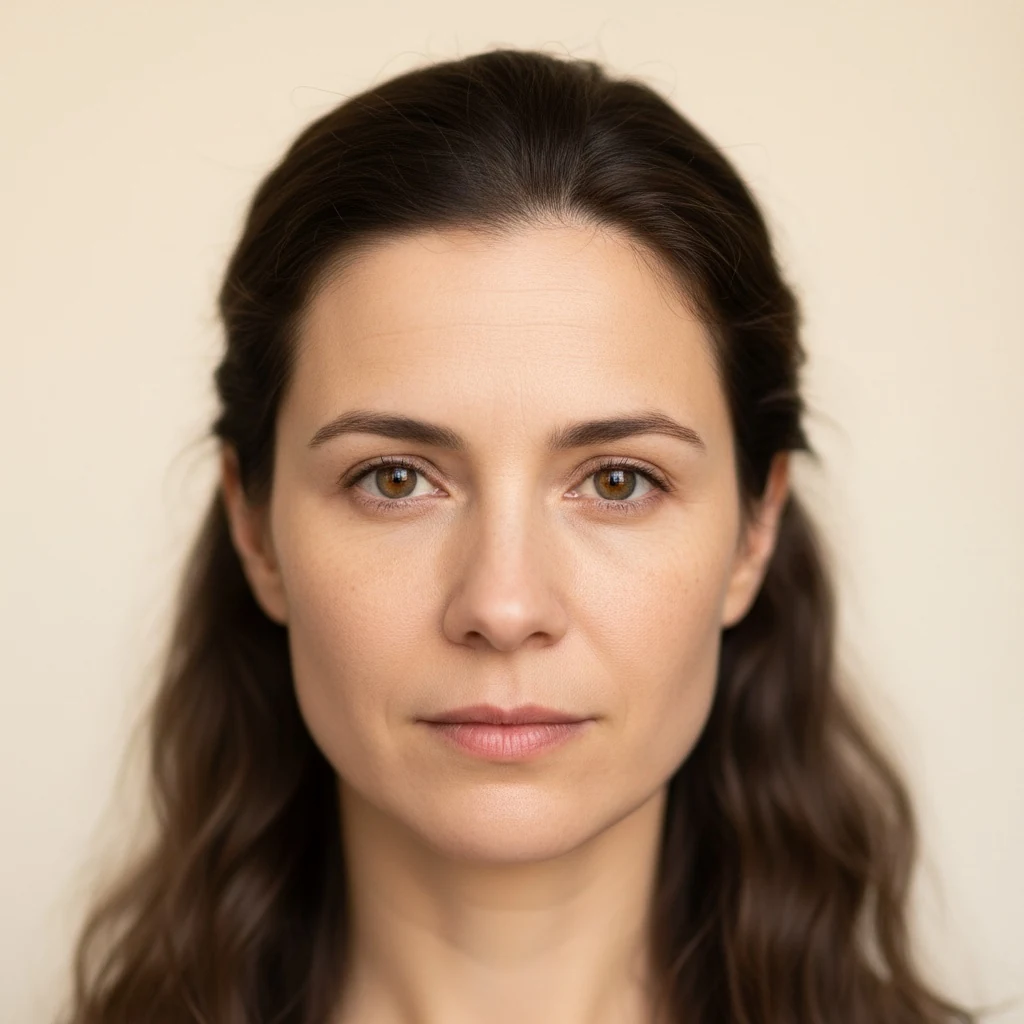
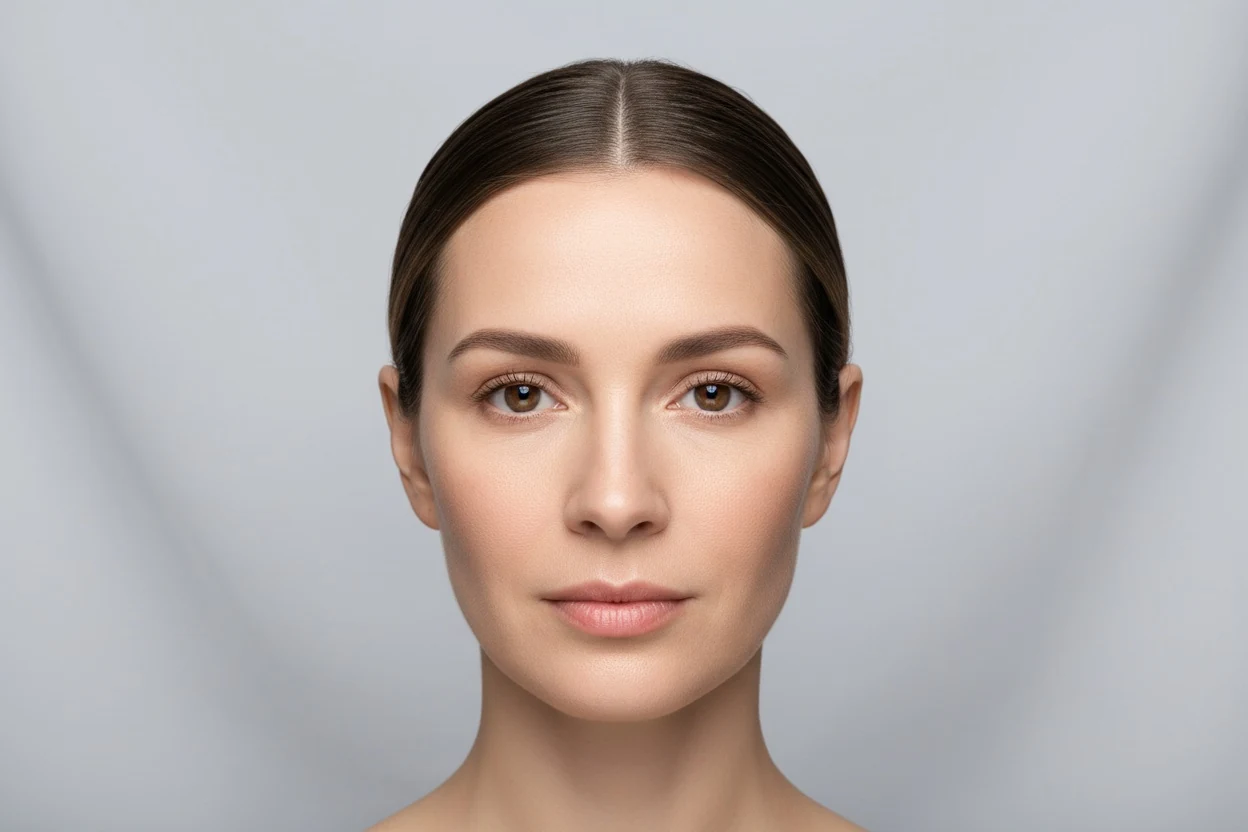
Front-facing · Even lightingStraight-on, even lighting, at arm's length gives the most comparable reading.
Runs in your browser. Your photo is not uploaded.
What decides your face shape?
- There are seven standard shapes: oval, round, square, heart, oblong, diamond and triangle.
- Across 102 research faces measured with this detector, oval was the most frequent result (38) and diamond the least (9).
- A landmark model cannot see your hairline, so its length ratios run lower than the tape-measure ones: across the 102 faces the middle 80 per cent ran from 1.12 to 1.23. This detector uses cut points set from those measurements, not the tape's 1.2 and 1.6.
- Small changes to the same photo — a few degrees of rotation, lower resolution or darker light — changed the label on 17 per cent of faces on average; no accuracy percentage is claimed.
- From a three-quarter angle every one of the 102 faces read oblong, so the photo must be straight on.
See what a change would actually look like
These are the renders that act on what this page measures. Each one below was generated by the same model that runs on your own photo — labelled examples on another face, so you can see what the procedure changes before you spend anything.
Jaw Reduction
Jaw Reduction · AI example
Jaw Reduction. A different possibility.
Tap the photo to enlarge. AI visualisation, not a prediction. Both images are AI generated.
Changes the width of your jaw angle.
What it does →Buccal Fat Removal
Buccal Fat Removal · AI example
Buccal Fat Removal. A different possibility.
Tap the photo to enlarge. AI visualisation, not a prediction.
Changes cheek fullness below the cheekbone.
What it does →Cheek Filler
Cheek Filler · AI example
Cheek Filler. A different possibility.
Tap the photo to enlarge. AI visualisation, not a prediction.
Changes cheekbone projection and midface volume.
What it does →
Every “after” above is an AI simulation on a sample face, not a photograph of a surgical result — it shows the direction a procedure moves a face, not an outcome anyone achieved and not a prediction of yours. Where a frame reads “Before · AI example”, the before image is generated too: the same portrait with the condition that procedure treats added, because none of the source photographs had it. Run one on your own photo.
What is my face shape? The four measurements that decide it
Face shape is not a vibe, it is a ratio problem. Four numbers settle it: forehead width, cheekbone width, jaw width, and face length from the top of the forehead to the chin. Every one of the seven shapes is a specific relationship between those four.
An oval face is long relative to its width with a jaw narrower than the cheekbones. A round face is short relative to its width with a jaw that carries most of that width. A diamond has cheekbones clearly wider than both the temples and the jaw. Once you have the measurements, the label follows from a fixed set of rules — which is why a detector is more repeatable than holding a printed chart against a mirror.
Detected face shape: the seven rules the face shape analyzer checks, in order
The detector turns the four measurements into three ratios, all against cheekbone width: face length, jaw width and temple width. It then checks the rules below from top to bottom and stops at the first one your face meets. The order is part of the definition. A broad rule checked early swallows every face a narrower rule further down was meant to catch, which is how some detectors end up calling nearly every face round or nearly every face diamond.
Oval sits last on purpose. It is the label a face receives when none of the six sharper rules is met, which is why it is the most frequent result and why an oval reading covers a wider range of faces than any other.
| Checked | Detected face shape | Rule (widths against cheekbone width) | In plain words |
|---|---|---|---|
| 1 | Oblong | Face length 1.23 or more times cheekbone width | Clearly longer than it is wide |
| 2 | Triangle | Jaw at least 79.4% of cheekbone width, and temples no more than 1.13 times the jaw | A heavy jaw under a narrow forehead |
| 3 | Round | Face length 1.16 or less, and jaw at least 79.1% of cheekbone width | Short and broad, with the width carried down |
| 4 | Square | Jaw at least 79.6% of cheekbone width, and temples no more than 1.16 times the jaw | Forehead, cheekbones and jaw close in width |
| 5 | Heart | Temples at least 1.24 times the jaw | Wide forehead, clearly narrower jaw |
| 6 | Diamond | Temples no more than 93.4% and jaw no more than 79.6% of cheekbone width | Narrow at both ends, widest at the cheekbones |
| 7 | Oval | None of the above | Balanced; the remainder |
Because round is checked before square, a square jaw on a short face reads as round. Square is a broad-jawed face that is slightly longer, with temples a little wider than the jaw; if the temples are barely wider than the jaw at all, triangle catches it first. If you have been told round and the jaw has visible corners, the round vs square comparison on the square page is the one to read. The jawline rating shows your jaw-to-cheekbone ratio as a number, which is the figure that separates most of these rules.
What face shape is most common? A face shape chart from 102 measured faces
We ran the detector on the Face Research Lab London Set: front-facing photos of 102 adults (49 women, 53 men) published for research under an open licence. Every face went through the same landmark model and the same rules this page runs. Oval came out most often, at 38 of 102 faces, and diamond least often, at 9.
Read the chart for what it is. The cut points were chosen from the spread of these same faces — the oblong line, for example, sits at the 90th percentile of their length ratio — so roughly one face in ten reading oblong is partly a consequence of where the line was drawn. This shows how the detector spreads real faces across the seven shapes; it is not a population survey, and we are not aware of one that measures face shape prevalence with a consistent method.
| Face shape | All 102 faces | Share | Women (49) | Men (53) |
|---|---|---|---|---|
| Oval | 38 | 37% | 24 | 14 |
| Round | 13 | 13% | 4 | 9 |
| Heart | 12 | 12% | 11 | 1 |
| Square | 10 | 10% | 1 | 9 |
| Triangle | 10 | 10% | 1 | 9 |
| Oblong | 10 | 10% | 5 | 5 |
| Diamond | 9 | 9% | 3 | 6 |
Face shape for women and men
The detector does not ask for your sex and applies one set of rules to everyone. The split still differs: in this set heart was almost entirely a women's result (11 of 12) and square and triangle almost entirely men's (9 of 10 each). That follows from the measurements — the men's jaws were typically a larger share of their cheekbone width (a median of 81 per cent against 78 for the women) — rather than from any separate female or male calculator.
Across the 102 faces the length ratio ran from 1.12 to 1.23 for the middle 80 per cent, with a median of 1.18. The jaw measured 77 to 82 per cent of cheekbone width over the same range. The differences between shapes are small, which is the main reason a face near a cut point can change label between two photos.
How to tell your face shape from a photo, without a tape measure
The manual method is a tape measure, a mirror and four written-down numbers. It works, and it is tedious enough that almost nobody finishes it.
This detector places 478 landmark points on your photo — the 468-point face mesh Google published for mobile devices, plus iris points — and takes the same four measurements from them in about a second. The points it uses are the ones the manual method aims at: the temples, the widest point of the cheekbones, the jaw corners and the chin. Upload a photo or use your camera; either way the image is read on your device.
How to measure face shape with a tape, and where it disagrees with the detector
If you would rather measure by hand, this is the method styling charts use. You need a soft tape measure, a mirror and a way to write the numbers down.
- Pull all hair back from the forehead and jaw, including a fringe.
- Forehead: measure across the widest part of the forehead, about halfway between the eyebrows and the hairline.
- Cheekbones: measure across the widest point of the cheekbones, just below the outer corners of the eyes. This is usually the widest of the three.
- Jaw: measure from one jaw corner, below the ear, to the other.
- Length: measure from the centre of the hairline straight down to the tip of the chin.
- Divide the length by the cheekbone width, then compare the three widths with each other.
| Tape measure in a mirror | This detector | |
|---|---|---|
| Face length starts at | The hairline | The top of the forehead surface, below the hairline — the landmark model cannot see where hair begins |
| Typical cut points | Round under about 1.2, oval about 1.5, oblong over about 1.6 (styling-chart convention, no single research source) | Round 1.16 or less, oblong 1.23 or more |
| Widths read | One at a time, while you hold your head still | All three at the same instant, from the same head position |
| Main weakness | Placement: half a centimetre either way changes a borderline result | The photo: camera height, head turn and expression |
| Receding or high hairline | Makes the face read longer | No effect on length |
This is why a tape and a detector can disagree on the same face without either being broken. A hairline-to-chin length is always longer than a forehead-landmark-to-chin length, so a detector that borrowed the tape's 1.5 and 1.6 would call almost nobody oval or oblong. The rules here were set by measuring real faces with the same landmark model instead.
Face shape detector accuracy: what we can and cannot claim
We cannot give you an accuracy percentage, and a tool that does should say what it was checked against. Measuring accuracy needs a set of faces whose shape has been agreed independently, and we have not found one: the research face set above records attractiveness ratings, not shape labels. What we can measure is stability — whether the same face gets the same label when the photo changes slightly.
On that test the honest answer is: mostly, not always. Across four small changes to the photo, on average 17 per cent of the 102 faces changed label. Rotating the picture within the frame does not change any distance on the face, so the flips there come from the landmark model placing points a fraction differently. They happen to faces sitting near a cut point.
| Change to the same photo | Faces whose label changed (of 102) |
|---|---|
| Rotated 5° within the frame | 15 |
| Rotated 10° within the frame | 21 |
| Shrunk to 338 pixels wide | 20 |
| Darkened to 45% brightness | 15 |
| Cropped to a 3:4 portrait | 11 |
| A second photo of the same person smiling | 41 |
| A three-quarter view instead of straight on | 92 (all 102 read oblong) |
Two practical rules follow. A smile moves the cheekbone and jaw landmarks enough to change 41 labels, most often oval to oblong, so use a neutral expression. And a turned head is not a small error: every face in the set read oblong from a three-quarter angle. If your result names a shape next to one you expected, read both pages — the oval and oblong pages, or round and square, are the usual pairs.
Face shape detector online, with nothing uploaded
The face mesh model downloads to your browser and the measurements are computed on your device. Your photo is not transmitted or stored for the measurement.
For a face shape reading, angle matters more than most people expect. A phone held low widens the apparent jaw and can flip a genuine oval into a reported round. Straight on, at arm's length, in even light.
Tips for an accurate face shape reading
- Pull all hair back, including a fringe. The measurement uses your temple and jaw landmarks, and hair over them makes the detection less stable.
- Straight on and at eye level. A low camera angle widens the apparent jaw enough to turn an oval into a reported round, and a turned head reads as oblong.
- Neutral, closed-mouth expression — a smile moves the cheekbone and jaw landmarks.
- Even lighting so the jaw edge is visible on both sides.
- Near a boundary? Run two or three photos. If they agree, trust the label; if they split between two shapes, read both shape pages.
Face Shape Detector — frequently asked questions
How do I find out what my face shape is?
Take a straight-on photo with your hair pulled back and run it through the detector at the top of this page. It measures forehead, cheekbone and jaw width against face length and names the shape whose rule you meet. You can also measure the same four numbers with a tape measure, though the two methods start the face length at different points.
What face shape do I have if I only have a selfie?
A selfie works if it is taken at eye level with the phone at arm's length. A phone held below the chin widens the jaw in the picture and can push an oval toward round, and a phone held close distorts the middle of the face. Keep your expression neutral.
Is this face shape detector free?
Yes. Detection and the result are free, there is no sign-up, and your photo is processed in your browser rather than sent to a server. Only the optional AI simulation offered after the result uses credits.
Is there a face shape app, or does this work online?
It works online in any modern browser on a phone or computer, so there is nothing to install. The measurement model downloads once to your browser and then runs on the device, the same way an app would.
Can I use my camera instead of uploading a photo?
Yes. The tool can take the picture with your phone or laptop camera, and the frame is analysed on your device in the same way as an uploaded photo. Hold the camera at eye level and look straight into it.
How does an AI face shape detector work?
A neural network trained to locate facial landmarks places 478 points on your face. The detector then reads four distances from those points and applies fixed rules to the ratios between them. The AI part is the landmark placement; the shape decision itself is a set of measured thresholds you can read in the table on this page.
How accurate is an AI face shape detector?
The honest answer is that no one can give you a verified percentage without a set of faces whose shapes were agreed independently, and we have not found one. What we measured is stability: small changes to the same photo changed the label on 17 per cent of 102 research faces on average. Faces near a cut point can legitimately be described two ways.
What is a face shape calculator, and is it different from a detector, finder or analyzer?
They are names for the same job. A calculator usually means you type in measurements, a detector or finder reads them from a photo, and an analyzer adds the numbers behind the result. This page does the photo version and shows the rules, so you can check the calculation.
Is there a face shape calculator for women and for men?
The rules are the same for everyone and the tool does not ask your sex. In our 102-face test set heart was mostly a women's result and square and triangle mostly men's, but that came from the measurements themselves, not from separate rules.
What is the most common face shape?
On this detector, oval: 38 of 102 research faces. That partly reflects what oval is — the result when no sharper rule is met — and partly where the cut points were drawn. There is no population survey of face shapes with a consistent method, so treat any claim of a worldwide percentage with suspicion.
What is the rarest face shape?
In our 102-face test set diamond was the least frequent result, with 9 faces, closely followed by square, triangle and oblong at 10 each. The gaps are small, and they depend on where the cut points sit, so no shape here is genuinely rare.
What are the seven face shapes?
Oval, round, square, heart, oblong, diamond and triangle. Some charts merge triangle into pear, or list rectangle separately from oblong; the detector uses the seven above.
Is face shape the same as head shape?
No. Face shape is the outline of the front of your face: forehead, cheekbones, jaw and chin. Head shape includes the skull behind the hairline and the back of the head, which a front photo cannot see, so this tool does not measure it.
Does smiling change my face shape result?
It can. A smile lifts the cheeks and moves the jaw landmarks, and in our test 41 of 102 faces got a different label smiling than neutral, most often oval to oblong. Use a relaxed, closed-mouth expression.
Can I use a photo with glasses on?
Better not to. Frames sit across the widest part of the face and can obscure the cheekbone landmark, which is the width the other two are compared against.
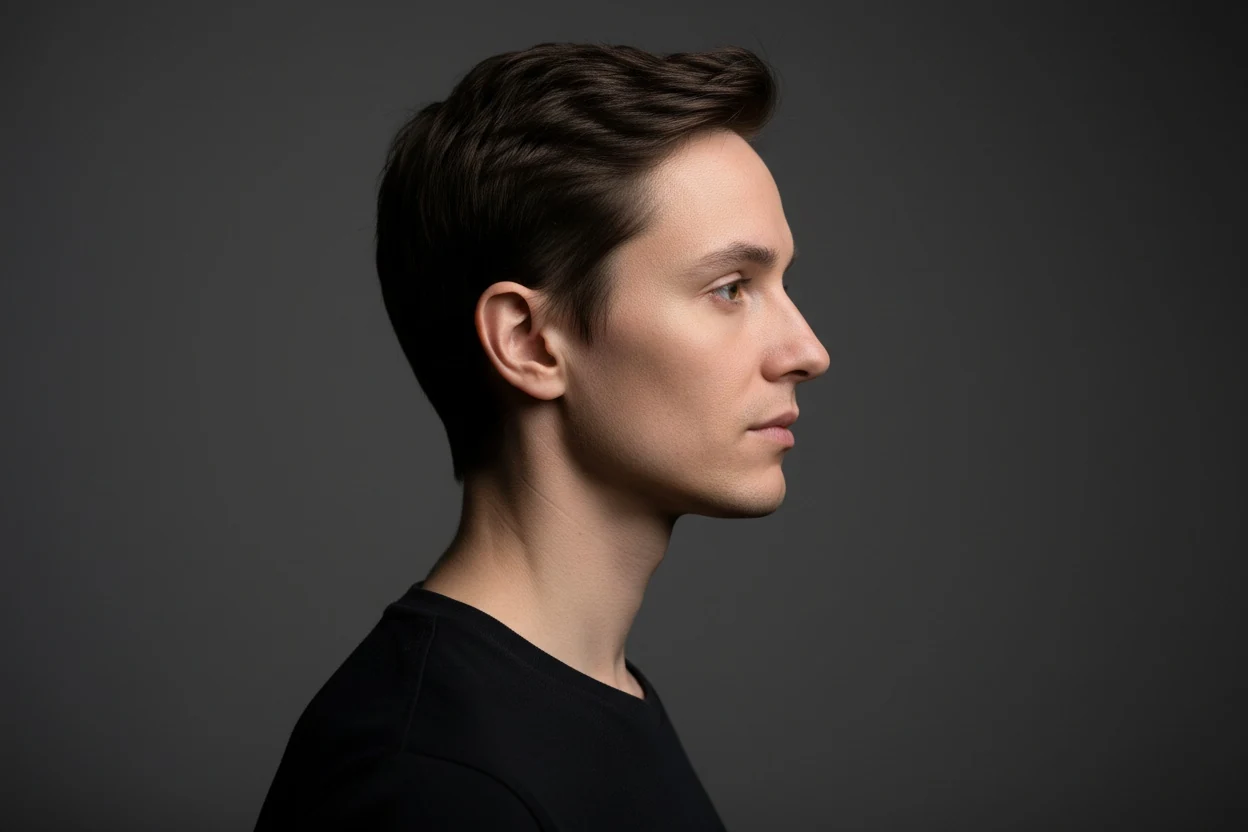
Does the detector work on a side profile?
No. Every measurement is a width read against face length, and a turned head compresses the widths. In our test all 102 faces read oblong from a three-quarter angle, so it needs a straight-on photo.
Does hair or a beard change the result?
It can. The jaw landmarks follow the visible lower outline of the face, and a full beard changes that outline, so a heavy beard can widen the measured jaw and push a borderline result toward square. Hair over the forehead or cheeks does the same to the upper widths, so pull it back.
Why did I get a different face shape on another site?
Tools use different landmark points for the same named measurement and different cut points, and many borrow the tape-measure ratios, which assume a hairline the photo model cannot see. A face near a boundary will flip between labels as a result.
Can my face shape change over time?
Slowly, yes. The facial skeleton itself changes with age, with bone resorbing in parts of the midface, around the eye sockets and in front of the jaw, and soft tissue and weight change the outline on top of that. A result from ten years ago is worth re-running.
Is face shape genetic?
Largely. Twin studies using 3D face scans find that facial geometry is strongly heritable, which is why face shape tends to run in families. Weight, age and posture still change how the outline reads in a photo.
References
- 1.DeBruine, L., & Jones, B. (2021). Face Research Lab London Set [Data set]. figshare. doi:10.6084/m9.figshare.5047666.
- 2.Kartynnik, Y., Ablavatski, A., Grishchenko, I., & Grundmann, M. (2019). Real-time facial surface geometry from monocular video on mobile GPUs. CVPR Workshop on Computer Vision for Augmented and Virtual Reality. doi:10.48550/arXiv.1907.06724.
- 3.Farkas, L. G. (1994). Anthropometry of the Head and Face (2nd ed.). Raven Press.
- 4.Mendelson, B., & Wong, C. H. (2012). Changes in the facial skeleton with aging: implications and clinical applications in facial rejuvenation. Aesthetic Plastic Surgery, 36(4), 753–760. PMID 22580543.
- 5.Tsagkrasoulis, D., Hysi, P., Spector, T., & Montana, G. (2017). Heritability maps of human face morphology through large-scale automated three-dimensional phenotyping. Scientific Reports, 7, 45885. doi:10.1038/srep45885.