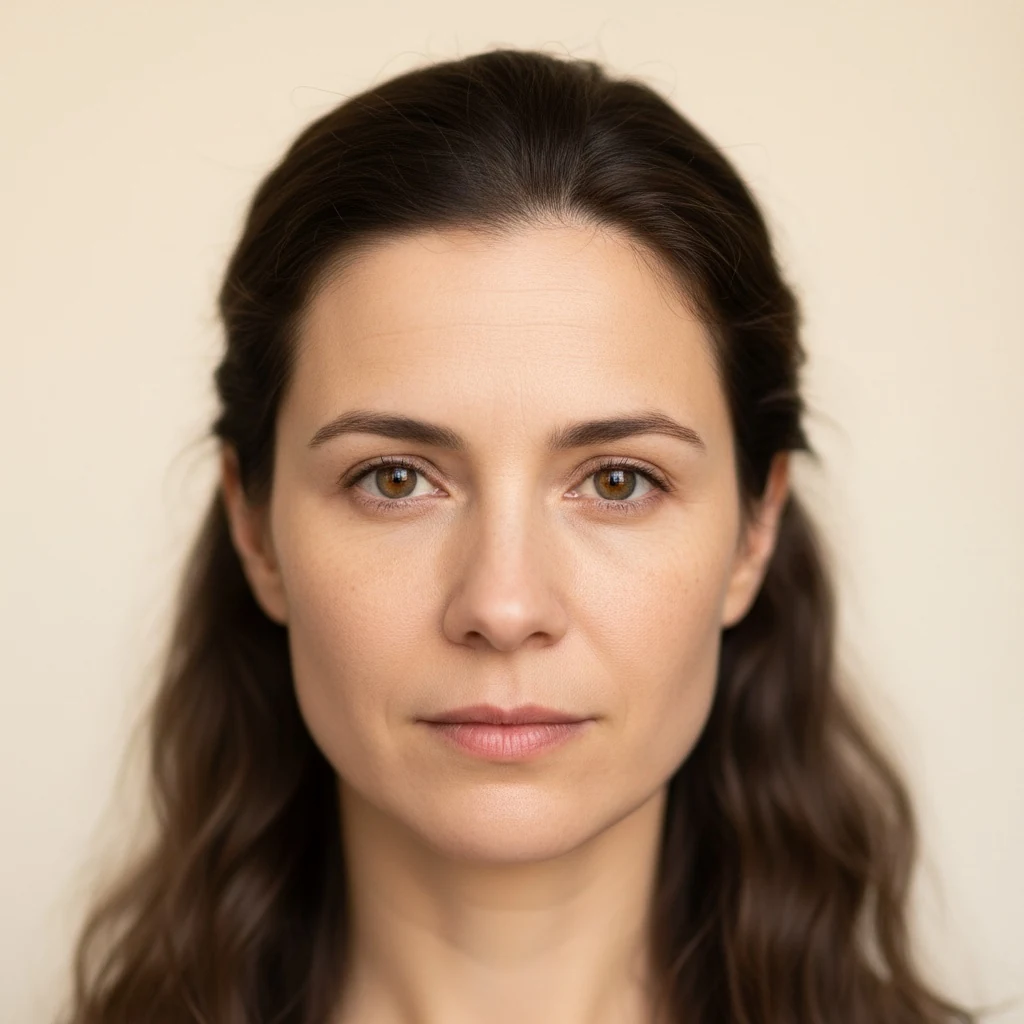
Golden Ratio Face Calculator
The measurement is real; the beauty claim built on it is not supported. This calculator reports how close three facial proportions sit to phi (1.618). When we ran it on 102 research faces rated by 2,513 people, the golden ratio score and the ratings were unrelated (Spearman ρ = −0.10, 95% CI −0.28 to +0.09), and published studies mostly agree.
- 1.618
- phi
- 3
- proportions compared
- ρ −0.10
- vs 2,513 raters
- 102
- reference faces
 Example
Choose your own photo
See your score, symmetry and proportions.
Choose your own photoClick to choose a photo, or drop one here
Front-facing · Even lightingStraight-on, even lighting, at arm's length gives the most comparable reading.
Runs in your browser. Your photo is not uploaded.
Does the golden ratio really define a beautiful face?
- Three ratios are measured: face length to width, outer-eye spacing to nose width, and nose length to mouth width.
- Each ratio scores 100 at exactly 1.618 and loses one point per 1% distance from it.
- On 102 research faces the median golden ratio score was 56.4, and the median face length-to-width ratio was 1.18, not 1.618.
See what a change would actually look like
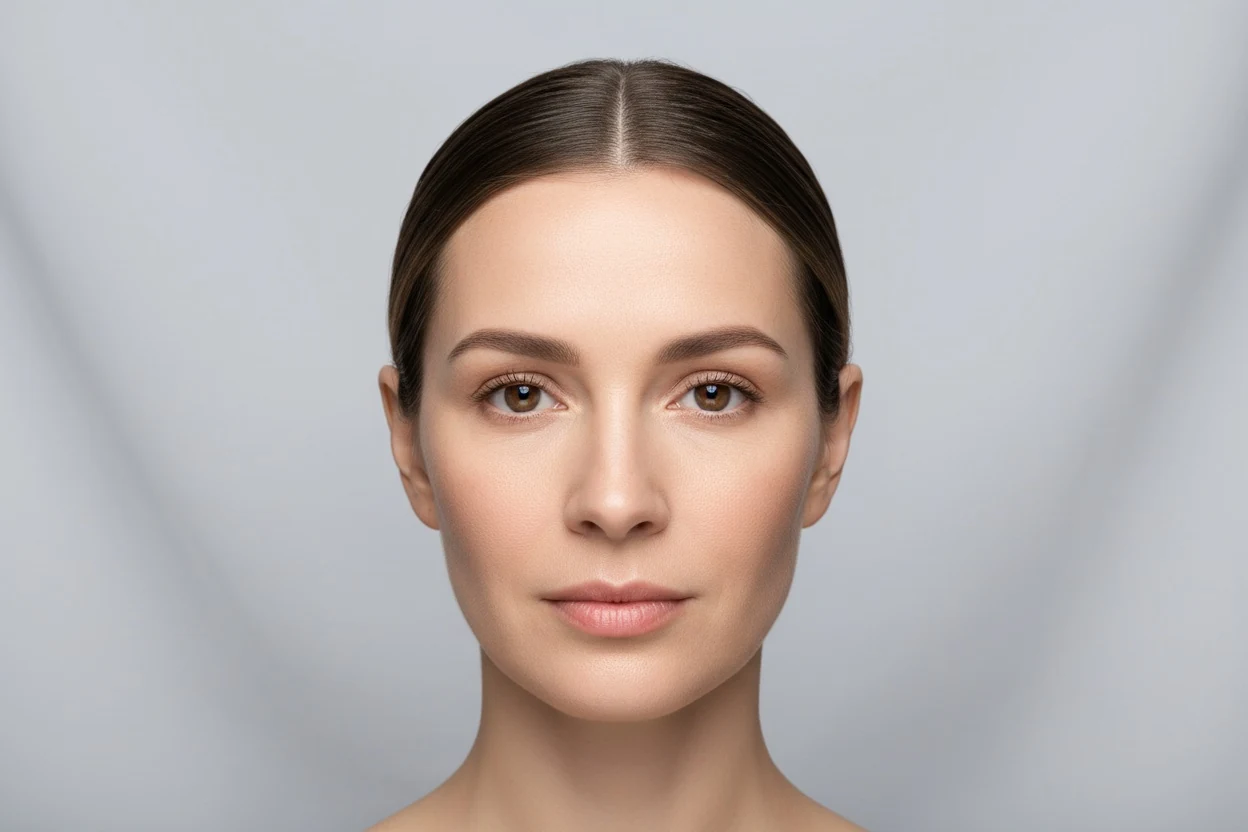
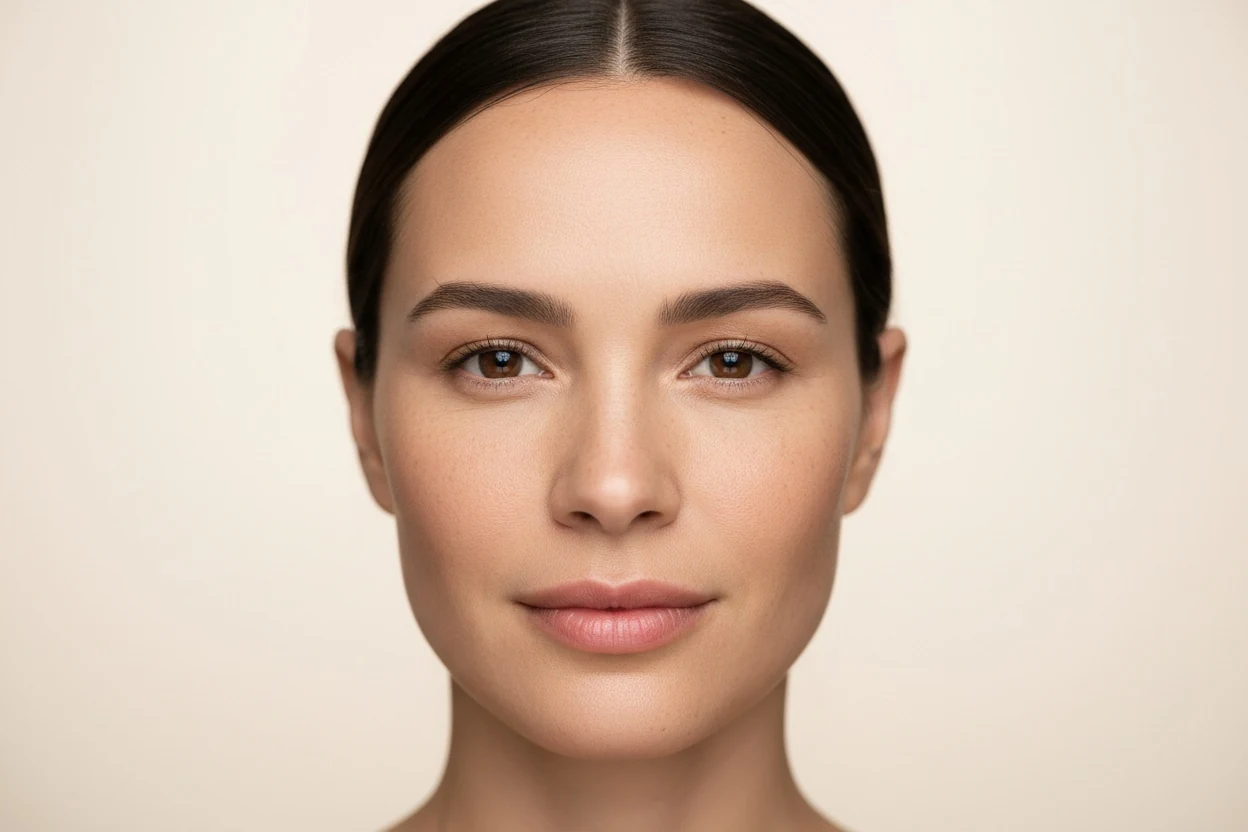
These are the renders that act on what this page measures. Each one below was generated by the same model that runs on your own photo — labelled examples on another face, so you can see what the procedure changes before you spend anything.
Rhinoplasty
AI glow-up · nose + styling
Rhinoplasty. A different possibility.
Tap the photo to enlarge. AI visualisation, not a prediction. Includes makeup, brow styling, hair and outfit changes. Both images are AI generated.
Changes the bridge, tip and nostril width of your nose.
What it does →Chin Augmentation
Chin Augmentation · AI example
Chin Augmentation. A different possibility.
Tap the photo to enlarge. AI visualisation, not a prediction. Both images are AI generated.
Changes chin projection and length.
What it does →Lip Filler
Lip Filler · AI example
Lip Filler. A different possibility.
Tap the photo to enlarge. AI visualisation, not a prediction. Both images are AI generated.
Changes the volume and shape of your lips.
What it does →
Every “after” above is an AI simulation on a sample face, not a photograph of a surgical result — it shows the direction a procedure moves a face, not an outcome anyone achieved and not a prediction of yours. Where a frame reads “Before · AI example”, the before image is generated too: the same portrait with the condition that procedure treats added, because none of the source photographs had it. Run one on your own photo.
What is the golden ratio face? Phi 1.618 and the divine proportion
Phi is 1.6180339… — the number you get when a line is divided so that the whole relates to the longer part exactly as the longer part relates to the shorter. The name “divine proportion” comes from Luca Pacioli's 1509 book De divina proportione, illustrated by Leonardo da Vinci; the book is about geometry, not faces.
A “golden ratio face” is the modern idea that a beautiful face repeats phi between its features — most often face length against face width, sometimes mouth width against nose width, or a dozen other pairs. Different phi canons pick different pairs, and none of them agree on a single list. The best known is Stephen Marquardt's phi mask, a template of lines claimed to fit an ideal face.
“Golden section face”, “face phi ratio”, “golden proportion face” and “face beauty ratio” are the same idea under different names. This page measures it, and then shows how well it holds up.
How this golden ratio face calculator measures phi
The tool finds 478 landmark points on your face with Google's MediaPipe face mesh, running in your browser. From six pairs of those points it builds three ratios and compares each to 1.618.
| Ratio shown | Top of the fraction | Bottom of the fraction | Phi target |
|---|---|---|---|
| Face length to width | Top of the forehead to the bottom of the chin | Cheekbone edge to cheekbone edge | 1.618 |
| Eye spacing to nose width | Outer corner of the left eye to outer corner of the right | Nostril edge to nostril edge | 1.618 |
| Nose length to mouth width | Bridge between the eyes to the tip of the nose | Mouth corner to mouth corner | 1.618 |
How a ratio becomes a 0–100 phi score
Each ratio's score is 100 minus its percentage distance from phi. A ratio of exactly 1.618 scores 100. A ratio 10% away from 1.618 in either direction — 1.456 or 1.780 — scores 90. Anything 100% or more away scores 0. The score does not say whether you are above or below phi, only how far away you are.
The face length is taken from the highest point the mesh detects on the forehead, which sits below the hairline. Classical canons measure from the hairline, so a real face reads shorter here than in a hand measurement. That is one reason the faces in our test set sat far below 1.618 on this ratio (see the table further down).
What the big score out of 10 on the result card is
The large number is not a golden ratio score. It is the site's overall proportion score — symmetry weighted 40% and these three ratios 20% each — converted to where you sit among 102 adult research faces, on a 1–10 scale where 5.5 is the middle of that set. The three phi scores underneath it are the golden ratio part. For left-right balance on its own, the face symmetry test breaks symmetry down pair by pair.
We tested the golden ratio face score against 2,513 human ratings
If the golden ratio described beauty, faces closer to phi should be rated as more attractive. We checked that directly. We ran this calculator's own measurement code on the 102 adult faces of the Face Research Lab London Set (49 women, 53 men), a research photo set published under an open licence. Every face in it has been rated for attractiveness from 1 to 7 by 2,513 people. On that scale the median face scored 2.96, with the middle 80% between 2.13 and 3.95.
We then ranked the faces twice — once by the calculator's golden ratio score (the average of the three phi scores), once by the people's average rating — and measured how well the two rankings agree (Spearman's ρ, where 0 means no relationship and 1 means identical order). The bracket is a bootstrap 95% confidence interval.
| What we compared with the human rating | Spearman ρ [95% CI] | Women / men separately | What it means |
|---|---|---|---|
| Golden ratio score (this calculator) | −0.10 [−0.28, +0.09] | −0.04 / +0.03 | No relationship found |
| Facial symmetry | +0.09 [−0.12, +0.28] | +0.11 / +0.10 | No relationship found |
| Overall score (symmetry + three ratios) | −0.07 [−0.27, +0.12] | — | No relationship found |
| Closeness to the average face of the same sex (13 ratios) | +0.21 [+0.01, +0.39] | Measured within each sex | Weak, positive |
In these 102 faces, how close a face sat to phi told us nothing about how attractive people found it. The interval for the golden ratio score runs from −0.28 to +0.09 and includes zero, and the split by sex is flat. This is one set of mostly young adults photographed in London, so it does not prove phi is irrelevant everywhere — but it gives no support to the idea that a higher golden ratio score means a better-looking face.
The one measure that did lean the right way was averageness: faces whose proportions were closer to the average of their own sex were rated slightly higher. That matches Langlois and Roggman's 1990 finding that averaged faces are judged attractive. It is a weak effect, and it was weaker again on the smiling photos.
Golden ratio of beauty: what published research found
Our result is in line with most of the published work that has actually measured faces against ideal ratios and compared them with ratings. The claim that phi defines beauty rests mainly on assertion and on selected examples, not on studies that tested it.
| Study | What was measured | What it found |
|---|---|---|
| Farkas et al., 1985 | Nine neoclassical facial canons in 153 young adults | The canons fit only some faces and do not represent average facial proportions; the vertical profile canons, which include equal thirds, fitted worst |
| Holland, 2008 | Marquardt's phi mask against real face samples | The mask best describes masculinised white women as seen in fashion models, and fits non-European faces poorly |
| Kiekens et al., 2008 | 27 ideal frontal ratios and 26 profile angles, 64 adolescents, 76 raters | Only 2 ratios and 3 angles were related to how attractive the faces were rated |
| Pallett et al., 2010 | Eye-to-mouth distance and eye spacing varied on the same faces | Attractiveness peaked at about 36% of face length and 46% of face width — the proportions of an average face, not phi |
| Anand et al., 2015 | 13 facial ratios in 100 adults in Moradabad, India | Most mean ratios differed significantly from phi; phi should not be the only measure of beauty |
| Zwahlen et al., 2022 | 77 golden ratio, canon and ideal measurements on 3-D photos, 161 raters in Hong Kong | Only a few of the recommended ideal parameters correlated with attractiveness |
| Naini, 2024 | Review of golden ratio claims in the clinical literature | No convincing evidence links the golden ratio to idealised human proportions or facial beauty |
What phi is still useful for is being a fixed reference. The target never moves, so the same face photographed the same way gives the same number — which makes it a proportion you can compare over time, not a verdict on how you look. For a broader read that does not rest on phi, the attractiveness test uses the same measurements alongside what they can and cannot tell you.
Perfect face ratio and face beauty ratio: what real faces measure
The “perfect face ratio” usually means a face 1.618 times as long as it is wide. Real faces, measured the way this calculator measures them, are nowhere near that. In the 102 London faces the median face length-to-width ratio was 1.18, and 90% of faces measured 1.23 or less. A face at the median scores about 73 on that ratio.
| Measurement (102 research faces) | Low (10th percentile) | Median | High (90th percentile) |
|---|---|---|---|
| Face length ÷ cheekbone width | 1.12 | 1.18 | 1.23 |
| Golden ratio score (average of the three phi scores) | 52.6 | 56.4 | 60.6 |
| Facial symmetry | 92.4% | 96.4% | 98.0% |
| Human attractiveness rating (1–7) | 2.13 | 2.96 | 3.95 |
So a golden ratio score in the mid-50s is ordinary, and a result near 60 is already at the high end of this set. Because it did not track the human ratings, a higher number is not a better face — it only means your three proportions sit closer to one chosen constant.
Facial thirds vs the golden ratio: two different rules
Facial thirds are often mixed up with the divine proportion, but they are a separate classical rule. The thirds canon splits the face into three bands — hairline to brow, brow to the base of the nose, nose base to chin — and says they should be equal, 1:1:1. Phi says one part should be 1.618 times another. A face cannot follow both on the same vertical line.
Farkas and colleagues found the vertical equal-part canons to be the weakest fit of all the neoclassical rules in real young adults. This calculator does not score your thirds; the dedicated facial thirds tool measures each band as a share of face height.
To run a facial thirds test on your photo, use the facial thirds calculator. It works the same way — in your browser, without uploading the photo.
Golden ratio face calculator: upload a photo without uploading it
The face mesh model downloads to your browser and the arithmetic runs on your device. There is no request carrying your image, no storage bucket, and no copy of your face kept anywhere.
You can confirm it. Open your browser's network panel, run the calculator and watch: the model file comes down, and nothing containing your photo goes up.
Golden ratio face celebrities: why the published percentages don't hold up
Articles claiming a specific actor scored 94% on the golden ratio are almost always measuring a retouched press photo shot on a long lens under controlled light, with a method that is not published. Change the camera distance and the same face returns a different number: a mathematical model of selfie distortion showed that short camera distances make the nose look larger, and two of the three ratios here use the nose.
For a reading you can actually compare over time, keep the conditions constant: straight on, arm's length or further, even light, no filter. The measurement is precise; the photograph is the loose part.
Tips for an accurate golden ratio measurement
- Face the camera squarely — all three ratios are frontal measurements and rotation distorts them.
- Hold the phone at arm's length or further. Close selfies make the nose look larger, and two of the three ratios use the nose.
- Neutral expression. A smile widens the mouth, which directly moves the nose-to-mouth ratio.
- Keep the same distance and light every time you re-run it, so the numbers are comparable.
- Even lighting, fringe off the forehead, no filter.
Golden Ratio Face Calculator — frequently asked questions
Is this golden ratio face calculator free?
Yes. The golden ratio test runs online in your browser with no account and no sign-up, and the three phi scores and the overall result are free. Paid credits apply only to the optional AI simulation, which is a separate step.
How do I calculate the golden ratio of my face?
Upload or take a straight-on photo and press analyse. The calculator finds 478 landmarks, measures face length against cheekbone width, outer-eye spacing against nostril width, and nose length against mouth width, then scores each ratio by how close it is to 1.618.
How can I check the golden ratio of my face by hand?
On a straight-on photo, measure face length and face width with a ruler, divide length by width, and compare the result to 1.618. Do the same for any other pair you want to test. Hand results will differ from the calculator's, mostly because a ruler starts at the hairline while the face mesh starts at the top of the detected forehead.
What is the divine proportion of the face?
It is another name for the golden ratio, phi, about 1.618. Applied to faces it means the claim that attractive faces repeat 1.618 between features, such as length to width. The name comes from a 1509 geometry book by Luca Pacioli, not from any study of faces.
What is the face beauty ratio?
Usually the golden ratio, 1.618, applied to the face — most often face length divided by face width. Some sites use it for a broader set of phi proportions. When we compared this calculator's golden ratio score with 2,513 people's ratings of 102 faces, we found no relationship (Spearman ρ = −0.10).
What is the perfect face ratio?
In the classical claim it is a face 1.618 times as long as it is wide. Measured from the top of the detected forehead, as here, real faces are much closer to square: the median of 102 research faces was 1.18. Ninety per cent of them measured 1.23 or less.
What is a good golden ratio face score?
On 102 research faces, the golden ratio score (the average of the three phi scores) had a median of 56.4, with the middle 80% between 52.6 and 60.6. So the mid-50s is typical. The number did not track how attractive people rated those faces, so a higher score is not a better face.
What does the score out of 10 mean on the golden ratio test?
It is the site's overall proportion score — symmetry 40% plus the three phi ratios 20% each — expressed as where you sit among 102 adult research faces, on a 1 to 10 scale. A 5.5 is the middle of that set. It is a ranking of measurements, not an attractiveness rating.
Is phi 1.618 the ideal face length to width?
It is the traditional claim, not a measured ideal. Studies that compared faces with ideal ratios found few ratios related to attractiveness, and one found people preferred the proportions of an average face instead. A 2024 review concluded there is no convincing evidence linking the golden ratio to facial beauty.
Does the golden ratio really determine facial beauty?
No. In our own test of 102 faces rated by 2,513 people, the golden ratio score and the ratings were unrelated. Published studies mostly agree, and averageness showed a weak link where phi showed none. Phi's value here is as a fixed reference you can compare between photos.
Is the facial thirds test part of the golden ratio?
No. Facial thirds is a separate rule that says the upper, middle and lower thirds of the face should be equal, 1:1:1, while phi is 1.618:1. This calculator does not score thirds. The site's facial thirds calculator measures each band as a share of face height.
Is the golden ratio different for male and female faces?
The target is the same 1.618 for everyone, and the calculator does not ask your sex. In our test the golden ratio score was unrelated to ratings for women (ρ = −0.04) and for men (ρ = +0.03) alike.
Who has the most golden ratio face?
Celebrity lists usually come from a cosmetic surgeon's press release that measures a retouched photo with an unpublished method, so the percentages cannot be checked or reproduced. Photo distance alone changes the numbers. Treat the rankings as entertainment rather than measurement.
Is this a golden ratio AI app?
The landmark detection is a machine-learning model (MediaPipe face mesh) that runs in your browser, so in that sense it is AI. The golden ratio scores themselves are plain arithmetic on those points, and the same photo gives the same result every time. It works on phones, so no separate app is needed.
Why is my face phi ratio different in another calculator?
Different tools pick different landmark points for the same named measurement — some use the hairline for face length, others the brow, and many pick different pairs of features altogether. Neither is wrong, but the numbers are not interchangeable between tools.
Is there a golden ratio for the side profile?
Not a validated one. This calculator uses only frontal measurements, and a profile photo puts its landmarks on the wrong plane, so use a straight-on shot. Profiles are usually described with angles, such as the nasolabial angle, rather than phi.
Is this the same as the Marquardt golden ratio mask?
No. The calculator does not lay a mask or template over your face; it measures three distances and reports how close each ratio is to 1.618. Marquardt's phi mask has been criticised for describing the faces of fashion models and fitting non-European faces poorly.
Is the golden ratio the same as facial harmony or fWHR?
No. Facial width-to-height ratio (fWHR) divides cheekbone width by upper-face height and has no phi target. “Facial harmony” scores are usually a blend of symmetry and several ratios. This page reports only closeness to 1.618, with symmetry shown separately.
Can I change my golden ratio proportions?
Most of these distances are set by bone, so grooming and exercise do not move them in a measurable way. Photo conditions move them much more: camera distance, head tilt and expression all shift the ratios. The optional simulation shows what a change in one area would look like, as an AI render rather than a prediction.
References
- 1.DeBruine, L., & Jones, B. (2021). Face Research Lab London Set (Version 5, 2021) [Data set]. figshare. CC BY 4.0. doi:10.6084/m9.figshare.5047666.
- 2.Langlois, J. H., & Roggman, L. A. (1990). Attractive faces are only average. Psychological Science, 1(2), 115–121. doi:10.1111/j.1467-9280.1990.tb00079.x.
- 3.Farkas, L. G., Hreczko, T. A., Kolar, J. C., & Munro, I. R. (1985). Vertical and horizontal proportions of the face in young adult North American Caucasians: revision of neoclassical canons. Plastic and Reconstructive Surgery, 75(3), 328–338. PMID 3883374.
- 4.Holland, E. (2008). Marquardt's Phi mask: pitfalls of relying on fashion models and the golden ratio to describe a beautiful face. Aesthetic Plastic Surgery, 32(2), 200–208. PMID 18175168.
- 5.Kiekens, R. M., Kuijpers-Jagtman, A. M., van 't Hof, M. A., van 't Hof, B. E., Straatman, H., & Maltha, J. C. (2008). Facial esthetics in adolescents and its relationship to “ideal” ratios and angles. American Journal of Orthodontics and Dentofacial Orthopedics, 133(2), 188.e1–188.e8. PMID 18249280.
- 6.Pallett, P. M., Link, S., & Lee, K. (2010). New “golden” ratios for facial beauty. Vision Research, 50(2), 149–154. PMID 19896961.
- 7.Anand, S., Tripathi, S., Chopra, A., Khaneja, K., & Agarwal, S. (2015). Vertical and horizontal proportions of the face and their correlation to phi among Indians in Moradabad population: a survey. Journal of Indian Prosthodontic Society, 15(2), 125–130. PMID 26929498.
- 8.Zwahlen, R. A., Tang, A. T. H., Leung, W. K., & Tan, S. K. (2022). Does 3-dimensional facial attractiveness relate to golden ratio, neoclassical canons, ‘ideal’ ratios and ‘ideal’ angles? Maxillofacial Plastic and Reconstructive Surgery, 44(1), 28. PMID 36070018.
- 9.Naini, F. B. (2024). The golden ratio — dispelling the myth. Maxillofacial Plastic and Reconstructive Surgery, 46(1), 2. PMID 38228978.
- 10.Ward, B., Ward, M., Fried, O., & Paskhover, B. (2018). Nasal distortion in short-distance photographs: the selfie effect. JAMA Facial Plastic Surgery, 20(4), 333–335. PMID 29494735.