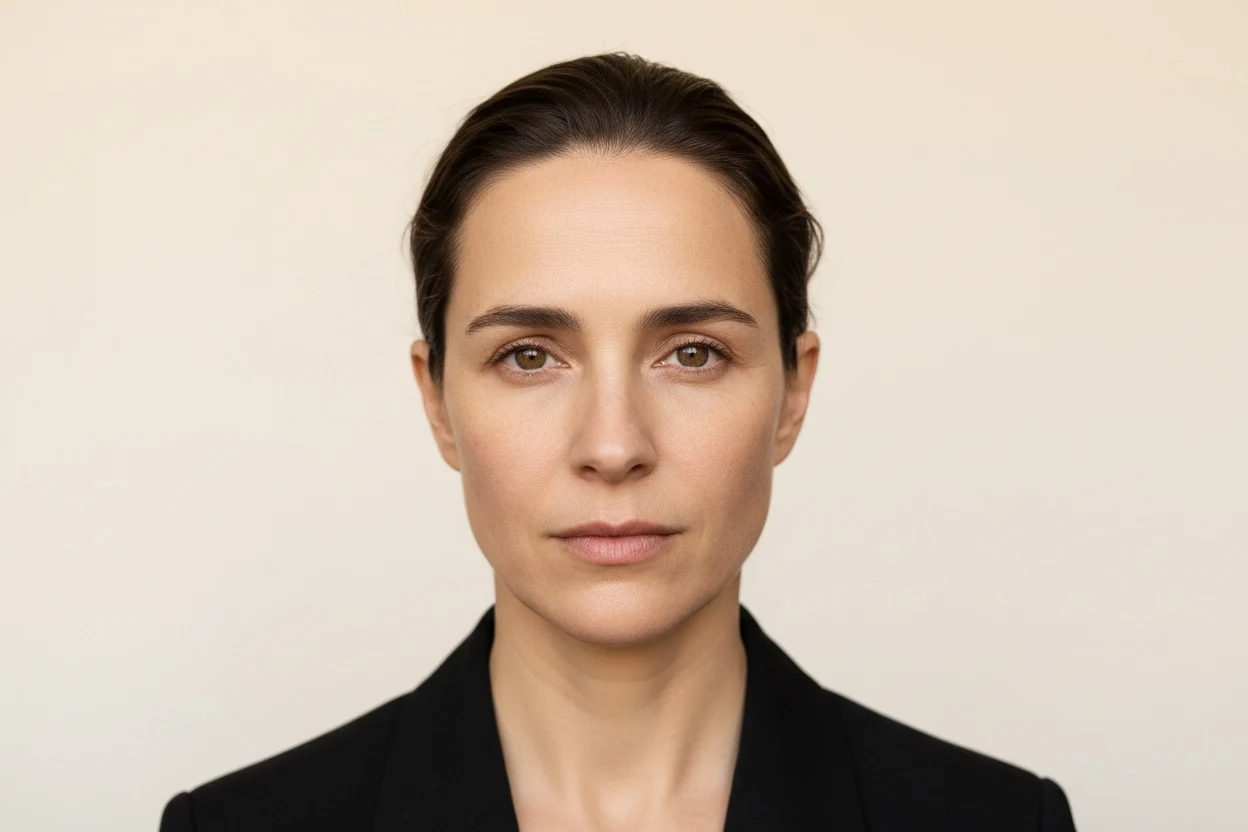
Seasonal Color Analysis
Seasonal color analysis sorts a person's natural colouring into one of 12 categories named after the 4 seasons, based on 3 properties: whether the colouring is warm or cool, light or deep, and bright or soft. Each category comes with a palette of colours predicted to sit well against that combination. It is a styling framework rather than a scientific one, and this test reads it from skin, eye and hair colour in your browser.
- 12
- seasonal categories
- 3
- colour axes
- Free
- photo not uploaded
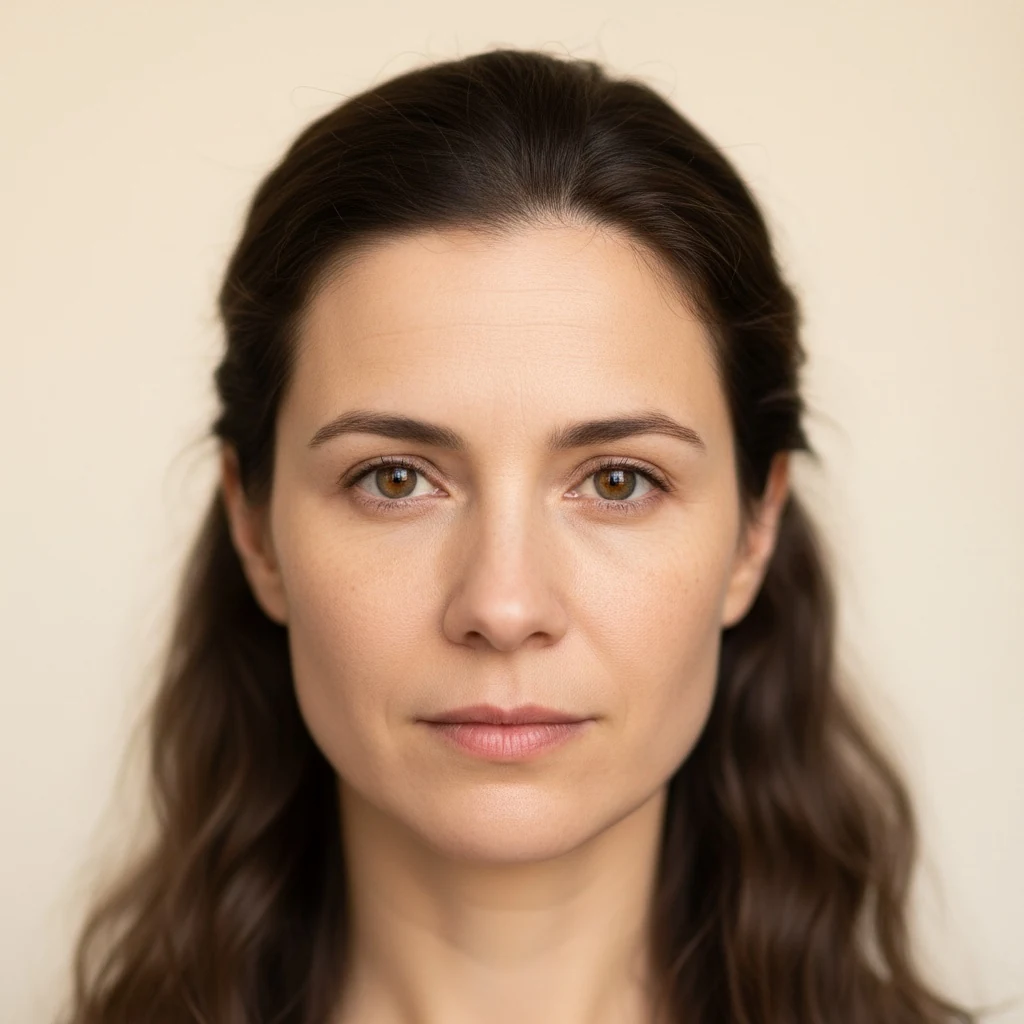 Example
Choose your own photo
Find your color season and palette.
Choose your own photoClick to choose a photo, or drop one here
Front-facing · Even lightingStraight-on, even lighting, at arm's length gives the most comparable reading.
Runs in your browser. Your photo is not uploaded.
Light Spring color palette
Warm · light · moderately clear
True Spring color palette
Warm · balanced value · clear
Bright Spring color palette
Warm · high contrast · vivid
Light Summer color palette
Cool · light · softly muted
True Summer color palette
Cool · balanced value · muted
Soft Summer color palette
Cool · medium value · very muted
Soft Autumn color palette
Warm · medium value · very muted
True Autumn color palette
Warm · balanced value · rich and muted
Deep Autumn color palette
Warm · deep · rich
Bright Winter color palette
Cool · high contrast · vivid
True Winter color palette
Cool · balanced-to-deep · clear
Deep Winter color palette
Cool · deep · clear
What is seasonal color analysis?
- The system grew out of four seasons popularised in 1980s colour consulting and was later split into twelve subtypes.
- The three axes are borrowed from colour theory: hue, value and chroma.
- A professional analysis is done by draping fabric under the face in neutral daylight, because judging colour under coloured light is unreliable.
- Photographic white balance shifts measured skin hue enough to move a reading between seasons, which is why the light matters more than the camera.
See what a change would actually look like
Your season is a colour reading, not a structural one, so nothing here follows from it. These renders change skin rather than proportion — the part of a face colour analysis is actually about.
Glass Skin
Glass Skin · AI example
Glass Skin. A different possibility.
Tap the photo to enlarge. AI visualisation, not a prediction.
Changes skin clarity, pore visibility and redness, without changing your features.
What it does →Skin Resurfacing
Skin Resurfacing · AI example
Skin Resurfacing. A different possibility.
Tap the photo to enlarge. AI visualisation, not a prediction. Both images are AI generated.
Changes texture, pores and surface lines.
What it does →Glow Up Pack
Glow Up Pack · AI example
Glow Up Pack. A different possibility.
Tap the photo to enlarge. AI visualisation, not a prediction.
What Changed & Why · Annotated AI example
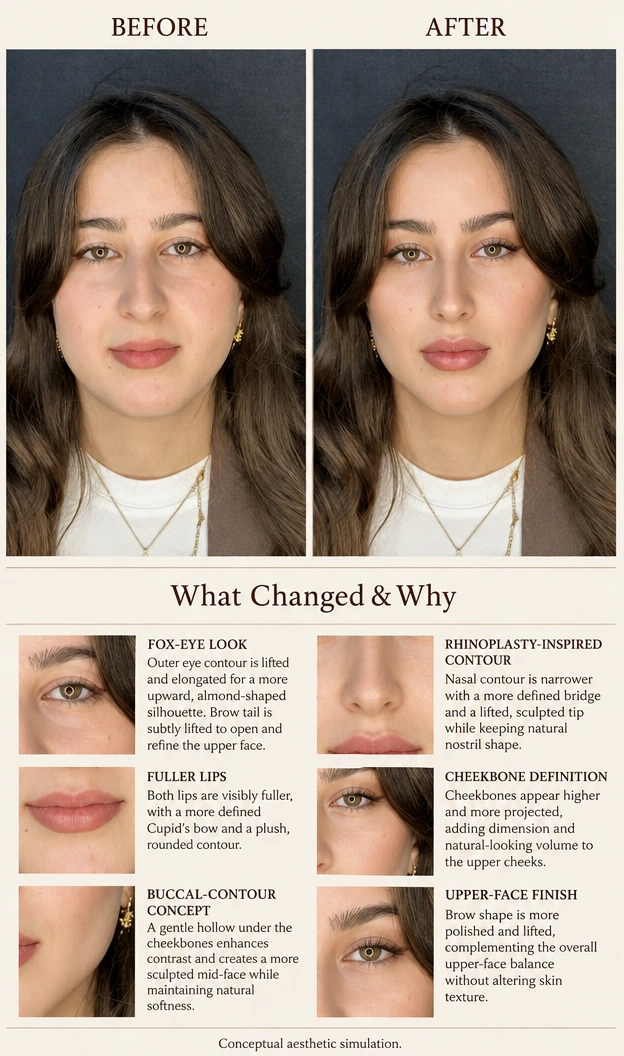
Conceptual aesthetic simulation. Another face, not your result.
Changes several changes at once, as one render.
What it does →
Every “after” above is an AI simulation on a sample face, not a photograph of a surgical result — it shows the direction a procedure moves a face, not an outcome anyone achieved and not a prediction of yours. Where a frame reads “Before · AI example”, the before image is generated too: the same portrait with the condition that procedure treats added, because none of the source photographs had it. Run one on your own photo.
How seasonal color analysis works
Three properties decide a season. Temperature is whether your colouring leans warm — golden, peach, amber — or cool, toward pink, ash and blue. Value is how light or deep it is overall, taken mostly from your hair, since the same skin tone appears with both very light and very dark hair and the palette changes with it. Chroma is whether your colouring is bright and clear or soft and muted, which is largely a question of how much contrast there is between your hair and your skin and how saturated your irises are.
Temperature picks the family: spring and autumn are the warm ones, summer and winter the cool ones. Whichever of the remaining two axes is more pronounced then picks the subtype — a cool face that is mostly notable for being light is a Light Summer, a cool face that is mostly notable for its contrast is a Bright Winter. If neither axis is pronounced, you sit in the middle of your family, which is what the True seasons are. This tool reports all three axis values, not just the label, so you can see which one made the decision and how close the call was.
Why the light in your photo decides your color analysis
This is the part almost every free colour analysis skips, and it is the part that determines whether the result is worth anything. A camera records the colour of your skin multiplied by the colour of the light falling on it. Tungsten bulbs are strongly orange, overcast daylight is blue, open shade under a clear sky is bluer still, and phone cameras apply their own automatic white balance on top, guessing at the light from the whole frame. The same face photographed in a warm kitchen and by a north-facing window can measure a full season apart.
A professional colour analyst solves this by working in controlled daylight with a neutral drape and no coloured walls. This tool solves it differently: it looks for something in the frame that ought to be neutral and corrects against it. The sclera — the white of your eye — is close enough to neutral to serve as a grey card you are already carrying. When the whites of your eyes are clearly visible, the channels are scaled so that they read neutral and everything else moves with them. When they are not, no correction is applied and the result is labelled uncorrected, with the confidence lowered to match. An uncorrected reading is still worth looking at, but it is describing your light as much as your colouring.
The three axes: warm-cool, light-deep, bright-soft
The warm-cool axis comes from the hue angle of your skin in CIE Lab, a perceptually organised colour space, with your hair casting a second vote. Human skin is warm in absolute terms regardless of season — the question is only which side of the typical band yours sits on. That is why an eyeballed guess about undertone is so unreliable and why the veins-in-your-wrist test gives people different answers on different days.
The light-deep axis takes skin lightness and hair lightness together, weighted toward hair. The bright-soft axis takes the saturation of your irises and the contrast between your hair and your skin. Both of those are what a draping session is testing when the analyst holds up a clear colour and then a muted one: they are watching whether the face or the fabric wins. Reported as numbers between minus one and plus one, an axis value near zero means the call was close, and a season built on a near-zero axis should be held loosely.
The twelve seasons
Spring is warm and clear, running from Light Spring through True Spring to Bright Spring as contrast increases. Summer is cool and muted: Light Summer at the pale end, True Summer in the middle, Soft Summer where the contrast between hair and skin is lowest. Autumn is warm and rich, from Soft Autumn through True Autumn to Deep Autumn as the colouring darkens. Winter is cool and strong, spanning Bright Winter, True Winter and Deep Winter.
The neighbouring seasons across a family boundary are much closer to each other than the ones at opposite ends of the same family. A Soft Summer and a Soft Autumn share the muted quality and differ only in temperature; a Soft Summer and a Bright Winter are both cool and have almost nothing else in common. If your result feels wrong, the useful thing to try is the season next to yours on the axis that scored closest to zero, not a different family altogether.
What season am I? Reading your result
Start with the confidence figure and the white balance note. A corrected reading with hair and eyes both read is the strongest version of this measurement; an uncorrected one with no hair sample is the weakest, and the honest response to the weak version is to retake the photo rather than to trust the label. The three colour swatches show exactly what was sampled — if the skin swatch does not look like your skin, the sample landed somewhere it should not have, and nothing downstream of it is reliable.
Then read the axes rather than the name. Knowing that you are decisively cool and only mildly light is more actionable than the words Light Summer, because it tells you which direction to move when a colour does not work: away from warmth first, and only then toward or away from lightness. The palette is a starting set, not a boundary. Colours outside it are not forbidden and the ones inside it are not guaranteed, because how a colour reads also depends on its finish, the fabric and what is next to it.
Free color analysis versus a draping appointment
A professional analysis puts dozens of fabrics under your chin in controlled daylight while someone trained watches your face across all of them. That is a fundamentally better measurement than reading three colours out of one photograph, and it costs accordingly. What it gives you that this cannot is the response of your face to each colour, tested directly, rather than a prediction from three numbers.
What a free reading gives you is a starting point, a set of numbers you can repeat, and a reason for the answer. If you retake the photo in daylight facing a window and get the same season twice, that is meaningful. If you get a different one each time, that is meaningful too — it tells you your colouring sits near a boundary, which is common and which is exactly the case where paying for a draping session is worth it.
Tips for an accurate color analysis
- Daylight, facing a window, indirect. Direct sun blows out the skin and open shade under blue sky is strongly cool — both are worse than an overcast day.
- No filter, no beauty mode, no makeup on the face. Every one of them edits the exact numbers being measured, and phone beauty modes change skin hue without telling you.
- Eyes open with the whites visible. That is the neutral reference the correction runs on — without it the reading is not corrected at all.
- Hair down and visible above your forehead. If nothing readable sits above the hairline, the hair sample is skipped and two of the three axes lose their strongest input.
- Avoid a strongly coloured wall or top. Light bounces off both and lands on your face.
Seasonal Color Analysis — frequently asked questions
How do I know if I am warm or cool toned?
By comparing your skin's hue against the typical range rather than by eye. The wrist-vein test and the gold-versus-silver test both produce inconsistent answers because both are judgements made under whatever light you happen to be in. This tool reports the measured hue angle and where it sits on the axis, along with how decisive it was.
Can I do a colour analysis from a selfie?
Yes, with one condition: the light has to be accounted for. Face a window in daylight, use no filter, and make sure the whites of your eyes are visible so there is a neutral reference in frame. Without that, the reading describes your bulb as much as your face.
What is the most common season?
There is no reliable population figure, because the system has never been measured that way — it comes from styling practice rather than from research. What is true is that the True seasons and the soft ones are common outcomes, since most people are not extreme on any single axis.
Does my season change if I dye my hair?
The result will change, because hair carries a large share of the light-deep and bright-soft axes. Whether your season has changed is a matter of definition: the system is usually taught as describing natural colouring, but the palette that works on you day to day follows the hair you actually have.
Why did I get a different season from another test?
Most likely white balance. Two photos taken in different light will measure different skin hues, and most tools do not correct for it. Beyond that, some systems use different axis thresholds, and near a boundary a small difference in method flips the label.
Does a tan change my colour season?
It changes your measured skin depth, which is what the ITA figure reports, and can move you along the light-deep axis. Temperature is the more stable property, so a tanned reading usually keeps the same family and shifts the subtype.
References
- 1.Fink, B., Grammer, K., & Matts, P. J. (2006). Visible skin color distribution plays a role in the perception of age, attractiveness, and health in female faces. Evolution and Human Behavior, 27(6), 433–442. doi:10.1016/j.evolhumbehav.2006.08.007.
- 2.Chardon, A., Cretois, I., & Hourseau, C. (1991). Skin colour typology and suntanning pathways. International Journal of Cosmetic Science, 13(4), 191–208. PMID 19291061.
- 3.Rhodes, G. (2006). The evolutionary psychology of facial beauty. Annual Review of Psychology, 57, 199–226. PMID 16318594.