True Spring Color Palette
Warm · balanced value · clear · also called Warm Spring
Warmth is the defining quality — neither especially light nor especially deep. Golden, clear colours read as yours.
 Example
Choose your own photo
Find your color season and palette.
Choose your own photoClick to choose a photo, or drop one here
Front-facing · Even lightingStraight-on, even lighting, at arm's length gives the most comparable reading.
Runs in your browser. Your photo is not uploaded.
The True Spring color palette
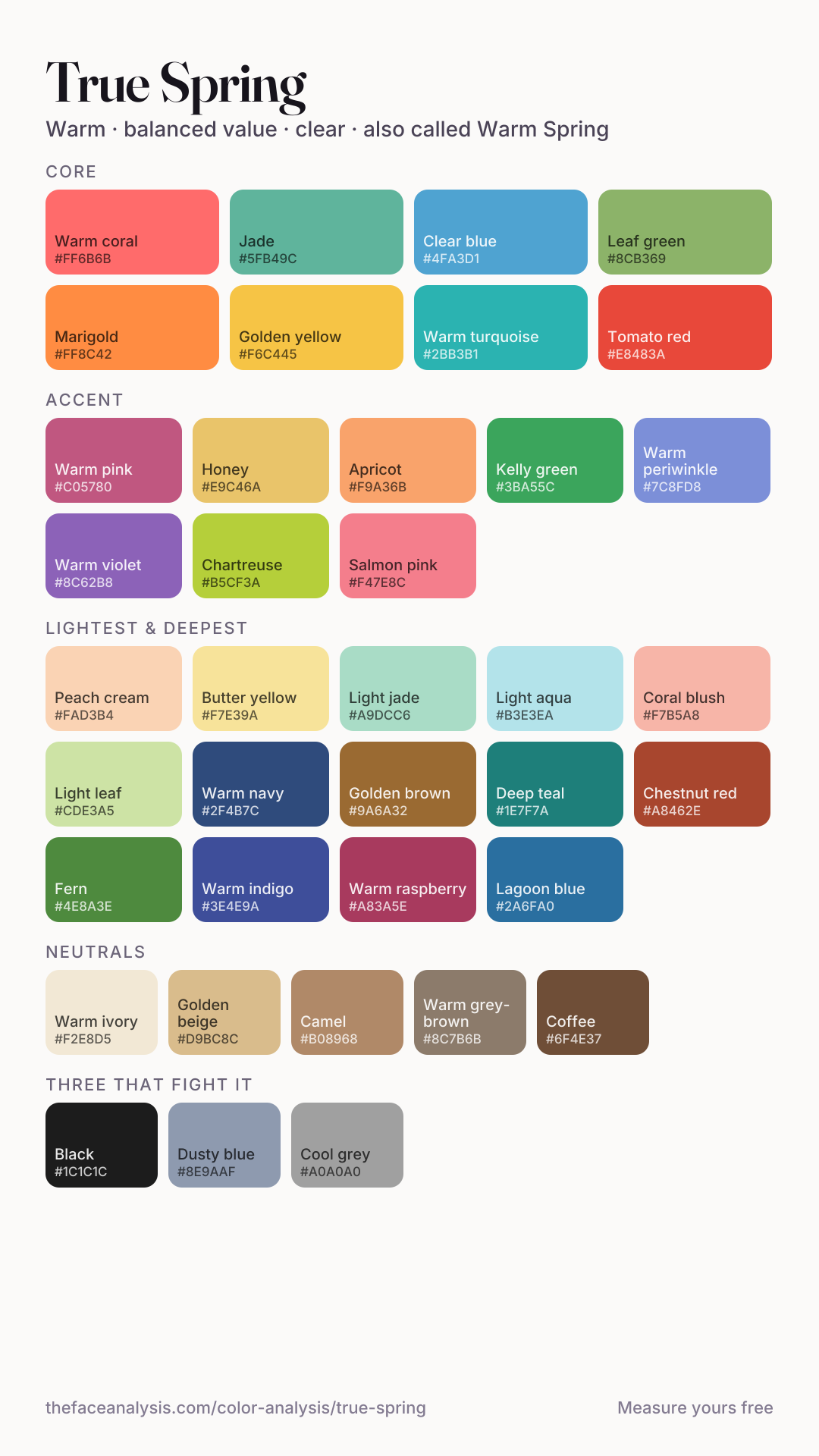
30 colours in four groups and 5 neutrals, each written out with its hex code — tap any code to copy it, or take a whole group at once. The same palette is available as a True Spring palette card (PNG) sized for a phone screen, to take shopping.
Core
- Warm coral
- Jade
- Clear blue
- Leaf green
- Marigold
- Golden yellow
- Warm turquoise
- Tomato red
Accent
- Warm pink
- Honey
- Apricot
- Kelly green
- Warm periwinkle
- Warm violet
- Chartreuse
- Salmon pink
Lightest
- Peach cream
- Butter yellow
- Light jade
- Light aqua
- Coral blush
- Light leaf
Deepest
- Warm navy
- Golden brown
- Deep teal
- Chestnut red
- Fern
- Warm indigo
- Warm raspberry
- Lagoon blue
True Spring core and accent colors
The eight core colours are True Spring's everyday wardrobe: warm coral, tomato red, marigold, golden yellow, leaf green, jade, warm turquoise and clear blue. They are warm, clear and medium in weight — cheerful without being neon, rich without being earthy. That is the season: warmth is the strongest thing about the colouring, and neither lightness, depth nor clarity is extreme.
Accents are warm pink, salmon pink, apricot, honey, kelly green, chartreuse, warm periwinkle and warm violet. True Spring can wear blue and purple, as long as they lean warm — a periwinkle or violet with some red in it rather than an icy lavender.
The lightest and deepest True Spring shades
The lightest shades — peach cream, butter yellow, coral blush, light leaf, light jade, light aqua — are for shirts and summer clothes. The deepest — warm navy, warm indigo, lagoon blue, deep teal, fern, chestnut red, warm raspberry and golden brown — are the True Spring darks. They have real depth without the heaviness of black or the earthiness of autumn browns.
True Spring neutrals
- Warm ivory
- Golden beige
- Camel
- Warm grey-brown
- Coffee
Five neutrals carry the wardrobe. Warm ivory replaces optic white; coffee and warm navy replace black; camel, golden beige and warm grey-brown fill the middle. Can True Spring wear black? Away from the face, yes; near it, coffee or warm navy give the same job with warmth in them.
What makes a True Spring: warm or cool, light or deep, soft or bright
True Spring is the centre of the warm-and-clear family: warmth is the defining property, and neither lightness nor contrast is extreme enough to take over. Skin has a golden or peachy warmth, hair usually runs golden blonde to warm mid-brown, and the eyes are often clear green, warm blue or golden hazel. Colours that are both warm and clean read as belonging here.
True Spring and Warm Spring are the same season. One family of the twelve-season system calls the middle subtype of each season True; the other names it by its defining quality, warmth. This page answers to both.
The test on this page turns three measurements into numbers between minus one and plus one. Warm–cool is mainly the hue angle of your skin in CIE Lab, with your hair counting for about a third. Light–deep is skin and hair lightness together, with hair weighted slightly more. Soft–bright is the saturation of your irises and the lightness gap between hair and skin, half each.
It calls you True Spring when warm–cool reads warm, neither of the other two axes gets past 0.3, and light–deep is zero or above. In plain terms: warmth is the only strong signal and the colouring sits slightly on the light side of the middle.
The rule shows how close the neighbours are. With light–deep below zero the same reading is True Autumn — the two warm True seasons are separated only by the sign of depth. Lightness past 0.3 makes it Light Spring, clarity past 0.3 Bright Spring, and softness past 0.3 Soft Autumn. A temperature shift from the light in the photo can move it into True Summer.
True Spring skin, eyes and hair
Skin — examples across depths
Eyes
Natural hair
These are examples, not a checklist. True Spring runs from fair to deep skin with a golden or peachy cast; what makes it is warmth with nothing else extreme — hair and eyes at medium depth, some clarity but not high contrast. Eye colour does not feed the warm–cool reading on this test, only soft–bright, so warm blue, green and brown eyes all belong.
Am I a True Spring? A drape test you can do at home
True seasons are diagnosed by exclusion — you are one when no second axis dominates.
- 1
Stand facing a window in daylight, with no coloured walls behind you and no makeup. Tie your hair back or cover it with a white towel.
- 2
Test temperature first. Cool grey against camel: camel should warm the face and grey should make it look tired. Then gold against silver — gold should win.
- 3
Then depth: true black against coffee. On a True Spring black looks heavy and coffee sits with the face. Very pale pastels should look slightly weak too; if they look best, check Light Spring.
- 4
Then clarity: a clean turquoise against a dusty sage. The turquoise should win. If the most saturated neon-bright version looks even better, check Bright Spring; if the dusty one wins, check Soft Autumn.
The depth test: a warm dark against a true dark. An illustration of a drape test — it shows the two colours, not a result on a real face.
The temperature test with neutrals. An illustration of a drape test — it shows the two colours, not a result on a real face.
- Warm beats cool clearly: gold jewellery, cream over optic white, camel over grey.
- But neither light nor deep wins outright — very pale pastels wash you out and very dark shades weigh you down about equally.
- And clear beats muted: a clean turquoise looks better on you than a dusty sage.
True Spring vs Bright Spring, Light Spring and True Autumn
| True Spring | Bright Spring | Light Spring | True Autumn | |
|---|---|---|---|---|
| Warm or cool | Warm | Warm | Warm | Warm |
| What decides it on this test | Warmth alone | Clarity | Lightness | Warmth alone |
| Depth | Medium, slightly light | Varies — contrast matters more | Light | Medium, slightly deep |
| Clarity | Clear | Vivid | Clear, gentle | Rich |
| One-colour test | Warm coral beats hot coral | Hot coral beats warm coral | Pale peach beats marigold | Rust beats warm coral |
| Darkest neutral | Coffee | Deep navy | Warm navy | Espresso |
| Metal | Yellow gold, copper, bronze | Bright polished gold | Light or brushed gold | Yellow gold, copper |
True Spring
Bright Spring
Light Spring
True Autumn
True Spring vs Bright Spring shares warmth and clarity, and differs in how far clarity goes. Bright Spring is called when clarity is the strongest axis — saturated irises and a big gap between hair and skin — and it wears neon-adjacent brights. On a True Spring those look loud, and slightly softer, medium-weight warm colours look right. Warm coral against hot coral decides it. The Bright Spring color palette covers the more vivid side.
True Spring vs Light Spring is a question of lightness. Light Spring is called when lightness is the strongest axis, which usually means light golden hair. Its pale peach, butter and mint look weak on a True Spring, and True Spring's marigold and tomato red look heavy on it. If pastels genuinely suit you rather than washing you out, read the Light Spring color palette.
True Spring vs True Autumn is the closest border on this test. Both are called when warmth is the only strong signal, and the sign of light–deep splits them — so a result a few hundredths either side of zero can flip. In a drape the difference is clarity and weight: True Autumn looks best in earthy, richer colours like rust and olive; True Spring in cleaner, lighter ones like coral and jade. If rust beats warm coral, read the True Autumn color palette.
True Spring colors to avoid, and what to wear instead
The three colours that fight a True Spring hardest are below. Three, not thirty — a palette is a prediction about which tones lift the face, not a list of banned colours, so every one of them has a version that does the same job.
- Black
- Dusty blue
- Cool grey
| Instead of | Wear | Why |
|---|---|---|
| Black | Coffee | Depth with warmth in it. |
| Cool grey | Camel | The everyday mid-tone neutral, warmed. |
| Icy blue | Clear blue | Blue that is clear and warm-leaning rather than pale and cold. |
| Burgundy | Tomato red | Red at the season's weight and temperature. |
| Dusty rose | Warm pink | Pink with the grey taken out and warmth added. |
| Optic white | Warm ivory | The warm white of the palette. |
| Plum | Warm violet | Purple lightened and warmed. |
True Spring outfits and clothing
Six combinations built only from the palette, shown in the proportions you would wear them — the largest block is the main garment, the smallest is the accessory.
Coral and camel
A warm coral top, camel trousers, warm ivory shoes.
Jade and ivory
A jade dress, a warm ivory cardigan, golden yellow accessories.
Warm navy workday
Warm navy suiting, a warm ivory shirt, a marigold scarf.
Turquoise weekend
A warm turquoise tee, golden beige chinos, coffee leather sandals.
Leaf and coffee
A leaf green knit, coffee trousers, a peach cream shirt.
Tomato evening
A tomato red dress, a warm navy wrap, honey-gold jewellery.
| Occasion | What to wear | Neutral that carries it |
|---|---|---|
| Work | Warm navy, camel or warm grey-brown suiting with a warm ivory or clear blue shirt | Warm navy |
| Weekend | Mid-wash denim, a coral, jade or golden yellow top, tan sandals or trainers | Golden beige |
| Evening | Tomato red, warm turquoise, warm violet or kelly green in silk or satin | Coffee |
| Wedding guest | Apricot, warm periwinkle, jade or salmon pink in a fluid fabric | Warm ivory |
| Interview | Warm navy or camel with warm ivory and one warm coral accent | Camel |
True Spring suits medium-contrast, lively prints: florals, gingham and checks in warm colours, stripes in warm navy and ivory, tropical and fruit prints in clear colour. Stark black-and-white graphics and muddy, blurred earth-tone prints both miss — one is too cold and hard, the other too dull. Crisp cotton, linen, silk and light knits suit the clarity of the palette.
True Spring capsule wardrobe
- Camel coat
- Warm navy blazer
- Warm ivory shirt
- Warm coral knit
- Jade or turquoise blouse
- Golden beige trousers
- Mid-wash denim
- Tomato red dress
- Tan leather sandals or loafers
- Yellow gold jewellery
True Spring color palette for men
A True Spring man looks best in warm, clean tailoring. Camel, light tan and warm navy suits replace black and charcoal; a warm navy blazer with golden beige trousers is an easy True Spring look. Shirts in warm ivory, clear blue and light aqua. Knitwear in coral, jade, leaf green and camel. Ties and pocket squares carry coral, marigold, jade and warm turquoise. Leather in tan and cognac rather than black. The pieces to drop are cold and heavy: black suits, charcoal knitwear and icy blue shirts drain warmth from the face.
True Spring makeup
Warm and clean, at ordinary intensity.
| Product | Shades | Skip |
|---|---|---|
| Foundation | Warm, golden or peach, matched at the jaw in daylight | Pink or grey-toned shades |
| Blush | Coral, warm peach, clear warm pink | Cool berry, plum |
| Lipstick | Warm coral, clear warm red, warm pink, apricot | Blue-red, berry, brown |
| Eyeshadow | Golden brown, warm green, bronze, soft gold | Silver, charcoal, icy blue |
| Eyeliner | Brown, bronze, warm navy | Jet black |
| Brows | Golden to warm brown | Ash, black |
Shade is decided by your season; where the colour goes is decided by your eye shape.
True Spring nail colors
- Warm coral
- Tomato red
- Peach
- Golden nude
- Jade
- Gold shimmer
The best hair colors for a True Spring
Golden blonde through warm chestnut, with copper and honey highlights sitting naturally. Anything described as ash, platinum or cool brown works against the season.
Golden blonde through warm chestnut is the natural range, and copper, honey and caramel highlights sit naturally on it. True Spring is a season where adding warmth usually improves the result.
Going grey cools the hair, and hair is about a third of the warm–cool reading, so a greying True Spring can drift toward True Summer on this test. Golden or honey blending through the grey keeps the palette working.
Hair colors that fight a True Spring
Anything described as ash, platinum, silver-toned or cool brown works against the season, because it removes warmth the whole palette is built on. Blue-black and very dark brown add weight and contrast, which push the colouring toward Autumn or Winter rather than keeping it in Spring.
True Spring jewelry: gold or silver?
Gold, in warm yellow. Copper and bronze also suit; silver reads cold against the skin.
Yellow gold, copper and bronze are the natural metals, in polished rather than antiqued finishes — the clarity of the season suits a clean shine.
Should True Spring wear gold or silver? Gold. Silver reads cold against the skin; if you want white metal, mix it with gold. Stones follow the palette: coral, turquoise, peridot, citrine, jade, topaz and golden pearls.
Glasses frames work the same way: honey tortoiseshell, camel, coral or light gold metal rather than black or silver. Colour is decided here; the frame shape is decided by your face shape.
True Spring celebrities, and why this page does not list them
True Spring celebrity lists are some of the least reliable, because warm studio light and golden colour grading make people look like True Springs or True Autumns, and the two are separated by a small difference in depth. The same person appears in both.
This page does not list names. The measurement worth having is your own, from a photo taken facing a window — which is what the test at the top of this page reads.
Can your True Spring color season change?
Your measured result can change even when your colouring has not. A tan darkens the skin and can tip light–deep below zero into True Autumn; pale winter skin can push the reading toward Light Spring.
Hair dye moves the result most. Darker dye pushes toward True or Deep Autumn, lighter golden dye toward Light Spring, and ash dye pulls warm–cool toward the Summers. The system is usually taught as describing natural colouring, but the colours that flatter you follow the hair you actually have.
Why selfie tests give True Springs different results
The True seasons are the most sensitive to lighting, because they are called when no axis except temperature is strong. Golden-hour light is dim as well as warm, which can darken the depth reading enough to tip a True Spring into True Autumn; cold shade can pull temperature across the line to True Summer.
The test looks for the whites of your eyes and uses them as a neutral reference to correct for the colour of the light, and the result says whether that worked. For a True Spring, read all three bars on the result — if light–deep is close to zero, compare the True Autumn palette with the drape pairs above. The full explanation is on the color analysis page.
How do I know if I am a True Spring?
True seasons are diagnosed by exclusion — you are one when no second axis dominates. Warm beats cool clearly: gold jewellery, cream over optic white, camel over grey. But neither light nor deep wins outright — very pale pastels wash you out and very dark shades weigh you down about equally. And clear beats muted: a clean turquoise looks better on you than a dusty sage.
What colours suit a True Spring?
Marigold, Golden yellow, Jade, Warm coral, Clear blue and similar tones, with warm ivory, camel, coffee as the neutrals that carry them.
Should a True Spring wear gold or silver?
Gold, in warm yellow. Copper and bronze also suit; silver reads cold against the skin.
What hair colour suits a True Spring?
Golden blonde through warm chestnut, with copper and honey highlights sitting naturally. Anything described as ash, platinum or cool brown works against the season.
True Spring or Light Spring?
Value. If pastels genuinely suit you rather than washing you out, you are lighter than True Spring.
True Spring or True Autumn?
Value and clarity. Same warmth; True Autumn is deeper and more muted, and gold-on-brown reads richer than gold-on-gold.
Is True Spring the same as Warm Spring?
Yes. They are two names for the same season in the twelve-season system — True names it as the centre of the Spring family, Warm names it by its defining quality. The palette and the tests are the same.
What colors should I avoid if I am a True Spring?
Cool, dark and dusty colours fight hardest: black, cool grey, icy blue, burgundy, dusty rose, plum and optic white near the face. The swap table on this page gives a warm, clear version of each.
Can True Spring wear black?
Away from the face, yes. Near it, black looks heavy and cold against golden colouring; coffee or warm navy give depth that sits with the face.
What nail colors look best on a True Spring?
Warm coral, tomato red, peach, a golden nude, jade and a gold shimmer. Cool berry, burgundy and silver shades are the ones to skip.
True Spring or Bright Spring?
Clarity decides it. If the most saturated brights — hot coral, vivid turquoise — make your face look awake, you are Bright Spring. If they look loud and medium-weight warm colours look better, you are True Spring.
References
- 1.Fink, B., Grammer, K., & Matts, P. J. (2006). Visible skin color distribution plays a role in the perception of age, attractiveness, and health in female faces. Evolution and Human Behavior, 27(6), 433–442. doi:10.1016/j.evolhumbehav.2006.08.007.
- 2.Chardon, A., Cretois, I., & Hourseau, C. (1991). Skin colour typology and suntanning pathways. International Journal of Cosmetic Science, 13(4), 191–208. PMID 19291061.
The other eleven seasons
- Light Spring
- Bright Spring
- Light Summer
- True Summer
- Soft Summer
- Soft Autumn
- True Autumn
- Deep Autumn
- Bright Winter
- True Winter
- Deep Winter
Not sure which one you are? Measure your three axes — it runs in your browser and nothing is uploaded.