Lip Filler Simulator: See Your Before and After First
Lip filler is hyaluronic acid gel injected into the lips to add volume and shape. Here is what it changes, what it costs, how long it lasts and what the first two weeks look like — plus a render of fuller lips on your own photo before you book.
Lip Filler simulator — example render


- How long it lasts
- Usually 6–12 months
- Typical US cost
- Commonly $500–$1,000 per syringe
- Swelling
- Peaks at 24–48 hours, settles in about 2 weeks
- Type
- Non-surgical, reversible with hyaluronidase
- Upload one front-facing photo
- The render changes the volume and shape of your lips — and leaves the rest of your face alone
- Compare your before and after side by side
1 render = 1 credit
5 credits $4.99, no subscription · or Starter $7.99/month for 10. The face analysis is free.
What is lip filler?
Lip filler is a soft gel, almost always hyaluronic acid (HA), injected into the lips with a fine needle or a blunt cannula. Hyaluronic acid is a sugar molecule the body already makes; the filler version is cross-linked so it holds its shape for months instead of days. Most lip fillers also contain lidocaine, a local anesthetic, to take the edge off the injections.
In the United States, several HA products carry FDA approval specifically for lip augmentation, from brand families such as Juvéderm and Restylane. They differ in how firm the gel is: softer gels are used for subtle hydration and the border, firmer ones for height and structure. "Lip injections" usually means the same thing as lip filler, though the term is sometimes stretched to include a lip flip, which uses botulinum toxin instead of filler.
The part that decides the result is placement, not quantity. The same syringe can add height, push the lip forward, sharpen the vermilion border or define the Cupid's bow, depending on where the gel goes.
Lip filler before and after: what actually changes
Lip filler before and after photos usually show several changes at once. Separating them tells you which one you are actually after — and which one is doing most of the work in a result you liked on someone else.
| What changes | Before | After | Where the filler goes |
|---|---|---|---|
| Height | Little red lip visible at rest | More vermilion shows from the front | Body of the lip, often vertical threads |
| Projection | Lips sit flat in profile | Lips carry further forward | Deeper in the body of the lip |
| Border definition | Soft, blurred edge | Crisper outline | Along the vermilion border |
| Cupid's bow | Flat or shallow bow | Two clearer peaks | Philtral columns and bow peaks |
| Upper-to-lower balance | Thin upper lip against a fuller lower | Closer to the balance you chose | Mostly the upper lip |
Lip filler techniques and types of lip injections
Most injectors blend techniques, but the names below come up constantly in consultations and searches. None of them is a different product — they are different ways of placing the same kind of gel.
| Technique | What it aims for | How it is usually done | Commonly noted trade-off |
|---|---|---|---|
| Classic or natural augmentation | Overall volume that follows your existing shape | Small amounts through the body of both lips | Can look flat if volume replaces shape |
| Russian lip technique | Height and a heart-shaped, lifted front view | Small vertical injections starting at the border | Less forward projection; demanding to do well |
| Border or lip-line definition | A crisper outline without much volume | Threads of soft gel along the vermilion border | Overdone, it reads as a visible ridge |
| Cupid's bow and philtral columns | Sharper peaks on the upper lip | Tiny amounts in the columns under the nose | Very small volumes, easy to overcorrect |
| Lip hydration | Smoother, softer texture | Very soft, low-volume HA | Subtle; little change in size |
Lip filler vs a lip flip
A lip flip is not filler. A few units of botulinum toxin relax the muscle around the mouth so the upper lip rolls slightly outward, showing a little more pink without adding any volume. It is commonly reported to last around two to three months — shorter than filler — and it cannot add height or projection.
Lip filler vs a lip lift
Filler adds volume to the lip itself. A lip lift is surgery that shortens the skin between the nose and the upper lip, so more of the lip you already have is visible. When the space under the nose is long, filler alone often makes the lip bigger without making it look shorter or more lifted.
Lip filler cost: what you'll actually pay
Lip filler is commonly quoted at roughly $500–$1,000 per syringe in the United States. Most first treatments use one syringe, usually 1 mL, and some injectors offer a half syringe for a first, conservative treatment. The price is set per syringe rather than per lip, so the same appointment can cost double if a second syringe is opened.
| Cost factor | Why it moves the price |
|---|---|
| Number of syringes | The biggest variable; building volume over several visits multiplies the cost |
| Product | Different HA brands and gel types are priced differently |
| Injector and setting | Physician-led practices in major cities tend to sit at the top of the range |
| Touch-ups | Some clinics include a small top-up at two weeks, others charge for it |
| Dissolving | Hyaluronidase to reverse or correct filler is a separate charge |
| Maintenance | Filler is temporary, so the real cost is per year, not per visit |
How long does lip filler last?
Six to twelve months is the range usually quoted for lip filler. Lips sit toward the shorter end compared with areas like the cheeks, because the mouth moves constantly when you talk, eat and smile, and the body breaks hyaluronic acid down over time.
- Product — firmer, more cross-linked gels generally last longer than very soft hydration fillers.
- Volume and placement — deeper structural placement tends to hold longer than thin threads along the border.
- Metabolism and activity — people with faster metabolisms often report filler fading sooner.
- Repeat treatments — many people top up once or twice a year to hold a result rather than starting from zero.
Fading is gradual. Most people notice the lips looking less defined before they notice a loss of size.
Before — generatedAfter — simulatedSee a lip filler on your own face
Run this simulationLip filler swelling and aftercare: the first two weeks
Lip filler swelling is the part people are least prepared for. The lips can look noticeably bigger — and sometimes uneven — for the first few days, and that is typically swelling rather than the result.
| When | What is commonly reported |
|---|---|
| Day 1 | Swelling, tenderness and pinpoint bruises; lips feel firm |
| Day 2 | Often the most swollen day — the "worst day" people describe |
| Days 3–5 | Swelling drops quickly; bruising turns yellow and fades |
| Week 1 | Most swelling gone; some firmness or small bumps can remain |
| Week 2 | Lips settle into their final shape — the point to judge the result |
Lip filler aftercare commonly given
- Cold compresses, wrapped and brief, for swelling in the first day or two.
- No strenuous exercise, saunas or hot yoga for about 24–48 hours.
- Go easy on alcohol for the first day, since it can worsen swelling and bruising.
- Avoid pressing, massaging or kissing hard unless your injector tells you otherwise.
- If you get cold sores, mention it beforehand — injections can trigger an outbreak, and injectors often plan for it.
Your injector's own instructions are the ones that apply. These are the points that appear in most aftercare sheets.
Lip filler side effects, migration and when it goes wrong
Common and short-lived
Swelling, bruising, tenderness and small lumps that soften over days to weeks are the side effects most commonly reported. Asymmetry during the swelling phase is normal and often resolves by itself.
Lip filler migration
Migration means filler that has spread beyond where it was placed, most often above the vermilion border, where it can show as a puffy shelf or ridge over the upper lip — sometimes called a "filler mustache". Large volumes, repeated treatments and placement technique are the explanations usually discussed, and the evidence on exactly why it happens is not settled. Because the gel is hyaluronic acid, it can be dissolved.
Rare but serious
The complication injectors train hardest for is vascular occlusion: filler blocking or pressing on a blood vessel. It is rare, but it is an emergency, and it is the main reason who injects you matters more than the price. Signs typically described are severe pain, skin turning white or dusky, or a blotchy pattern spreading from the injection site. The standard guidance is to contact the injector immediately, because HA filler can be dissolved with hyaluronidase.
The overfilled look
The recognizable bad result usually comes from placement rather than from a single syringe too many: projection without height, a lower face that no longer matches the lips, or a border so heavy it reads as a line. Most of it builds up over several top-ups rather than in one visit.
Lip filler for thin lips, men and older lips
Lip filler for thin lips
Thin lips often need less filler than people expect. When the starting height is low, a small volume changes the proportion a long way, and treating a naturally thin mouth as though it needed a full mouth's volume is how the overfilled look happens. Half a syringe to start is a common approach. The thin lips page explains how that measurement is read.
Lip filler for men
Lip filler for men is usually about hydration, border definition and restoring volume lost with age rather than a visible pout. Injectors commonly avoid sharpening the Cupid's bow or adding strong upper-lip height, which read as feminine.
Lip filler after 50
With age, lips commonly lose volume, the border softens and fine vertical lines form above the upper lip. Filler for older lips tends to focus on restoring the border and softening those lines with small amounts. A long upper lip that has lengthened with age is something filler handles poorly, which is where a lip lift comes into the conversation.
Lip filler simulator: see the result on your own face
The lip filler simulation renders noticeably fuller, plumper lips with a defined Cupid's bow and a soft pout, while keeping them proportionate to your face and leaving everything else alone. It answers the question behind "what would I look like with lip fillers" on your own photo, instead of on a stranger in a clinic gallery.
What it cannot show: projection in profile, the swelling of the first week, how the lips move when you smile, or how many milliliters a real injector would use. It is a direction to discuss, not a plan. Start with the free lip shape analysis — it measures total fullness against mouth width and the upper-to-lower ratio separately, and an unbalanced ratio and an overall thin mouth call for different placement.
Fullness, upper-to-lower ratio, Cupid's bow and corner angle from one front photo — the numbers worth bringing to a lip filler consultation.
Measure your lip shapeQuestions to ask your injector before lip filler
- How much filler are you planning to use — and can we start with less and add at a follow-up?
- Where exactly will you place it: the body of the lip, the border, the Cupid's bow, or several — and what does each part change?
- Which product are you using, and how firm is it?
- Do you keep hyaluronidase on site, and what is your plan if I get a complication or do not like the result?
Alternatives to lip filler


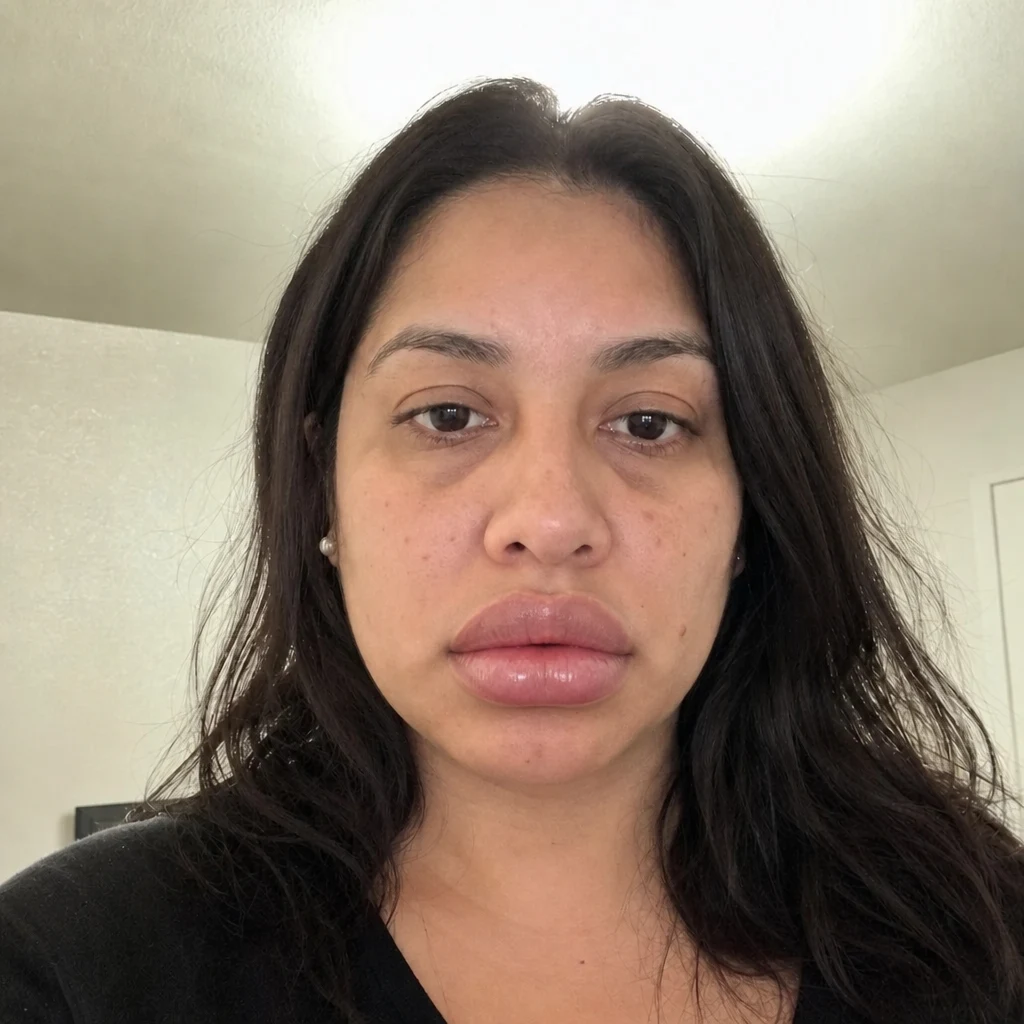

How the lip filler simulation works
Your photo is analysed for the landmarks that matter to this procedure, and the render changes the volume and shape of your lips while leaving the rest of your face alone. That constraint is the hard part — a generic image model will happily redraw your whole face and hand you a stranger who looks better.
The render adds volume to the lips in the frame. It cannot show projection — how far the lip carries forward — which is a profile measurement and a large part of what a good result looks like.
It is an illustration of a plausible direction, not a prediction of your result and not a medical opinion. What it is genuinely good for is finding out whether you want the change at all — plenty of people render one, find the difference smaller than they imagined, and stop there.
Measure your face before a lip filler simulation
The free analysis tools measure symmetry, facial proportion and face shape, and tell you which measurements sit outside the reference range. Choosing a procedure from that is a much better starting point than choosing one from a photo you saved.



Lip Filler simulator — frequently asked questions
How painful is getting lip filler?
Lips are sensitive, but most people describe it as brief stinging and pressure rather than sharp pain. Numbing cream beforehand and the lidocaine mixed into most lip fillers take much of the edge off, and the appointment itself is usually short.
What age is lip filler usually done at?
FDA-approved lip fillers in the United States are labeled for adults over 21. Beyond that there is no best age: younger patients usually ask for shape and definition, older patients for restoring volume and softening lines above the lip.
Can lip filler be dissolved?
Hyaluronic acid filler can be broken down with an enzyme called hyaluronidase, often within a day or two. Permanent fillers, silicone and fat transfer cannot be dissolved this way, which is the main reason HA is the standard for lips.
Does lip filler stretch your lips over time?
It is widely debated and not well settled. What is documented is that repeated large volumes can affect tissue over time, so conservative amounts with gaps between treatments are the usual advice.
What do people wish they knew before getting lip filler?
That day two is the most swollen, so the first photos are not the result; that a half syringe is often enough the first time; that filler is a yearly cost, not a one-off; and that it can be dissolved if it goes wrong — which only helps if your injector keeps the enzyme on hand.
Can you work out after lip filler?
Most aftercare instructions say to skip strenuous exercise for about 24 to 48 hours, because raised blood pressure and heat can worsen swelling and bruising. Walking is generally fine.
Is the lip filler simulator free?
The face analysis is free and needs no account. A rendered simulation costs credits because it runs on a GPU — $4.99 buys five and does not require a subscription.
How accurate is an AI lip filler simulation?
It is an illustration of a plausible outcome, not a prediction of your result. Real outcomes depend on your anatomy, the licensed injector and how you respond. Treat it as a conversation starter for a consultation, not a promise.
Do you keep my photo?
The free measurements never leave your browser. A simulation does send the photo to a rendering service, which is why it asks for explicit consent first, and you can delete the result from your dashboard at any time.
Can I show this to a licensed injector?
Yes, and that is the most useful thing to do with it. Bringing a picture of the direction you want is far more precise than describing it in words.
Other lips & mouth simulations




This page is not medical advice and we are not clinicians. A simulation cannot tell you whether a procedure is appropriate for you, what it costs, or what the risks are. Those questions belong with a qualified licensed injector.