Glasses for My Face Shape
One photo, your face shape from four measurements, and the frames that suit it — with real models and the frames to skip. The measurement runs in your browser and the photo is never uploaded.
- No signup
- No upload
- Free
- ~10 seconds
ExampleTry a demophotosExample faces
Choose your own photoClick to choose a photo, or drop one here
Front-facing · Even lightingStraight-on, even lighting, at arm's length gives the most comparable reading.
Runs in your browser. Your photo is never uploaded.
See how it works · Example face
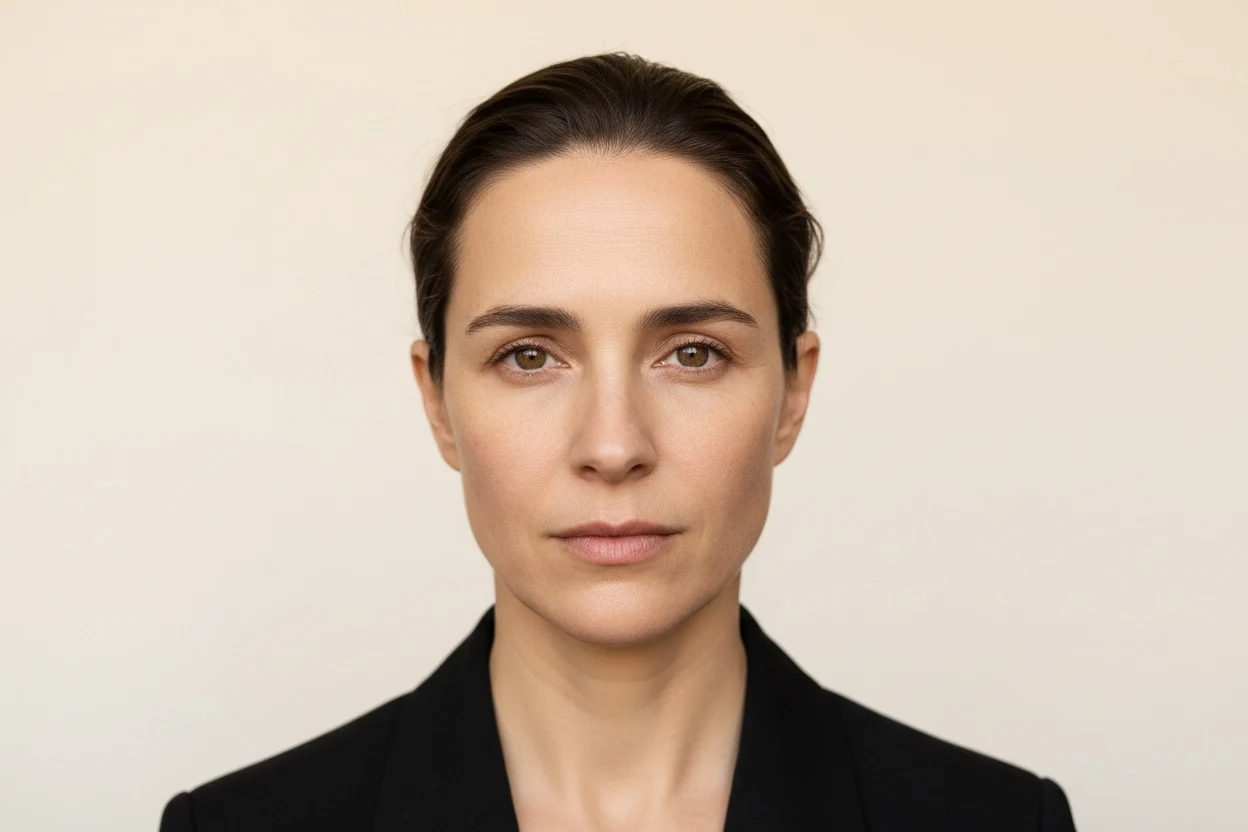
A demo on a sample portrait. Your own reading appears in the analysis tool.
What glasses suit my face?
Frames that contrast with your face's dominant line and reach its widest point. Angular frames suit round faces, curved frames suit square ones, deep frames suit long faces, and frames carrying weight at the brow suit faces that are narrow at the forehead. Your face shape comes from forehead, cheekbone and jaw widths against face length.
- Face shape is decided by four measurements: forehead width, cheekbone width, jaw width and face length.
- Round and square faces have almost the same proportions but opposite frame advice, so the jaw measurement matters.
- On a long face, lens height — how deep each lens is — matters more than frame style.
- No study has tested frame shape against face shape; the rules are an optician's convention built on visual contrast.
What glasses suit my face? Three rules that do most of the work
Most frame advice reduces to three rules, and each one has a reason you can check in a mirror.
- Contrast the dominant line. A face built from curves gets structure from a frame with corners; a face built from angles gets softened by curves. Repeating the face's own line — small round frames on a round face, sharp rectangles on a square one — emphasises it.
- Reach the widest point. A frame that ends inside the widest part of the face makes the face beside it look wider. Total frame width close to the width at the cheekbones is the usual target.
- Put weight where the face is narrow. A heavy brow bar adds width at the top, which helps a face narrow at the forehead and hurts one that is already widest there; weight low in the frame does the opposite.
How the face shape detector for glasses works
The panel at the top of this page places 478 landmarks on your photo and takes four measurements from them. Those measurements decide the face shape, and the face shape selects the frame advice.
The four measurements
| Face shape | What decides it | Frame rule it implies |
|---|---|---|
| Round | Length close to cheekbone width, wide soft jaw | Add angles and a straight top line |
| Square | Similar widths at forehead, cheekbones and jaw | Add curves; avoid sharp, heavy corners |
| Oblong | Length clearly greater than width | Add depth and width |
| Oval | None of the other conditions clearly met | Most frames; watch width and depth |
| Heart | Forehead much wider than the jaw | Keep weight off the top; carry width low |
| Diamond | Cheekbones clearly wider than forehead and jaw | Add width at the brow; avoid lines at the cheekbone |
| Triangle | Jaw wide relative to the forehead | Put weight and width at the top |
The exact cut points, and the order the rules are checked in, are on the oval face shape page. Face length is taken from the top of the forehead rather than the hairline, because a landmark model cannot see where hair starts.
From face shape to frames
Once the shape is read, the result lists the first three frame styles for that shape, with real models and their sizes where the manufacturer publishes them, and the frames to skip. Each recommendation is tied to a mechanism — what the frame's line does against the face's widths — and a recommendation that could not be tied to one was left out. The full advice for each shape, including frames for men and women, sunglasses and frame size, is on that shape's page.
Your photo stays on your device
The landmark model downloads to your browser and the measurements run there. The photo is not sent anywhere. You can check: open your browser's developer tools, watch the Network tab, and run a photo — no image is transmitted.
Which glasses suit my face shape? All seven at a glance
Every shape in one table, then a short summary of each. The linked pages go into frame size, men's and women's frames and sunglasses for each shape.
| Face shape | Frames that suit | Frames to skip | Why |
|---|---|---|---|
| Round | Rectangular, browline, wayfarer, geometric | Small round frames; frames narrower than the face | Corners add the structure a curved outline lacks |
| Oval | Most shapes; rectangular, aviator, round | Frames wider than the face or very deep | No imbalance to correct, so scale is the limit |
| Square | Round, oval, rimless, thin metal | Sharp, heavy rectangles | Curves offset an angular jaw |
| Heart | Aviator, rimless, oval, round | Pronounced cat-eye, heavy browline | Weight low balances a wide forehead |
| Diamond | Cat-eye, browline, oval, rimless | Narrow frames ending at the cheekbone | Width at the brow balances wide cheekbones |
| Oblong | Deep and wide frames, oversized, wayfarer | Narrow, shallow frames | Depth divides a long face |
| Triangle | Cat-eye, browline, wide frames | Frames heavier at the bottom | Width at the top balances a wide jaw |
Glasses for a round face
A round face is close to as long as it is wide, with a soft jaw. Rectangular and browline frames add a straight line and corners, and lenses wider than they are deep avoid repeating the face's proportions. The most common mistake is size: a frame narrower than the face makes the cheeks beside it look wider. Glasses for a round face, in full.
Glasses for an oval face
An oval face carries most frames, so the decision is about scale rather than shape. Keep the frame about as wide as the widest part of the face, and the lenses from being so deep that they shorten it. If your result is close to round or oblong, that shape's advice applies too. Glasses for an oval face, in full.
Glasses for a square face
A square face has similar widths and an angular jaw, so round, oval and rimless frames soften it. A square frame is not ruled out; it is the combination of sharp corners and heavy acetate that repeats the jaw. Round and square faces share proportions and take opposite frames, so check the jaw corner. Glasses for a square face, in full.
Glasses for a heart-shaped face
A heart-shaped face is widest at the forehead and narrows to the chin. Aviators, rimless and oval frames carry their width low or add nothing at the top. Pronounced cat-eyes and heavy browlines add width where there is already the most. Glasses for a heart-shaped face, in full.
Glasses for a diamond-shaped face
A diamond-shaped face is widest at the cheekbones, with a narrow forehead and jaw. Cat-eye and browline frames add width at the brow, the opposite of the heart-shaped advice. Avoid frames whose width or lower rim lands exactly on the cheekbone. Glasses for a diamond-shaped face, in full.
Glasses for an oblong face
An oblong, or long, face needs depth: a tall lens divides the face's length into shorter sections. Wide and oversized frames add horizontal measure, and a frame narrower than the face makes it look longer. Lens height is the number to look for; the Ray-Ban Justin RB4165's is about 44 mm. Glasses for an oblong face, in full.
Glasses for a triangle face
A triangle face is wider at the jaw than at the forehead, so weight belongs at the top of the frame. Cat-eye and browline frames add width high on the face; wide frames move the widest visible line up. Frames heavier at the bottom add weight beside the jaw. Glasses for a triangle face, in full.
Glasses for face shape: men and women
The geometry is the same for everyone; what differs is the range of frames people usually consider and what else is on the face.
Men's frame choices tend to cluster around rectangles, browlines, wayfarers and aviators, and a beard changes the lower face in a way frames have to work with. On a round face, a beard longer at the chin and an angular frame both add length; on a triangle face, where the jaw is already widest, close stubble and a frame heavier at the top work together. Women's frame ranges add cat-eyes, soft ovals and more colour, and colour itself is a lever: a light or translucent frame adds structure without adding visual weight. The colour analysis tool covers which frame colours suit your colouring — shape measurement cannot tell you that.
Sunglasses for your face shape
The same rules apply, with coverage and depth mattering more, because sunglasses are usually larger than eyeglasses.
| Face shape | Sunglass style | Example model | Why |
|---|---|---|---|
| Round | Wayfarer, squared oversized | Ray-Ban Original Wayfarer RB2140 ($$) | Corners and width reach the cheekbones |
| Oval | Wayfarer, aviator, round metal | Ray-Ban Aviator Classic RB3025 ($$) | Moderate size keeps the balance |
| Square | Aviator, round, oval | Ray-Ban Round Metal RB3447 ($$) | Curves and a taper soften the jaw |
| Heart | Aviator, round, rimless | Persol 649 ($$$) | Width carried low |
| Diamond | Cat-eye, browline, oval | Ray-Ban Nina RB4314N ($$) | Width at the brow |
| Oblong | Deep, oversized, wraparound | Ray-Ban Justin RB4165 ($$) | About 44 mm of lens height covers vertical run |
| Triangle | Cat-eye, browline | Ray-Ban Clubmaster RB3016 ($$) | Weight at the top of the face |
What size glasses fit my face?
Shape narrows the choice; size decides whether a frame actually fits. The detector does not measure frame size from your photo, so this part is yours to check.
The three numbers on the temple arm
| Number | What it measures | What goes wrong if it is off |
|---|---|---|
| First (e.g. 52) | Lens width, in millimetres | Too wide and your eyes sit too close to the inner edge; too narrow and the face extends past the frame |
| Second (e.g. 18) | Bridge width — the gap between the lenses | Too narrow pinches the nose; too wide lets the frame slide |
| Third (e.g. 140) | Temple arm length | Too short presses behind the ear; too long lets the frame slip forward |
Should I get 52 or 54 glasses?
Those numbers are lens widths. In the same model, a 54 is 2 mm wider per lens than a 52, so about 4 mm wider across the whole frame. Choose the size whose total width lines up with the widest part of your face, and check that your pupils sit near the centre of each lens. If your current glasses fit well, their numbers are the best starting point.
Why your pupillary distance matters more than your face shape
The optical centre of each lens needs to sit in front of your pupil, and that is set by your pupillary distance, not your face shape. The pupillary distance tool measures it from a photo, with an error band of about ±3 mm: often fine for low single-vision prescriptions, not for progressives or stronger prescriptions, which should be measured in person.
Can AI tell me what glasses look best on me?
Partly. A landmark model can measure your face shape reliably from a good photo and apply the frame rules to it, which is what this tool does. It cannot tell how a bridge sits on your nose, whether a temple arm is long enough, or what you will like when you see yourself in a frame.
Virtual try-on tools overlay or generate a frame on your photo. That is useful for seeing a style on your own face, but it is an image edit, not a fitting, and generative edits can subtly change the face they draw on. This tool does not offer try-on; retailers' try-on tools are the place for that. A chat assistant asked for your face shape is estimating from the image as a whole rather than measuring distances between points, so its answer is a guess rather than a measurement.
What research has measured is that glasses change how a face is read. In a series of experiments, glasses drew observers' gaze to the eye region, and the familiar stereotype — more intelligent, less attractive — appeared but depended on the frame: rimless glasses made faces look more trustworthy without making them less attractive. In another study, people were worse at telling whether two photos showed the same person when only one of the faces wore glasses. A frame is a large feature, and it is reasonable to choose it deliberately.
What this glasses tool can't tell you
The result is a starting list, not a decision. Some things a front photo cannot show at all.
- How a bridge and nose pads sit on your nose.
- Your temple arm length, or how a frame sits over your ears.
- Frame size in millimetres — use your current glasses and your pupillary distance.
- How thick your lenses will be at your prescription, which affects which frames look right.
- Which frame colours suit your colouring.
- What you like. Plenty of people wear the frame the rules say to skip, and wear it well.
Tips for an accurate face shape reading for glasses
- Take the photo without glasses. Frames sit across the sides of the face and can hide the landmarks the widths are measured from.
- Pull your hair back, including a fringe. In our test, hair-coloured bands painted over the forehead changed the face shape label on four of six faces.
- Hold the camera at eye level, at arm's length or further. A low or close camera changes the proportions of the lower face.
- Face the camera squarely. A turned head shortens every width on the far side.
- Use even light from the front, and keep a neutral expression.
Glasses for My Face Shape — frequently asked questions
How do I know what glasses suit my face shape?
Find your face shape from four measurements — forehead, cheekbone and jaw widths against face length — then apply the frame rule for that shape: angles for round, curves for square, depth for oblong, weight at the brow for diamond and triangle, weight low for heart, and scale rather than shape for oval. The tool on this page does both steps from one photo.
How can I check my face shape for glasses from a photo?
Use a straight-on photo at eye level, without glasses, with your hair pulled back, and upload it to the panel at the top of this page. It measures the four widths and length in your browser and shows the face shape with the frames that suit it.
Is there a free app to find glasses that fit my face?
You do not need an app. This tool is free and runs in the browser on a phone or computer. It gives the frame styles for your face shape and example models; for fit, you still need your frame size and pupillary distance, and a retailer's try-on or a fitting in person.
Should I take the photo with my glasses on?
No. Frames cover the sides of the face near the eyes and temples, where the widths are measured, and can move the landmarks the result depends on. Take it off for the photo, then choose frames from the result.
Which face shape can wear any glasses?
Oval comes closest, because it has no strong imbalance for a frame to correct. Even then two limits apply: a frame much wider than the face, or one deep enough to shorten it, looks out of scale.
Do glasses rules differ for men and women?
The geometry is the same. The difference is in the frames usually on offer and in the rest of the face: beards change the lower face for many men, and colour and cat-eye shapes are larger levers in many women's frame ranges.
Can I try on glasses virtually here?
No. This tool measures your face shape and recommends frame styles, but it does not render frames on your photo. Virtual try-on is an image edit rather than a fitting; retailers' try-on tools are the place for it.
What sunglasses suit my face?
The same rules as eyeglasses, with more emphasis on coverage: wayfarers and squared shapes for round faces, aviators and rounds for square faces, deep oversized frames for long faces, aviators for heart-shaped faces, and cat-eye or browline sunglasses for diamond and triangle faces.
References
- 1.Leder, H., Forster, M., & Gerger, G. (2011). The glasses stereotype revisited: effects of eyeglasses on perception, recognition, and impression of faces. Swiss Journal of Psychology, 70(4), 211–222. doi:10.1024/1421-0185/a000059.
- 2.Kramer, R. S. S., & Ritchie, K. L. (2016). Disguising Superman: how glasses affect unfamiliar face matching. Applied Cognitive Psychology, 30(6), 841–845. doi:10.1002/acp.3261.
- 3.McKelvie, S. J. (1997). Perception of faces with and without spectacles. Perceptual and Motor Skills, 84(2), 497–498. PMID 9106839.
- 4.Farkas, L. G. (1994). Anthropometry of the Head and Face (2nd ed.). Raven Press.