Am I Ugly?
The category you are asking about does not appear in the measurements. This test reports four facial proportions and where yours sit among 102 research faces. It has no threshold below which a face becomes the thing the question describes. Tested against 2,513 people's ratings of those faces, the score did not predict who they found attractive.
- 102
- reference faces
- 4
- proportions measured
- 2,513
- raters in our validity test
- Free
- photo not uploaded
 Example
Choose your own photo
See your score, symmetry and proportions.
Choose your own photoClick to choose a photo, or drop one here
Front-facing · Even lightingStraight-on, even lighting, at arm's length gives the most comparable reading.
Runs in your browser. Your photo is not uploaded.
Am I ugly?
- The four measurements are symmetry and three proportion ratios; none has a cut-off that defines ugliness.
- On 102 faces rated by 2,513 people, this tool's score correlated with attractiveness ratings at ρ = −0.07 — effectively zero.
- Rated attractiveness varies substantially between individual raters, so no single score is a verdict.
See what a change would actually look like
These are the renders that act on what this page measures. Each one below was generated by the same model that runs on your own photo — labelled examples on another face, so you can see what the procedure changes before you spend anything.
Glow Up Pack
Glow Up Pack · AI example
Glow Up Pack. A different possibility.
Tap the photo to enlarge. AI visualisation, not a prediction.
What Changed & Why · Annotated AI example
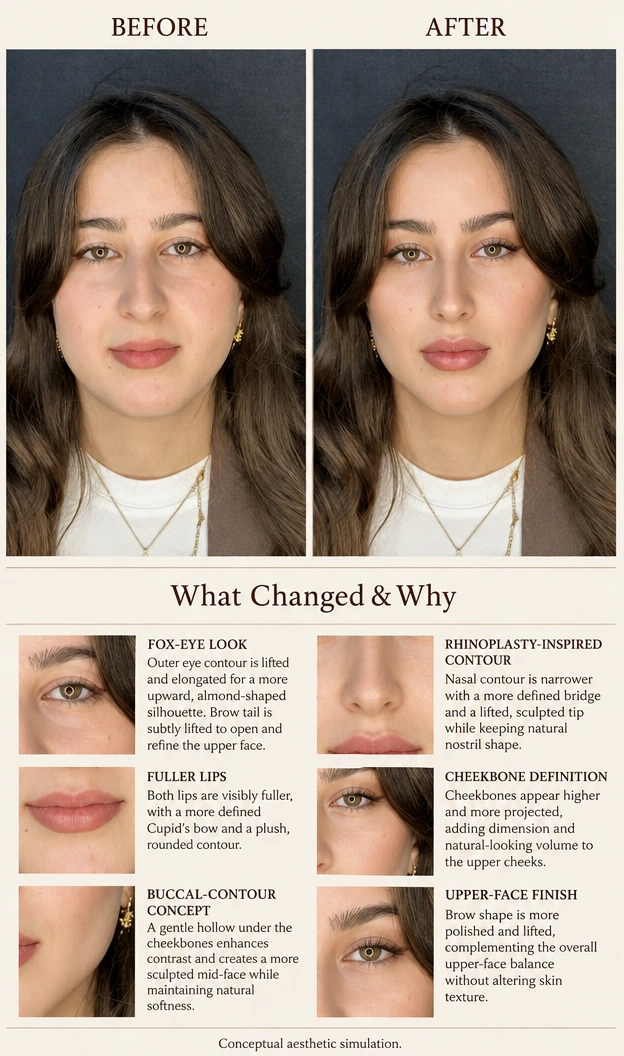
Conceptual aesthetic simulation. Another face, not your result.
Changes several changes at once, as one render.
What it does →Skin Resurfacing
Skin Resurfacing · AI example
Skin Resurfacing. A different possibility.
Tap the photo to enlarge. AI visualisation, not a prediction. Both images are AI generated.
Changes texture, pores and surface lines.
What it does →Jawline Filler
Jawline Filler · AI example
Jawline Filler. A different possibility.
Tap the photo to enlarge. AI visualisation, not a prediction.
Changes definition along your jaw.
What it does →
Every “after” above is an AI simulation on a sample face, not a photograph of a surgical result — it shows the direction a procedure moves a face, not an outcome anyone achieved and not a prediction of yours. Where a frame reads “Before · AI example”, the before image is generated too: the same portrait with the condition that procedure treats added, because none of the source photographs had it. Run one on your own photo.
Am I ugly? Why the data has no answer to that question
There is no threshold in facial measurements where one category ends and another begins. Plot any of these proportions across a population and you get a smooth hill — a lot of people near the middle, fewer at each edge, and no valley anywhere that would mark a boundary.
That is not a diplomatic dodge. It is what the distribution looks like. The category you are asking about is a thing people say, not a thing the measurements contain, and no test can find a line that is not there.
What the test measures instead
Four things: bilateral symmetry, the ratio of face height to cheekbone width, the ratio of eye spacing to nostril width, and the ratio of nose length to mouth width. Each one is reported separately with its reference range.
Read the four separately rather than the total. A face is rarely far from the middle on all four at once; more often one ratio sits out at an edge and the rest are ordinary. That is a much narrower fact than the one the question assumes.
How ugly am I — the gap between the mirror and the measurement
People are consistently worse at judging their own face than a stranger's, and the error runs in one direction. You have looked at your face more than anyone else has, you have looked at it mostly in mirrors, which are reversed, and you have looked at it while thinking about it — none of which is how anyone else encounters it.
A measurement is useful here precisely because it does not care how you feel about the face. It reports distances. If the number comes back ordinary and the feeling does not change, that gap is worth paying attention to — it is telling you the problem was never in the geometry.
Does a low score mean I am ugly? What our own test found
No, and we can show why. We ran 102 research faces through this exact tool. Each of those faces had been rated for attractiveness by 2,513 people. The tool's score did not predict those ratings at all: the correlation was −0.07, which is indistinguishable from zero. Faces that scored low here were not the faces people rated low.
People also disagree with each other far more than the question assumes. In a 2006 series of experiments, one person's private taste counted about as much as the taste people share. So even a perfect measurement could not return a single answer to "am I ugly", because there is no single judge.
What actually changes how a face reads
Expression is the clearest one. When the same 102 people were photographed smiling, their median score on this tool jumped from 5.5 to 7.4, and experiments find a happy expression can make up for a face otherwise being rated less attractive. Grooming, sleep, posture and weight visible in the face follow.
None of these are in the test, and every one of them moves how other people actually see a face more than a two-millimetre ratio does.
When this is not a question for a face app
If distress about your appearance is taking up hours of your day, driving avoidance of mirrors, photographs or people, or repeatedly pulling you toward procedures that do not settle it afterwards, that is a recognised and treatable pattern — body dysmorphic disorder — and it does not respond to more measurement.
No score on this page speaks to that, and running the test again with a different photo will not either. That one is worth taking to a doctor rather than a tool.
Tips before you read too much into a number
- Take the photo straight on at arm's length. A low-angle selfie can move the composite by more than a real anatomical difference would.
- Run it with three different photos. The spread between them tells you how much of the number is the camera.
- Read the four measurements, not the total. The pattern is almost always three ordinary values and one outlier.
Am I Ugly? — frequently asked questions
Is this am I ugly test free?
Yes, with no account. The measurements and the breakdown are free.
Will the test tell me if I am ugly?
No, and not out of politeness. There is no threshold in the measurements that separates one category from another, so a test that gave you that answer would be inventing it.
What is the average score?
5.5. The score is your position among 102 research faces, so 5.5 is exactly the middle and half of everyone scores below it by definition. A score below the middle is not a verdict — on those same faces, the score did not predict how attractive people found them.
How ugly am I on a scale of 1 to 10?
No scale can answer that honestly. This one tells you where four proportions of one photo sit among 102 research faces, and our test found that position does not match how people rated those faces. Treat it as a measurement of the photo, not of you.
Why do I look worse in photos than in the mirror?
Mirrors show a reversed face you have adapted to over years, and phone cameras use short focal lengths that distort features closest to the lens. Both effects are real and neither is your face.
Should I get surgery based on this score?
No. A score is not an indication for a procedure. If you are considering one, the simulation feature exists to show you the size of the change first — and a consultation with a surgeon is the actual next step.
References
- 1.Langlois, J. H., & Roggman, L. A. (1990). Attractive faces are only average. Psychological Science, 1(2), 115–121. doi:10.1111/j.1467-9280.1990.tb00079.x.
- 2.Rhodes, G. (2006). The evolutionary psychology of facial beauty. Annual Review of Psychology, 57, 199–226. PMID 16318594.
- 3.DeBruine, L., & Jones, B. (2021). Face Research Lab London Set [Data set]. figshare. doi:10.6084/m9.figshare.5047666.
- 4.Hönekopp, J. (2006). Once more: is beauty in the eye of the beholder? Relative contributions of private and shared taste to judgments of facial attractiveness. Journal of Experimental Psychology: Human Perception and Performance, 32(2), 199–209. PMID 16634665.
- 5.Golle, J., Mast, F. W., & Lobmaier, J. S. (2014). Something to smile about: the interrelationship between attractiveness and emotional expression. Cognition and Emotion, 28(2), 298–310. PMID 23875865.
- 6.Salari, N., Kazeminia, M., Heydari, M., Darvishi, N., Ghasemi, H., Shohaimi, S., & Mohammadi, M. (2022). Body dysmorphic disorder in individuals requesting cosmetic surgery: a systematic review and meta-analysis. Journal of Plastic, Reconstructive & Aesthetic Surgery, 75(7), 2325–2336. PMID 35715310.