Upturned Eyes
An upturned eye has an outer corner sitting clearly above the inner corner, producing a natural lift at the end of the eye. This test calls an eye upturned when its canthal tilt, the angle from inner to outer corner, is +5° or more, the same cut as a positive canthal tilt, unless the lid reads as hooded first.
- ≥ +5°
- canthal tilt
- Same
- cut as a positive tilt
- Yes
- readable from a front photo
- Free
- photo not uploaded
Drop a photo into the panel and it will say whether your measurement reads as upturned, with the numbers behind it.
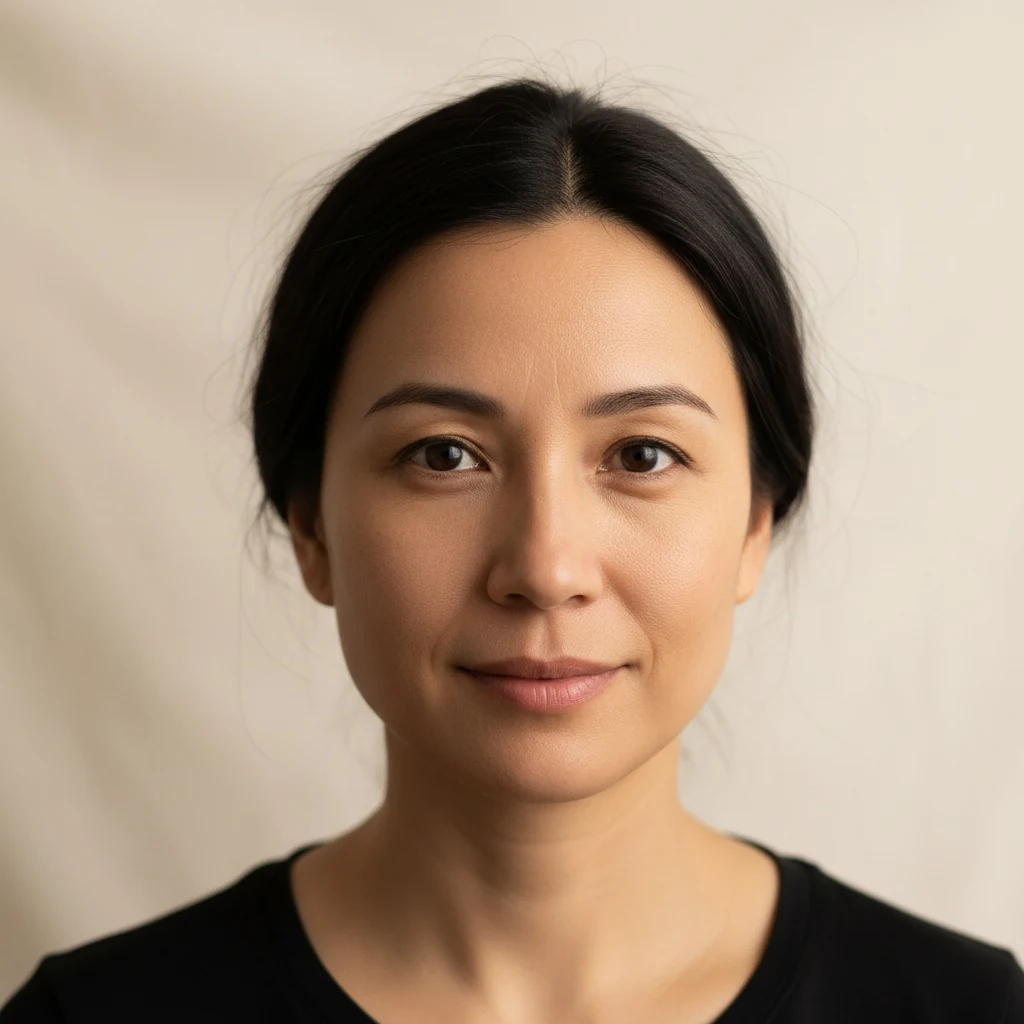 Example
Choose your own photo
Discover your eye shape and proportions.
Choose your own photoClick to choose a photo, or drop one here
Front-facing · Even lightingStraight-on, even lighting, at arm's length gives the most comparable reading.
Runs in your browser. Your photo is not uploaded.
What are upturned eyes, and how are they measured?
The same inner-corner-to-outer-corner angle as downturned, read from the other end of the scale. From +5°, the cut point where this site's canthal tilt test starts calling a tilt positive, the eye reads as upturned.
- Outer corner distinctly higher than the inner corner
- The upper lash line sweeps upward at the outer third without help
- The lower lid often shows more at the inner end than the outer
An upturned eye has an outer corner sitting clearly above the inner one — a positive canthal tilt, +5° or more on this test. It is the angle that the entire hunter-eyes vocabulary is built on, and it is measurable to a fraction of a degree, which makes it one of the few traits in this space where the online discussion and the anatomy can actually be reconciled.
How to tell if you have upturned eyes
- Hold a straight edge horizontally between your inner corners. Outer corners sitting clearly above it means upturned.
- Almost everyone has some positive tilt. The question is whether it is pronounced enough to see at a glance, not whether it exists.
Upturned eyes vs almond eyes
These overlap heavily and are not alternatives. Almond describes the outline — long, tapered, crease visible. Upturned describes the angle of that outline. A great many almond eyes are also upturned, which is precisely why beauty charts that force one label per person produce inconsistent answers between sites.
Upturned eyes vs hunter eyes
Positive canthal tilt is one of the four traits the hunter eyes vocabulary is built from, so an upturned eye satisfies part of that description by definition. The other three are compact upper lid, a horizontally long opening, and orbital depth — and the last of those cannot be read from a front photo at all. If you arrived here from that vocabulary, the hunter eyes test scores the three measurable traits separately and says plainly which one it is missing.
Makeup for upturned eyes
The shape already does what most eye makeup is trying to achieve, so technique here is usually about balance rather than lift.
Works
- Depth along the lower outer lash line to balance the natural upward sweep
- A softer, shorter wing than the shape suggests, since the lift is already there
- Even colour across the lid without forcing an outer-corner focus
Fights the shape
- A steep cat-eye wing, which exaggerates a lift that is already present
- Heavy inner-corner highlight, which tips the balance further outward
Eyeliner for upturned eyes
The shape already produces the lift that most liner technique exists to fake, so the useful advice is about not overshooting it.
- A shorter, flatter wing than the corner suggests — the angle is already there to be followed
- Balance along the lower outer lash line, which stops the eye reading as permanently swept up
- Even lid colour rather than an outer-corner focus
- A thin line that thickens only slightly toward the outer third
Eyelashes for upturned eyes
Lash length distribution is the easiest way to balance an upturned eye without losing what it already has.
- Even lengths rather than outer-corner emphasis
- A moderate curl; a dramatic curl adds lift where there is already plenty
- Lower lashes at the outer corner, which counterweights the upward sweep
Upturned eyes celebrities
Upturned eyes are the shape most claimed and least measured online, because the angle that defines them is small enough to be created by tilting the head a few degrees. This site reports your own tilt in degrees, separately for each eye, and does not publish celebrity assignments.
Upturned eyes — frequently asked questions
Are upturned eyes the same as a positive canthal tilt?
They are the same measurement under two names. Upturned is the makeup term, positive canthal tilt is the anatomical one, and both describe an outer corner sitting above the inner one. The test above reports it in degrees, for each eye separately.
How many degrees of tilt count as upturned?
This site reads +5° and above as upturned, the same cut point its canthal tilt test uses for a positive tilt, so an upturned eye and a positive tilt are one reading. The number is a convention — tilt is continuous, and a degree either side of it is not visible to anyone.
Can you get upturned eyes without surgery?
Not the measurement itself, which is set by where the outer corner tendon attaches. Liner, lash placement and brow shape all change how the corner reads, and a canthoplasty changes where the corner actually sits — that is surgery, and it is not a minor one.
What is an upturned eye shape?
One where the outer corner sits clearly above the inner corner, giving a natural upward lift at the outer end.
Are upturned eyes and cat eyes the same?
No. Upturned is anatomy, cat eye is a makeup style that imitates it. That is why the style reads as effortless on an upturned eye and as a stronger statement on a downturned one.
Can I be upturned and hooded?
Yes. Tilt and lid coverage are independent measurements — the tool reports both separately.