Hooded Eyes
A hooded eye has a fold of skin from the brow bone that drops over the crease, so little or none of the mobile lid shows when the eye is open. This test calls an eye hooded when the visible lid between lash line and crease is less than 0.20 of the eye's width.
- < 0.20
- lid space ÷ eye width
- 4
- eye measurements per photo
- Yes
- readable from a front photo
- Free
- photo not uploaded
Drop a photo into the panel and it will say whether your measurement reads as hooded, with the numbers behind it.
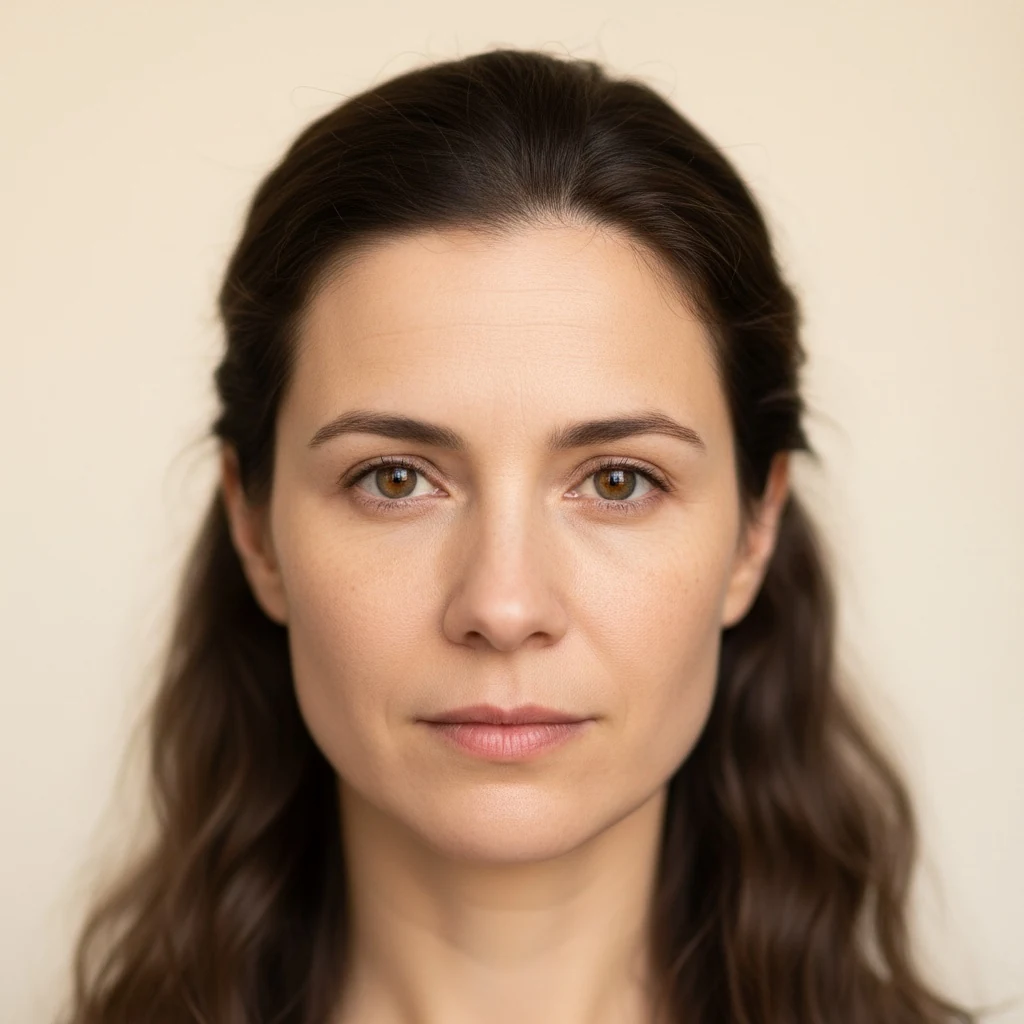 Example
Choose your own photo
Discover your eye shape and proportions.
Choose your own photoClick to choose a photo, or drop one here
Front-facing · Even lightingStraight-on, even lighting, at arm's length gives the most comparable reading.
Runs in your browser. Your photo is not uploaded.
What are hooded eyes, and how are they measured?
The band between your lash line and the ring of landmarks just above it — where the crease sits — measured against your eye width. On a hooded eye that band falls below about a fifth of the eye's width, because the brow-bone skin folds down over it. Two limits come with that number. It is the average of both eyes, so a hood that is heavier on one side shows up only as a lower overall figure, not as a left-right difference. And a monolid produces the same low reading, because the landmarks see that no lid space shows but not whether a crease is hidden or absent — the closed-eye step in the mirror test below is what separates them.
- Little or no lid space visible with the eye open and looking straight ahead
- The crease reappears when you close the eye or look down
- Eyeshadow placed on the lid disappears when you open your eyes
- The outer third of the lid is usually covered more heavily than the inner
Hooded is the most searched eye shape by a wide margin, and it is also the one people most often acquire rather than are born with: lid skin loses elasticity across adulthood, so a crease that was fully visible at twenty can be partly covered at forty. It is not rare in any population, and the degree matters more than the label — a lightly hooded eye and a heavily hooded one need different technique even though both get the same word.
Partially hooded vs fully hooded eyes
Hooding comes in degrees, and the two everyday terms describe how far the fold reaches. On a partially hooded eye the fold covers the outer part of the lid while a strip of mobile lid still shows toward the inner corner. On a fully hooded eye the fold reaches the lash line across most of the width, so almost no lid shows at all. The test on this page uses one cut point rather than grades, so it will not print the word partial. What it does show is the band itself, as the lid-space bar on the result. The hooded range starts a little under two-thirds of the way along that bar: a bar just inside it is a light hood, and a nearly empty one means very little lid is visible. Because the two eyes are averaged, a heavy hood on one side and a light one on the other land somewhere between.
How to tell if you have hooded eyes
- Look straight ahead in a mirror, relaxed, without raising your brows. Raising them lifts the hood and hides the trait you are trying to see.
- Look for the crease. If you cannot see a strip of mobile lid between your lash line and the crease, the eye is hooded.
- Now close the eye. If a crease appears, you have a crease that is being covered — hooded. If no crease appears at all, that is a monolid, not a hood.
- Check whether the upper lid covers part of the pupil rather than just the lid space. That is a different finding and belongs to an eye doctor, not a makeup guide.
- Repeat all of it for the other eye. One side is often more hooded than the other, and a test that averages both eyes cannot show you that.
Hooded eyes vs monolid eyes
Both hide the crease, and almost every guide online treats them as the same thing. They are not. A hooded eye has a crease that is covered by a fold of brow-bone skin — close the eye and the crease is there. A monolid has no crease to begin with, and closing the eye shows a smooth lid. The distinction matters because the makeup advice diverges: hooded technique works above the hood, monolid technique builds a gradient on the lid itself.
Hooded eyes vs deep-set eyes
Both look shadowed at the top of the eye and both get called hooded online. The difference is what is casting the shadow. A hooded eye has a fold of lid skin lying over the crease; a deep-set eye has a normal lid that sits back under a projecting brow bone. From the front they can look identical, and from the side they never do — which is one of the two traits this site tells you it cannot measure from a front photo.
Hooded eyes vs non-hooded eyes: the five-way comparison
Most confusion about hooded eyes comes from four other lids that also hide the crease, show less lid than expected, or look heavy. They differ in what is doing the hiding, and one mirror check separates each of them. The drawing shows the four you can compare side by side; the fifth, ptosis, has its own section below because it is the one that can matter medically.
| Lid type | What hides the lid | Crease with the eye closed | The mirror tell | Can this test read it from a front photo? |
|---|---|---|---|---|
| Hooded | A fold of skin lying over the crease | Yes | The crease appears when you close the eye or look down | Yes as a low lid band — but a monolid gives the same reading |
| Non-hooded | Nothing | Yes | A strip of mobile lid shows between lashes and crease with the eye open | Yes |
| Monolid | There is no crease to hide | No | Closing the eye shows one smooth lid surface | No — reads the same as hooded; the closed-eye check decides |
| Deep-set | Shadow from a brow bone that projects forward | Usually yes | In profile, the eye sits behind the plane of the brow | No — depth is not measurable from the front |
| Ptosis | The lid edge itself sits low | Usually yes | The lashed edge sits close to or over the pupil | No — the clinical measure needs a light reflex and a ruler |
Hooded eyes vs ptosis (droopy eyelids)
"Droopy eyelid" gets used for three different things, and they are not interchangeable. Clinicians keep them apart because each has a different cause and a different fix, and the ophthalmology references are explicit that loose lid skin and a low brow have to be distinguished from a low lid edge before anything is done.
| What droops | Where the lid edge sits | Typical onset | Name clinicians use | Who assesses it |
|---|---|---|---|---|
| Skin fold over the crease | Normal height | Present for life, or builds slowly with age | Hooding; dermatochalasis when the skin rests on the lashes | Nobody, if it is cosmetic; an eye doctor if it blocks vision |
| The brow | Normal height, with skin pushed down from above | Gradually, over years | Brow ptosis | An oculoplastic or facial plastic surgeon |
| The lid edge | Low — close to or over the pupil | From birth, gradually with age, or suddenly | Blepharoptosis (ptosis) | An eye doctor, promptly if it is new or one-sided |
Ptosis ranges from a millimetre or two to a lid that covers the pupil completely, and it can affect one eye or both. Most adult cases come from the tendon that lifts the lid stretching with age. The less common causes — nerve, muscle and neuromuscular conditions — are the reason a new or one-sided droop is worth an examination rather than a makeup tutorial. People with significant ptosis often compensate without noticing, by raising their brows or tilting their chin up, and that compensation can hide the droop in a mirror.
What causes hooded eyes
For most people hooding is simply how their lids are built, and for many it becomes more pronounced with age. The research on sagging upper lids points to a mix of inheritance and ageing, with a few other factors on top.
- Inheritance. In a study of more than a thousand twin pairs, heritability of sagging upper eyelids was estimated at 61%. That is why hooding so often looks the same across a family.
- Age. Lid skin loses elasticity and the connective tissue behind it weakens, so skin that sat above the crease at twenty can rest over it at fifty. In a population study of Dutch adults with an average age of 67, 17.8% had lids sagging far enough to hang over the lashes.
- Other independent risk factors in the same research: male sex, lighter skin and a higher body mass index. Current smoking was borderline.
- Brow position. A brow that sits low, or drops over the years, pushes skin down onto the lid from above. This is a different mechanism from the lid skin itself and it has a different surgical answer.
- Fat and anatomy. Where the tissue layers of the lid join, and how far down the fat pad sits, change whether a crease forms high, low or not at all.
- Temporary look-alikes. Morning puffiness, allergies, fluid retention, crying and a late night all swell the lid and make a hood look heavier for hours or days. A hood that comes and goes with sleep is not a change in anatomy.
People often ask which ethnicity is most likely to have hooded eyes. There is no population figure that answers it, and this page does not assign lid types to ancestries. What anatomy studies do show is that lid structure varies: in single-crease East Asian upper lids, the membrane that holds back the orbital fat joins the lifting tendon lower down and more fat extends toward the lash line, which lowers or removes the crease. That produces a monolid or a low crease, which is often mislabelled as hooding — the closed-eye check in the table above is what separates them.
Why is only one eye hooded?
Some difference between the two sides is normal, and one lid looking more hooded than the other is common. The usual reasons are ordinary: one brow sitting a little lower than the other, swelling on one side, or a photo taken with the head slightly turned so one lid is foreshortened. Check both eyes separately in a mirror at eye level with your brows relaxed. What changes the answer is timing and the lid edge. If the difference is new, if the lid edge on one side sits over the pupil, or if it varies through the day, that belongs in the red flags below rather than in a makeup guide.
One limit of the test here matters for this question: the lid band is averaged across both eyes, so the result cannot show you that one side is more hooded than the other. The mirror can.
Are hooded eyes attractive, and do they make you look older?
No study that holds up ranks lid types by attractiveness, and the internet cannot agree with itself on this one. Makeup writing treats a hooded lid as something to work around. The hunter eyes vocabulary treats the very same compact lid as the ideal. The anatomy is identical in both; only the framing flips.
The age question has a more concrete answer. Because lid skin increases with age for most people, more skin over the crease is one of the cues people read as older, and a hood that has grown heavier over the years does change how a face reads. A hood someone has had since their teens is simply the shape of their eye. It is also why the same lid can look tired in a photo taken from above and look entirely different at eye level.
Makeup for hooded eyes
Every hooded-eye technique solves the same problem: the surface you would normally decorate is not visible when the eye is open. So the work moves upward, onto the area that stays in view.
Works
- Place shadow above the natural crease, so colour is still visible with the eye open
- Keep liner thin at the lash line and extend it outward rather than upward, since an upward wing folds into the hood
- Use a tightline along the upper lash roots to define the eye without spending lid space
- Matte mid-tones in the outer corner to create the depth the hood flattens
Fights the shape
- Thick liner across the whole lid — it vanishes and reads as a dark smudge when the eye opens
- Shimmer directly on the hood, which catches light and makes the fold more prominent
- A classic winged flick that follows the lower lash line up, since the fold breaks it
Eyeshadow for hooded eyes
Every step below is done with your eyes open and looking straight ahead into the mirror. That single change fixes most hooded-eye shadow, because it puts colour where it will actually be seen.
- Prime the whole lid, up to the brow bone. A hood presses on the lid all day and creases shadow faster than on any other shape.
- Place a matte transition shade just above the fold, not in the crease. With the eye open, find where the hood ends and blend a soft mid-tone a few millimetres above that line. This builds the crease the hood covers.
- Take depth up and out at the outer corner. A deeper matte shade blended in an upward diagonal toward the tail of the brow lifts the outer third, which is usually where the hood sits heaviest.
- Keep shimmer to the inner half of the mobile lid. It catches light when you blink and look down. Shimmer on the hood itself makes the fold look fuller.
- Add a little of the deeper shade on the outer third of the lower lash line. It balances the outer-corner depth above without closing the eye.
- Clean up under the brow. A matte shade a touch lighter than your skin under the brow tail sharpens the edge of the transition shade.
Hooded eyes makeup chart
| Step | Product | Where it goes (eyes open) | Why it works on a hooded lid |
|---|---|---|---|
| 1 | Eye primer | Whole lid to the brow bone | The hood presses on product and creases it |
| 2 | Matte transition shade | Just above the fold line | Builds a visible crease where the real one is covered |
| 3 | Deeper matte shade | Outer corner, blended up and out | Lifts the outer third, where hooding is usually heaviest |
| 4 | Shimmer | Inner half of the mobile lid only | Shows on blinks without making the fold look fuller |
| 5 | Pencil or gel | Tightline the upper lash roots | Defines the eye without using up lid space |
| 6 | Liner wing | Drawn with the eye open, outward | A wing drawn closed breaks or vanishes when the eye opens |
| 7 | Mascara or lashes | Curled firmly, length in the outer half | Lashes sit at the one edge that stays visible |
| 8 | Brow product | Tail kept level or lifted, never dropped | A lower brow tail pushes more skin onto the lid |
Makeup for hooded eyes over 50
Hooding often deepens in the fifties, and the lid skin itself changes: thinner, more finely lined, less able to hold a cream product without it settling into lines. The steps above still apply, with a few adjustments.
- Powder mattes over creams on the lid, and very little shimmer — shimmer on crepey skin shows texture
- A tightline or a pencil smudged into the lashes instead of a crisp liquid line, which skips over lined skin
- Transition shade placed higher than you used to put it, because the fold now ends higher
- Brows filled at the tail, which tends to thin and drop with age and drags the eye down with it
- Lash curl over lash length: long, heavy lashes rest against the hood and hold it down
Eyeliner for hooded eyes
Eyeliner on a hooded eye has one governing constraint: whatever you draw on the mobile lid disappears when the eye opens. Every technique below is a way of putting the line somewhere it survives.
- Tightline the upper lash roots first — it defines the eye and costs no lid space at all
- Keep the visible line thin at the lash line and let it thicken only past the outer corner
- Find the wing angle with your eyes open, not closed: mark the point where the hood ends and draw outward from there
- Extend outward rather than upward — a steep wing folds into the crease and prints onto the brow bone
- A batwing wing — drawn with the eye open so its top edge follows the hood — fills the gap a standard flick leaves when the fold breaks it
- Floating liner, a line drawn just above the fold instead of at the lashes, is the one graphic style that stays whole on a heavy hood
- Smudge-proof gel or a waterproof pencil, because a hooded lid presses against the line all day
Eyelashes for hooded eyes
Lashes do more on a hooded eye than shadow does, because they sit at the one edge that stays visible.
- A firm curl matters more than length — straight lashes press against the hood
- Length concentrated in the outer half, which lengthens without lifting into the fold
- Avoid very long, heavy lashes in the centre, which can brush the hood and hold it down
How to get rid of hooded eyes: what works and what does not
Nothing needs fixing about a hooded lid, but the question gets asked a lot, so here is every option in one place. The honest split is this: only surgery changes the fold itself. Everything else changes how it reads.
| Option | Changes the fold? | Changes how it reads? | How long it lasts | Main downside |
|---|---|---|---|---|
| Makeup placement | No | Yes, clearly | A day | Needs the eyes-open technique to work |
| Brow grooming or lamination | No | A little — more lid shows under a lifted tail | Weeks | Small effect on heavy hoods |
| Eyelid tape or stickers | Temporarily, while worn | Yes | Hours | Studies report eye-surface and lid-skin effects with regular use |
| Retinoid and daily sunscreen | No | Possibly slows sun-related skin ageing | Ongoing | Not studied on eyelid hooding specifically |
| Eye exercises and eyelid yoga | No | No | — | A skin fold is not a weak muscle |
| Cucumber, tea bags, cold spoons | No | Only by reducing puffiness | Hours | Treats swelling, not the hood |
| Neuromodulator brow lift | No | Slightly, by raising the brow tail | Months | A clinician's treatment; a recent injection is one of the causes eye doctors ask about when a lid droops |
| Upper blepharoplasty | Yes | Yes | Years | Surgery, with recovery and surgical risks |
| Surgical brow lift | Yes, when the brow is the cause | Yes | Years | Only helps if the brow is what pushes the skin down |
| Ptosis repair | Only if the lid edge is low | Yes | Years | The wrong operation for ordinary hooding |
Eyelid tape for hooded eyes
Tape and stickers tuck the fold into a crease for as long as they stay on, and they do work cosmetically. The research on everyday use is small but consistent in direction. In a four-week study of 29 young women wearing double eyelid tape eight hours a day, staining of the eye surface and meibomian gland dysfunction increased, tear film break-up time fell, and by the third week every participant was blinking incompletely — while none of them reported feeling any different. A larger survey of long-term users found most of them reporting a permanent change in lid shape, though that was self-reported. If you use tape, occasional use is a different exposure from daily wear.
Surgery: upper blepharoplasty and brow lift
The operation has to match what is drooping, which is exactly why the three-way distinction above matters. Loose lid skin is treated with an upper blepharoplasty, which removes skin (and sometimes a little muscle or fat) through an incision hidden in the crease. A low brow is treated with a brow lift, since removing lid skin does not raise a brow that is the real cause. A low lid edge is ptosis and needs ptosis repair, most often by tightening or reattaching the tendon that lifts the lid. Many people have more than one of these at once.
If you want to see roughly what each changes before a consultation, there are previews for blepharoplasty, brow lift and ptosis correction. They are simulations drawn on your photo, not predictions of a surgical result, and they are not a recommendation to have anything done.
What does not work
Eye exercises, eyelid yoga and "eye-opening" routines are the most repeated advice and the least supported. Hooding is extra skin resting on the lid, not a weak muscle, so strengthening the muscle underneath has nothing to act on — and the broader research on facial exercise has not shown reliable effects on the face either. Cucumber slices, tea bags and cold spoons reduce puffiness for a few hours, which can make a hood look lighter that morning. They do not change the fold.
Hooded eyes in men
Hooded eyes in men look different from the makeup-guide examples mostly because of the brow. Male brows tend to sit lower and flatter, closer to the brow bone, and the brow bone itself tends to project more, both of which leave less room between brow and lashes for the lid to show. Male sex also turned up as an independent risk factor for sagging lids in the Dutch population research above. In practice the useful levers are grooming under the brow rather than above it, keeping the brow tail from being trimmed low, and choosing glasses whose top rim does not sit across the fold. The same compact lid is also one of the traits the hunter eyes vocabulary rates highly, which is the next section.
Hooded eyes and hunter eyes: the same measurement
The hunter eyes score on this site has a component called compact upper lid, and it is calculated from exactly the same number as the hooded label here: the band between lash line and crease, divided by eye width. When that band falls below a fifth of the eye's width, this page calls the eye hooded and the hunter eyes result prints "hooded" next to that component. At that point the component is already past halfway, and it keeps climbing to full marks as the band narrows further. So the more hooded an eye reads here, the more it matches, on that one axis, what the looksmaxxing vocabulary is aiming for. The other components are canthal tilt and a long eye shape, plus orbital depth, which no front photo can measure. See the hunter eyes test for the full breakdown and canthal tilt for the angle.
Hooded eyes celebrities
Hooded eyes attract more celebrity lists than any other shape — 3,600 searches a month in the United States alone. This site does not publish one. The amount of visible lid changes with brow position, camera height and how wide someone's eyes are open in that frame, so a press photo is a poor instrument for a measurement that is about millimetres of lid.
When hooded eyes are a question for a doctor
The patterns below are the ones worth having an eye doctor look at rather than styling around. None of them is a diagnosis, and a photo tool cannot tell them apart from ordinary hooding:
- The droop started recently, over days or weeks, rather than building over years
- One lid is clearly lower than the other and the difference is new
- The lid edge itself covers part of the pupil, rather than skin hanging above a normal lid edge
- It is worse at the end of the day or when you are tired, and better after rest
- It arrives together with double vision, a headache, a change in pupil size or weakness elsewhere — that combination is urgent, not routine
- You find yourself raising your brows or tipping your chin up to see under the lid
- The fold is resting on your lashes or cutting into the top of your vision
The last two are also the reasons eyelid surgery gets classed as functional rather than cosmetic. The American Academy of Ophthalmology's review of the evidence lists a lid edge 2 mm or less above the pupil's light reflex, a loss of at least 12 degrees (or 24%) of the upper visual field, and a chin-up head posture among the indicators that surgery improves vision rather than only appearance.
Hooded eyes — frequently asked questions
How do I know if I have hooded eyes?
Look straight ahead without raising your brows and see whether any mobile lid is visible between your lash line and your crease. If the crease is hidden when open but appears when you close the eye, they are hooded.
Are hooded eyes rare?
No — they are common, and they become more common with age. They are also strongly heritable: a twin study estimated the heritability of sagging upper lids at 61%, which is why hooding runs visibly in families.
Can hooded eyes be almond shaped too?
Yes. Hooding describes lid coverage; almond describes the outline. An eye can be both, and many are. That is why this site reports them as separate measurements rather than one label.
Do hooded eyes get worse with age?
Upper lid skin loses elasticity over time and brows can drop, so hooding tends to increase. How fast varies a great deal between people — inheritance, sex, skin colour and body mass index all turned up as factors in population research.
What is the difference between hooded eyes and ptosis?
Hooding is skin covering the crease while the lid edge sits at its normal height. Ptosis is the lid edge itself sitting low, often over part of the pupil. The first is anatomy; the second is a medical finding, and the section on ptosis above shows how clinicians tell them apart.
What ethnicity is most likely to have hooded eyes?
No population figure answers that, and this site does not assign lid types to ancestries. Lid anatomy does vary: single-crease lids, most common in East Asian populations, often get called hooded when they are monolids. Age-related hooding occurs in every population.
Can you get rid of hooded eyes without surgery?
Not the fold itself. Makeup placed with the eyes open, a lifted brow tail and eyelid tape all change how a hooded lid reads, and tape changes it only while it is on. Only an operation removes or lifts the skin.
Does eyelid tape damage your eyelids?
Occasional use is not well studied. Regular use has been: in a four-week study, daily tape wear increased eye-surface staining and meibomian gland problems and led to incomplete blinking, without participants noticing any discomfort. Long-term users in a separate survey mostly reported a lasting change in lid shape.
Why do my hooded eyes look worse in photos?
Camera height is the usual reason. A lens above eye level looks down onto the fold and shows less lid; one at eye level shows more. Raised brows, a relaxed face and even lighting change it too — the guide to being photogenic on this site covers the camera side in detail.
Do hooded eyes make you look tired?
They can, because the fold casts a shadow over the lid and shadow around the eye is one of the cues people read as tiredness. Puffiness from a short night makes the hood heavier for the same reason. It is a lighting and swelling effect, not a sign of anything.
References
- 1.Jacobs, L. C., Liu, F., Bleyen, I., Gunn, D. A., Hofman, A., Klaver, C. C. W., Uitterlinden, A. G., Neumann, H. A. M., Bataille, V., Spector, T. D., Kayser, M., & Nijsten, T. (2014). Intrinsic and extrinsic risk factors for sagging eyelids. JAMA Dermatology, 150(8), 836–843. PMID 24869959.
- 2.Jeong, S., Lemke, B. N., Dortzbach, R. K., Park, Y. G., & Kang, H. K. (1999). The Asian upper eyelid: an anatomical study with comparison to the Caucasian eyelid. Archives of Ophthalmology, 117(7), 907–912. PMID 10408455.
- 3.Finsterer, J. (2003). Ptosis: causes, presentation, and management. Aesthetic Plastic Surgery, 27(3), 193–204. PMID 12925861.
- 4.Cahill, K. V., Bradley, E. A., Meyer, D. R., Custer, P. L., Holck, D. E., Marcet, M. M., & Mawn, L. A. (2011). Functional indications for upper eyelid ptosis and blepharoplasty surgery: a report by the American Academy of Ophthalmology. Ophthalmology, 118(12), 2510–2517. PMID 22019388.
- 5.Yong, P. T., Arif, N., Sharanjeet-Kaur, S., & Hairol, M. I. (2020). Double eyelid tape wear affects anterior ocular health among young adult women with single eyelids. International Journal of Environmental Research and Public Health, 17(21), 7701. PMID 33105550.
- 6.Yang, K., Wang, X., Sun, Y., Xiong, X., Meng, X., Li, W., Yi, Z., Zhao, H., & Qiao, Z. (2025). Implications of long-term double eyelid tape use. Aesthetic Plastic Surgery, 49(1), 75–86. PMID 39433617.
- 7.Van Borsel, J., De Vos, M. C., Bastiaansen, K., Welvaert, J., & Lambert, J. (2014). The effectiveness of facial exercises for facial rejuvenation: a systematic review. Aesthetic Surgery Journal, 34(1), 22–27. PMID 24327764.
- 8.American Academy of Ophthalmology. EyeWiki: Dermatochalasis; Blepharoptosis. eyewiki.org, accessed 14 September 2026.