Close-set Eyes
Close-set eyes have about one eye's width or less between the inner corners. This test reads eyes as close-set when the gap between the inner corners is less than 1.1 eye widths.
- < 1.1
- eye widths apart
- 1.0
- drawing-rule reference
- Yes
- readable from a front photo
- Free
- photo not uploaded
Drop a photo into the panel and it will say whether your measurement reads as close-set, with the numbers behind it.
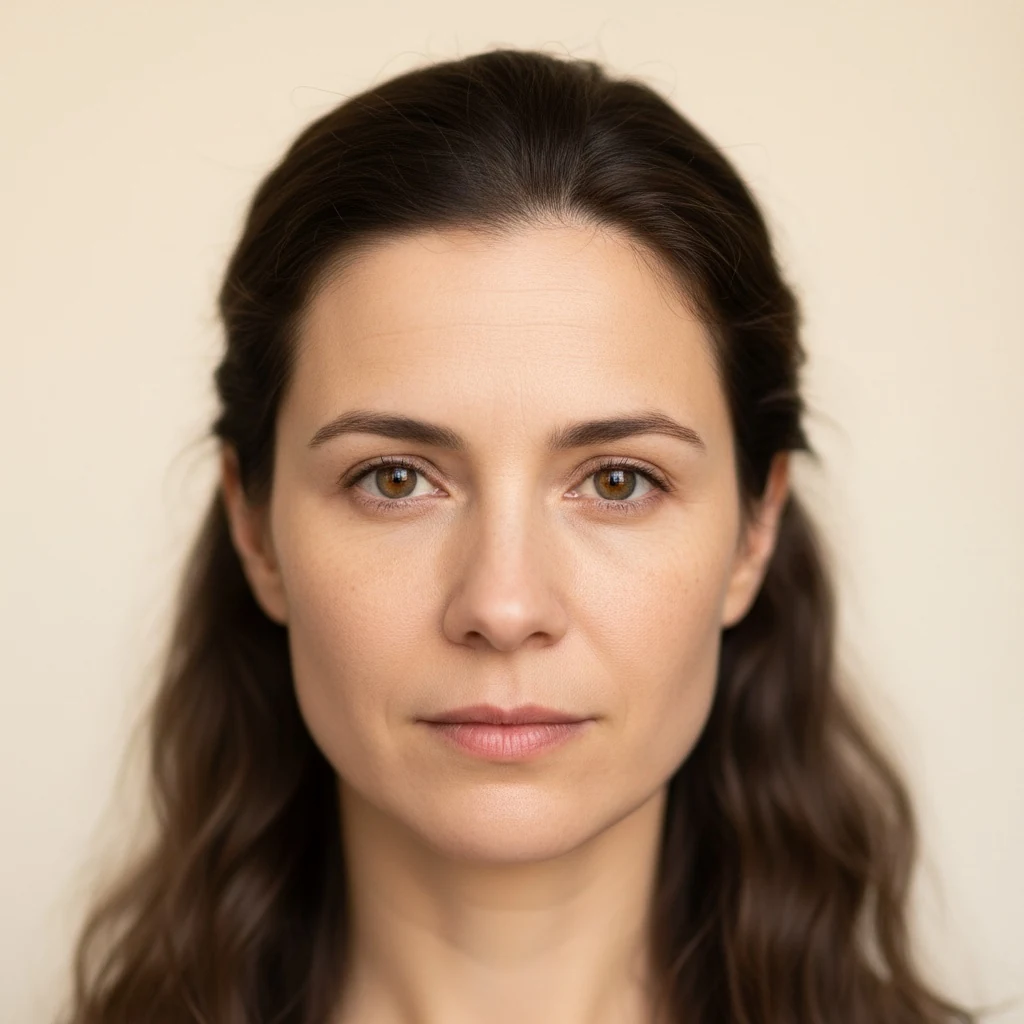 Example
Choose your own photo
Discover your eye shape and proportions.
Choose your own photoClick to choose a photo, or drop one here
Front-facing · Even lightingStraight-on, even lighting, at arm's length gives the most comparable reading.
Runs in your browser. Your photo is not uploaded.
What are close-set eyes, and how are they measured?
The same inner-corner gap divided by average eye width, read from the low end. Below 1.1 eye-widths reads as close-set, which is still about one eye-width: measured faces sit above the drawing rule's 1.0.
- About one eye's width or less between the inner corners
- The bridge of the nose reads as narrow relative to the eyes
- The centre of the face reads as compact
Close-set means the gap between the inner corners is about one eye width or less — below 1.1 eye-widths on this test. Like wide-set, it is a spacing measurement independent of everything else about the eye, and it is decided by bone that stops changing after growth. It is the least searched of the ten, which is worth knowing if you arrived here worried about it.
How to tell if you have close-set eyes
- Compare the inner-corner gap to the width of one eye. A gap of about one eye-width or less is at the close end; this test reads below 1.1 eye-widths as close-set.
- Straight on and relaxed — head rotation invalidates the comparison entirely.
Close-set eyes vs wide-set eyes
Two cut points on one ratio. Below 1.1 eye-widths of gap is close-set, above 1.27 is wide-set, and most faces fall between. The measurement is the same one either way, which is why the tool reports the ratio itself rather than only the label.
Close-set eyes vs pupillary distance
These are two different gaps and they get used interchangeably, which is why quizzes disagree. Close-set is about intercanthal distance — the gap between the inner corners, compared against the width of one eye. Pupillary distance is the gap between the centres of the pupils, in real millimetres, and it is what an optician needs to centre your lenses. You can have close-set eyes and a completely ordinary PD, because the two measure different things.
Makeup for close-set eyes
Close-set technique is standard eye-makeup advice at full strength: everything moves outward.
Works
- Light shades and highlight at the inner corner
- Depth concentrated in the outer third and blended outward
- Liner starting from the middle of the lid and extending past the outer corner
- Brows kept slightly further apart at the inner ends
Fights the shape
- Dark liner along the inner corner and inner lower lash line
- Depth carried all the way to the inner corner, which pulls the eyes together
Eyeliner for close-set eyes
Close-set technique is ordinary eye makeup advice at full strength: everything moves outward.
- Start the line at the middle of the lid and extend well past the outer corner
- Leave the inner corner clean, or lift it with a light shade
- Thickest at the outer third, tapering to nothing before the inner corner
- A longer wing than you would use on any other spacing
Eyelashes for close-set eyes
Lash weight distribution does the same job as liner placement here.
- Longest lashes at the outer third, shortest at the inner
- Outer-corner clusters, which are the single most effective option for this spacing
- Avoid full even strips, which distribute weight toward the inner corner
Close-set eyes celebrities
Close-set eyes get named in celebrity commentary far more often as criticism than as description, which is reason enough not to add to it. The measurement is a ratio against your own eye width, it takes a straight-on photo, and the tool above will give you yours.
Close-set eyes — frequently asked questions
Do close-set eyes look better with a particular brow shape?
Brows drawn or shaped slightly further apart at the inner ends open the space between the eyes, which is the same logic as leaving the inner corner clean. Brows that start close to the bridge do the opposite.
Is close-set eye spacing linked to anything medical?
Ordinary close spacing is a normal variation and is not a finding. There is a clinical term for an abnormally reduced distance between the orbits, but it is assessed against population norms by a clinician with imaging — not from a selfie, and not from a ratio against your own eye width.
Can close-set eyes be made to look further apart?
Yes, and it is the one spacing where standard makeup advice works at full strength: light shades at the inner corner, depth and length at the outer third, brows kept a little further apart at the inner ends. None of it changes the measurement, but all of it moves where the eye is drawn.
Do glasses make close-set eyes more noticeable?
A heavy or dark bridge sits exactly in the gap and shortens it further. Frames with a clear or high bridge, and with detail toward the outer edges, work in the opposite direction. Frame width matters more than lens shape here.
Does eye spacing change as you get older?
Effectively no. The distance between the inner corners is set by bone that stops changing after growth, which makes it one of the most stable measurements on the face. What changes around it is lid skin, not spacing.
How do I know if my eyes are close-set?
Compare the gap between your inner corners to the width of one eye. A gap of about one eye-width or less is at the close end; this test reads below 1.1 eye-widths as close-set.
Does close-set eye spacing matter?
Cosmetically it changes which makeup placement flatters. Beyond that it is an ordinary variation of facial proportion.