Facial symmetry exercises, and the asymmetries they cannot touch
·23 min read·Updated
Search for facial symmetry exercises and you get the same article twenty times: seven movements, a claim that consistency is key, and no mention of the one question that decides whether any of it applies to you. Facial asymmetry has at least four distinct causes, and observers need about 3 mm of difference before they notice any of them. Exercise has a plausible mechanism against exactly one. Working through a routine aimed at the wrong one is not merely ineffective — it is twenty weeks spent on the wrong problem.
So this is arranged in the order the decision actually runs. First, whether your asymmetry is visible to anyone at all. Second, which of the four kinds you have, decided from two photographs you can take now. Third, what the published research does and does not support. Only then, the exercises — with the specific imbalance each one targets and what it cannot reach.
How much facial asymmetry is visible: the 3 mm threshold
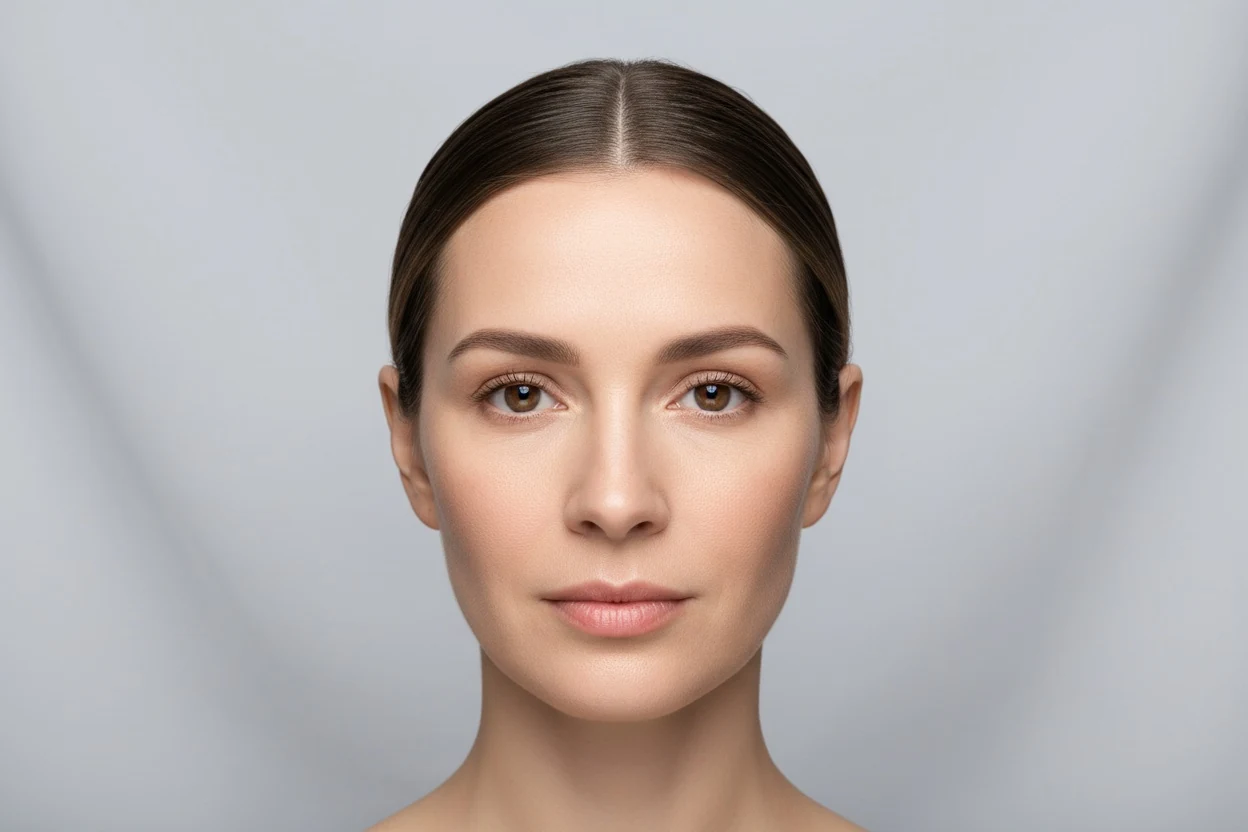
Chu and colleagues, publishing in Archives of Facial Plastic Surgery in 2011, built a model of one-sided facial paralysis by digitally morphing a healthy face, then showed observers who had no idea what the study was about a series of photographs with the manipulated image hidden inside it. The result is the most useful number in this subject: at least 3 mm of displacement at the mouth corner or the brow was needed before anyone consciously noticed. Below that, the asymmetry was there, measurable, and invisible.
Three millimetres is a lot on a face. It is roughly a quarter of the width of your iris. Most of what people describe as their uneven side, especially the kind found by staring into a mirror or flipping a selfie, is well under it. The study also found the threshold dropped when observers were allowed to look for longer, which is the mechanism behind the whole phenomenon: nobody else is looking at your face for the length of time you are.
Can a face be 100% symmetrical? No, including the benchmark faces
In 1991 Peck, Peck and Kataja took cephalometric radiographs of 52 adults selected specifically for exceptionally well-balanced faces — the group you would expect to be the exception — and measured skeletal asymmetry across the orbits, the zygomas and the gonial angles. Every single subject showed measurable asymmetry. Not most. All of them. What separated these faces was not the absence of asymmetry but where it sat: less of it, and more dimensional stability, the closer the landmark was to the cranium.
Ferrario and colleagues reached the same place from a different direction in 1995, using three-dimensional landmark data rather than radiographs, and Thiesen's 2015 review summarises the position that orthodontics has held for decades: facial asymmetry is common in the general population and usually subclinical. It becomes a clinical problem at a magnitude most people never reach.
In a group of 52 faces chosen for how well balanced they looked, the number with no measurable skeletal asymmetry was zero.— Peck, Peck & Kataja, The Angle Orthodontist, 1991
Which kinds of facial asymmetry respond to exercise
This is the section the exercise listicles skip, and it is the one that determines everything downstream. The four causes sit in different tissues, and the tissue decides what can move them.
| Cause | What is actually different | Does exercise reach it? |
|---|---|---|
| Skeletal | The bones themselves — orbital height, zygomatic projection, the position or length of one side of the mandible | No. Adult facial bone does not remodel in response to voluntary muscle work |
| Dental and occlusal | A canted bite plane, missing teeth on one side, a jaw that deviates on opening | No — but it is treatable, by a dentist or orthodontist rather than by a routine |
| Neuromuscular | One side habitually more active, weaker, or slower to fire; a one-sided smile; an eyebrow that lifts alone | Yes, in principle. This is the only one with a mechanism |
| Soft tissue and volumetric | Fat pad volume, swelling, one-sided skin laxity, sleep creasing | Partly, and mostly indirectly — through weight, sleep position and skin care rather than through contraction |
The proportions matter here. Skeletal and dental causes account for the majority of visible adult facial asymmetry — this is why orthognathic surgery and orthodontics exist as fields, and why Thiesen's review frames the clinical decision as a surgical one at the top end. Neuromuscular asymmetry is real and common at small magnitudes, and it is the only one where a person working alone at home has a defensible route.
Muscular or skeletal asymmetry? The two-photo test
You do not need a clinic for the first pass. The distinction between structural and muscular asymmetry has a simple behavioural signature: structure does not change when you move, muscle does.
- 1Take one photograph straight on, at eye level, with even light from the front, face completely relaxed and mouth closed. Relaxed means relaxed — no set jaw, no held brow.
- 2Take a second, identical in every way, holding a wide smile or a strong brow raise.
- 3Compare the two. Mark the same landmarks in both: outer eye corners, mouth corners, the top of each brow, the bottom edge of the jaw on each side.
- 4Present in both, roughly equal in both — structural. The difference lives in bone or in fixed soft tissue, and it did not appear because of anything you did.
- 5Small or absent at rest, obvious when you move — neuromuscular. The two sides are firing differently, and this is the pattern with a route.
- 6Present at rest and worse when you move — mixed, which is the most common real answer. There is a structural floor and a muscular component sitting on top of it.
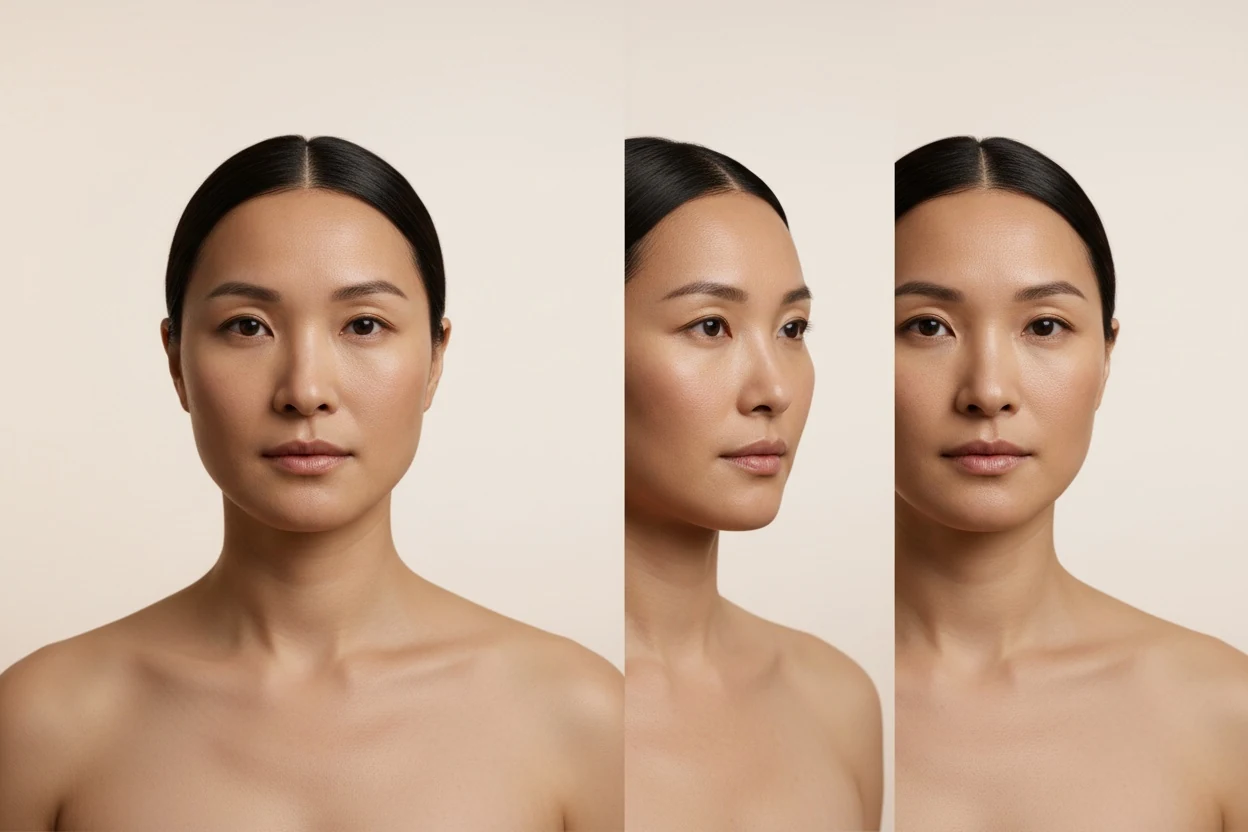
Two things will corrupt this test and both are avoidable. Head rotation changes every horizontal distance on the far side of the face, so if one ear shows more than the other, discard the frame and take it again. And light from one side casts a shadow that reads as a volume difference; the same face under symmetrical light will often lose the asymmetry entirely. If your uneven side changes between two photographs taken in different rooms, the room was the variable.
Do facial asymmetry exercises work? What the research measured
There is more evidence here than the sceptics allow and much less than the sellers claim. Four bodies of work matter, and they point in different directions because they studied different things.
The systematic review: no controlled evidence for rejuvenation
Van Borsel and colleagues searched five databases in 2014 and found nine reports on facial exercise for facial rejuvenation. All nine reported positive outcomes. None used a control group or randomisation, they were single cases, small series or single-group before-and-after designs, and in most of them the assessment was made by the authors or the participants themselves without blinding. Their conclusion was that the evidence was insufficient to say whether facial exercises work, and that large randomised trials would be needed before drawing any.
The Northwestern pilot: a real result, on a different outcome
Alam and colleagues published the best-known study in JAMA Dermatology in 2018. Middle-aged women performed a 32-exercise programme, 30 minutes a day for eight weeks and then every other day for twelve more, with blinded dermatologists rating standardised photographs on a validated scale. Upper and lower cheek fullness ratings improved and estimated age fell by around three years across twenty weeks.
Three caveats travel with it and are usually dropped. It was a pilot with no control group and a small completing sample. The founder of the exercise programme used in the study was an author on it. And most relevant here: it did not measure symmetry. It measured fullness and apparent age. Citing it as evidence that exercise corrects an uneven face is citing it for something it never tested.
Facial palsy: where the mechanism is actually established
The strongest evidence for facial exercise is in a population nobody quotes in beauty contexts. Pereira and colleagues published a systematic review and meta-analysis in Clinical Rehabilitation in 2011 covering facial exercise therapy for facial palsy — a condition that is, definitionally, severe one-sided facial asymmetry of neuromuscular origin. This is the clinical evidence base behind neuromuscular retraining, and it exists because there the asymmetry is unambiguously muscular.
That is the honest shape of the field: exercise has its best support in exactly the cause it should, by mechanism, be able to reach. It does not follow that a home routine moves a 2 mm resting difference in a healthy face. It does follow that the mechanism is not imaginary. It is also where the idea of working one side on its own comes from: in palsy rehabilitation the affected side is trained deliberately. Nobody has tested whether extra one-sided work closes a small asymmetry in a healthy face, which is why the exercises below use it only under a condition.
Face yoga and muscle properties: a 12-person study
Güzel and colleagues put 12 women with an average age of about 50 through eight weeks of intensive face yoga — two supervised sessions and five home sessions a week — and measured muscle properties with a hand-held myometer before and after. The direction depended on the muscle: tone and stiffness fell in the frontalis, corrugator, orbicularis oculi and orbicularis oris, rose in the buccinator and digastric, and elasticity rose in all of them. It is a genuine measurement of what face yoga does to muscle tissue. It had no control group, both sides were trained the same way, and it did not measure symmetry.
Chewing gum and the jaw: the six-month trial
Jung and colleagues randomised 58 healthy adults to chew gum three times a day for six months or to do nothing. The chewing group's maximum bite force rose significantly by three months. Masseter thickness and mandibular shape did not change. It is the cleanest answer available to the idea that jaw work reshapes the jaw, and it pairs with the cohort study further down that found chewing side had no effect on facial asymmetry.
Rollers and gua sha: measured, but not for balance
Ahn and colleagues ran a randomised trial in 2025 with 34 women, ten minutes a day, five days a week, for eight weeks. Both facial roller and gua sha reduced facial surface distances significantly — 2.23 to 2.40 mm for gua sha, 2.75 to 3.26 mm for the roller — but through different routes: gua sha changed muscle tone parameters, the roller changed skin elasticity. It is a genuinely controlled result and it is about contour, not symmetry. Both sides got the same treatment.
| Study | What it tested | What it can support |
|---|---|---|
| Van Borsel 2014, systematic review | Nine reports on facial exercise for rejuvenation | That the evidence base was uncontrolled and unblinded |
| Alam 2018, JAMA Dermatology pilot | 20 weeks of daily exercise, blinded photo rating | Improved cheek fullness and apparent age — not symmetry |
| Pereira 2011, meta-analysis | Exercise therapy in facial palsy | That neuromuscular retraining has clinical evidence |
| Ahn 2025, randomised trial | Roller vs gua sha, 8 weeks | Contour and skin or muscle property change, applied to both sides |
| Güzel 2025, uncontrolled study | 8 weeks of face yoga, 12 women, muscle myometry | That face yoga changes muscle tone and elasticity, in different directions per muscle — not symmetry |
| Jung 2024, randomised trial | 6 months of gum chewing, 58 adults | That bite force rose while masseter thickness and jaw shape did not change |
| Liu 2014, identical twins | 147 twin pairs, environment vs asymmetry | That sleep position, smoking and dental loss track with asymmetry |
8 facial asymmetry exercises, and the imbalance each one targets
These are worth doing if your photograph test put you in the neuromuscular or mixed group. Each one is written with its target muscle and the thing it cannot do, because a routine you understand is a routine you can stop when it is not the answer.
One principle needs stating carefully, because it is usually stated as fact: weighting the work towards the weaker side. It comes from palsy rehabilitation, where one side is clearly affected, and no study has shown that extra one-sided repetitions close a small asymmetry in a healthy face. So use it only if your two-photo test showed a difference that appears with movement, never on the strength of a single still photograph; keep the extra repetitions modest; and if the four-week reference photo shows the gap growing rather than shrinking, go back to working both sides evenly. Where an exercise is bilateral by design, the note says so.
1. Single-side mouth corner lift
Target: zygomaticus major and levator anguli oris on the weaker side, the muscles behind a one-sided smile. Place two fingertips flat on the cheek of the stronger side to hold it still, then lift only the weaker mouth corner towards the eye on that side. Hold five seconds, release slowly. Ten repetitions, twice a day. It cannot move a mouth corner whose position at rest is set by mandibular asymmetry — if the corner sits low with the face fully relaxed and does not change on smiling, this is the wrong exercise.
2. Isolated brow raise
Target: the frontalis on one side. Press a flat palm against the forehead over the dominant brow to prevent it lifting, then raise the other brow alone against no resistance. Hold three seconds, ten repetitions. Most people find this genuinely difficult on the non-dominant side at first, and that difficulty is itself the finding — a brow you cannot lift independently is a brow that is not being recruited independently in daily expression either.
3. Resisted lateral jaw opening
Target: the pterygoids, and the tracking of the jaw on opening. Skip this one entirely if opening your jaw clicks, locks or hurts. Open slowly with a fingertip resting lightly on the chin and watch in a mirror whether the midline of your lower teeth drifts. If it deviates, open repeatedly while guiding it back to centre with light finger pressure, ten slow openings. This is a coordination drill rather than a strength one, and a jaw that deviates consistently on opening belongs in front of a dentist — deviation can indicate a temporomandibular joint problem, which is not a cosmetic finding.
4. Unilateral cheek inflation hold
Target: buccinator on one side. Fill one cheek with air, hold ten seconds, then move the air to the other and hold. If your movement photo showed a difference, do the weaker side twice for every once on the other; otherwise alternate evenly. Six cycles. This changes muscle activity, not the volume of the buccal fat pad that sits over it — if one cheek is fuller than the other at rest and has been for years, the difference is volumetric and this will not address it.
5. Single-side lip pucker and hold
Target: orbicularis oris, unevenly. Purse the lips as if whistling, then pull the pucker deliberately towards the weaker side and hold five seconds. Fifteen repetitions. Useful when the asymmetry shows up in speech and eating rather than in still photographs — a mouth that pulls to one side when you talk is a different observation from one that sits off-centre at rest.
6. Eye squeeze, one side at a time
Target: orbicularis oculi. Close one eye firmly while keeping the other fully open and the brow relaxed, hold five seconds, release. Ten each side, weighted towards the weaker one. Notice whether the brow on that side drops as the eye closes — the two moving together is a recruitment pattern, and separating them is the actual skill being trained. It does nothing for canthal tilt, which is set by where the tendons attach to bone.
7. Tongue-to-palate posture hold
Target: resting tongue position, bilateral. Rest the whole tongue flat against the roof of the mouth, teeth lightly together, lips closed, and breathe through the nose. Hold two minutes. This one is bilateral by design and it is the one with the most inflated claims attached to it online — the plausible benefit is a consistent resting posture, not an altered adult jaw. Anyone promising bone change from tongue posture in an adult is describing something no controlled study supports.
8. Neck and shoulder release on the dominant side
Target: sternocleidomastoid and upper trapezius. Not a facial exercise, and included because a head habitually tilted or rotated presents an asymmetrical face to every camera and every mirror regardless of what the face itself is doing. Slow lateral neck stretches, twenty seconds each side, plus a check of how you hold your head when you are not thinking about it. The cheapest correction on this page is discovering the asymmetry was postural.

Uneven smile, uneven eyes, uneven jaw: what exercise reaches in each
Most people searching for asymmetry exercises are bothered by one feature rather than the whole face. The answer changes a great deal by feature, because each sits on a different mix of muscle, tendon and bone.
Uneven smile exercises
An uneven smile is the most exercise-responsive asymmetry there is, because the smile is made by muscles. If one corner lifts less when you smile but the corners sit level at rest, exercises 1 and 5 above are the relevant ones. If the corners sit at different heights with the face fully relaxed and stay that way on smiling, the difference is more likely skeletal or dental. And a smile that becomes uneven suddenly, over hours or days, is not a cosmetic question — it needs urgent medical assessment the same day.
How to fix asymmetrical eyes: what is muscle and what is not
| What differs between the eyes | Tissue | Responds to exercise? | Who looks at it |
|---|---|---|---|
| One brow sits or lifts higher | Frontalis muscle | Possibly — exercise 2 targets it | Nobody needs to, unless it is new |
| One eye closes or squints differently | Orbicularis oculi muscle | Possibly — exercise 6 | Nobody needs to, unless it is new |
| One upper lid sits lower over the eye | The muscle that lifts the lid and its tendon | No — this can be ptosis | An eye doctor, promptly if it is recent or one-sided |
| One eye corner tilts differently | Tendons anchored to bone | No | No one, unless it changed — see canthal tilt |
| One eye sits higher in the face | The bony eye socket | No | No one, unless it changed |
How to fix an asymmetrical jaw naturally
Mostly, you cannot, and the research is unusually direct about it. Six months of gum chewing did not change masseter thickness or jaw shape in a randomised trial, and a 748-person cohort found the side people chew on had no effect on facial asymmetry. Switching your chewing side, jaw exercises and chewing devices are therefore not routes to a more even jaw. A jaw that drifts to one side as it opens, clicks or hurts is a question for a dentist, because it can involve the jaw joint. To see how large a jaw difference actually is, the jawline rating measures how far each jaw corner sits from the midline on your photo.
A facial symmetry exercise routine you can verify
The failure mode here is not doing too little. It is doing twenty weeks of work with no way to tell whether anything changed, then deciding from memory — which for a 2 mm difference is worthless.
| When | What | Time |
|---|---|---|
| Every morning | Exercises 2, 6 and 8 — the ones involving the eye region and posture | 4 minutes |
| Every evening | Exercises 1, 4 and 5 — weighted to one side only if your movement photo showed a difference | 5 minutes |
| Three times a week | Exercise 3, only if your jaw deviates on opening | 2 minutes |
| Throughout the day | Exercise 7, whenever you notice your mouth open at rest | — |
| Every fourth Sunday | Reference photograph under fixed conditions, then measure | 5 minutes |
Fixed conditions means the same five variables every time: same room and same light source, same distance and camera height, same neutral expression, same time of day, hair off the face. Change any one of them and the difference between two photographs is the change you made to the setup, not to your face.
How long does it take to fix an asymmetrical face naturally?
Longer than any listicle suggests, and for most asymmetry the honest answer is that it does not happen at all, because most asymmetry is structural. For the muscular kind, the only controlled programme with a timeline ran for twenty weeks before reporting a change — and what it measured was cheek fullness, not symmetry. No study shows a measurable change in a week, and nothing fixes an asymmetrical face overnight. Compare reference photos every four weeks; if twenty weeks of consistent work shows nothing on a like-for-like photo, the routine has answered the question.
Six landmark pairs compared left against right, in your browser, on a photo that is never uploaded. Run it before you start and on the same day every fourth week — the whole value of a routine this small is a number to compare it against.
Get your baseline numbersHabits linked to facial asymmetry: sleep, teeth, smoking, chewing
Liu and colleagues did something clever in 2014: they recruited 147 pairs of identical twins at the Twins Days Festival, so genetics were held constant, and regressed eight measured facial features against detailed lifestyle questionnaires. What survived the analysis is a short and specific list.
- Sleeping face down was associated with greater nasal midline deviation and greater mouth corner asymmetry. Of everything on this page, this is the most actionable, and Anson's 2016 work on sleep distortion describes the mechanism — hours of compression against a pillow, repeated nightly for decades.
- Tooth extraction was associated with canting of the occlusal plane, and denture use with both nasal midline deviation and mouth corner asymmetry. Dental history shows up in the face, which is one more reason the dental column in the table above is not a footnote.
- Smoking was associated with occlusal plane canting and upper eyelid ptosis. The same research group's twin study on smoking found the effects concentrate in the middle and lower thirds of the face.
- Chewing on one side did not make the list — and a much larger test of it, Heikkinen's 748-person cohort study in 2024, measured chewing side preference against 3D facial scans and found no statistically significant effect on asymmetry. What predicted a chewing side was missing teeth on the opposite side. The internet has the arrow backwards. And in a six-month randomised trial, chewing gum three times a day did not change jaw shape or masseter thickness at all.
Asymmetry from sleeping on one side: what changing it can do
Sleeping face down was the clearest lifestyle association in the twin data, and changing sleep position is cheap. What it can do is stop adding a nightly source of compression; what it cannot do is undo a skeletal difference, and no study has measured how much an existing asymmetry softens after switching. Treat it as a variable worth removing, not a treatment.
Are facial exercises safe? When to stop
For most people facial exercises are low risk, but a few signals mean stop, and a couple mean more than that.
- Stop and rest if an exercise causes pain, a headache, or aching in the jaw or temples.
- Stop jaw exercises if your jaw clicks, locks, or will not open or close smoothly, and mention it to a dentist — these can be signs of a jaw joint problem.
- Get urgent care the same day for sudden drooping or weakness on one side of the face, a mouth corner that will not lift, a brow that will not raise, an eye that will not close, or slurred speech.
- See a clinician if an asymmetry is getting steadily worse, or if chewing, speaking or closing your eyes has become difficult.
- Back off one-sided work if the four-week photo shows the difference growing. Overloading one side on the strength of a single photo is the main way a routine can make things look worse.
One more reasonable caution: repeatedly holding strong expressions for long periods is a plausible contributor to expression lines, in the same way repeated expression contributes to lines around the eyes. That has not been measured for exercise routines specifically, so it is a reason for moderate holds rather than a reason to avoid the exercises.
When facial asymmetry exercises are the wrong answer
Three situations, in descending order of urgency.
Asymmetry that appears suddenly — over hours or a day — is a medical event until proven otherwise. One-sided drooping, a mouth corner that will not lift, a brow that will not raise, slurred speech or an eye that will not close belong in urgent care the same day. Nothing on this page applies and delay has a real cost.
Asymmetry that is structural on the photograph test and large enough to see is a conversation with an orthodontist, a maxillofacial surgeon or a dentist depending on where it sits. That is not a failure of the routine; it is the routine correctly telling you it is not the tool. If you are heading in that direction, the simulations render one change on your own photograph so you can see what a given procedure moves before you sit in a consultation — a visualisation to take with you, not a plan and not a recommendation.
Asymmetry you cannot stop looking at, that measures under 3 mm and that nobody has ever mentioned, is a perception problem rather than a geometry one, and it does not get better with more measuring. If checking has become a daily habit, the measurement is feeding it rather than settling it.
Does a more symmetrical face look better? What symmetry is worth
Grammer and Thornhill reported the correlation between facial symmetry and rated attractiveness in 1994, and it has replicated since. It is real, and it is modest — one contributor among several, sitting alongside averageness and skin quality rather than above them. In the studies where they are compared directly, skin frequently outperforms geometry.
The relationship also stops behaving above a certain point. Take one half of a face and mirror it into a perfect composite and the result is usually rated slightly worse, not better — a face with no asymmetry at all reads as manufactured, because no real one is. Perfect symmetry is not the top of the scale; it is off it.
Which leaves a narrower and more achievable goal than the one the exercise listicles sell. Not a symmetrical face. A face whose asymmetry sits under the threshold at which anyone consciously registers it — and if you measured at the top of this page, there is a good chance yours already does. If you want the rest of the arithmetic your face produces, the attractiveness test reports symmetry alongside the thirds, the fifths and the phi comparisons, and what those proportion rules actually claim is its own subject.
Frequently asked questions
Can facial exercises fix an asymmetrical face?
They can change the muscular component and nothing else. If one side of your face sits differently because the muscles on that side are habitually more active or weaker, targeted work has a plausible route to changing it. If the difference comes from the bone underneath — which is the common case — no amount of exercise moves it, because muscles pull on bone but do not reshape adult bone. The first job is deciding which of those you have, and two photographs will usually tell you.
How long before facial symmetry exercises show anything?
The only controlled work with a real timeline is the 2018 JAMA Dermatology pilot, which ran 30 minutes daily for eight weeks and then every other day for a further twelve, and reported a change in rated cheek fullness at twenty weeks. That study did not measure symmetry at all. Treat twenty weeks as the earliest honest checkpoint for a verdict, and photograph yourself under fixed conditions from day one, because memory is worthless for a change this small.
Is one uneven side of the face a sign of something serious?
A lifelong difference that has been in every photograph since childhood is ordinary anatomy. Asymmetry that appears suddenly, over hours or days, is not — drooping on one side, a mouth corner that will not lift, or a brow that will not raise are reasons to seek urgent medical care the same day rather than to look for a routine. Gradual change over years belongs in the ordinary category but is worth mentioning to a clinician.
Does chewing on one side make your face uneven?
The best evidence available says no. A 748-person cohort study published in 2024 measured chewing side preference against 3D facial scans and found no statistically significant effect on facial asymmetry. What did drive chewing side was missing teeth on the other side, which reverses the usual claim: dental loss changes chewing, rather than chewing changing the face. A separate six-month trial found that chewing gum daily did not change jaw shape either.
Can facial exercises make asymmetry worse?
They can make it look worse if one side is overworked on the strength of a single photo, particularly when the difference was really lighting, head tilt or bone. That is why one-sided work is only worth trying when a difference shows up with movement, and why comparing photos every four weeks matters: if the gap grows, go back to working both sides evenly. Pain, clicking or locking in the jaw are reasons to stop.
Which exercises help an uneven smile?
The single-side mouth corner lift and the single-side lip pucker, if the unevenness appears when you smile and the corners sit level at rest. If the corners are uneven with the face fully relaxed, the cause is more likely skeletal or dental. A smile that became uneven suddenly needs urgent medical assessment, not exercise.
Does facial asymmetry get worse as you age?
Some of it can. In the identical twin study, tooth extraction and denture use were associated with more asymmetry around the mouth and bite. There is no reliable general figure for how much asymmetry increases with age, and a lifelong difference usually stays about the same.
Should I use a face roller or gua sha for an uneven face?
A 2025 randomised trial in 34 women found both reduced facial surface distances by roughly 2 to 3 millimetres over eight weeks, with gua sha acting on muscle tone and the roller on skin elasticity. The trial measured contour, not left-right balance, and everyone in it did the same thing to both sides. Nothing there supports using either to correct an imbalance.
Do symmetrical faces really look better?
The correlation exists and is modest. It is also non-linear in an unhelpful direction: faces made perfectly symmetrical by mirroring one half tend to be rated as slightly wrong rather than better, because the result no longer looks like a real face. The realistic goal is not a symmetrical face, it is a face whose asymmetry sits under the threshold at which anyone consciously notices it — and most already do.
References
- Chu, E. A., Farrag, T. Y., Ishii, L. E., & Byrne, P. J. (2011). Threshold of visual perception of facial asymmetry in a facial paralysis model. Archives of Facial Plastic Surgery, 13(1), 14–19. PMID 21242426.
- Peck, S., Peck, L., & Kataja, M. (1991). Skeletal asymmetry in esthetically pleasing faces. The Angle Orthodontist, 61(1), 43–48. PMID 2012321.
- Ferrario, V. F., Sforza, C., Miani, A. Jr., & Serrao, G. (1995). A three-dimensional evaluation of human facial asymmetry. Journal of Anatomy, 186(Pt 1), 103–110. PMID 7649806.
- Thiesen, G., Gribel, B. F., & Freitas, M. P. M. (2015). Facial asymmetry: a current review. Dental Press Journal of Orthodontics, 20(6), 110–125. PMID 26691977.
- Liu, M. T., Iglesias, R. A., Sekhon, S. S., Li, Y., Larson, K., Totonchi, A., & Guyuron, B. (2014). Factors contributing to facial asymmetry in identical twins. Plastic and Reconstructive Surgery, 134(4), 638–646. PMID 25357025.
- Heikkinen, E. V., Vuollo, V., Heikkinen, T., & Harila, V. (2024). Chewing side preference, facial asymmetry and related factors in the Northern Finland Birth Cohort 1986. Acta Odontologica Scandinavica, 83, 500–506. PMID 39291747.
- Van Borsel, J., De Vos, M. C., Bastiaansen, K., Welvaert, J., & Lambert, J. (2014). The effectiveness of facial exercises for facial rejuvenation: a systematic review. Aesthetic Surgery Journal, 34(1), 22–27. PMID 24327764.
- Alam, M., Walter, A. J., Geisler, A., Roongpisuthipong, W., Sikorski, G., Tung, R., & Poon, E. (2018). Association of facial exercise with the appearance of aging. JAMA Dermatology, 154(3), 365–367. PMID 29299598.
- Pereira, L. M., Obara, K., Dias, J. M., Menacho, M. O., Lavado, E. L., & Cardoso, J. R. (2011). Facial exercise therapy for facial palsy: systematic review and meta-analysis. Clinical Rehabilitation, 25(7), 649–658. PMID 21382865.
- Ahn, S. H., Hwang, U. J., Han, H. S., Kim, J. H., Lee, H. J., Jeon, Y. R., Lee, H. H., & Hwang, A. H. (2025). Comparative effects of facial roller and gua sha massage on facial contour, muscle tone, and skin elasticity: randomized controlled trial. Journal of Cosmetic Dermatology, 24(6), e70236. PMID 40439289.
- Güzel, H. Ç., Keçelioğlu, Ş., Kurtoğlu, A., & Elkholi, S. M. (2025). Effect of intensive face yoga on facial muscles tonus, stiffness, and elasticity in middle-aged women: a pre-experimental clinical trial. Medicina, 61(5), 840. PMID 40428798.
- Jung, H. J., Hwangbo, N. K., Park, Y., & Ahn, H. J. (2024). Effects of gum chewing training on occlusal force, masseter muscle thickness and mandibular shape: a randomised controlled clinical trial. Journal of Oral Rehabilitation, 51(12), 2529–2536. PMID 39215439.
- Anson, G., Kane, M. A., & Lambros, V. (2016). Sleep wrinkles: facial aging and facial distortion during sleep. Aesthetic Surgery Journal, 36(8), 931–940. PMID 27329660.
- Grammer, K., & Thornhill, R. (1994). Human (Homo sapiens) facial attractiveness and sexual selection: the role of symmetry and averageness. Journal of Comparative Psychology, 108(3), 233–242. PMID 7924253.
Tools mentioned in this article
Symmetry Checker
Left against right across six landmark pairs.
Jawline Rating Test
Jaw against cheekbones, taper and asymmetry — and why the gonial angle is not in there.
Canthal Tilt Test
Your tilt in degrees, each eye separately.
Attractiveness Test
Your score out of ten, with every measurement behind it.
Measurements on this site are for information only. Nothing here is medical advice, and no result is a diagnosis. Talk to a qualified clinician before making any decision about a procedure.