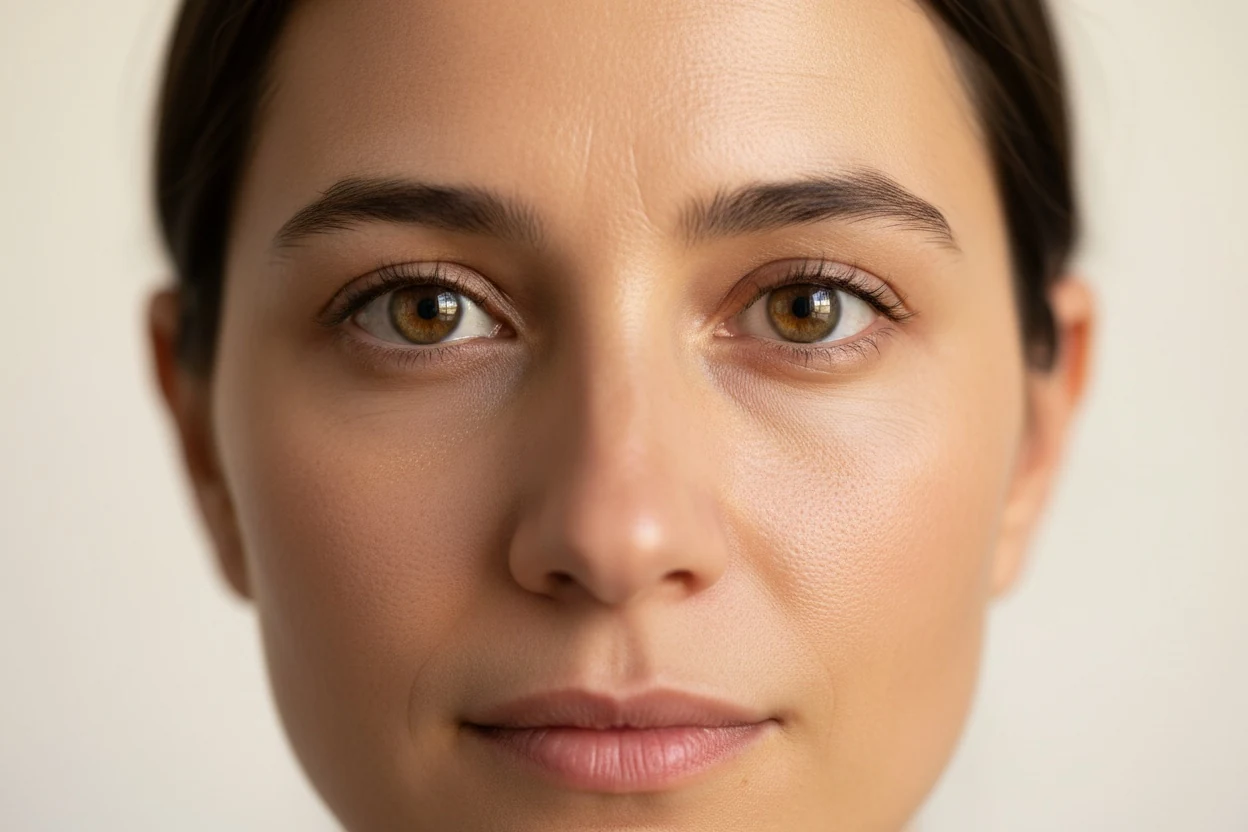
Negative Canthal Tilt (Measured in Degrees)
A negative canthal tilt means the outer corner of your eye sits below the inner corner. This test reads a tilt below 0° as negative, measuring each eye separately from a straight-on photo.
- < 0°
- negative
- 0° to +5°
- neutral
- 2
- eyes, measured separately
- Free
- photo not uploaded
Below 0°. The outer corner of the eye sits lower than the inner corner.
The panel measures your tilt in degrees, each eye separately, and says whether it reads as negative.
 Example
Choose your own photo
Measure the angle of each eye.
Choose your own photoClick to choose a photo, or drop one here
Front-facing · Even lightingStraight-on, even lighting, at arm's length gives the most comparable reading.
Runs in your browser. Your photo is not uploaded.
What a negative canthal tilt looks like
- Outer corner below the inner corner
- The lower lash line slopes gently downward toward the outer third
- Often accompanied by visible lower lid show
- Reads as soft rather than sharp — the same thing beauty writing calls downturned eyes
A negative canthal tilt means the outer corner sits below the inner one, at any angle below level. Two things get conflated here and should not be. The measurement is ordinary anatomy, and a mild negative reading is not rare. Separately, a downward corner that has developed over time — rather than always having been there — can reflect lower-lid laxity or, rarely, a neurological or thyroid cause, and that is a clinical question rather than an aesthetic one.
This page is about the negative reading. For what canthal tilt is in general and how all three readings are measured, the canthal tilt test is the place to start.
Negative vs neutral vs positive canthal tilt: the three readings
| Reading | Angle this test uses | What you see | Also called |
|---|---|---|---|
| Negative | Below 0° | The outer corner sits below the inner corner | Downturned eyes |
| Neutral | 0° up to +5° | The corners sit close to level | — |
| Positive | +5° and above; the eye shape test reads upturned from the same cut | The outer corner sits clearly above the inner corner | Upturned eyes, cat eyes |
Beauty writing and the looksmaxxing vocabulary describe the same measurement with different words. Downturned eyes is a negative canthal tilt described as an eye shape rather than an angle.
Why photos get negative canthal tilt wrong
This is the reading most often assigned wrongly from a photograph, and usually to oneself. A phone held below eye level, a raised chin, or a tired, puffy frame at the end of the day all produce an apparent downward corner — the outer corner sits further back in the head than the inner one, so any camera looking up at the face drops it in the picture. The tool measures each eye from a straight-on photo against the line through your inner corners, and a result that disagrees with what you saw in a selfie is usually the selfie's fault.
| Photo mistake | What it does to the reading | Fix |
|---|---|---|
| Phone held below eye level | The outer corner sits further back in the head than the inner one, so a camera looking up drops it in the frame — the reading moves toward negative | Camera at eye height |
| Chin raised | Same effect as a low camera | Chin level |
| Chin tipped down, or camera above eye level | The opposite: the corners read higher and the eye looks more angular. It flatters the angle rather than faking a negative one | Chin level — and do not use it to check yourself either way |
| Head leaning to one shoulder | Against the edge of the photo one eye gains tilt and the other loses it. This test measures against the line through your inner corners, so it corrects for this | Nothing for this test; keep level for a manual check |
| Tired, puffy frame | A swollen lower lid makes the outer corner look heavier than it measures | A rested photo in daylight |
| Smiling or squinting | The cheeks push the lower lid up and change the shape of the corner | Neutral expression, eyes relaxed |
Why your two eyes can read differently
The panel reports each eye against the line joining your inner corners, so leaning your head does not push one eye up and the other down. A gap that is left is in the face. Two or three degrees between sides is ordinary, and it is common for one eye to read neutral and the other negative when both sit close to level.
How to tell if you have a negative canthal tilt
- Hold a straight edge horizontally across from one inner corner to the other. If the outer corners fall below that line, the tilt is negative.
- Do it straight on with your chin level. The outer corner sits further back in the head than the inner corner, so raising your chin — or looking down into a mirror held low — makes the outer corner drop and manufactures a negative tilt that is not there. It is the single most common reason people misjudge their own.
- Check each eye separately. A two or three degree difference between sides is ordinary and a single averaged figure hides it.
What causes a negative canthal tilt
Bone and tendon: where the corner is anchored
The outer corner is held by the lateral canthal tendon, which in a dissection study of cadaver orbits inserted on a small bony point just behind the orbital rim. Where that point sits, and the shape of the orbit around it, sets the angle. Those are skeletal features laid down as the face grows, so a lifelong negative tilt is simply anatomy — the same kind of variation as the width of a nose.
Lower lid laxity and age
The lower lid and its supports can loosen over decades, and a corner that sat level at twenty can sit lower later. That is the one route by which the reading genuinely changes in an adult, and it is also why a tilt that has developed is a different question from one that has always been there.
After eyelid surgery
A lower outer corner that appears after eyelid surgery belongs with the surgeon who operated, not with a photo tool. The panel can tell you the angle; it cannot tell you why it changed.
Negative orbital vector
Surgeons use negative vector to describe an eye whose front surface sits forward of the cheekbone below it, so the lower lid has less support underneath. It is why implants below the eye turn up in searches about this tilt. It is a depth relationship, and a front-facing photo cannot measure it — this panel does not try.
When the change is new
Is a negative canthal tilt bad? What the research tested
It is a normal variation. The strength of feeling about it online is far ahead of the evidence, and the studies usually quoted do not say what they are quoted as saying.
| Study | What was changed | What it found | What it does not show |
|---|---|---|---|
| Kempa et al. 2025 — 2,081 raters | Eyebrow height and outer-corner height on an edited unisex face | Raising the outer corner lowered attractiveness and trustworthiness ratings and raised dominance and threat | That a lower corner is unattractive |
| Bashour & Geist 2007 | Inner-corner tilt accentuated on female faces | The altered faces were preferred 93% of the time | Anything about the outer corner |
| Rhee et al. 2012 | Composite faces of seven ethnic groups | Attractive composites had a steeper eye slant than average in some groups and a less steep one in others | One ideal angle |
| Vaca et al. 2022 | Head tilted forward and back in photos | Tipping the head forward made the corners read higher, the eye more angular, and was rated more attractive | Anything about anatomy — it is a camera-angle effect |
The largest recent study of outer-corner height found that raising it made a face read as more dominant and threatening, not more attractive. And the photography study shows how easily the angle is changed by the way a picture is taken — which is most of what online comparisons are measuring.
Is a negative canthal tilt rare?
A clearly negative reading is a minority, and a mild one is not unusual. What does not exist is a reliable population percentage: the figures that circulate come from individual apps counting their own users, with no controlled photography and no agreed cut point. This site cannot offer one either, and that is by design — the analysis runs in your browser and your photo is not uploaded, so there is nothing to count.
The more useful question is whether your own reading is real. Take two photos on different days, camera at eye height and chin level, and compare. A result that holds across both is your anatomy; one that flips is a photo that sits close to a cut point.
How to fix a negative canthal tilt: what changes it and what does not
The angle is set by where the lateral canthal tendon anchors to the orbital rim. That is a fixed anatomical attachment, which is why the honest list of what changes it is short — and why so much of the advice circulating online is simply false.
Changes it
- Canthopexy — the tendon is suspended higher without being detached. A smaller change, shorter recovery.
- Canthoplasty — the tendon is detached and reattached higher on the orbital rim. A larger change.
- Makeup and brow shaping, which change how the angle reads without changing the angle.
- Treating lower lid laxity, if the apparent downturn has increased with age rather than being lifelong.
Does not
- Mewing. Tongue posture does not move the lateral canthal tendon, and no evidence supports the claim that it does.
- Facial exercises, massage or 'eye yoga'.
- Any form of deliberate facial trauma. It circulates in looksmaxxing communities as advice; there is no evidence it reshapes bone, and it is injury rather than treatment.
- Weight loss, which changes fat volume rather than tendon position.
| Option | Changes the angle? | Changes how it reads? | Main downside |
|---|---|---|---|
| Lateral canthopexy | Yes — suspends the tendon higher | Yes | Eyelid surgery with its ordinary risks |
| Lateral canthoplasty | Yes — detaches and reattaches the tendon | Yes | A larger operation and a longer recovery |
| Treating lower-lid laxity | Can restore a corner that has dropped with age | Yes | Needs a clinical assessment first |
| Fox eye thread lift | No — lifts tissue, not the tendon | Yes, while it lasts | A procedure with a temporary result |
| Brow shaping | No | Yes | None |
| Eyeliner and lashes | No | Yes | None |
| Eye tape | No | While it is worn | Pulls on thin eyelid skin |
| Mewing, eye exercises, eye yoga | No | No | Time |
| Weight loss | No | Sometimes, through less puffiness | Not a reason to lose weight |
| Deliberate facial trauma | No | No | Injury |
Negative canthal tilt surgery: canthopexy vs canthoplasty
Both operate on the lateral canthal tendon, the band that anchors the outer corner to the orbital rim. A canthopexy tightens and suspends it without detaching it and makes the smaller change; a canthoplasty detaches it and reattaches it higher and makes the larger one. Neither is a cosmetic touch-up, and suitability depends on the lid, the eye and the bone behind it — which is an oculoplastic surgeon's assessment. You can look at a render of canthopexy or canthoplasty on your own photo first; it is a simulation, not a prediction of a result.
How to fix a negative canthal tilt naturally: what the claims are
Mewing, eye exercises, facial massage and eye yoga all act on muscle, skin or tongue posture, and none of them acts on a tendon attached to bone, so none of them changes the angle. Tape and liner change how the corner reads for as long as they are there. The one practice to name directly is deliberate facial trauma, sold in looksmaxxing spaces as bone smashing: a 2026 analysis found searches for it up by around 5,000% in a year, and there is no clinical evidence it reshapes bone. It is injury, not a treatment.
Eyeliner for a negative canthal tilt
Liner cannot move the corner, but it can move where the eye appears to end. The technique is the same as for downturned eyes, and the downturned eyes page has it in full; the short version:
- Start the wing from a point slightly inside the outer corner rather than at the corner itself, so it rises instead of following the downward line.
- Aim the wing toward the tail of the brow.
- Keep lower liner to the outer third at most, and stop before the corner — a full lower line weighs the edge down.
- Put lash volume and a little shadow just above the outer corner rather than below it.
- Leave the tail of the brow where it is or slightly lift it; a brow that drops at the end repeats the downturn.
Negative canthal tilt in men
Negative tilt carries more anxiety in male-dominated online spaces than any other measurement on this site, mostly as the inverse of the hunter eyes ideal. Two things are worth stating against that: the trait is common, and the surgical procedures that change it — canthoplasty and canthopexy — are eyelid operations with real complication profiles, not cosmetic touch-ups. Anyone considering one should be talking to an oculoplastic surgeon, not to a forum.
Negative canthal tilt memes and where the term came from
Canthal tilt is an oculoplastic surgery term, used for decades in planning eyelid operations. It reached a mass audience through looksmaxxing forums and then short-form video, where negative tilt became shorthand for the prey half of a hunter-versus-prey framing and a punchline in memes that rate faces from photos.
That context is worth knowing because it explains the tone of what you will find. A 2026 analysis of looksmaxxing content on social media found it overwhelmingly male and growing fast, and paediatricians have described the practices around it as an emerging concern in children and teenagers. None of that changes the measurement, which is a few degrees either way on an ordinary face. The hunter eyes and prey eyes pages take the framing apart trait by trait.
Negative canthal tilt celebrities
Negative tilt is used as criticism in celebrity commentary more often than as description, which is reason enough not to add a list to it. It is also the tilt most easily manufactured by a low camera angle. The measurement here is taken from your own straight-on photo, per eye, and no name is assigned to anyone.
Negative canthal tilt — frequently asked questions
What is a negative canthal tilt?
An eye where the outer corner sits below the inner corner, measured as an angle below 0° between them.
How common is a negative canthal tilt?
Less common than people assume. A clearly negative reading is a minority, and there is no reliable population figure — many who believe they have one took the photo from below eye level, which drops the outer corner in the frame.
Is a negative canthal tilt the same as downturned eyes?
Yes — the same measurement in two vocabularies, one from beauty writing and one from the looksmaxxing community.
Can you fix a negative canthal tilt without surgery?
Not the angle. It is set by where a tendon attaches to bone, so exercises, mewing and massage cannot move it. What non-surgical options change is how the corner reads: liner, lashes, brow shape and less puffiness all make a real visible difference without changing the measurement.
Does canthoplasty fix a negative canthal tilt?
It is one of the two operations that change the angle itself, by detaching the lateral canthal tendon and reattaching it higher. A canthopexy makes a smaller change without detaching it. Both are eyelid surgery, and whether either suits you is a question for an oculoplastic surgeon.
Is a negative canthal tilt genetic?
Mostly, in the sense that it is skeletal: where the outer-corner tendon anchors and the shape of the orbit around it are laid down as the face grows, the way other facial structure is. Later in life, a loosening lower lid can lower a corner that used to sit level. A change over weeks or months, especially on one side, is a reason to see an eye doctor.
Can a negative canthal tilt get worse with age?
It can. The lower lid and its supports loosen over decades, and the outer corner can sit lower than it once did. The bone does not change in that way; the soft tissue does.
Why does my canthal tilt look negative in selfies but not in the mirror?
Usually the camera angle. A phone held below eye level looks up at your face, and because the outer corner sits further back in the head than the inner one, it drops in the picture. Hold the phone at eye height with your chin level and compare again.
Is there a negative canthal tilt test I can use on a photo?
Yes — the panel at the top of this page measures the angle in degrees for each eye from a straight-on photo. It runs in your browser and the photo is not uploaded.
Why is there no list of famous people with this tilt?
Because it would measure their photographers as much as their faces. Celebrity photos are taken from uncontrolled angles, and a few degrees of camera or head position is enough to create or erase the reading — so the only measurement worth having is your own, from a straight-on photo.
References
- 1.Kempa, J., Kasielska-Trojan, A., Gabryszewski, M., Antoszewski, B., Biesman, B. S., Knoedler, L., Cotofana, S., & Alfertshofer, M. (2025). Understanding the impact of eyebrow and lateral canthal height on the perception of character traits: a rating-based analysis of 2081 participants. Journal of Plastic, Reconstructive & Aesthetic Surgery, 104, 417–425. PMID 40174260.
- 2.Bashour, M., & Geist, C. (2007). Is medial canthal tilt a powerful cue for facial attractiveness? Ophthalmic Plastic and Reconstructive Surgery, 23(1), 52–56. PMID 17237692.
- 3.Rhee, S. C., Woo, K. S., & Kwon, B. (2012). Biometric study of eyelid shape and dimensions of different races with references to beauty. Aesthetic Plastic Surgery, 36(5), 1236–1245. PMID 22810555.
- 4.Vaca, E. E., Bricker, J. T., Mioton, L. M., Fagien, S., & Alghoul, M. S. (2022). The influence of sagittal head tilt on periorbital appearance: implications for clinical photography and the evaluation of postoperative results. Aesthetic Surgery Journal Open Forum, 4, ojab043. PMID 35156018.
- 5.Gioia, V. M., Linberg, J. V., & McCormick, S. A. (1987). The anatomy of the lateral canthal tendon. Archives of Ophthalmology, 105(4), 529–532. PMID 3566607.
- 6.Grillo, R., Fernandes, L. A., Rodrigues dos Santos, L. A., Lima, B. C., Brozoski, M. A., & Spagnol, G. (2026). Dangerous trends on social media related to facial esthetics: analysis of looksmaxxing and its softmaxxing and hardmaxxing practices. Journal of Stomatology, Oral and Maxillofacial Surgery, 127(5), 102971. PMID 42674114.
- 7.Mekhail, J., Howard, C., & Milanaik, R. (2026). From mewing to peptides: looksmaxxing as an emerging pediatric concern. Pediatrics, 158(3), e2026077705. PMID 42580741.