Liquid Rhinoplasty: Nose Filler Before and After, Cost and Risks
A liquid rhinoplasty uses filler to straighten the line of the nose without surgery. It can hide a hump and lift a tip; it cannot make a nose smaller. Here is what nose filler realistically does, what it costs, how long it lasts, what can go wrong — and a render of the change on your own photo.
Liquid Rhinoplasty simulator — example render
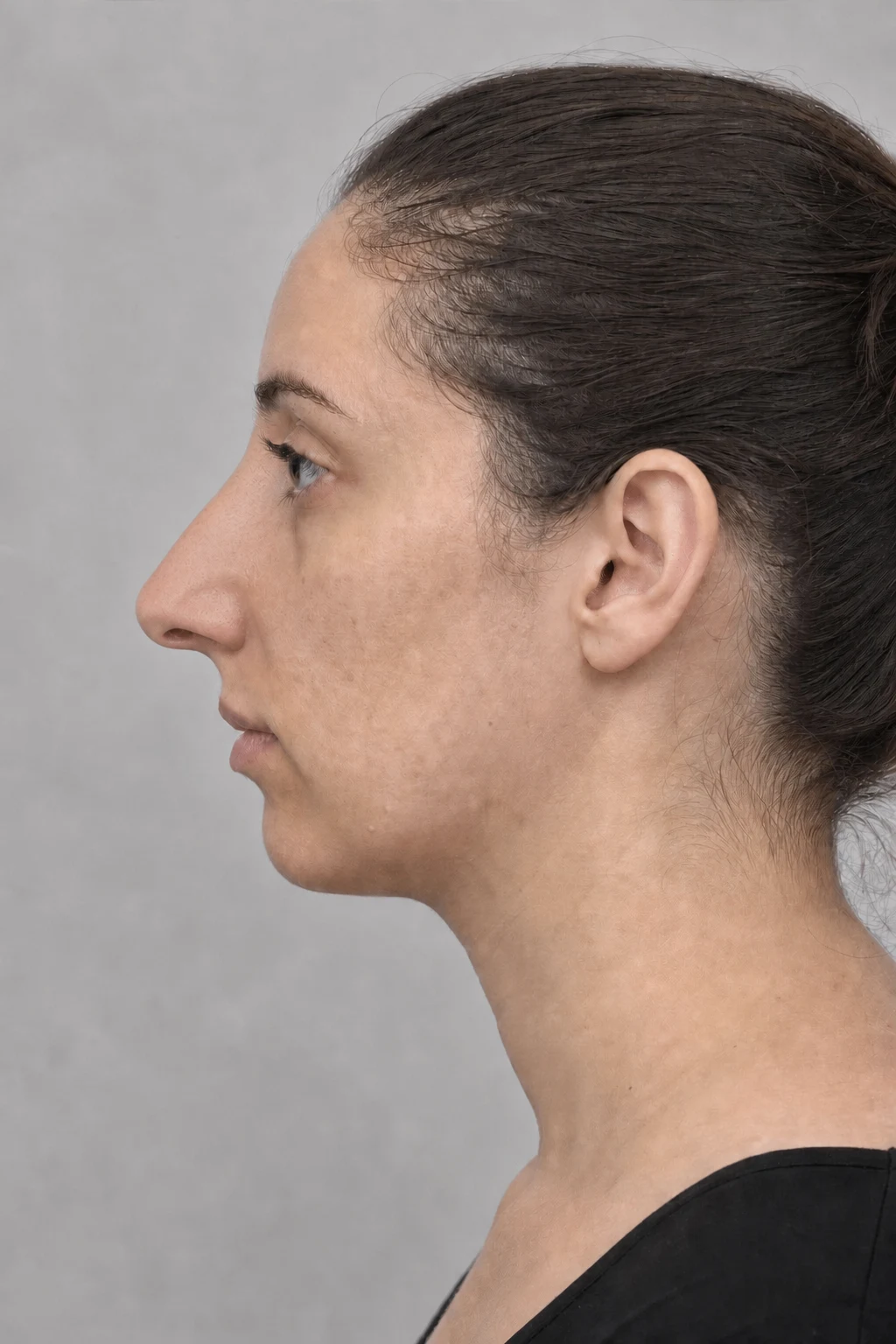
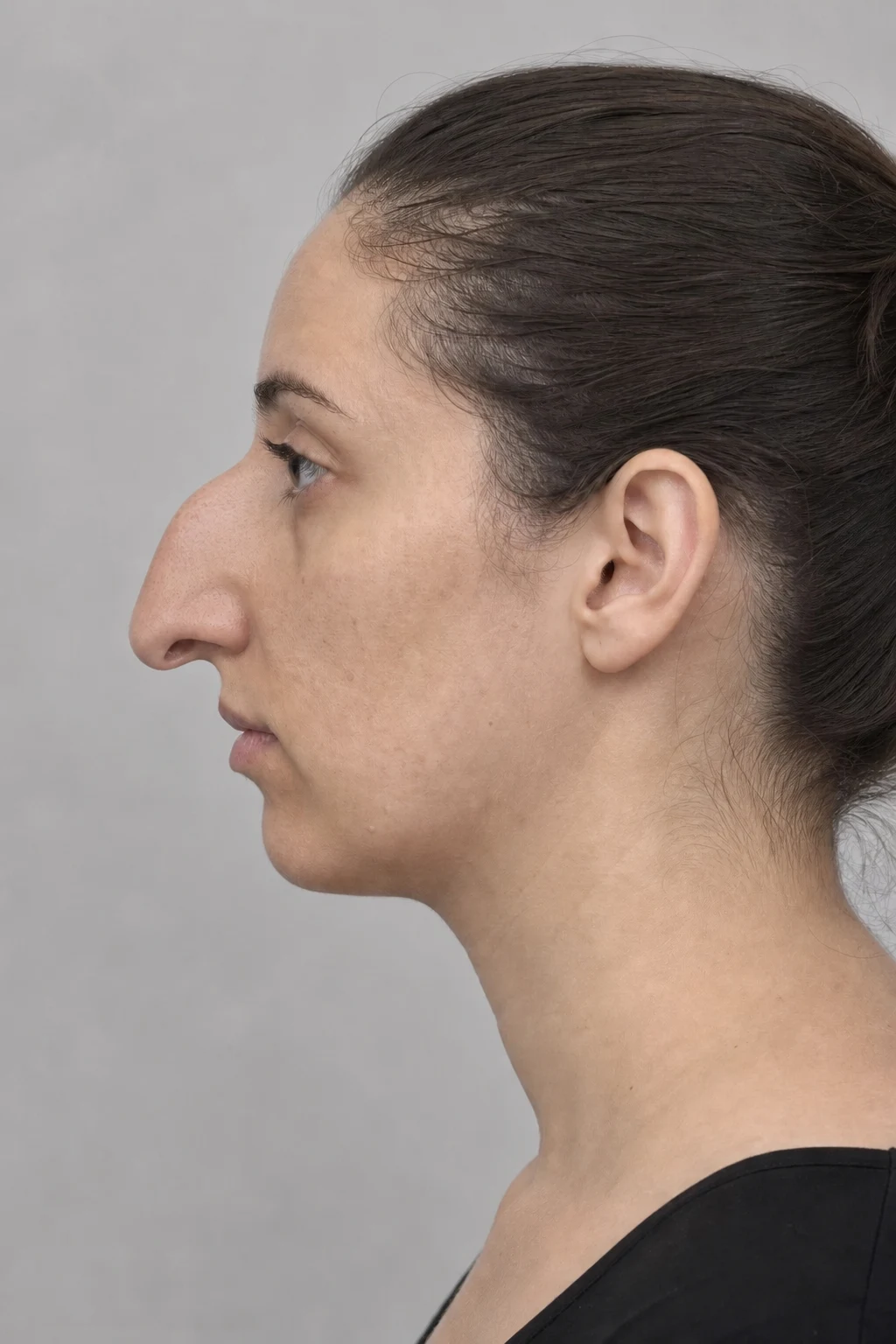
- Type
- Non-surgical, temporary
- How long it lasts
- Commonly 9–18 months
- Typical US cost
- Roughly $600–$1,500 a session
- Downtime
- Usually none; mild swelling for days
- Upload one front-facing photo
- The render changes the dorsal line of your nose with filler rather than surgery — and leaves the rest of your face alone
- Compare your before and after side by side
1 render = 1 credit
5 credits $4.99, no subscription · or Starter $7.99/month for 10. The face analysis is free.
What is a liquid rhinoplasty?
A liquid rhinoplasty — also sold as a non-surgical rhinoplasty, a non-surgical nose job or an injectable rhinoplasty — is dermal filler placed along the bridge and sometimes at the tip of the nose. The most common filler used is hyaluronic acid, the same family of gels used in lips and cheeks.
The key idea is that nothing is removed. A hump is not taken down; the dips above and below it are filled until the line looks level. That is why the result is a straighter nose, and a very slightly larger one.
What nose filler can and can't change
| Goal | Nose filler? | Why |
|---|---|---|
| Hide a small dorsal hump | Often, yes | Filling around the hump levels the profile line |
| Raise a low or flat bridge | Yes | Nose bridge filler adds height where there is little |
| Lift a slightly drooping tip | Modestly | Nose tip filler supports the tip; the lift is small |
| Camouflage mild asymmetry | Sometimes | Filling a dip on one side can even the line |
| Make the nose smaller | No | Filler only adds volume |
| Narrow a wide nose or bulbous tip | No | A straighter bridge can make a nose read narrower; it does not narrow it |
| Fix breathing | No | Filler does not touch the internal structure |
The nose shapes it suits best are usually a Roman nose with a modest hump, or a low bridge. A large hump needs so much filler to hide that the nose ends up visibly bigger.
Liquid rhinoplasty before and after: how to read the photos
Nose filler before and after photos flatter in predictable ways, mostly because the change is a profile change and the result is immediate.
- Profile, not front. The front view shows the least of a liquid rhinoplasty. Ask for side views at the same head angle.
- Not straight after injection. Early swelling can smooth the line further than the settled result.
- At a few weeks and at months. A photo at two to four weeks shows the settled result; one at nine months shows how it is holding.
- Look at width, too. A bridge that looks straighter but broader is the early sign of filler spreading.
- Same lens distance and light. A closer camera enlarges the nose; side light from one direction deepens a hump.
Non-surgical rhinoplasty vs rhinoplasty
| Non-surgical rhinoplasty | Surgical rhinoplasty | |
|---|---|---|
| What it does | Adds volume to straighten the line | Removes, reshapes or adds bone and cartilage |
| Can it reduce size? | No | Yes |
| Breathing | No change | Can be addressed at the same time |
| Anesthesia | Numbing cream or local | General anesthesia or sedation |
| Downtime | Usually none | One to two weeks off work, a year for the tip |
| How long it lasts | Commonly 9–18 months | Permanent |
| Reversible | Hyaluronic acid can be dissolved | No |
| Typical US cost | Roughly $600–$1,500 a session | Commonly $6,000–$15,000 |
The fair comparison is not cheap versus expensive. It is a temporary, reversible camouflage of one line against a permanent change to the whole structure. The rhinoplasty page covers the surgical side in detail.
Liquid rhinoplasty cost
The cost of a liquid rhinoplasty is commonly quoted at roughly $600–$1,500 a session in the United States. Non-surgical rhinoplasty is usually priced by the treatment or by the syringe, and noses tend to take less filler than lips or cheeks.
- Who injects — experience in the nose specifically is what practitioners stress, and it is priced in.
- How much filler — a low bridge takes more than a small hump camouflage.
- Maintenance — a top-up every year or so means the lifetime cost adds up, and a surgeon's quote is a one-off.
- Review appointment — ask whether a follow-up and small top-up at two weeks are included.
Before — generatedAfter — simulatedSee a liquid rhinoplasty on your own face
Run this simulationHow long does nose filler last?
Hyaluronic acid nose filler is commonly quoted at nine to eighteen months, often longer than in the lips because the nose moves less. The body breaks it down gradually, so the line softens rather than disappearing overnight.
Many people keep the result with top-ups. The trade-off is that repeated treatments are when a broader, heavier-looking bridge is most often described. Asking to let it wear down fully before topping up again is a reasonable conversation to have.
The liquid rhinoplasty procedure and recovery
- Consultation — profile photos, a discussion of what filler can and cannot do, and questions about any previous nose surgery.
- Numbing — topical cream; many fillers also contain a local anesthetic.
- Injection — small amounts placed along the bridge and at the tip, usually in well under an hour.
- Immediate result — visible straight away, with mild swelling and sometimes bruising at the injection points.
- Review — commonly at around two weeks, once swelling has settled.
Recovery is usually a matter of days. Practitioners commonly advise not pressing on or massaging the nose, and avoiding glasses resting on the bridge for a short period, so the filler stays where it was placed.
Nose filler risks: what "gone wrong" actually means
Liquid rhinoplasty is often described as low-risk because there is no incision. It is low-downtime, which is not the same thing. The nose is one of the areas where injectors are most careful, because of the blood vessels there.
- Common and short-lived: swelling, tenderness, bruising, redness at injection points.
- Shape problems: lumps, an uneven line, or a bridge that looks wider as filler spreads. Hyaluronic acid can usually be dissolved with hyaluronidase.
- Vascular occlusion: filler blocking a blood vessel. Warning signs commonly listed are severe pain, blanching or dusky skin on the nose. It is an emergency, because it can lead to skin damage (necrosis).
- Vision loss: rare but documented after filler injections in the nose and between the brows, and the reason operator experience matters more here than almost anywhere on the face.
Previous nose surgery changes the anatomy injectors rely on and is commonly cited as raising the risk. Permanent fillers are also offered for the nose in some clinics; they cannot be dissolved, which removes the main safety argument for choosing filler in the first place.
Liquid rhinoplasty simulator: see nose filler on your face
The liquid rhinoplasty simulation fills the bridge into a straighter line and lifts the tip slightly on your photo — soft tissue only, no bone change, which is what filler can do. The rest of your face is meant to stay untouched.
Its limit is the same as the treatment's strength: the change is mostly in profile, and a front photo shows it least. It also cannot show the slight increase in size, which is the thing most worth seeing before booking. Measuring the nose shape first tells you whether what bothers you is the line, which filler addresses, or the width, which it does not.
Width against face width, length against width and nostril width against eye spacing — worth knowing before choosing between filler and surgery.
Measure your nose shapeQuestions to ask before a liquid rhinoplasty
- How many nose filler treatments do you do, and what is your plan if a blood vessel is affected?
- Do you keep hyaluronidase on hand, and would you dissolve filler for me if I did not like the result?
- Which filler are you using, and why that one for the nose?
- I have (or have not) had nose surgery before — how does that change the risk for me?
Alternatives to liquid rhinoplasty


How the liquid rhinoplasty simulation works
Your photo is analysed for the landmarks that matter to this procedure, and the render changes the dorsal line of your nose with filler rather than surgery while leaving the rest of your face alone. That constraint is the hard part — a generic image model will happily redraw your whole face and hand you a stranger who looks better.
The render shows a straighter dorsal line from the front, which is the least useful view for this procedure — the change is a profile change almost entirely.
It is an illustration of a plausible direction, not a prediction of your result and not a medical opinion. What it is genuinely good for is finding out whether you want the change at all — plenty of people render one, find the difference smaller than they imagined, and stop there.
Measure your face before a liquid rhinoplasty simulation
The free analysis tools measure symmetry, facial proportion and face shape, and tell you which measurements sit outside the reference range. Choosing a procedure from that is a much better starting point than choosing one from a photo you saved.



Liquid Rhinoplasty simulator — frequently asked questions
How painful is liquid rhinoplasty?
Most people describe pressure and brief stinging rather than pain. Numbing cream is standard and many fillers contain a local anesthetic. Tenderness for a day or two afterwards is common.
Is a liquid rhinoplasty worth it?
It tends to suit people whose complaint is the line of the nose — a small hump or a low bridge — and who want to try a change without surgery. It tends to disappoint people who want a smaller nose, because filler cannot do that.
Is non-surgical rhinoplasty permanent?
Not with hyaluronic acid, which the body breaks down over months. Permanent fillers exist, but they cannot be dissolved if something goes wrong or the result is disliked.
Can filler fix a bulbous nose tip?
Not really. Filler adds volume, and a bulbous tip is already the widest part of the nose. It can sometimes improve how the tip sits in profile, but refining its shape is a surgical job.
Does nose filler migrate?
Filler can spread beyond where it was placed, which on the nose tends to show as a wider, softer bridge. It is most often described after repeated top-ups, and hyaluronic acid can be dissolved if it happens.
Can you get a surgical rhinoplasty after nose filler?
Yes. Surgeons commonly ask for the filler to have worn off or be dissolved first, because it changes the tissue they are assessing and operating on.
Is the liquid rhinoplasty simulator free?
The face analysis is free and needs no account. A rendered simulation costs credits because it runs on a GPU — $4.99 buys five and does not require a subscription.
How accurate is an AI liquid rhinoplasty simulation?
It is an illustration of a plausible outcome, not a prediction of your result. Real outcomes depend on your anatomy, the medical injector and how you respond. Treat it as a conversation starter for a consultation, not a promise.
Do you keep my photo?
The free measurements never leave your browser. A simulation does send the photo to a rendering service, which is why it asks for explicit consent first, and you can delete the result from your dashboard at any time.
Can I show this to a medical injector?
Yes, and that is the most useful thing to do with it. Bringing a picture of the direction you want is far more precise than describing it in words.
Other nose simulations
This page is not medical advice and we are not clinicians. A simulation cannot tell you whether a procedure is appropriate for you, what it costs, or what the risks are. Those questions belong with a qualified medical injector.