Roman Nosealso called aquiline or hawk or hooked
A Roman nose has a bridge that curves outward — a raised ridge along the dorsum rather than a straight line from the brow to the tip. The defining trait, a dorsal hump, sits on the bridge profile, so a front photo cannot label a Roman nose; this test reports the 3 front ratios instead.
- Profile
- only — not readable from the front
- 3
- front ratios measured
- Free
- photo not uploaded
A roman nose is defined in profile, so no front-facing tool can identify one — including this one. The profile test below is the honest method, and the panel measures the three proportions a photo can settle.
 Example
Choose your own photo
Discover your nose shape and proportions.
Choose your own photoClick to choose a photo, or drop one here
Front-facing · Even lightingStraight-on, even lighting, at arm's length gives the most comparable reading.
Runs in your browser. Your photo is not uploaded.
What defines a roman nose
A convex dorsal line. The bridge rises into a hump partway down and the tip often sits slightly lower than the hump, giving the profile its curve.
- A visible ridge or hump along the bridge, seen from the side
- A dorsal line that is convex rather than straight
- The tip frequently angled slightly downward
- From the front, nothing distinctive — the trait lives entirely in profile
How to tell if you have a roman nose
- Photograph or look at yourself from a true side view, not three-quarters. The hump disappears at any angle short of ninety degrees.
- Trace the line from between your brows to the tip of your nose. A Roman nose bulges outward somewhere along that line; a straight nose does not.
- Note where the highest point sits. A hump near the top of the bridge reads differently from one near the middle, and surgeons distinguish the two.
- A front-facing photo cannot answer this question, which is why this page does not pretend to.
Where the roman nose gets its name
The name comes from Roman portrait sculpture, where the profile was carved rather than idealised, and it has carried a shifting set of associations ever since — authority in classical busts, a target in nineteenth-century racial pseudoscience, and more recently a feature people specifically ask to keep. It is common across Mediterranean, Middle Eastern, South Asian and Indigenous American populations, which is worth stating plainly given how the shape has been written about historically.
What changes a roman nose
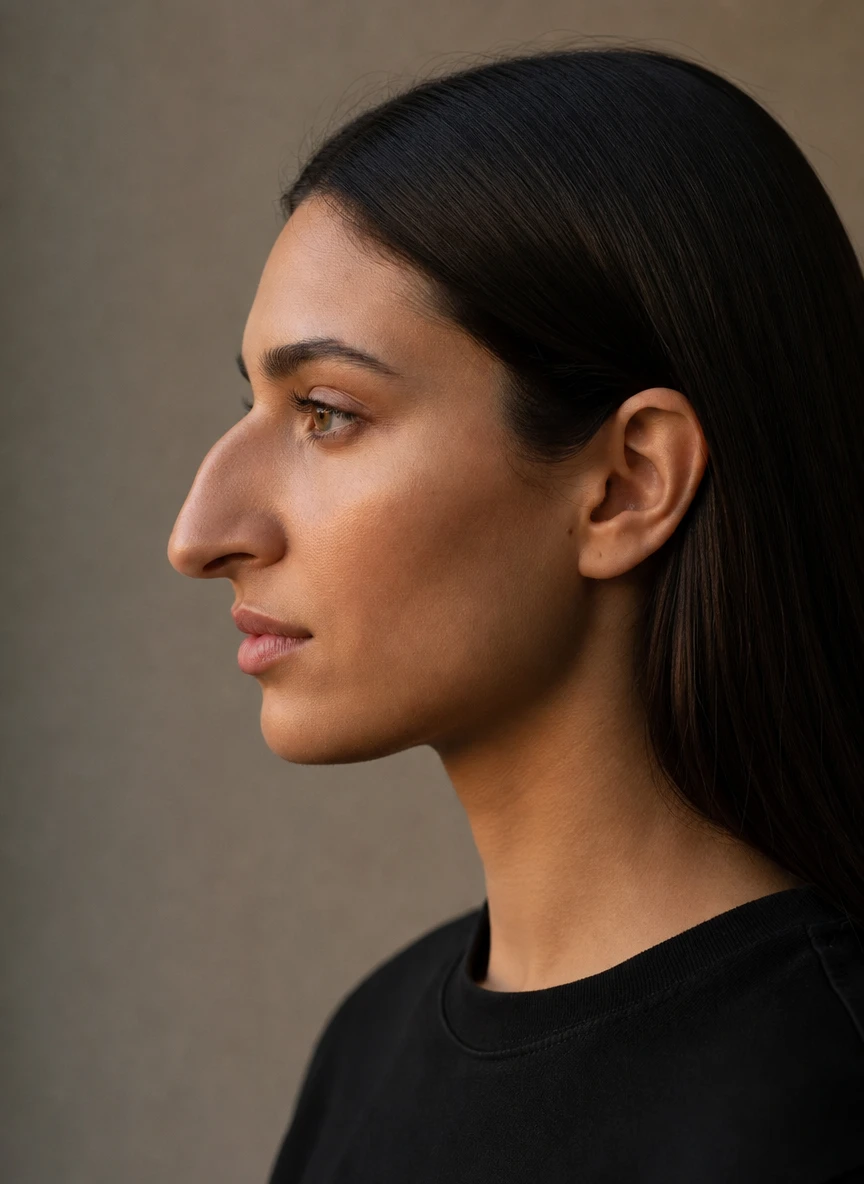 Before — generated
 After · AI glow-upRhinoplasty
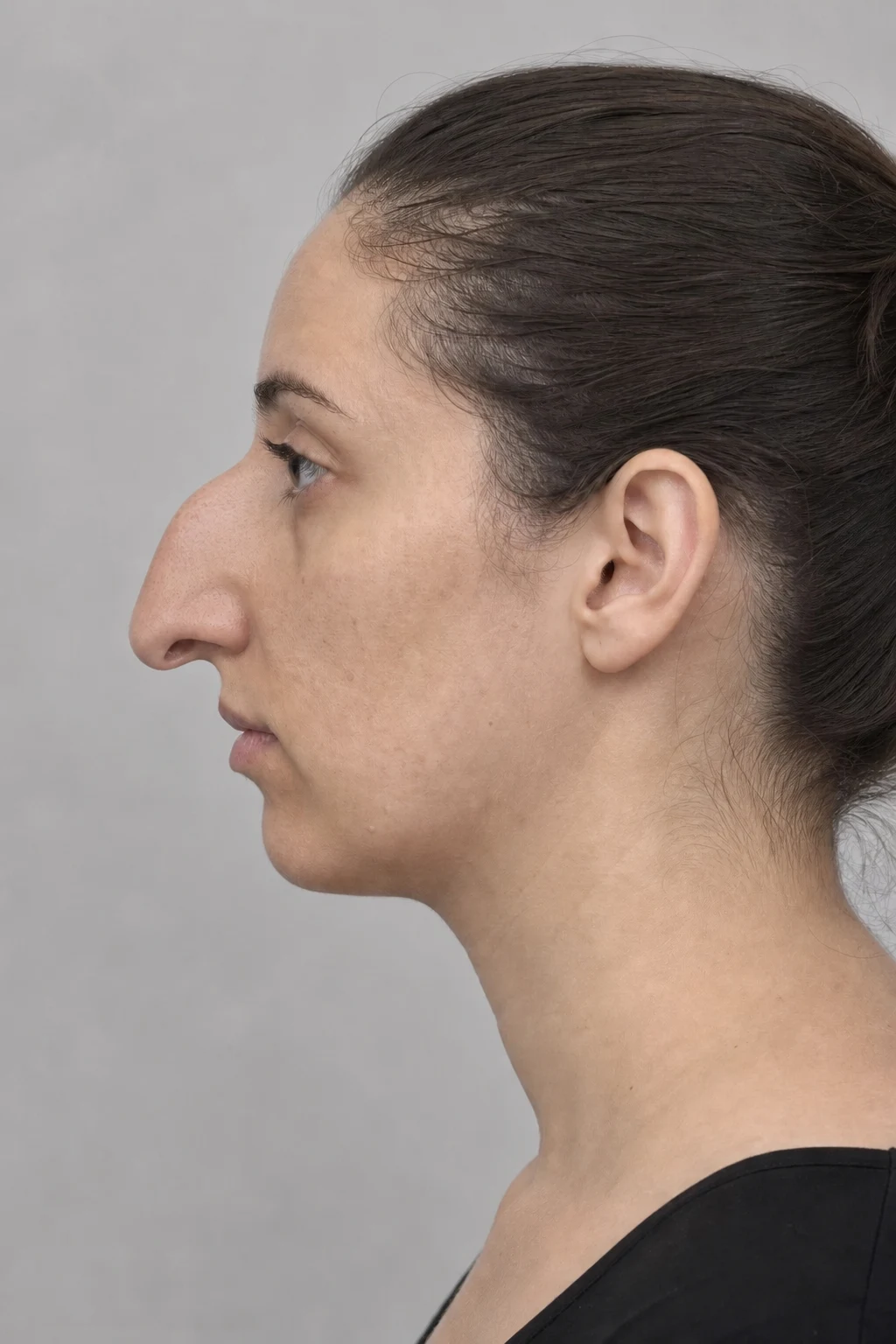 Before — generated
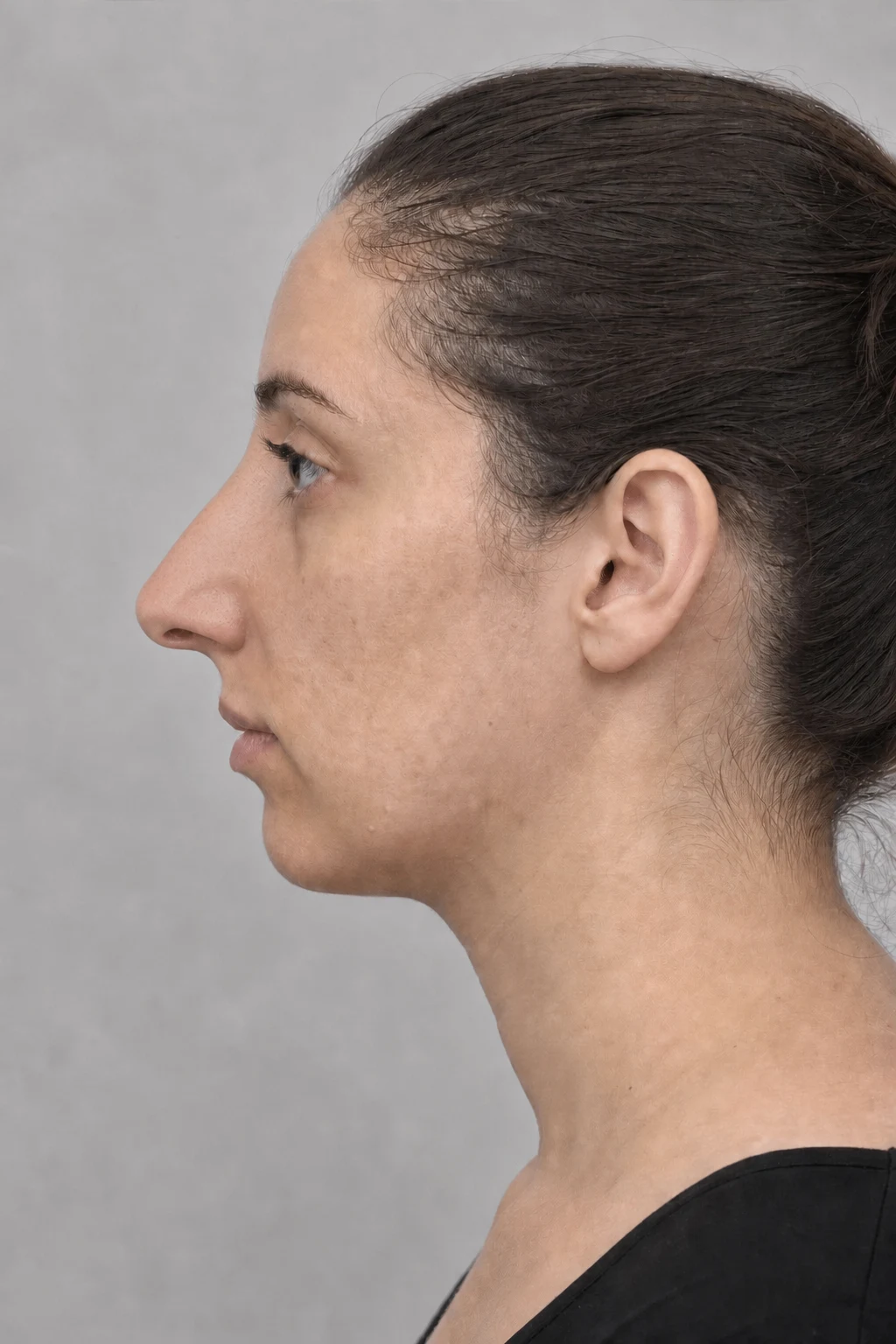 After — simulatedLiquid Rhinoplasty
Rhinoplasty
Reduces or removes the dorsal hump, changing the profile line directly.
See it simulated on your own photo →Liquid rhinoplasty
Adds filler above and below the hump so the dorsal line reads straighter without surgery.
See it simulated on your own photo →
Roman nose vs Greek nose
Both are described by the dorsal line and they are opposites. A Roman nose has a convexity — the profile bulges outward somewhere along the bridge. A Greek nose is straight, continuing the line of the forehead with almost no indentation at the brow. The two get confused because both are called strong or classical, but the measurement is simply whether the line curves out or does not.
The greek nose in full →How to contour a roman nose
Contouring cannot remove a hump — it can only reduce the contrast that makes the hump visible. Everything here is about flattening the highlight the convexity produces.
- A light matte shade over the hump itself, rather than the usual straight highlight down the bridge
- Shadow on both sides of the bridge kept parallel, which narrows without emphasising the curve
- Skip anything shimmering on the dorsum — it catches light exactly where the bridge projects most
- Work in daylight: the effect is entirely dependent on the light you are correcting for
The roman nose on men
The Roman profile is the one named nose type that men search for as often as they search for how to change it, and its associations run in both directions — authority in classical sculpture, a target in nineteenth-century caricature. Practically, the trait is more visible on a male face because male dorsal humps tend to be larger and the surrounding features less soft, which is also why male rhinoplasty for a hump is one of the most requested procedures in the field.
Roman nose celebrities
Roman nose celebrity lists are among the most searched in this cluster and they are built entirely from profile photographs, which is at least the right view — a dorsal hump is a profile trait and nothing else. What they cannot do is separate a hump from a shadow: a light placed to one side traces the dorsal line and can invent a convexity that a flat light erases. This site does not assign a nose type to anyone it has not measured, and it will not measure a hump from your front photo either.
Roman nose — frequently asked questions
What is a Roman nose?
A nose with a convex bridge — a hump or ridge along the dorsum instead of a straight line. Aquiline is the same shape; hawk nose describes a pronounced version with a downturned tip.
Is a Roman nose the same as an aquiline nose?
Yes. Aquiline comes from the Latin for eagle and describes the same curved bridge. Wikipedia files both under one entry for this reason.
Can a face analysis tool detect a Roman nose from a selfie?
No, and any tool claiming to is guessing. The defining trait is the profile line of the bridge, which a front-facing photo does not contain.
Are Roman noses common?
Yes, particularly in Mediterranean, Middle Eastern, South Asian and Indigenous American populations.
Can a Roman nose be straightened without surgery?
Filler can make the dorsal line read straighter by building up the area above and below the hump, which is what a liquid rhinoplasty does. It adds volume rather than removing bone, so the nose ends up slightly larger, and the effect lasts as long as the filler does.