Button Nose
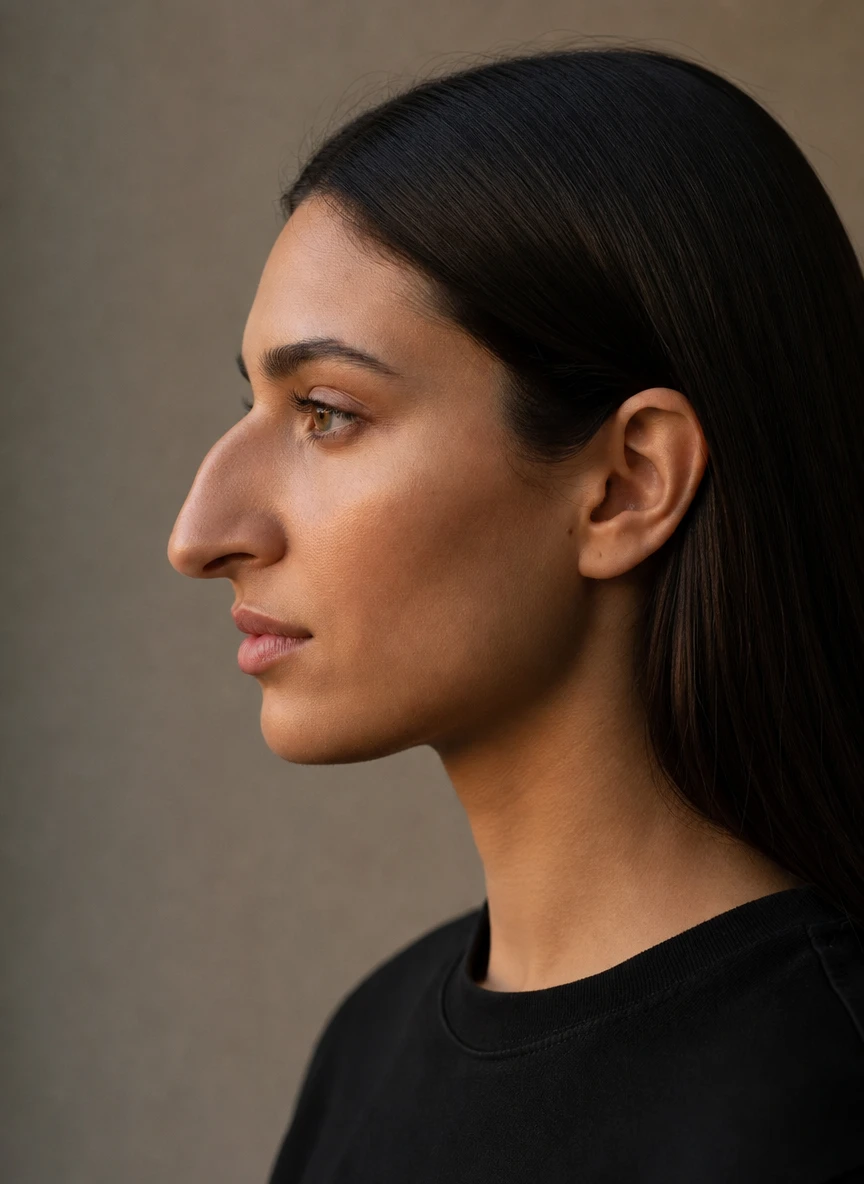
A button nose is short and small relative to the face, with a rounded tip and a bridge that does not project much. This test reads a nose as short when its length is 1.15× its width or less; tip projection, the other half of a button nose, needs a profile view.
- ≤ 1.15×
- length ÷ width
- 3
- front ratios measured
- Free
- photo not uploaded
The panel measures the three nose proportions a front-facing photo can settle.
 Example
Choose your own photo
Discover your nose shape and proportions.
Choose your own photoClick to choose a photo, or drop one here
Front-facing · Even lightingStraight-on, even lighting, at arm's length gives the most comparable reading.
Runs in your browser. Your photo is not uploaded.
What defines a button nose
Short length relative to width, a small alar base, and a rounded rather than defined tip. The measured signal is a length-to-width ratio at the low end, roughly 1.15 or below.
- Noticeably short relative to the height of the face
- A narrow alar base — the nose occupies less of the face's width than average
- A rounded, soft tip rather than a defined or angular one
- A bridge with little projection
How to tell if you have a button nose
- From the front, the tool above measures the two traits that show: length relative to width, and alar width relative to face width.
- In profile, check how far the tip stands off the face. A button nose projects less than average, and projection is the trait a front photo misses.
- A short nose with a wide base is not a button nose — the smallness has to be in both dimensions.
Why the button nose keeps coming back into fashion
Of all the named shapes this is the one most often requested in rhinoplasty consultations, and surgeons write about the request specifically because the result depends on skin thickness and cartilage more than on what is removed. It has also cycled through fashion repeatedly, which is a reasonable argument against making a permanent change on the basis of it.
What changes a button nose
 Before — generated
 After · AI glow-upRhinoplasty
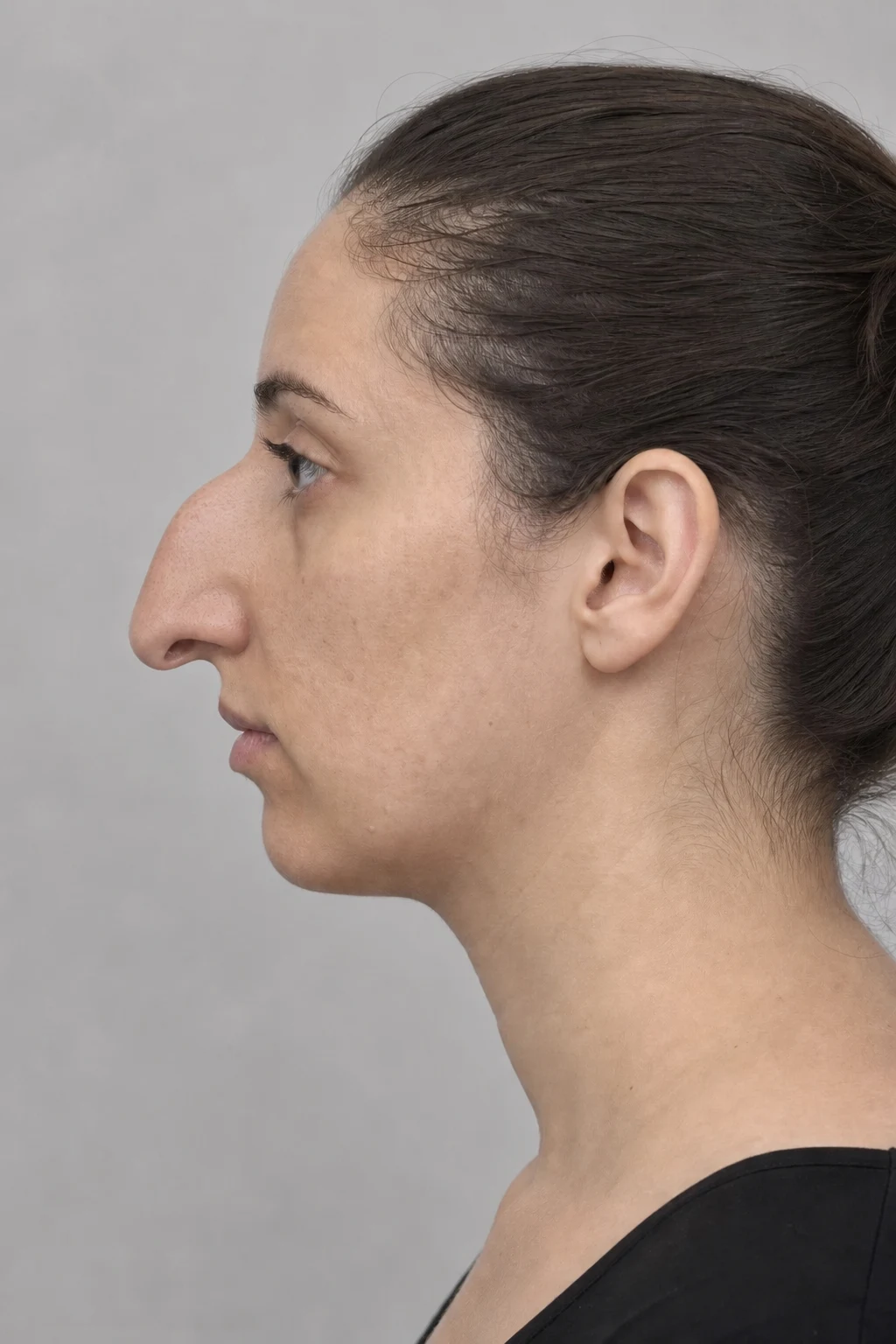 Before — generated
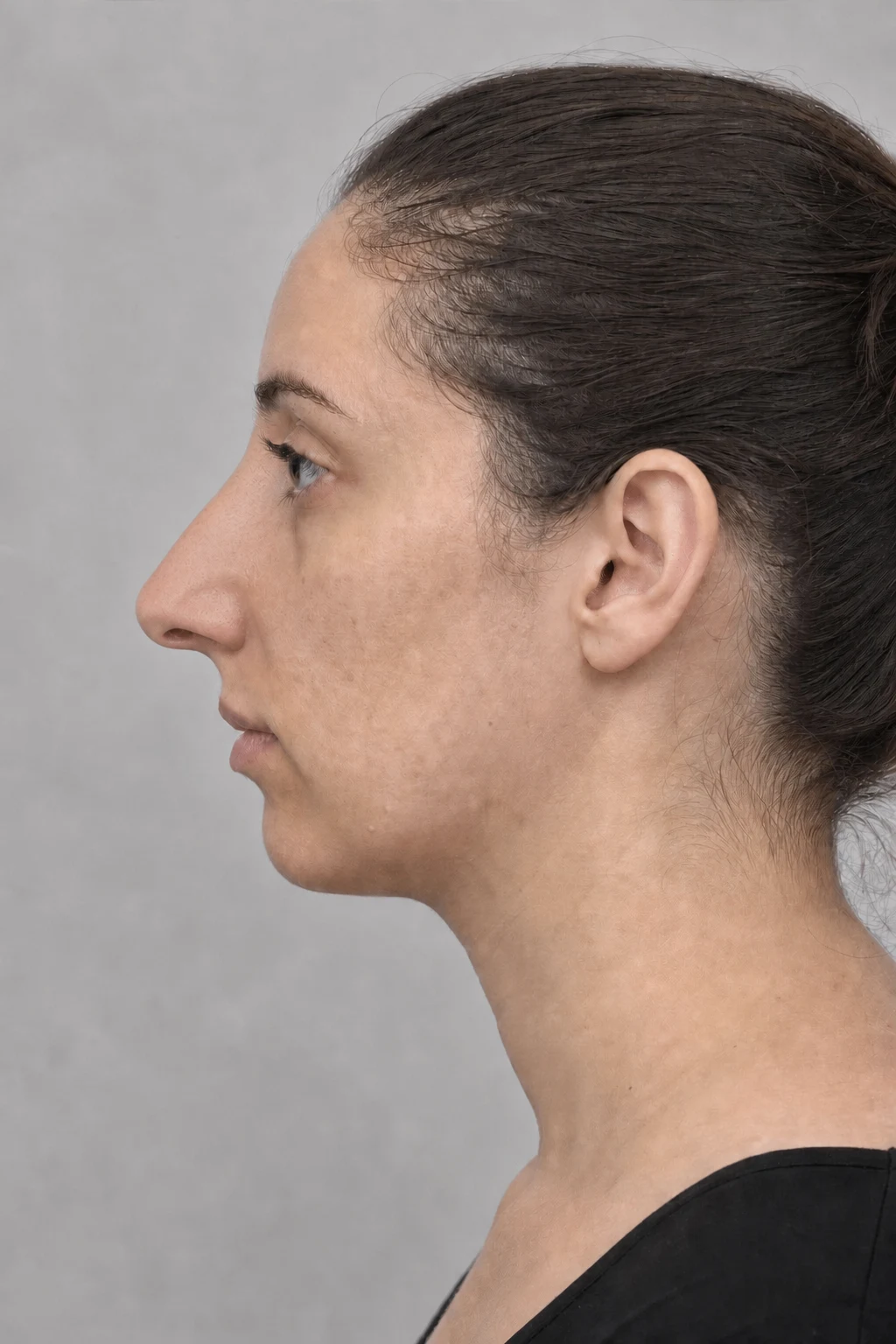 After — simulatedLiquid Rhinoplasty
Rhinoplasty
Shortens the nose and refines the tip; the achievable result depends heavily on skin thickness.
See it simulated on your own photo →Liquid rhinoplasty
Adds definition to the bridge and tip with filler, reversibly.
See it simulated on your own photo →
Button nose vs Snub nose
These overlap almost entirely and most charts treat them as one shape under two names. Where they differ is emphasis: button describes a nose that is short and small with a rounded tip, while snub — also called upturned or celestial — puts the weight on the tip rotating upward so the nostrils are more visible from the front. A nose can be both, and often is.
The snub nose in full →How to contour a button nose
The aim is usually length rather than narrowness, which reverses the standard contouring instruction.
- Highlight running the full length of the bridge, extended slightly onto the tip
- Shadow kept close to the sides and carried down past the tip rather than stopping above it
- Avoid a highlight that stops short of the tip, which shortens the nose further
- A light touch under the tip lifts it visually; a heavy one flattens it
The button nose on men
A short, softly-tipped nose is described far more often on female faces in beauty writing, and men who search for it are usually searching about a rhinoplasty request rather than about their own. Surgeons write about that request specifically, because the achievable result depends on skin thickness and cartilage strength rather than on how much is removed.
Button nose celebrities
Button nose lists exist and are unusually shaped by camera distance. A short nose photographed from close range gets enlarged relative to the rest of the face, and a longer nose photographed from further back can read as small — the same face can appear on and off these lists depending on the lens. This site does not assign the label from photographs of people it has not measured.
Button nose — frequently asked questions
Do button noses run in families?
Nasal cartilage shape is heritable like the rest of the skeleton, so short noses with rounded tips do cluster in families. What varies within a family is skin thickness, which changes how defined the tip reads without changing the underlying cartilage at all.
Does a button nose change with age?
Nasal cartilage keeps changing slowly through adulthood and skin loses elasticity, so tips tend to drop a little over decades. A nose that read as short and upturned at twenty can read as longer at fifty without anything dramatic having happened.
Why do photos make my nose look bigger?
Distance. A phone held at arm's length puts the lens far closer to your face than a person standing in front of you, and whatever is nearest the lens is enlarged relative to everything else — which on a face is almost always the nose. Step back and use zoom and the effect disappears.
What is a button nose?
A short, small nose with a rounded tip and a bridge that projects little. Length relative to width is the measurable part.
Can this tool tell if I have a button nose?
Partly. It measures shortness and narrowness, which are two of the three traits. Tip projection needs a profile view.
Is a button nose rare?
It is less common than an average-proportioned nose simply because it requires two measurements at the low end at once.
Can you get a button nose without surgery?
Filler can add bridge and tip definition but cannot make a nose shorter or smaller — filler adds volume, it does not remove it.