Greek Nosealso called straight
A Greek nose has a straight bridge — a dorsal line running from the brow to the tip with no hump and no dip. A straight bridge is a side-view line, so a front photo cannot label a Greek nose; this test reports the 3 front ratios instead.
- Profile
- only — not readable from the front
- 3
- front ratios measured
- Free
- photo not uploaded
A greek nose is defined in profile, so no front-facing tool can identify one — including this one. The profile test below is the honest method, and the panel measures the three proportions a photo can settle.
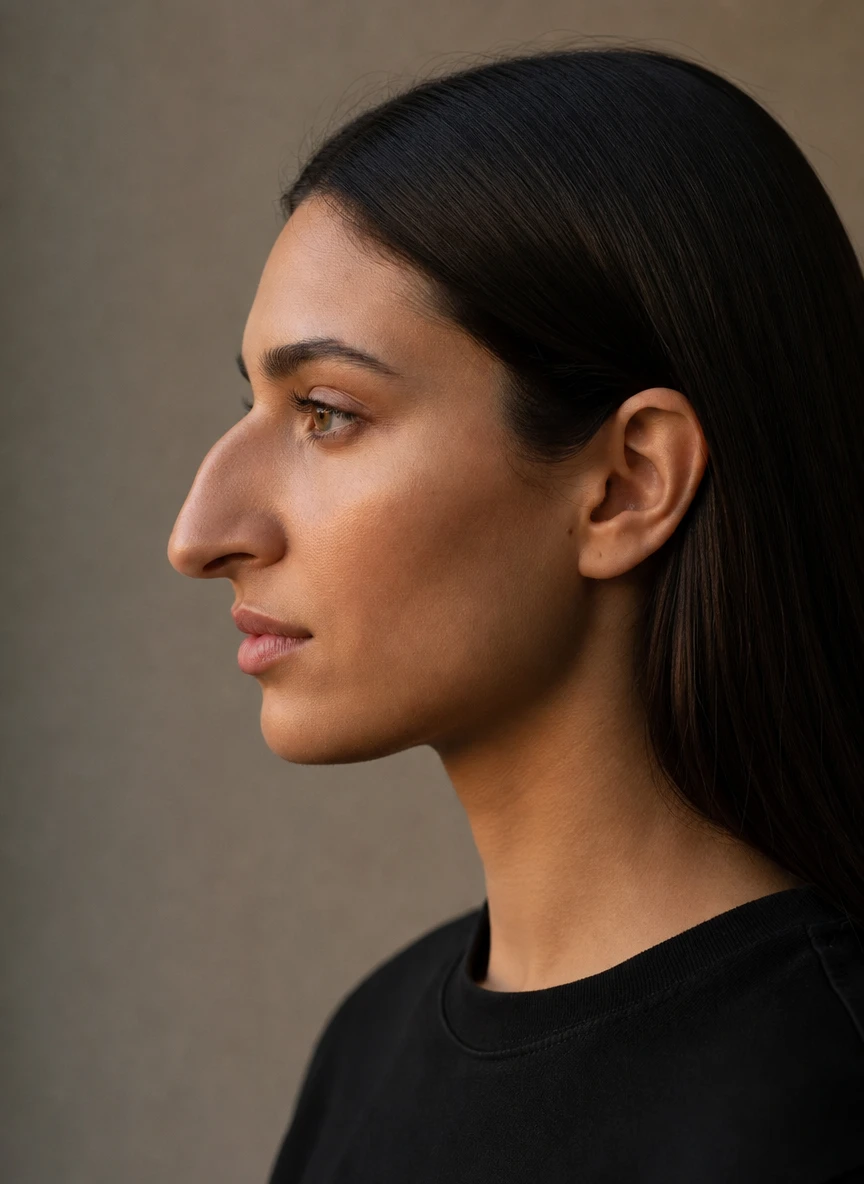
 Example
Choose your own photo
Discover your nose shape and proportions.
Choose your own photoClick to choose a photo, or drop one here
Front-facing · Even lightingStraight-on, even lighting, at arm's length gives the most comparable reading.
Runs in your browser. Your photo is not uploaded.
What defines a greek nose
A straight dorsal line in profile, with the bridge continuing from the forehead at a shallow angle and no convexity or concavity along it.
- A dorsal line that reads as a straight edge from the side
- No hump and no scoop
- A narrow bridge in most descriptions, though width is a separate measurement
- Frequently a tip with little upward or downward rotation
How to tell if you have a greek nose
- A true side view is required. Hold a straight edge against the photo along the bridge — a Greek nose follows it, a Roman nose bulges away from it and a snub nose falls inside it.
- The front-facing tool above measures alar width — the base of the nose, across the nostrils — and length. Neither is bridge straightness, and neither is bridge width: a wide nose can have a perfectly straight, narrow bridge.
Where the greek nose gets its name
The classical Greek profile in sculpture — a nose continuing the line of the forehead with almost no brow indentation — is a stylistic convention rather than a record of how people looked. It was an idealisation carved into marble, and it has been treated as a measurement ever since, which is a good example of an aesthetic norm acquiring false authority through repetition.
What changes a greek nose
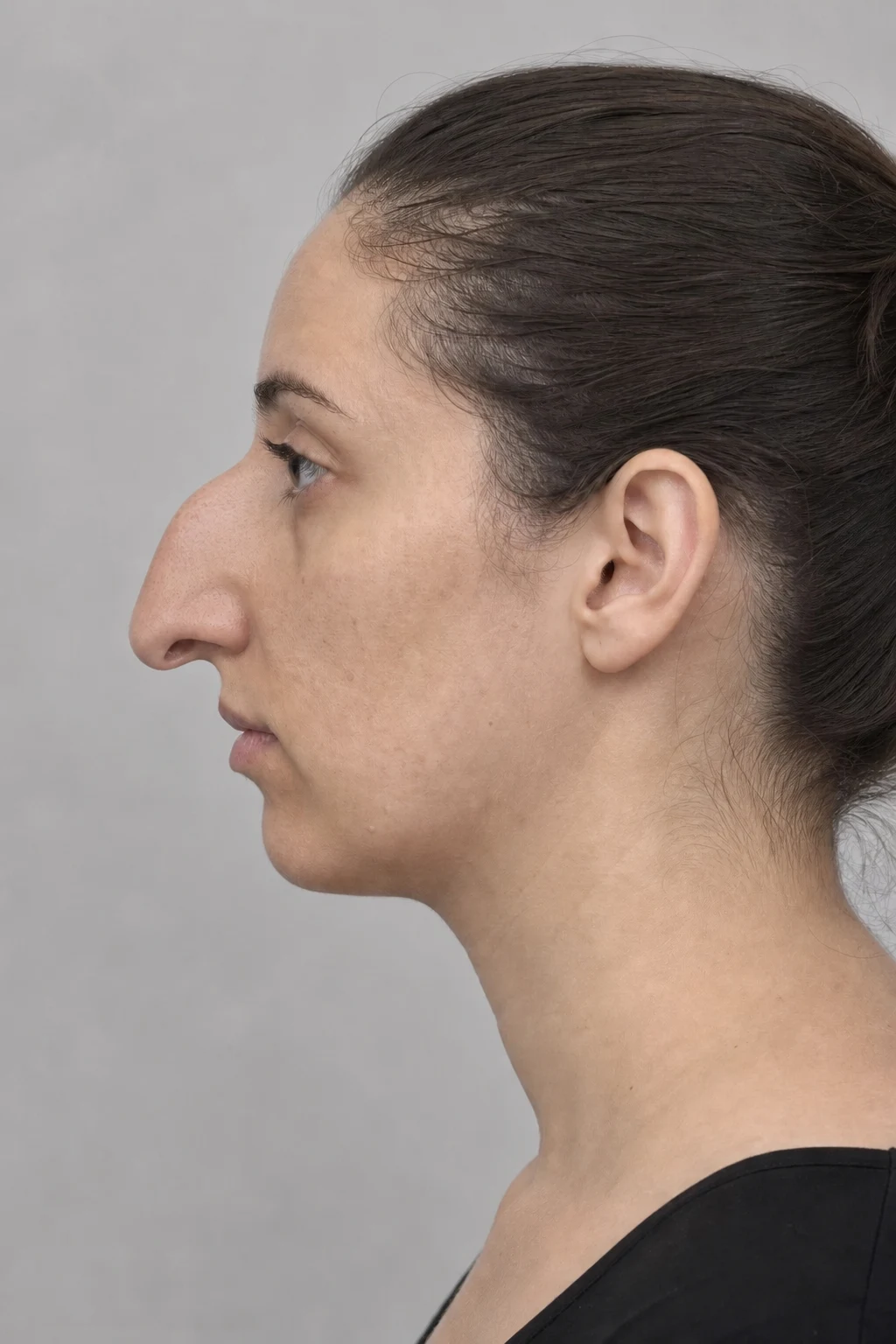
 Before — generated
 After · AI glow-upRhinoplasty
 Before — generated
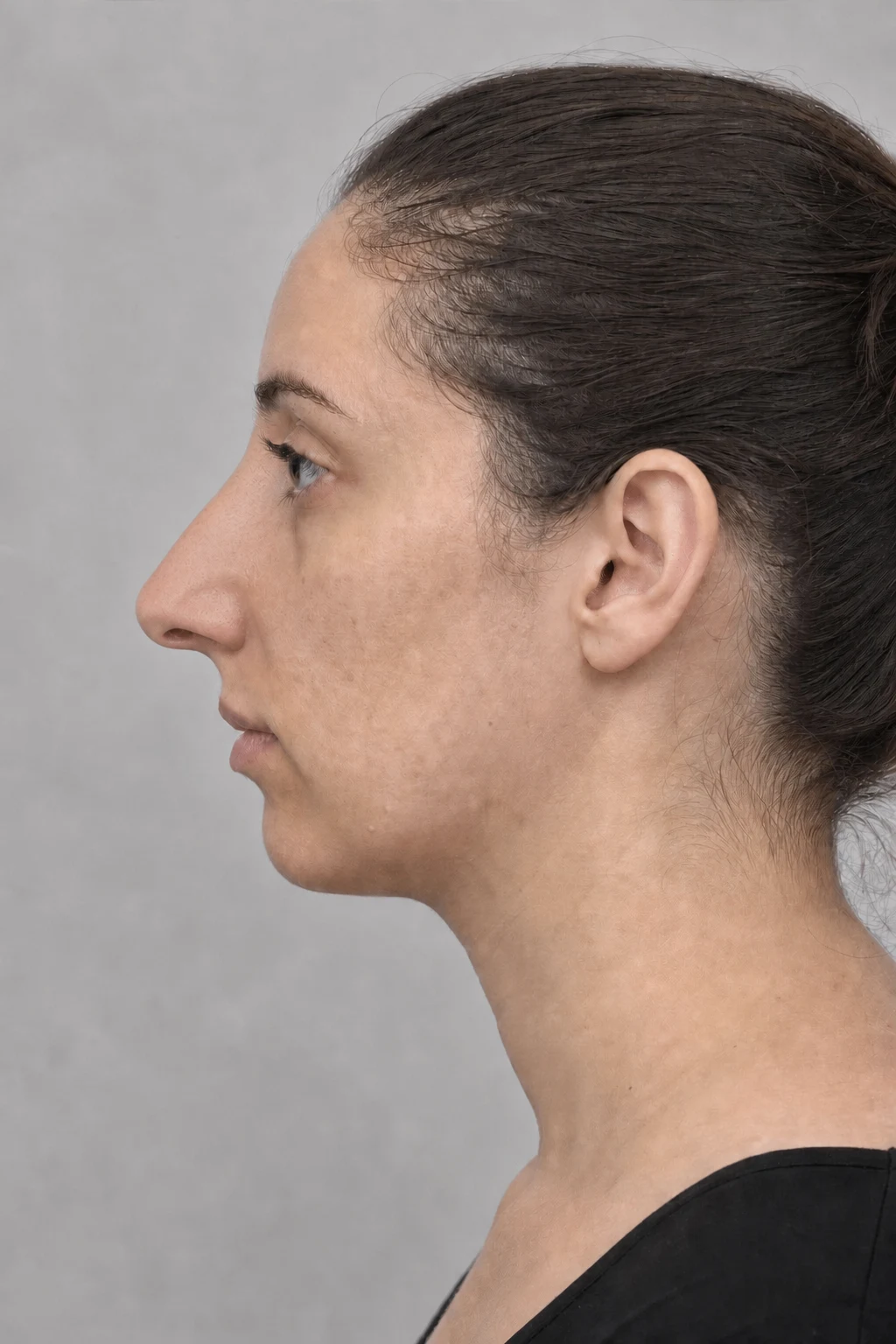 After — simulatedLiquid Rhinoplasty
Rhinoplasty
Straightens the dorsal line by reducing a hump or grafting a dip.
See it simulated on your own photo →Liquid rhinoplasty
Fills a dip or camouflages a small hump so the line reads straight.
See it simulated on your own photo →
Greek nose vs Roman nose
One measurement separates them, and it is the dorsal line in profile. Greek is straight; Roman is convex. Both are described as strong or classical in the same breath, which is why the labels get swapped, but no front photograph can distinguish them — this is one of the four traits this cluster tells you it cannot read from a selfie.
The roman nose in full →How to contour a greek nose
There is not much correction to make on a straight bridge, so contouring here is about width rather than line.
- Parallel shadows down both sides if you want a narrower read
- A thin highlight along the centre, which the straight line already supports
- Avoid heavy shading at the bridge top, which invents an indentation the profile does not have
The greek nose on men
This is the most searched named nose type for men after Roman, and it is worth knowing what is being searched: the trait is a straight dorsal line with a shallow nasofrontal angle, and it is judged entirely in profile. It is also one of the two directions a rhinoplasty for a hump is asked to move toward, the other being a slight dorsal dip.
Greek nose celebrities
The Greek nose is the one type where celebrity lists and the historical record diverge sharply. The straight profile they cite comes from sculpture, and sculpture idealised — it is a convention carved into marble, not a photograph of anyone. Assigning the label to a living person from a press photo compounds one guess with another, so this site does not.
Greek nose — frequently asked questions
Do Greek noses run in families?
The dorsal line is set by bone and cartilage and is inherited like other skeletal proportions, so a straight profile does cluster in families. What does not follow is the nationality the name implies — the label comes from sculpture, and sculpture idealised rather than recorded.
Why can't the tool tell me if my nose is Greek?
Because the trait lives in the profile. A straight dorsal line and a convex one look identical from the front — the difference is a curve seen edge-on, and a front photograph contains no depth. The page describes the profile test instead of reporting a number it cannot have.
Are Greek noses actually common in Greece?
There is no evidence for it, and the premise is the problem: the straight profile comes from sculpture, which idealised rather than recorded. Assigning a nose type to a nationality repeats the structure of nineteenth-century classification without adding any measurement to it.
What is the nasofrontal angle?
The angle where the bridge of the nose meets the forehead, measured in profile. A shallow angle — little indentation between brow and bridge — is what the Greek label describes. It is a profile measurement, and no front photograph contains it.
Can a nose be made straighter without surgery?
Filler can camouflage a small hump or fill a shallow dip so the dorsal line reads straighter, which is what a liquid rhinoplasty does. It adds volume rather than removing bone, so the nose ends up slightly larger overall, and the effect lasts as long as the filler.
What is a Greek nose?
A nose with a straight bridge — no hump, no scoop — running in a continuous line from brow to tip.
Is a Greek nose the same as a straight nose?
In everyday use, yes. Some descriptions add a narrow bridge and a specific brow angle to the definition.
Can a photo tool detect a Greek nose?
Not from the front. Bridge straightness is a profile line, and this page says so instead of guessing at it.