How to know if you're attractive — and which of the signs hold up
·7 min read
Search this question and you get the same article fifteen times: a numbered list of signs. People hold eye contact a beat too long. Strangers do you favours. You get double takes. The lists are cheerful, they are ancient, and none of them can be checked — to know your double-take rate is high you would have to know everyone else's, and you never will.
There is a smaller, duller answer that can be checked. Part of a face is geometry, and geometry is measurable to a fraction of a degree. This is what that part covers, what the research says it is worth, and where it stops.
Why the signs listicles cannot answer the question
A sign is useful when its absence would tell you something. Take the most common one on those lists: strangers smile at you. Suppose they do. Is that a high rate? You have no baseline, no control group, and no access to what happens when you are not in the room. The claim cannot fail, which is exactly why it is comfortable to read and useless to act on.
The other structural problem is the observer. Attractiveness is a rating other people produce, and you are the only person on earth who cannot produce it about your own face — you have looked at it too many times, and mostly in a mirror, which is not the version anyone else sees.
The four things about a face that are actually measurable
From a single straight-on photo, four families of number can be extracted reliably. Everything else people list is either depth information a front photo does not carry, or an opinion.
- Symmetry. How closely the left and right sides mirror each other across matched landmark pairs. Reported as a percentage, and measured here. Nobody scores 100, and the normal range is much narrower than people assume.
- Proportion. The vertical thirds and the horizontal fifths, plus how each ratio compares to phi. The golden ratio calculator reports them individually rather than as one composite number, and the full guide to facial proportions explains where the rules came from.
- Shape classification. Which named category your outline and features fall into — face shape, eye shape, nose type, lip shape. These are labels, not scores; no shape is ranked above another anywhere on this site.
- Angles. Canthal tilt in degrees is the clearest example: a real angle, measured per eye, that people constantly guess at from photographs and constantly get wrong.
One photo, 478 landmarks, every number shown with the landmarks it came from. It runs inside your browser tab — the photo is never uploaded and never stored.
Measure all fourPhotos, mirrors, and why the same face reads differently
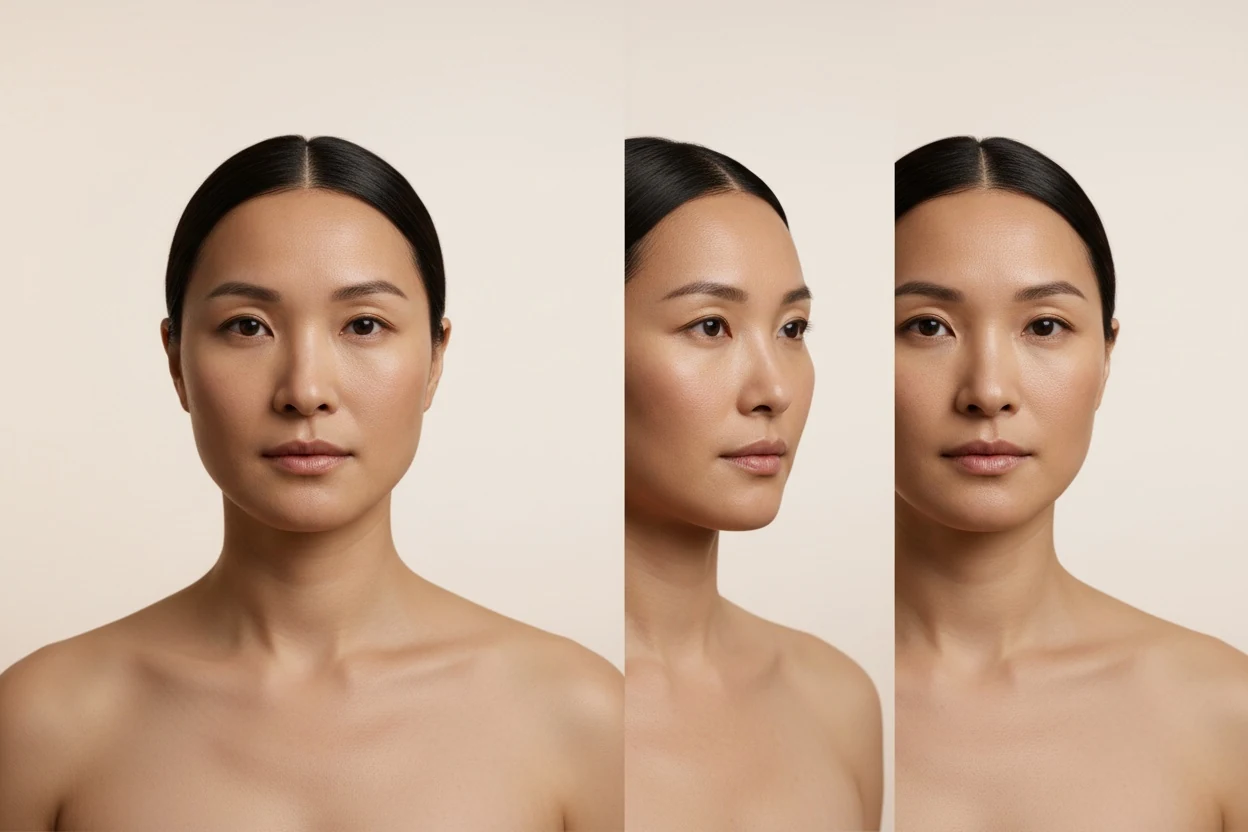
This is the single most common version of the question, and it has an answer that has nothing to do with how attractive anyone is.
- 1You know the flipped version. A mirror shows your face reversed, and that is the version you have practised recognising for your whole life. A photograph shows the unflipped one — the one everyone else knows — and it reads as subtly, unplaceably wrong. Try flipping a photo of yourself horizontally; most people find the flipped copy immediately more familiar and more flattering, and it is the same face.
- 2The lens is too close. A phone's front camera at arm's length sits far closer than a person talking to you does. Whatever is nearest the lens — usually the nose — is enlarged relative to everything else. This is a property of distance, not of the nose.
- 3The light is wrong. Overhead light drops shadows under the brow and eyes; light from below does the opposite. A mirror is usually lit deliberately. A snapshot usually is not.
- 4The expression is frozen. Faces are read in motion. A still frame catches one arbitrary moment out of thousands, and it is very often not a moment you would have chosen.
The popular signs, checked against the research
| The sign | Can it be checked? | What is actually known |
|---|---|---|
| High cheekbones | Partly | Cheekbone width against jaw width is measurable and feeds face shape classification. Whether it is preferred varies by study and by rater. |
| Facial symmetry | Yes | Grammer and Thornhill (1994) found a real correlation with rated attractiveness. It is modest, and perfect symmetry is not the peak. |
| An average-looking face | Yes | Langlois and Roggman (1990) found composite faces are rated above most of the faces averaged into them. One of the most robust results in the field, and the least intuitive. |
| Positive canthal tilt | Yes | Measurable in degrees. Popular online as a marker; the published support is thin, and the hunter eyes page separates the two claims. |
| Clear skin | Yes | Fink, Grammer and Matts (2006) shifted ratings of age, health and attractiveness by changing skin colour distribution alone, with the shape untouched. |
| Strangers hold eye contact | No | No baseline exists. Unfalsifiable. |
| You get double takes | No | Same problem, and memory strongly favours the times it happened. |
What actually moves how a face gets rated
Rhodes' 2006 review in the Annual Review of Psychology is the standard summary: averageness, symmetry and sexual dimorphism all contribute, with modest effect sizes, and none of them acts as the single lever the popular accounts describe. Two things follow from that, and they point in a more useful direction than a bone-structure audit.
First, the fixed geometry explains less of the variance than people assume. Second, the parts that are not fixed — skin condition, sleep, grooming, expression, posture, and how a photograph was lit and framed — move ratings measurably, and all of them are within reach. That is not a consolation prize. It is where the available gains are.
How to get a measured answer about your own face
Take one photo straight on at eye level, in even light, with a relaxed expression, and run it. The output is a set of numbers with the landmarks they came from — not a verdict.
- Attractiveness test — the composite score, and the four measurements it is built from.
- Am I pretty? — the same measurements, framed for the question people actually type.
- Rate my face — a rating out of ten that shows its arithmetic instead of hiding it.
- Face symmetry test — left against right, pair by pair.
- PSL scale — what that 1-10 ladder is, where it came from, and why the labels at the bottom of it are not used here.
What the measurements will not tell you
They will not tell you whether you are attractive, because that is not a property of a face — it is a rating produced by other people, in a context, with a history. Two faces with near-identical geometry get rated very differently depending on lighting, expression, grooming and who is doing the rating.
They also will not tell you anything about depth. Orbital depth, the profile of a nose, chin and lip projection — none of it is present in a front photo, and every page here says so where it applies rather than filling the gap with a plausible number.
And a number is a poor thing to argue with. If the question behind the search is really about how you feel when you look at a photograph of yourself, a symmetry percentage will not settle it — that one is worth talking to someone about rather than measuring harder.
If you are weighing an actual change, the simulations render one procedure on your own photo so you can see the difference instead of imagining it. It is a visualisation. Nothing on this site is medical advice, and no result here is a diagnosis.
Frequently asked questions
How do you know if you are attractive?
There is no self-administered test that answers it, because attractiveness is a judgement other people make and you are the one person who cannot make it about yourself. What you can do is measure the geometry — symmetry, proportion, the ratios that recur in the research — and know that geometry explains only part of how faces get rated.
Why do I look worse in photos than in the mirror?
Three things stack up. You know your face flipped, because that is what a mirror shows, and the unflipped version reads as subtly wrong. A phone's front camera sits close to your face, which enlarges whatever is nearest the lens. And overhead or underlit light exaggerates every shadow. None of these is your face changing.
Are the signs you are attractive real?
Most of the popular signs — people hold eye contact, strangers help you, you get double takes — cannot be checked, because you would need to know what happens to everyone else for comparison and you never do. They are not lies exactly; they are simply unfalsifiable.
Does facial symmetry mean you are attractive?
It correlates, modestly. Perfectly symmetrical faces are not the top of the scale, and faces made artificially symmetrical tend to be rated as slightly odd. Nobody has a symmetrical face, and the typical deviation is far too small to see.
What matters more than facial features?
In published work, skin condition often outperforms facial geometry, and grooming, expression, posture and how a photo was lit all move ratings without any change to the underlying face. These are the parts that are actually within reach.
References
- Langlois, J. H., & Roggman, L. A. (1990). Attractive faces are only average. Psychological Science, 1(2), 115–121.
- Grammer, K., & Thornhill, R. (1994). Human (Homo sapiens) facial attractiveness and sexual selection: the role of symmetry and averageness. Journal of Comparative Psychology, 108(3), 233–242.
- Fink, B., Grammer, K., & Matts, P. J. (2006). Visible skin color distribution plays a role in the perception of age, attractiveness, and health in female faces. Evolution and Human Behavior, 27(6), 433–442.
- Rhodes, G. (2006). The evolutionary psychology of facial beauty. Annual Review of Psychology, 57, 199–226.
Tools mentioned in this article
Attractiveness Test
Your score out of ten, with every measurement behind it.
Am I Pretty?
A measured answer instead of an opinion.
Symmetry Checker
Left against right across six landmark pairs.
Golden Ratio Calculator
How close your proportions sit to phi (1.618).
Face Rater
A rating that shows its arithmetic.
Measurements on this site are for information only. Nothing here is medical advice, and no result is a diagnosis. Talk to a qualified clinician before making any decision about a procedure.