Celebrity Look Alike
A look-alike comparison is only worth something if it says what matches. The free layer here measures the six features any honest comparison runs on — face shape, canthal tilt, eye spacing, jaw against cheekbones, nose width, lip fullness — in your browser, with nothing uploaded. The match itself names public figures and, for each one, what genuinely lines up and what does not.
- No signup
- No upload
- Free
- ~10 seconds
Click to choose a photo, or drop one here
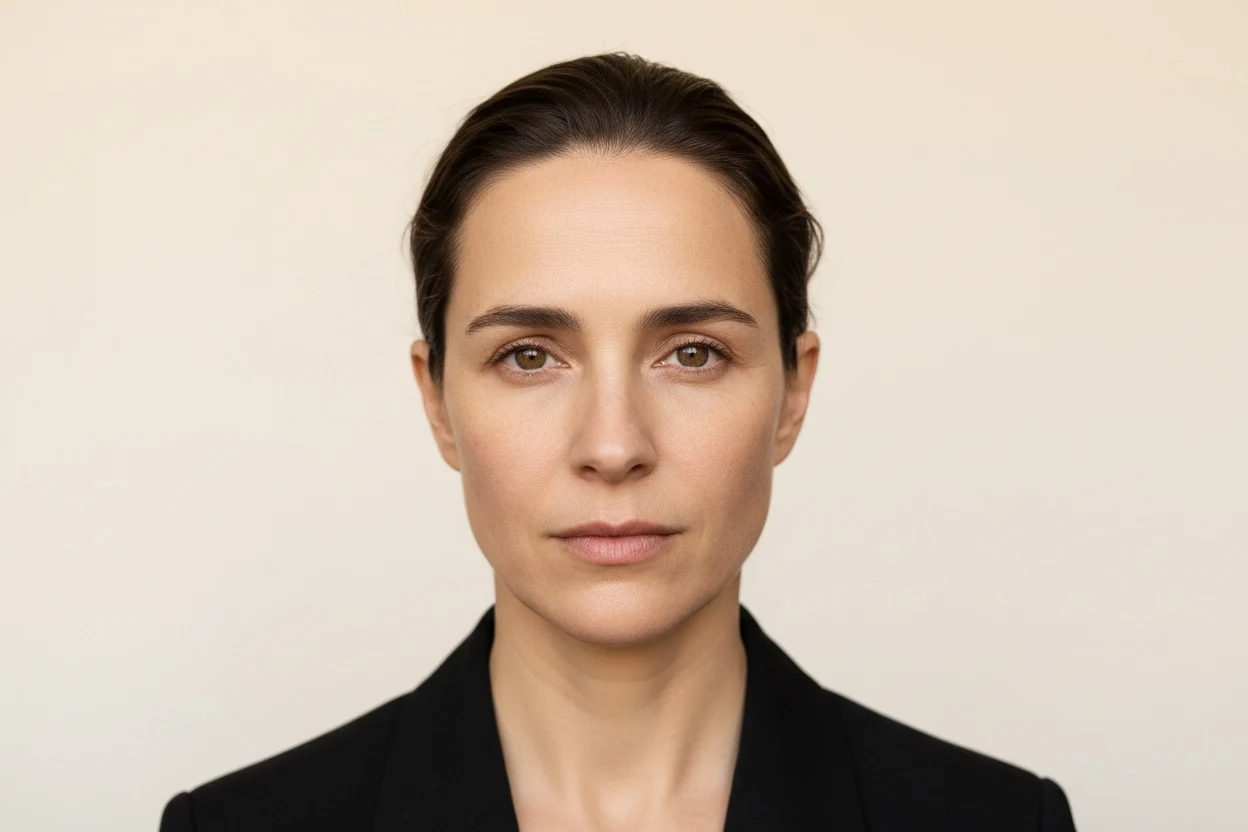
Straight-on, even lighting, at arm's length gives the most comparable reading.
No photo to hand? Try one of these and see what the tool returns.
Runs in your browser. Your photo is never uploaded.
How does a celebrity look-alike tool work?
Most tools convert each face into a numeric embedding and return the nearest celebrity in that space, which requires a stored database of celebrity face vectors. A structural comparison works differently: it measures named features — face shape, canthal tilt, eye spacing, jaw width, nose and lip proportions — and reports which of them match and which do not.
- Embedding-based matching needs a stored database of celebrity faces; structural comparison does not.
- Face shape, eye spacing and canthal tilt carry more of the perception of resemblance than colouring or hairstyle.
- A similarity percentage without a named feature list is not a measurement — the same number can come from entirely different faces.
- Resemblance judgements shift with hairstyle and expression, which is why two photos of the same person can return different matches.
What makes two faces look alike
Resemblance is carried by a small number of features, and they are not the ones people name first. Face shape and the contour of the jaw set the outline. Canthal tilt — the angle from the inner corner of the eye to the outer — and the spacing between the eyes set the upper face. Nose width and dorsal line, lip fullness and philtrum length set the lower. When several of those agree between two faces, people describe them as similar even when the colouring is completely different.
Hair and colouring do most of the work in casual comparisons and almost none in structural ones. That is why a change of hairstyle can make the same person read as a different celebrity, and why any comparison that leans on hair is unstable by construction. The free measurement on this page reports the structural features specifically, so you can see what a match would be built on before you ask for one.
Why this returns names and reasons, not photographs
Two decisions shape what comes back. The first is that the result names public figures rather than showing their pictures. Serving someone else's portrait is a licensing question, not a product question, and there is no version of it that improves the answer — the name is what you were after.
The second is that every match arrives with two lists: what matches and what does not. A bare percentage is unfalsifiable, and the same eighty-two per cent can be produced by two completely different faces. Naming the features makes the claim checkable against your own mirror, which is the same standard every other measurement on this site is held to.
This does not try to identify you
There is an important difference between asking who a face resembles and asking who a face belongs to. This asks the first, and the instruction given to the model explicitly rules out the second — if it happens to recognise the person, it is told to set that aside and answer the structural question.
That distinction is also why the free layer is the one that lives on the public page. The structural measurement runs on landmark geometry in your browser and nothing is uploaded. The comparison needs a model that has seen both faces, which means the photograph has to be sent, so it sits behind an account, one credit and an explicit step rather than happening automatically because you loaded a page.
Why celebrity look alike apps disagree
Different tools hold different databases, and a face can only be matched against what the tool knows. A system built on a few hundred Hollywood actors will return one of those few hundred no matter who you are, which is why the answers cluster on the same handful of names across users. Coverage differences alone explain most of the disagreement between two apps.
The rest is the photograph. Angle, expression and lighting shift the measured features enough to change which comparison wins, and hair changes the casual impression without changing anything structural. If a match matters to you, take a straight-on unfiltered photo and compare the named features rather than the percentage — the features are stable across photos in a way the ranking is not.
Reading a similarity score honestly
Treat anything above about seventy per cent with suspicion. Faces that genuinely read as similar usually share three or four features clearly and differ on the rest; a number in the nineties would mean the structures are close to interchangeable, which is rare enough that a tool reporting it routinely is telling you about its own scoring rather than about your face.
The useful part of a match is the disagreement list. Learning that your eye spacing and jaw contour line up with someone but your nose and midface length do not is a real description of your face, and it stays true across photographs. The name at the top is the part people share; the two lists underneath it are the part worth keeping.
Tips for a comparison worth reading
- Face the camera square on. Rotation changes measured eye spacing and jaw contour, which are two of the strongest resemblance features.
- Neutral expression, mouth closed. A smile moves the lower face enough to change which comparison wins.
- Hair back off the face. Not because hair is measured, but because it drives casual impressions and can crowd out the structure.
- Read the two feature lists before the percentage. The lists stay true across photos; the ranking does not.
Celebrity Look Alike — frequently asked questions
Is there a free celebrity look alike?
The structural profile on this page is free, runs in your browser and uploads nothing — it measures the features a comparison is built on. The named match uses a model that has to see your photo, so it needs an account and one credit.
Does this identify who I am?
No, and it is instructed not to. The question asked is which public figures share your facial structure, not who you are; if the model recognises the person it is told to set that aside and answer structurally.
Why do I not see the celebrity's photo?
Because serving someone else's portrait is a licensing matter rather than a measurement one. You get the name and the specific features that match, which is what makes the comparison checkable.
Can ChatGPT do a celebrity look alike?
It can produce an answer, and it has the same limits as any other model-based comparison: no stored celebrity database, sensitivity to the photo, and a tendency toward widely photographed faces. What it usually will not give you unprompted is the list of features that do not match.
Why did I get a different result from a different photo?
Angle, expression, hair and lighting all move the measured features. Structural results are more stable than impressionistic ones, but a turned head changes eye spacing and jaw contour enough to reorder the matches.
What features matter most for resemblance?
Face shape and jaw contour, then canthal tilt and eye spacing, then nose and lip proportions. Colouring and hairstyle drive casual impressions and almost nothing structural, which is why they are excluded from the comparison.
References
- 1.Langlois, J. H., & Roggman, L. A. (1990). Attractive faces are only average. Psychological Science, 1(2), 115–121.
- 2.Grammer, K., & Thornhill, R. (1994). Human (Homo sapiens) facial attractiveness and sexual selection: the role of symmetry and averageness. Journal of Comparative Psychology, 108(3), 233–242.
- 3.Farkas, L. G. (1994). Anthropometry of the Head and Face (2nd ed.). Raven Press.