Side Profile Analyzer
A side profile analysis measures the outline of the face seen from the side: the facial convexity angle (glabella–subnasale–pogonion, typically 160–172°), the nasofrontal angle at the nose root (115–135°), the nasolabial angle under the nose (90–115°), the mentolabial angle at the chin crease (110–135°), where the lips sit against Ricketts' E-line, and the three profile thirds. These are soft-tissue outline measurements, not bone measurements.
- 6
- angles and lines
- Free
- no signup
- In browser
- photo not uploaded
- 1 photo
- true side-on
Click to choose a side-on photo, or drop one here
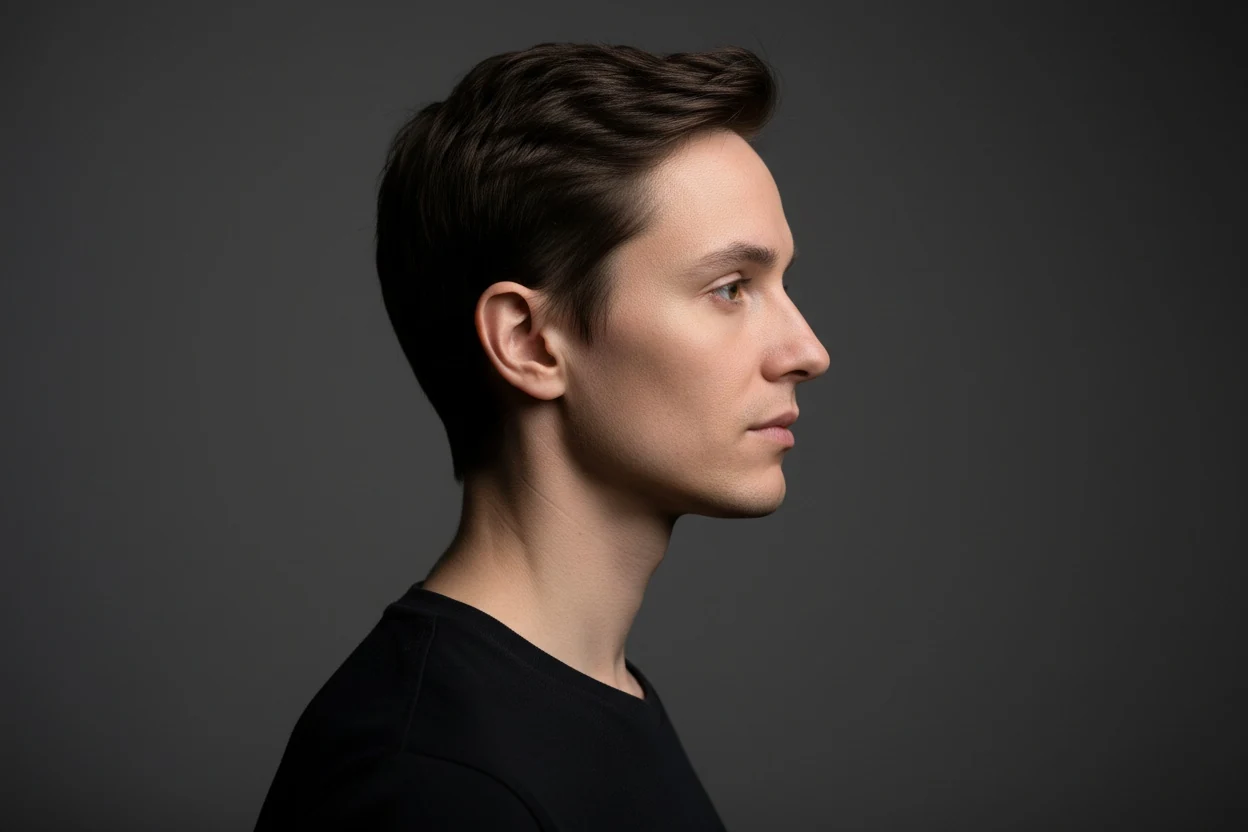
A true profile: you see one eye, the far cheek is hidden. Plain background, hair off the forehead, mouth relaxed.
Runs in your browser. Your photo is not uploaded.
What does a side profile analysis measure?
- The nasolabial angle is read from the underside of the nose and the upper lip; it is what separates an upturned tip from a downturned one.
- The E-line runs from the nose tip to the chin point; lips are described as behind it, on it or in front of it.
- A photo shows the soft-tissue outline only — the bone beneath it, which is what an orthodontist or surgeon plans around, is not visible.
- Reference bands differ by sex, age and ancestry; they describe typical adults and are not targets.
See what a change would actually look like
These are the renders that act on what this page measures. Each one below was generated by the same model that runs on your own photo — labelled examples on another face, so you can see what the procedure changes before you spend anything.
Rhinoplasty
AI glow-up · nose + styling
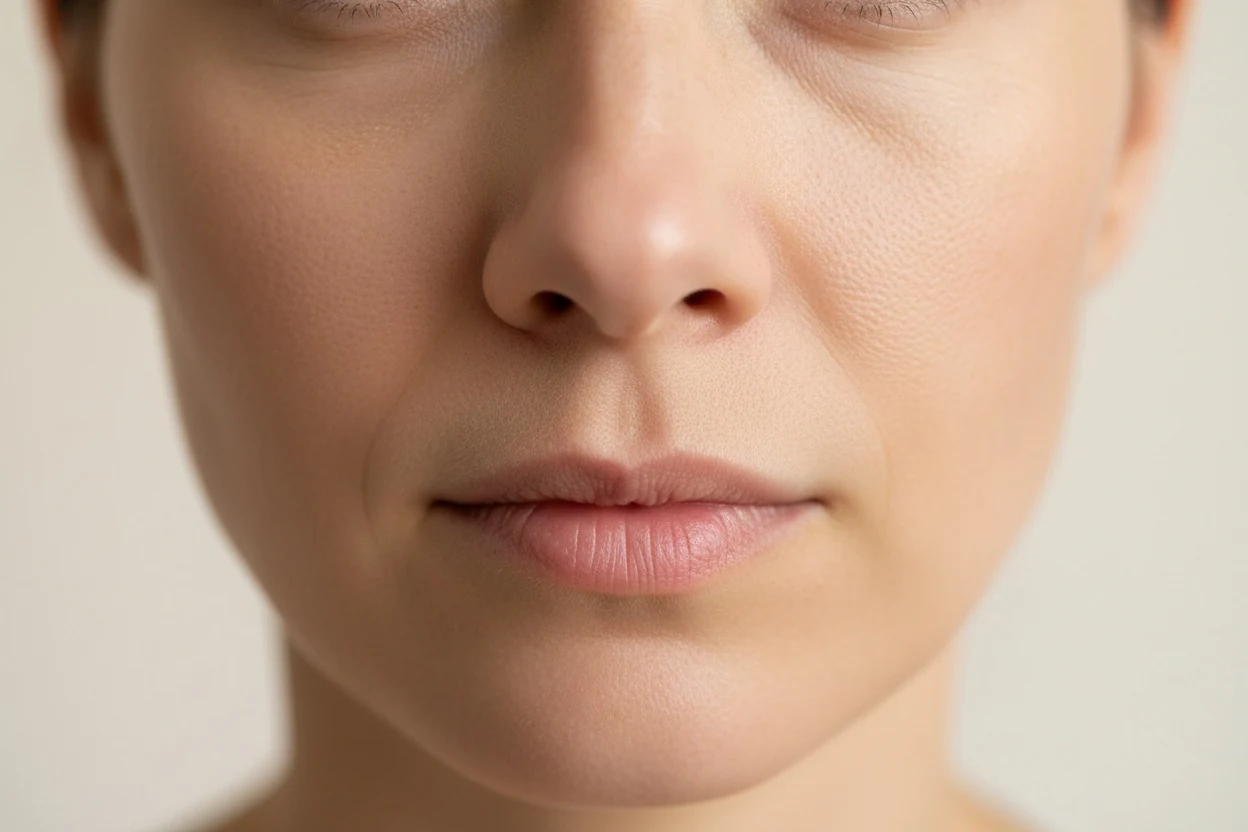
Rhinoplasty. A different possibility.
Tap the photo to enlarge. AI visualisation, not a prediction. Includes makeup, brow styling, hair and outfit changes. Both images are AI generated.
Changes the bridge, tip and nostril width of your nose.
What it does →Chin Augmentation
Chin Augmentation · AI example
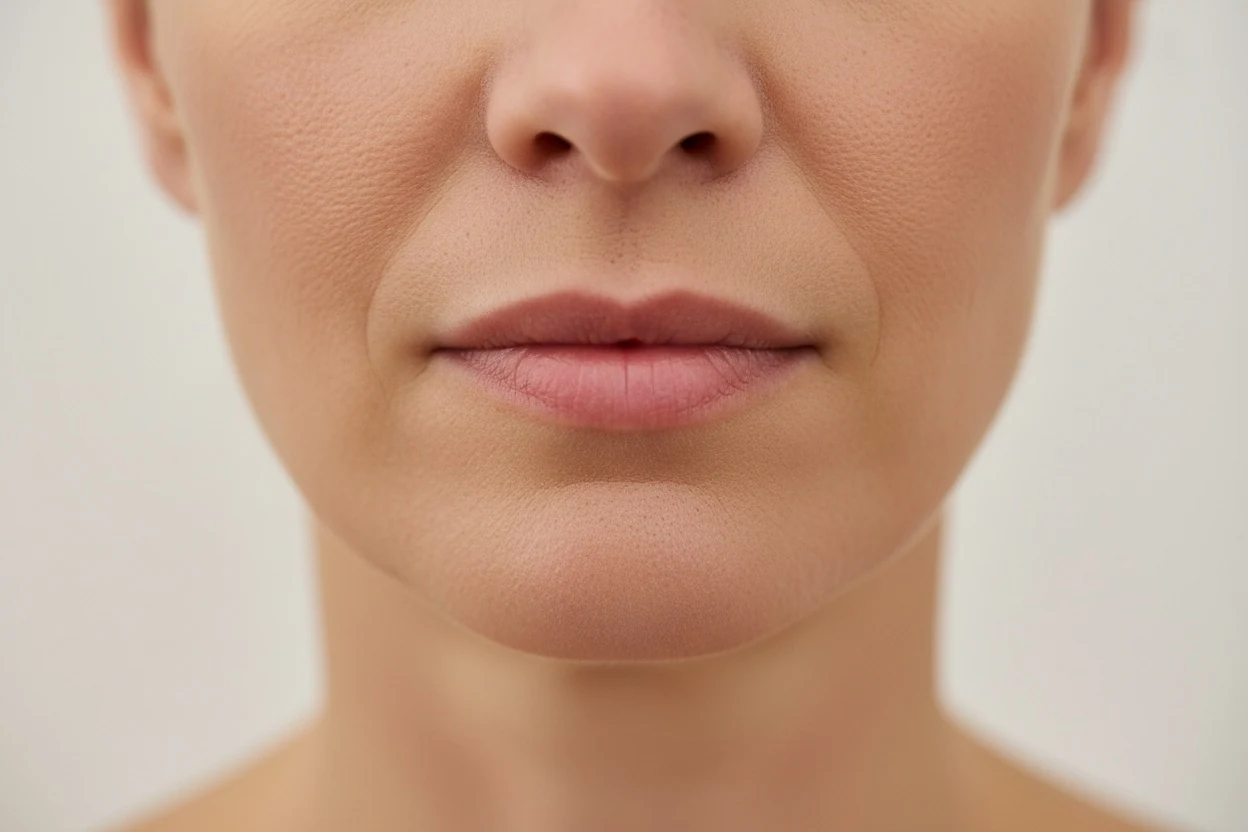
Chin Augmentation. A different possibility.
Tap the photo to enlarge. AI visualisation, not a prediction. Both images are AI generated.
Changes chin projection and length.
What it does →Lip Filler
Lip Filler · AI example
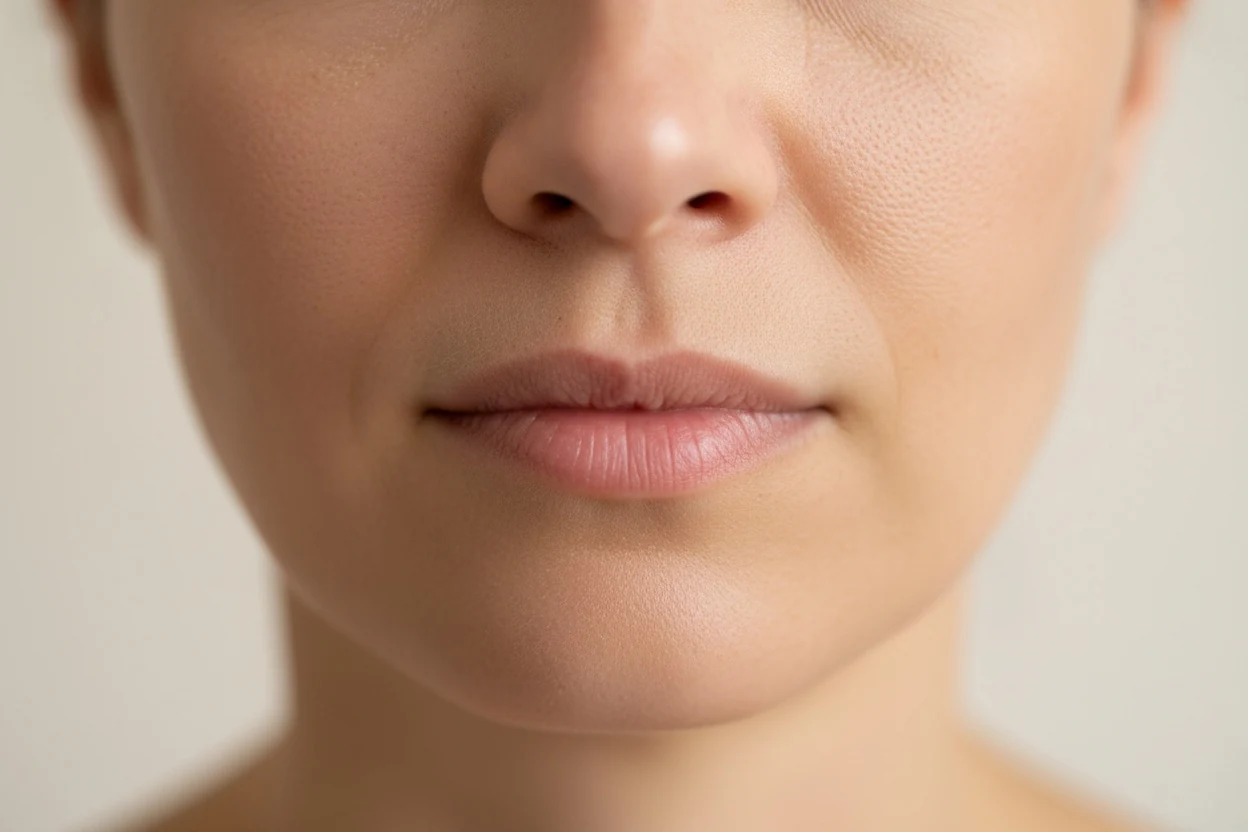
Lip Filler. A different possibility.
Tap the photo to enlarge. AI visualisation, not a prediction. Both images are AI generated.
Changes the volume and shape of your lips.
What it does →
Every “after” above is an AI simulation on a sample face, not a photograph of a surgical result — it shows the direction a procedure moves a face, not an outcome anyone achieved and not a prediction of yours. Where a frame reads “Before · AI example”, the before image is generated too: the same portrait with the condition that procedure treats added, because none of the source photographs had it. Run one on your own photo.
How the Side Profile Analyzer works
Face Mesh, the model behind the other tools on this site, expects to see both halves of a face. In a true side view it guesses, so this tool does not use it for the measurement. Instead an on-device segmentation model sorts every pixel of your photo into hair, face skin, neck, clothing or background, and the front edge of the face skin is your profile line.
The profile line is then read the way a clinician reads a silhouette: the nose tip is the most forward point of the mid-face, the subnasale is where the steep underside of the nose ends, the chin crease is the hollow between lower lip and chin, and the pogonion is the chin's front. The nose root and brow come from the hollow and the bulge above the nose. The points and angles are drawn back onto your photo so a misplaced point is visible rather than hidden inside a number.
Nothing leaves your device. If the outline cannot be traced — hair or a collar over it, a head that is not turned far enough, a busy background — the tool says so and measures nothing, rather than reporting angles from a guess.
What each side profile angle means
Facial convexity (glabella–subnasale–pogonion) is how much the profile bows forward in the middle. A straight profile reads near 180°; a typical adult sits around 160–172°. A smaller angle means a more convex profile — a prominent mid-face against a receding chin — and a larger one means a flatter or concave profile.
The nasofrontal angle is where the forehead meets the nose, at the nose root. About 115–135° is typical. A smaller angle reads as a deep nose root and a more projecting brow; a larger one as a shallow, flat transition from forehead to nose.
The nasolabial angle sits between the underside of the nose and the upper lip. Around 90–115° is typical, with narrower values common in men and wider in women. It is the measurement behind "upturned" and "downturned" tips: a wide angle means the tip rotates up, a narrow one that it points down. Because a photo has no view of the nostril floor, the tool uses the midpoint of the nose underside as the columella point.
The mentolabial angle is the crease between the lower lip and the chin. About 110–135° is typical; a smaller angle is a deep crease, often with a prominent chin, and a larger one a shallow crease.
The E-line and your lips
The E-line (esthetic line) is a straight line from the tip of the nose to the front of the chin. Ricketts described a typical adult as having the upper lip a few millimetres behind it and the lower lip slightly closer to it. Photos have no millimetre scale, so this tool reports each lip's distance as a percentage of the nose-tip-to-chin length, with the reference bands converted accordingly.
A lip well in front of the line reads as full or protruding; well behind it, as flat or retruded. Both depend as much on the nose tip and chin that define the line as on the lips themselves — a prominent nose pushes the line out and makes the lips look set back, which is why the angle and the line are read together rather than separately.
Nose profile types the analyzer reports
From the line between the nose root and the nose tip the tool classifies the bridge: straight, convex (a dorsal hump — the outline bulges forward of the line) or concave (scooped — it dips behind it). The deviation has to reach about 3.5% of the line's length to count, because anything smaller is the size of the outline's own pixel noise.
Tip rotation comes from the nasolabial angle: wide reads upturned, narrow downturned, in between neutral. A straight front-on photo cannot show either of these, which is why the nose-types page can only measure width and length and sends the profile questions here.
Is there a golden ratio side profile?
Not one that survives scrutiny. Claims that the ideal profile has angles or segments in the ratio 1.618 trace back to the same facial-mask arguments that were tested against real faces and found wanting; the angles clinicians use come from measuring large groups of adults, and they vary with sex, age and ancestry. That is why the bands on this page are ranges described as typical, never as an ideal.
The tool reports a balance figure — the share of its measurements that fall inside their band — because it is easy to read, but it is a description of how typical the outline is, not how attractive it is. A profile outside several bands can be distinctive and harmonious; one inside all of them can be unremarkable.
Profile thirds
Profile thirds divide the face from hairline to chin into three by height: hairline to glabella, glabella to subnasale, subnasale to chin. Roughly equal thirds are the classic teaching, with real faces varying by several percentage points. If hair covers your hairline the first third cannot be seen, and the tool skips the thirds instead of inventing a hairline.
How to take a side profile photo
- Turn until only one eye is visible and the far cheek has disappeared — a three-quarter view is refused.
- Camera at eye height, head level: look straight ahead rather than up or down, because tilt changes every angle.
- Plain, contrasting background and even light so the outline is crisp.
- Hair off the forehead and ear; no glasses, collar or hand across the face.
- Relaxed mouth, lips together without pressing — a pout or a smile moves the lips along the line.
Side Profile Analyzer — frequently asked questions
What is a good side profile?
There is no single good profile. Measurements are compared against typical adult ranges for context, and a profile outside them is a difference, not a flaw. Harmony of the whole face and personal preference carry more than any one angle.
How is the balance score calculated?
It is the percentage of the tool's measurements that land inside their reference band — the four angles, the two lip positions and, when the hairline is visible, the three thirds. It describes how typical the outline is and says nothing about attractiveness.
Can phi define the ideal profile?
Claims of a phi-based ideal profile are not supported by measurement of real faces. The reference bands here come from orthodontic and surgical soft-tissue norms instead.
What is a normal nasolabial angle?
Around 90–115°, with narrower values common in men and wider in women. It changes with the tip of the nose, the upper lip and the head's position, which is why a level head matters for the photo.
What is the E-line?
A line from the tip of the nose to the front of the chin, used to describe where the lips sit relative to the nose and chin. This tool expresses the distance as a percentage because a photo has no scale.
Does the chin matter for the profile?
A lot — it sets the convexity angle, the mentolabial angle and the E-line. A small or receding chin makes the nose and lips look more prominent, and a strong chin does the opposite, without anything about the nose changing.
Does mewing change my profile?
No measurement from one photo can show that. A change in posture, weight or head tilt moves these angles by a few degrees between photos, so compare only photos taken the same way.
Why did the tool refuse my photo?
It refuses rather than guessing when the head is not turned far enough, when hair, a collar, glasses or a hand covers the outline of the nose, lips or chin, or when the outline is too unclear to trace.
Is my photo uploaded?
No. The model runs in your browser and the photo stays on your device.
References
- 1.Farkas, L. G. (1994). Anthropometry of the Head and Face (2nd ed.). Raven Press.
- 2.Proffit, W. R., Fields, H. W., Larson, B. E., & Sarver, D. M. (2019). Contemporary Orthodontics (6th ed.). Elsevier.