Qoves review: what the report contains, and which half you can measure yourself
·15 min read·Updated
Qoves is the most searched name in this field, and almost everything written about it is either the company's own copy or a forum argument. This is neither. It is a description of what the product contains, checked against qoves.com on 7 September 2026 and again on 14 September 2026, followed by the part nobody separates: which half of it is measurement, and which half is judgement.
What $150 a year includes
The membership price does not appear in the page source. It is rendered by JavaScript, which is why summaries of Qoves pricing across the web disagree with each other and with the site. Loaded in a real browser, the block reads Qoves Membership, $150 / year, no hidden fees, cancel anytime, above a list of what the membership carries.
- A complete facial analysis — a breakdown of your facial structure and features, advertised as more than 160 assessments across regions of the face.
- A personalised improvement protocol — a step-by-step plan, non-surgical, with costs and timeframes attached to individual actions.
- Biometric scores with tracking — your current numbers, and progress against them over time.
- Before-and-after visualisations of the projected result.
- Direct questions to their team from a dashboard.
Two structural details matter more than the list. It is one analysis per year, not unlimited. And it is described as an ongoing service you can cancel — an annual subscription rather than a one-off purchase, with the report delivered within 28 days of uploading photos.
The $150 is not the only price. The Guardian, which bought a report for its August 2026 feature, reported an optional $180 upgrade for surgical recommendations — the membership itself covers non-surgical changes — and an $80 express delivery option. Neither add-on appears in the pricing block on the homepage, so the realistic range is $150 to $410 depending on what you choose.
Who is behind Qoves, and does it use AI?
Qoves describes itself on its about page as a personal beauty consultancy, headquartered in London and founded in 2019, with 121 team members and more than 50,000 clients — the company's own figures. It says it started as Shafee Hassan's research using computer vision models to study what drives attractiveness ratings, and that by 2024 Hassan and co-founder Leo Olsen Guillot had turned that into the current service. The contracting entity in its terms is Qoves Inc., under Delaware law. It also runs a large YouTube channel — more than a million subscribers, according to the Guardian — which is how many people first hear of it, and its customers discuss it in the r/QOVESStudio subreddit.
How much of a Qoves report is automated
By its own account, a mix. The measurement layer is software: proprietary models that place 512 landmarks on your face and run more than 160 assessments. The site says every analysis is reviewed by its team, and in its FAQ it states that it uses tools like Claude to help articulate findings, while the measurements, tests and protocols come from its own models and staff. So the honest answer to "does Qoves use AI" is yes for measuring and drafting, and a human review on top. The FaceIQ Labs review draws the same line between a measurement product and a programme sold around it.
How the Qoves process works: photos, turnaround, deliverable
| Step | What you do | What Qoves does | Time |
|---|---|---|---|
| 1. Sign up and pay | Buy the membership | Opens a dashboard | Minutes |
| 2. Questionnaire | Answer questions on demographics, lifestyle and goals; the Guardian reporter was asked to confirm no body dysmorphia concerns and consent to weight-loss suggestions | Uses the answers to tailor the plan | Minutes |
| 3. Photos | Upload six photos from specific angles, including front, side and quarter profiles | Places 512 landmarks and runs its assessments | Minutes |
| 4. Review | Wait | Its team reviews the analysis and writes the protocol | Up to 28 days; two days with express, per the Guardian |
| 5. Delivery | Read the report, ask questions from the dashboard | Analysis, protocol, biometric scores, before-and-after visualisations and a letter from its team | Updated once a year |
Where Qoves is genuinely doing something no free tool does
This is the section a competitor page usually skips, and skipping it is what makes those pages worthless. There are four things in the Qoves offer that no automated measurement can produce, including ours.
- 1A human decided what to say. Software can report that your lower third is 4% longer than your middle third. Deciding whether that is worth acting on, and what to do first, is judgement. Their site advertises assessment against ethnic background, personal preference, lifestyle and cultural context — those are inputs a landmark detector does not have.
- 2It is a plan, not a number. Ordering — this before that, over these weeks, at this cost — is the actual deliverable. The example steps visible on their page carry price and timeframe columns, which is the format of a plan rather than a report.
- 3Coverage. 160+ assessments is far past what any browser-based tool attempts, and past what a single front photograph can support. It asks for six photos, including side and quarter profiles, which is how it can read traits a front photo cannot carry.
- 4Someone answers you. A dashboard where you can ask a person a question is a service, and services cost money for the reason all services do.
The $150 is not buying arithmetic. It is buying somebody's time and an opinion attached to their name. Whether that is expensive depends entirely on whether you want an opinion.
The half that is arithmetic
Facial geometry from a photograph is a solved and unglamorous problem. A landmark model places points on a face — the one this site uses places 478 — and every ratio anybody quotes is subtraction and division on those coordinates. Thirds, fifths, symmetry across landmark pairs, canthal tilt in degrees, jaw width against cheekbone width, the phi comparisons: all of it is the same arithmetic, and none of it requires a server, an account or a payment.
That is why the measurement layer is free here and free at several other sites. It is not a loss leader or a trick. It is that the computation costs approximately nothing once the model is loaded in your browser, and your photograph never leaves the device — which is also the only version of this that is safe to offer under biometric privacy law.
The thirds, the fifths, symmetry across six landmark pairs and the phi comparisons, reported with the landmark each number came from. No account, no upload, no payment — so you can see exactly which part of any paid report is the measured part.
Run the measurements nowIs Qoves worth it? What buyers have reported
Qoves says it has served more than 50,000 clients and quotes happy customers on its site, praising detail and honesty. The most detailed independent accounts of what buyers actually received come from the Guardian's August 2026 feature, which described two customers and the reporter's own purchase. They are three experiences, not a survey, and they point in different directions.
- A customer who spent $330. She bought after seeing TikTok videos, during a period of unemployment, and received a 30-page report. It recommended a rhinoplasty, a lower blepharoplasty, a canthopexy, chin implants and a malarplasty, plus injectables and microblading. She told the Guardian she planned procedures once her debt was paid.
- A customer who paid $80 for express delivery. Results arrived in two days. She described relief that the report did not recommend changing her nose, which she had been bullied about, and said it confirmed what she already believed about her flaws.
- The reporter's own report. After the questionnaire, she received an 18-tab analysis and a 16-page protocol within a couple of days, including a visualisation with lip filler, makeup and over-tweezed brows. She wrote that she had never considered several of the features it assessed, and afterwards found herself second-guessing her face.
Put together: the report is long, specific and delivered as promised, and whether it helps depends heavily on who is reading it. For someone who wants a structured plan and can take recommendations as options, it delivers what it sells. For someone already anxious about their face, a detailed list of what could change is not neutral information.
The Qoves controversy: what the Guardian reported
On 5 August 2026 the Guardian published a feature on paid facial analysis services in looksmaxxing culture, focused mainly on Qoves and the app Epica. This is a summary of what it reported, not a finding of this site.
- Scientists cited by the industry questioned the use of their work. A psychology professor whose research Qoves referenced in a video said she studies bullying and mental health rather than beauty, and warned that services like this can be destructive for people with body dysmorphia or eating disorders. A researcher whose study on perceived masculinity and femininity Qoves cited said his findings do not generalise across populations and he would not base recommendations on them.
- The science was called too thin to sell recommendations. A third academic who studies attraction said the literature is too inconsistent for population-wide generalisations and that he would caution anyone against acting on such a service.
- Safeguards were described as easy to bypass. Qoves limits its service to adults and asks users to self-report body image concerns; the Guardian noted both can be circumvented.
- Commenters online, cited by the Guardian, said its promotional material skews Eurocentric, despite the company's stated attention to ethnicity.
- Qoves did not respond to the Guardian's request for comment.
Two things are worth setting next to that, from Qoves's own pages. Its about page says it earns no referral fees and sells no procedures, so it is paid the same whether it recommends changes or none. And its terms state plainly that its reports are not medical advice, that accuracy is not guaranteed, and that any procedure should be discussed with a qualified professional. The disagreement is less about whether Qoves is honest about what it is than about whether a scored list of your features is good for the person receiving it. This site's own line is the same one it uses on the PSL scale page: a measurement is not a verdict.
Qoves before and after: why there is no clean answer
Searches for Qoves before-and-after photos mostly find two kinds of image, and neither is evidence of an outcome. The first is Qoves's own visualisations, which its site describes as designed to be realistic — and its footer notes that some images on the website are digitally generated to illustrate potential changes, with results varying. The second is customer photos posted online, taken months apart under different conditions.
The trouble with the second kind is that the variables that make a face look different in a photo are mostly not the face. Camera height, head tilt, lens distance and light change measured proportions on their own, which is why any before-and-after that does not hold them constant is comparing setups rather than results.
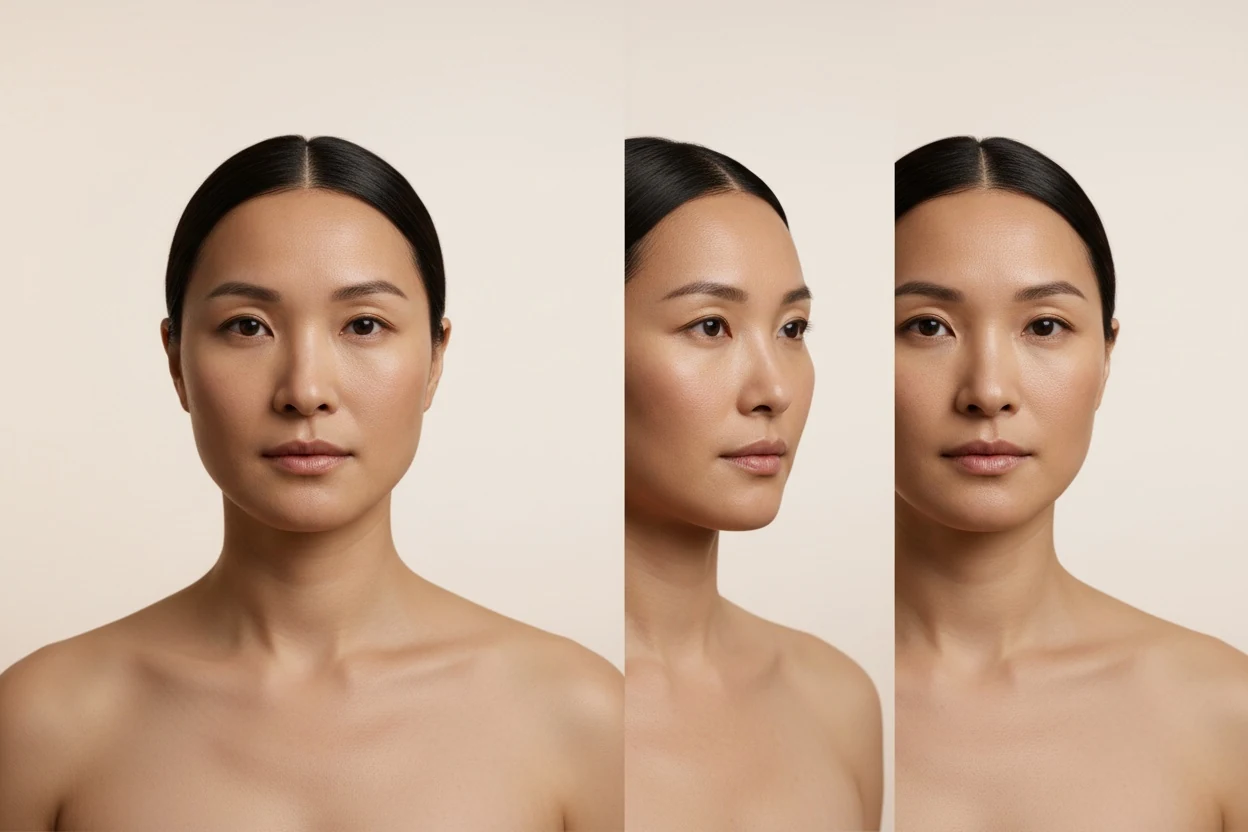
The simulations on this site are the first kind of image too, and every frame is labelled as an AI simulation rather than a result, so it cannot be mistaken for one.
Is Qoves free? Qoves cost, add-ons and refunds
There is no free version. On 14 September 2026 qoves.com listed a single paid membership at $150 a year and no free tier or trial; its free material is its YouTube videos and Insights articles rather than an analysis. The optional surgical upgrade and express delivery reported by the Guardian are extra.
Refunds are narrower than the "cancel anytime" line suggests. Its terms, last updated 15 May 2026, give a full refund for up to 90 days after purchase only if you have not yet submitted your photos or questionnaire. Once photos are uploaded or work has started, it does not refund, though it offers revisions through your care team. Express delivery fees are non-refundable once any part of the order has been delivered. In practice, the decision point is before you upload.
What the research behind the pitch actually found
The Qoves homepage opens with evidence that looks matter economically, and the headline figure — attractive servers receiving around $1,261 more in tips annually — traces to a real, citable paper: Parrett's 2015 study in the Journal of Economic Psychology using restaurant tipping data. The citation is sound. It is worth being precise about what a result like that supports.
- These are population averages. A correlation between rated attractiveness and tips across many servers says nothing about what any individual would earn, and nothing about what changing one feature would do.
- The underlying beauty research has modest effect sizes. Averageness (Langlois & Roggman, 1990) and symmetry (Grammer & Thornhill, 1994) both correlate with ratings, and Rhodes' 2006 review puts them together: real, replicated, and none of them a single lever.
- Skin frequently beats geometry. Fink, Grammer and Matts found that changing skin colour distribution alone shifted ratings of age, health and attractiveness with the underlying shape untouched. That is an argument for the cheap end of any protocol, not the expensive end.
- Phi is weaker than it is quoted. Holland's 2008 analysis found Marquardt's mask was derived from a narrow set of fashion models and fits some populations far better than others. Any report leaning on the golden ratio is leaning on that.
None of this makes the product bad. It means the honest claim is "here is a plan, informed by evidence with modest effect sizes" rather than "here is what your face is worth", and it is worth knowing which one you are buying.
Side by side
| Qoves | This site | |
|---|---|---|
| Price | $150 / year, one analysis per year | Measurement free; paid plans from $7.99/month, $49.99/year |
| Account needed to measure | Yes | No — the 22 tools run without one |
| Where your photo goes | Uploaded for review | Nowhere — analysis runs in your browser |
| Reviewed by a person | Yes | No |
| Written plan with costs and timeframes | Yes | No |
| Number of assessments | 160+ advertised | 22 tools, each reporting the landmarks behind it |
| Turnaround | Within 28 days | Immediate |
| Visualisation of the result | Included | Included on paid plans — simulations |
| Photos required | Six, including side and quarter profiles | One front-facing photo |
| Surgical recommendations | Optional $180 add-on, as reported by the Guardian | None |
| Free analysis | No | Yes — every measurement tool |
| Refunds | Full refund within 90 days only before photos or questionnaire are submitted | Unused credits refundable, no time limit |
| Says what it cannot measure | Terms say accuracy is not guaranteed | On every tool page |
Who should buy it, and who should not
Buy it if you have already measured, you already know which feature you care about, and what you actually want is a person to tell you what to do about it in what order. That is a real want, it is not served by any free tool, and $150 for a year of it is not an unreasonable price for a written plan plus access to someone.
Do not buy it if what you actually want is the numbers. Every ratio in a report like this is available in a browser in under a minute, and paying for arithmetic is the most common mistake in this category. Also do not buy it expecting a medical opinion: a written aesthetic protocol is not a diagnosis, and nothing on their page claims it is.
And if you are considering it because a number somewhere upset you, measure first. A large share of what people want re-rated turns out to sit inside the range where nobody, including them, can see a difference — and that is a cheaper thing to discover than $150.
What we charge, and for what
Stated plainly, because a comparison page that hides its own pricing has told you what it is. The 22 measurement tools are free, run without an account and never upload your photograph. Paid plans buy the generated layer — simulation renders, the written report, skin and age analysis — at $7.99 a month for 10 renders, $17.99 for 30, or $49.99 a year for 100.
The thing we do not sell is the thing Qoves does sell: nobody here looks at your face and tells you what to do. Our simulations render a change so you can see it, and every frame says it is an AI simulation rather than a surgical outcome. If you want a human opinion, this is not the product, and the $150 is going somewhere it will actually be spent.
Frequently asked questions
How much does Qoves cost?
The membership was listed at $150 per year on qoves.com on 14 September 2026, described as one analysis per year, no hidden fees, cancel at any time. The Guardian reported two optional extras in August 2026: $180 for surgical recommendations and $80 for express delivery. The price is rendered by JavaScript rather than written into the page source, so check the site before acting on any figure you read anywhere, including here.
Is Qoves legitimate or a scam?
It is a real company selling a real deliverable. There is a public Trustpilot profile, a large Reddit footprint with people who have bought the report, and long-form independent reviews from customers. What you are buying is a written report and a plan, not a medical service or a guaranteed outcome, and that distinction is where most disappointment comes from rather than from anything hidden.
How long does a Qoves report take?
Their site says it takes up to 28 days from uploading your photos. The Guardian reported an $80 express option that returned one customer's results in two days. It is described as an ongoing service rather than a single purchase, which is why the price is annual and cancellation is mentioned in the same sentence.
Is there a free alternative to Qoves?
For the measurement half, yes — the geometry is arithmetic on landmark positions and several sites, including this one, do it in your browser for nothing. For the other half there is no free equivalent, because a written recommendation reviewed by a person is labour, and labour is what the $150 is actually paying for.
What does the Qoves report actually contain?
Per their own page: a breakdown of your facial structure, biometric scores with progress tracking, a step-by-step improvement protocol, before-and-after visualisations of the projected result, and direct questions to their team from a dashboard. They advertise more than 160 aesthetic assessments across regions of the face.
Do looks really affect earnings the way the marketing says?
The tipping figure they lead with traces to a real paper — Parrett (2015) in the Journal of Economic Psychology, using restaurant tipping data. Effects of this kind are repeatedly found and they are averages across populations, not predictions about one person. A study showing that attractiveness correlates with tips does not tell you what a report about your face is worth.
Who is behind Qoves?
Per its own about page, Qoves is headquartered in London and was founded in 2019. It began as Shafee Hassan's work using computer vision models to study attractiveness perceptions, and by 2024 Hassan and co-founder Leo Olsen Guillot had built it into the current service. Its terms name the contracting company as Qoves Inc., governed by Delaware law.
Does Qoves use AI or a human?
Both, by its own description. Measurements come from proprietary models that place 512 landmarks and run more than 160 assessments; every analysis is reviewed by its team; and it says it uses tools like Claude to help write up findings, while stating that the analysis itself is not done by a general chatbot.
Why was Qoves criticised in the press?
A Guardian feature in August 2026 reported on customers who received long lists of recommended procedures, and quoted academics who said the science does not support selling personalised recommendations, that research was being used out of context, and that the service could harm people with body dysmorphia. The Guardian said Qoves did not respond to a request for comment.
Can I get a refund from Qoves?
Its terms, last updated 15 May 2026, allow a full refund for up to 90 days after purchase if you have not yet submitted your photos or questionnaire. Once photos are uploaded or work has started, refunds are not offered, though revisions are, and express delivery fees are non-refundable once any part of the order is delivered.
References
- Parrett, M. (2015). Beauty and the feast: examining the effect of beauty on earnings using restaurant tipping data. Journal of Economic Psychology, 49, 34–46. doi:10.1016/j.joep.2015.04.002
- Langlois, J. H., & Roggman, L. A. (1990). Attractive faces are only average. Psychological Science, 1(2), 115–121. doi:10.1111/j.1467-9280.1990.tb00079.x.
- Grammer, K., & Thornhill, R. (1994). Human (Homo sapiens) facial attractiveness and sexual selection: the role of symmetry and averageness. Journal of Comparative Psychology, 108(3), 233–242. PMID 7924253.
- Fink, B., Grammer, K., & Matts, P. J. (2006). Visible skin color distribution plays a role in the perception of age, attractiveness, and health in female faces. Evolution and Human Behavior, 27(6), 433–442. doi:10.1016/j.evolhumbehav.2006.08.007.
- Rhodes, G. (2006). The evolutionary psychology of facial beauty. Annual Review of Psychology, 57, 199–226. PMID 16318594.
- Holland, E. (2008). Marquardt's Phi mask: pitfalls of relying on fashion models and the golden ratio to describe a beautiful face. Aesthetic Plastic Surgery, 32(2), 200–208. PMID 18175168.
Tools mentioned in this article
Attractiveness Test
Your score out of ten, with every measurement behind it.
Symmetry Checker
Left against right across six landmark pairs.
Golden Ratio Calculator
How close your proportions sit to phi (1.618).
Face Shape Detector
Oval, round, square, heart, oblong, diamond or triangle.
Facial Thirds Calculator
Upper, middle and lower thirds as percentages — and which one not to trust.
Measurements on this site are for information only. Nothing here is medical advice, and no result is a diagnosis. Talk to a qualified clinician before making any decision about a procedure.