Hairstyles for men with a round face: 20 cuts, and what each one does to the shape
·17 min read
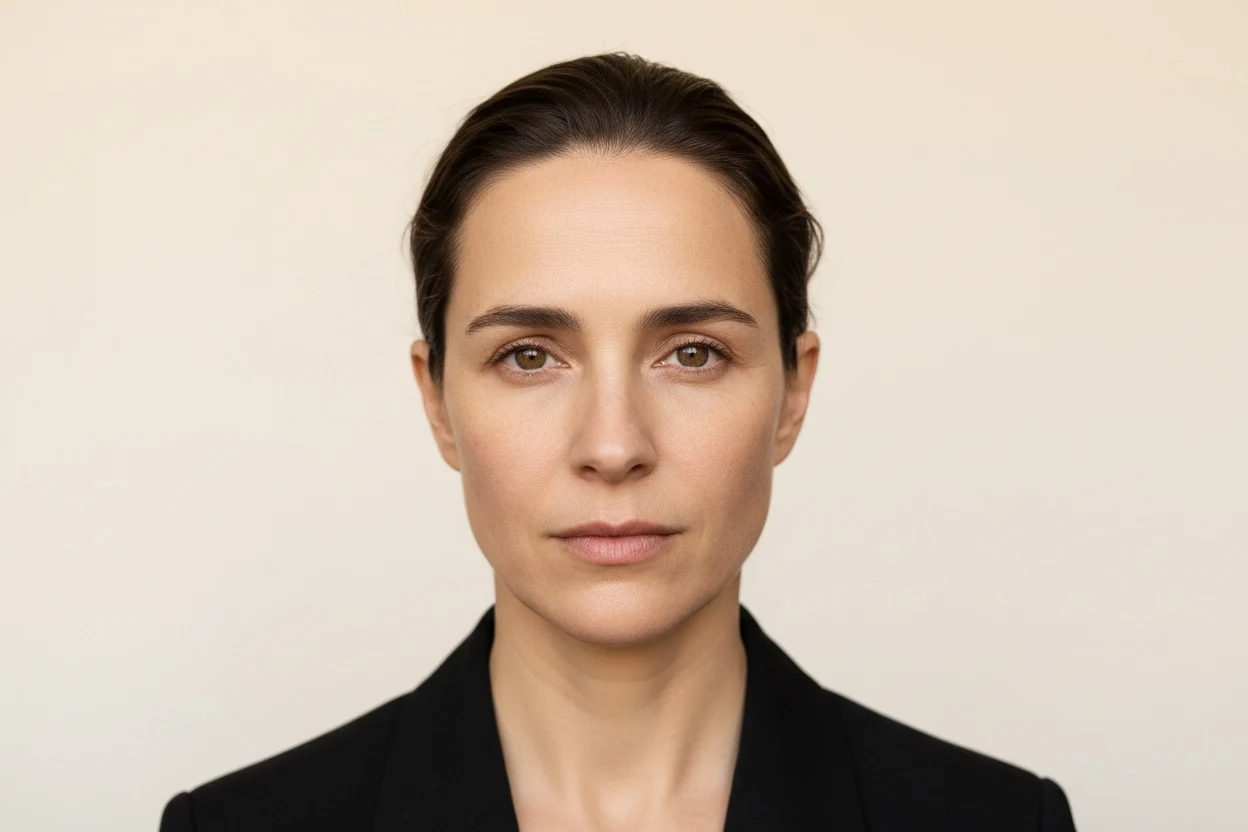
Men's hairstyle advice for a round face is usually a list of twenty cuts with no reason attached. This guide gives the reason for each one, because the reason is what lets you adapt a cut to your hair and your barber. A round face is close to as wide as it is long, with full cheeks and a jaw that curves rather than turning a corner. Every cut below either adds length to that outline or takes width away from it, and the best ones do both.
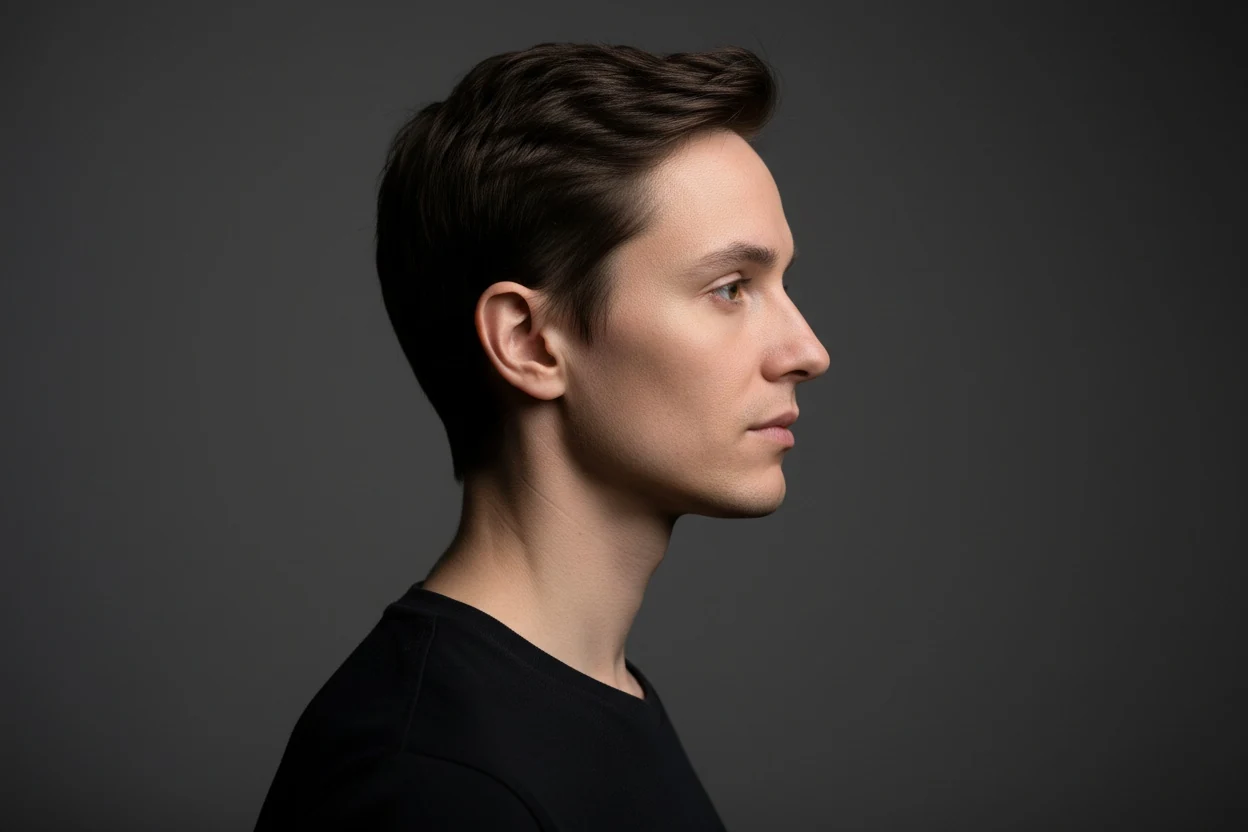
Round and square faces have almost the same proportions, and the haircut advice differs at the jaw. One straight-on photo, hair back, analysed in your browser.
Check that your face is round, not squareIs your face actually round? The men's version
Round and square are easy to confuse, and they need different things at the jaw. Both are about as long as they are wide. The difference in a mirror is the corner of the jaw below the ear: on a round face it curves into the neck, on a square face it turns a visible angle. Measure face length from hairline to chin and width across the cheekbones; if length is under about 1.2 times width, you are in round or square territory, and the jaw corner decides which.
A front-facing photo shows that corner poorly, so the face shape detector on this site does not use it. It separates the two by length and jaw width instead: a face no more than 1.16 times as long as its cheekbone width, with a jaw at least 79.1% of that width, is labelled round, and a longer face with three similar widths square. Its length starts at the top of the forehead rather than the hairline, so its numbers are not the same as a tape measure's. The round face shape page covers the shape in full.
Round face or chubby face?
Round describes a proportion, but soft tissue is part of the outline, which makes round the one shape that genuinely shifts with weight. In a study of 22 adolescent girls, higher body fat was linked with a rounder, larger lower face, and lower body fat with a more angular lower face and a pointier chin; the sample was small and not adult men, but the direction matches what most people see in a mirror. Separately, a study of perceived facial adiposity — how much weight people see in a face — found it predicted how healthy and attractive the face was rated. For haircuts, the practical point is that the advice is the same either way — height on top, short sides, a clean line under the jaw — and that a face shape measured at one weight can read differently at another.
What a haircut does to a round face
Men's cuts change three things, and every cut in this guide is a combination of them.
| Lever | What it changes | Cuts that use it | Overdone looks like |
|---|---|---|---|
| Height on top | Adds length to the silhouette | Quiff, pompadour, faux hawk, brush up | A tall block that makes the head look top-heavy |
| Short sides (fade or taper) | Removes width at temple and cheek level | High fade crop, undercut, skin-fade buzz | Very high skin fade with a flat top: no height to balance it |
| A straight line or edge | Adds an angle where the face has curves | Hard side part, line-up, disconnected undercut, beard neckline | Sharp lines everywhere with no texture, which can look severe |
Why fade height matters more on a round face
A fade takes the hair at the sides and back down close to the skin and blends it into the longer hair above. Where that blend starts decides how much width the haircut leaves at the sides. A low fade starts just above the ear and leaves most of the side covered, so the head keeps its width at temple level. A mid fade starts about halfway to the temple. A high fade reaches the temple, so nearly the whole side is close-cropped and only the top holds length. On a round face, that high narrowing is what makes the height on top read clearly, which is why mid and high fades are the usual recommendation. A taper is a gentler version that shortens gradually rather than going to skin; a mid taper is a good choice if a high skin fade feels too sharp.
Short hairstyles for round face men
Short cuts are the easiest way to control a round face, because the barber decides exactly where the volume sits. All nine below keep the sides short; they differ in how much height and how much edge they add.
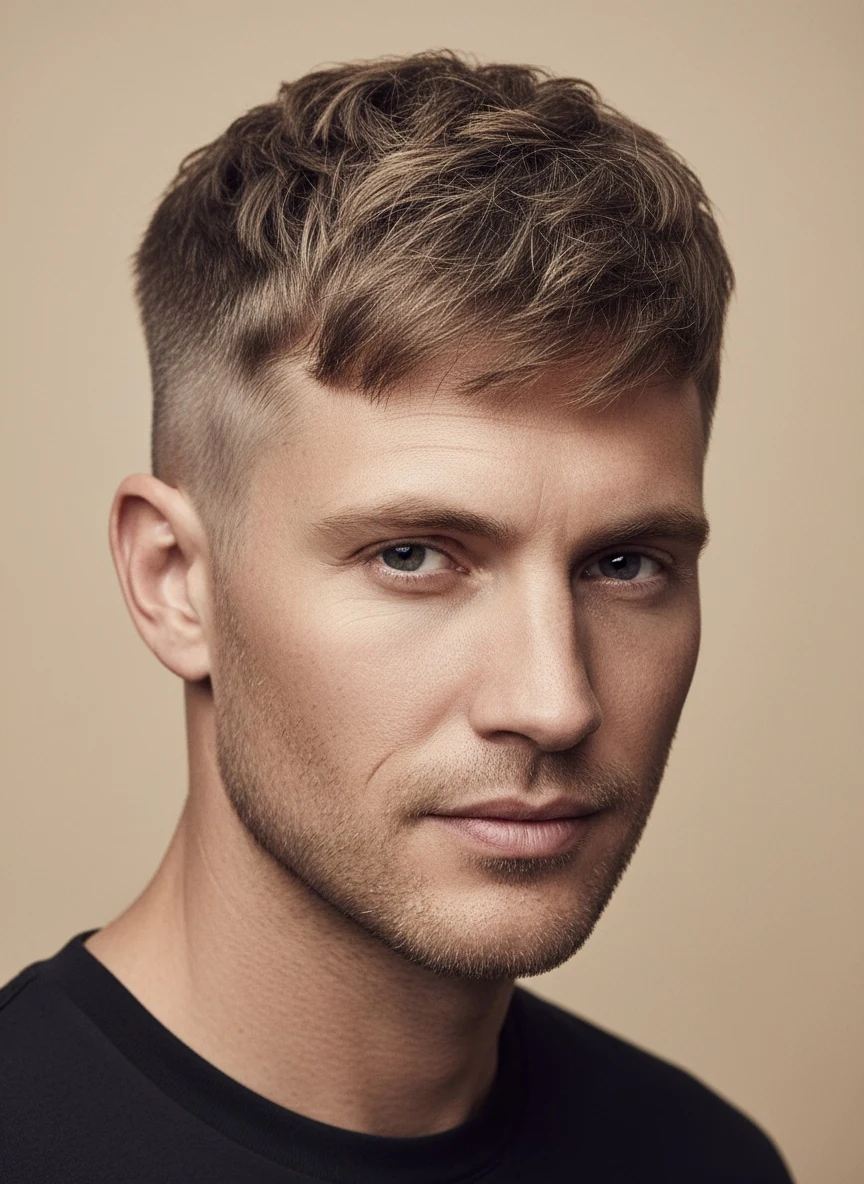
1. Textured crop with a high fade
A short, choppy top with a high fade. The texture gives the crown some lift without much styling, and the high fade takes width off the sides. Wear the front pushed up or slightly to one side rather than straight down, because a heavy straight fringe shortens a face that is already short. Ask for: a high skin fade, about 5–7 cm on top, point-cut for texture, front left long enough to push up. Upkeep: every 2–3 weeks to keep the fade sharp.
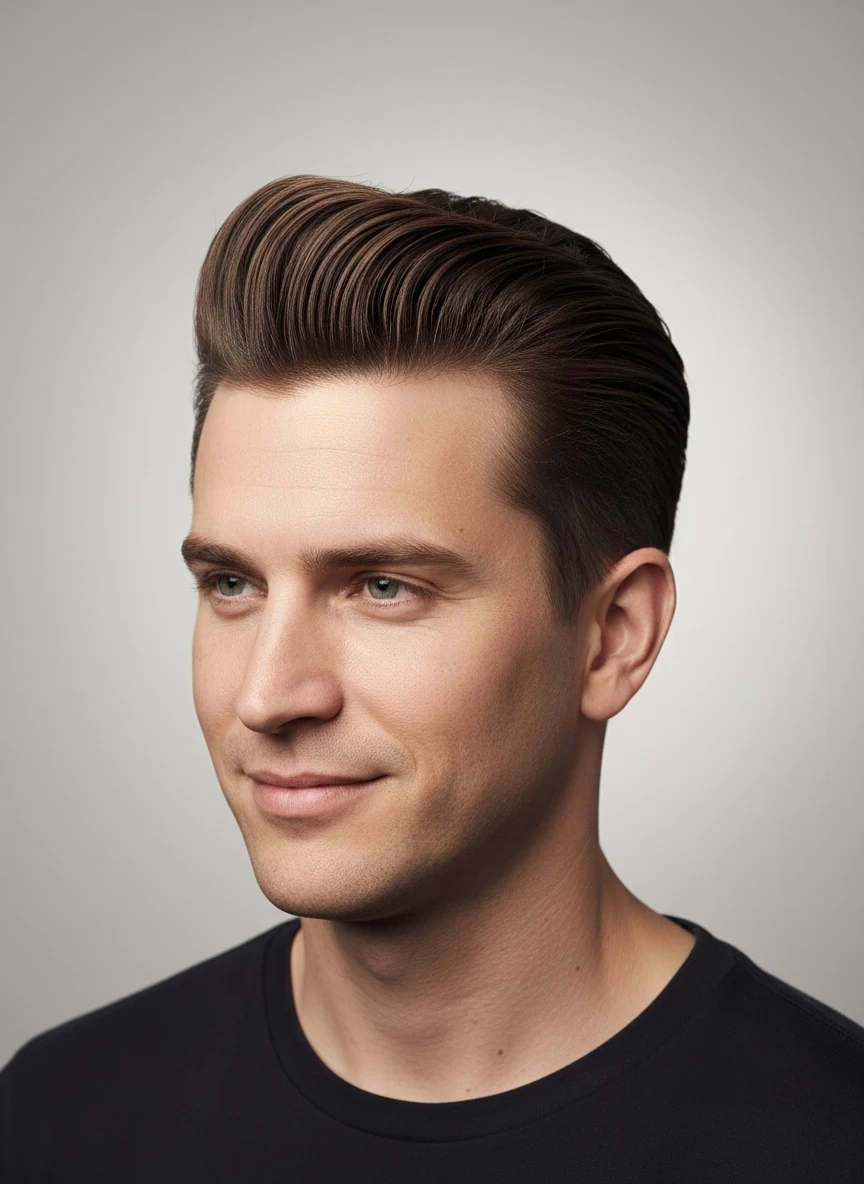
2. Pompadour with tapered sides
Hair on top swept up and back into a rounded mass of height at the front, with tapered sides. It is the most height a short cut can give, which makes it one of the strongest options for a round face. It needs length, product and a blow-dryer. Ask for: 8–10 cm on top, graduated shorter toward the crown, mid taper at the sides. Upkeep: a cut every 3–4 weeks and daily styling.
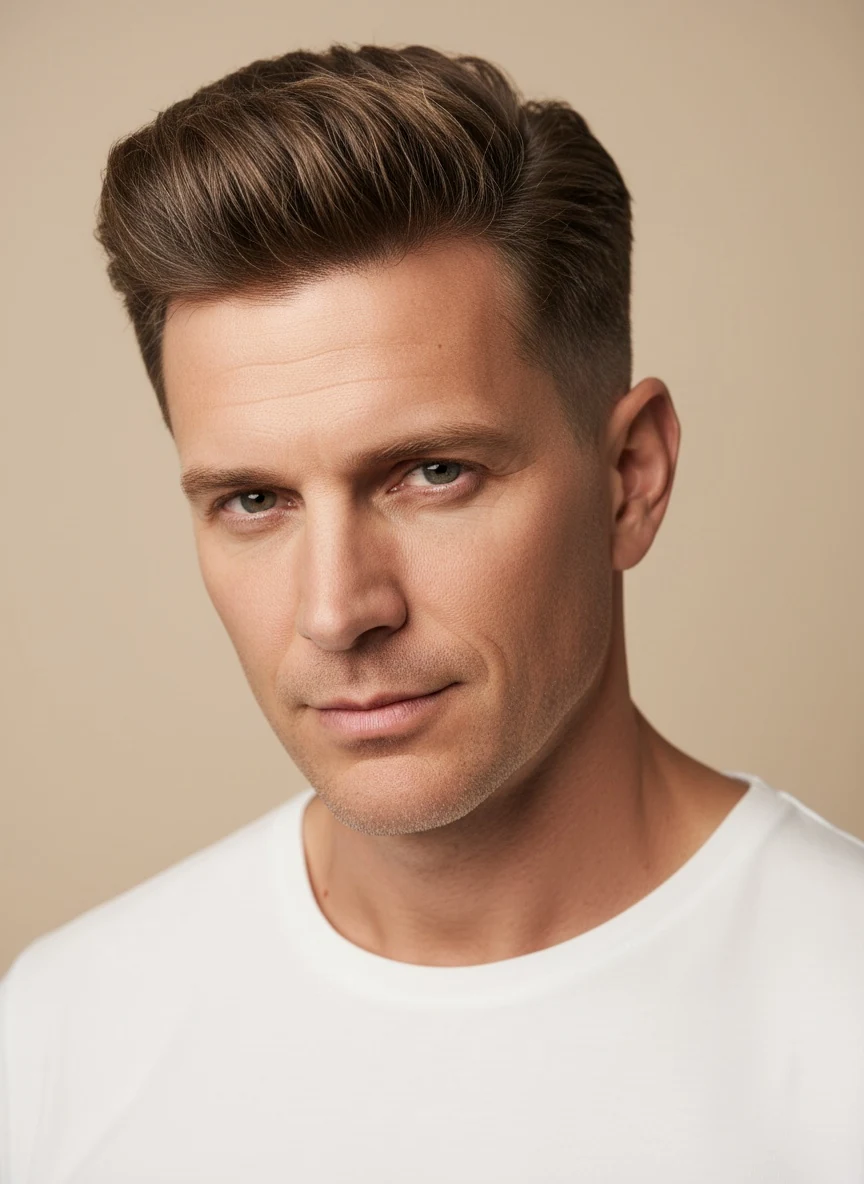
3. Textured quiff
A looser, messier cousin of the pompadour. The front is brushed up and slightly back rather than into a smooth roll, so it adds height with less styling. It suits most hair types, including fine hair if you use a matte product at the roots. Ask for: 6–8 cm at the front, shorter toward the crown, tapered or faded sides. Upkeep: every 3–4 weeks.
4. Hard side part
A classic side part with a line shaved or clippered into the parting. The line is the point: a straight diagonal on a face built of curves. Comb the top over with a little lift at the front, and keep the sides short. Ask for: a side part with a hard part line, 4–6 cm on top, mid or high fade. Upkeep: every 2–3 weeks; the shaved line grows out fast.
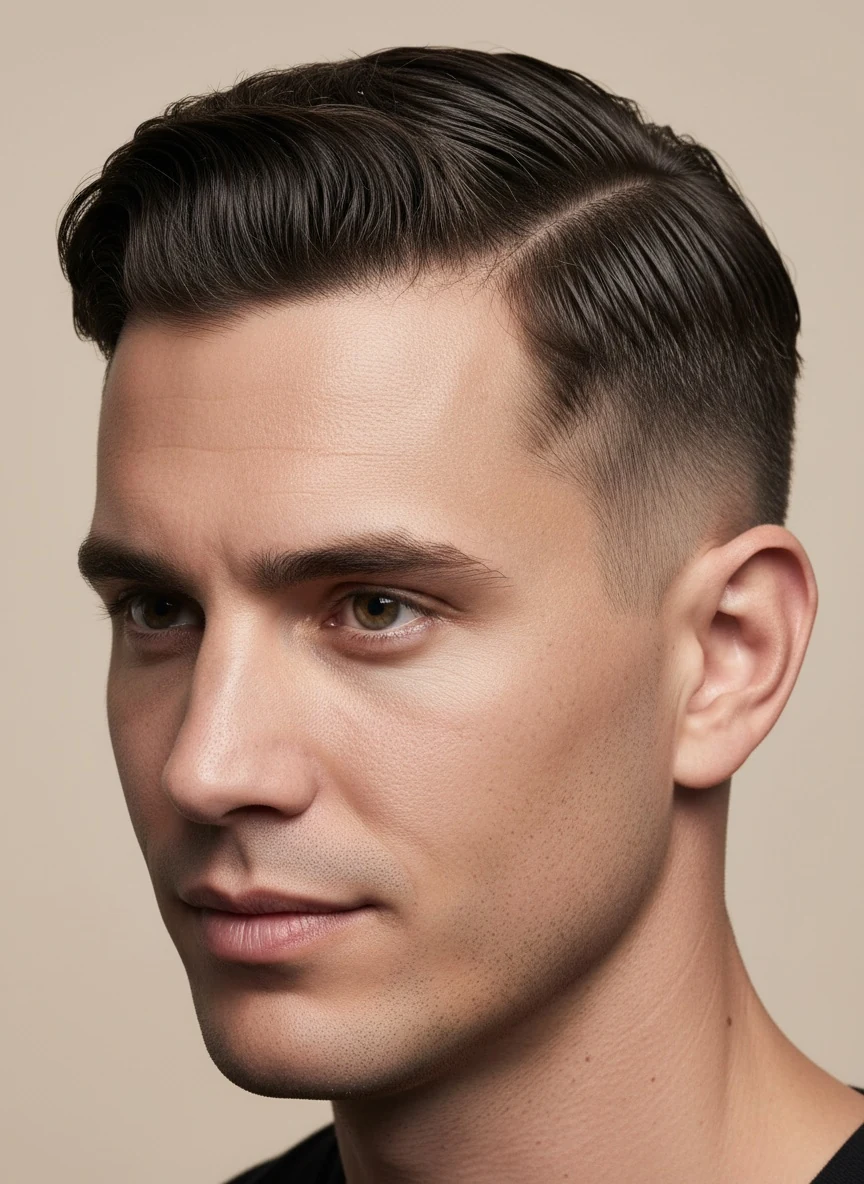
5. Faux hawk
Hair on top pushed up toward a soft ridge down the centre, with short sides. Concentrating the volume in a strip down the middle of the head adds height and makes the silhouette narrower at the same time. Keep it short and textured rather than spiked and tall for an everyday version. Ask for: 5–7 cm down the centre, shorter toward the sides of the top, mid or high fade. Upkeep: every 3 weeks.
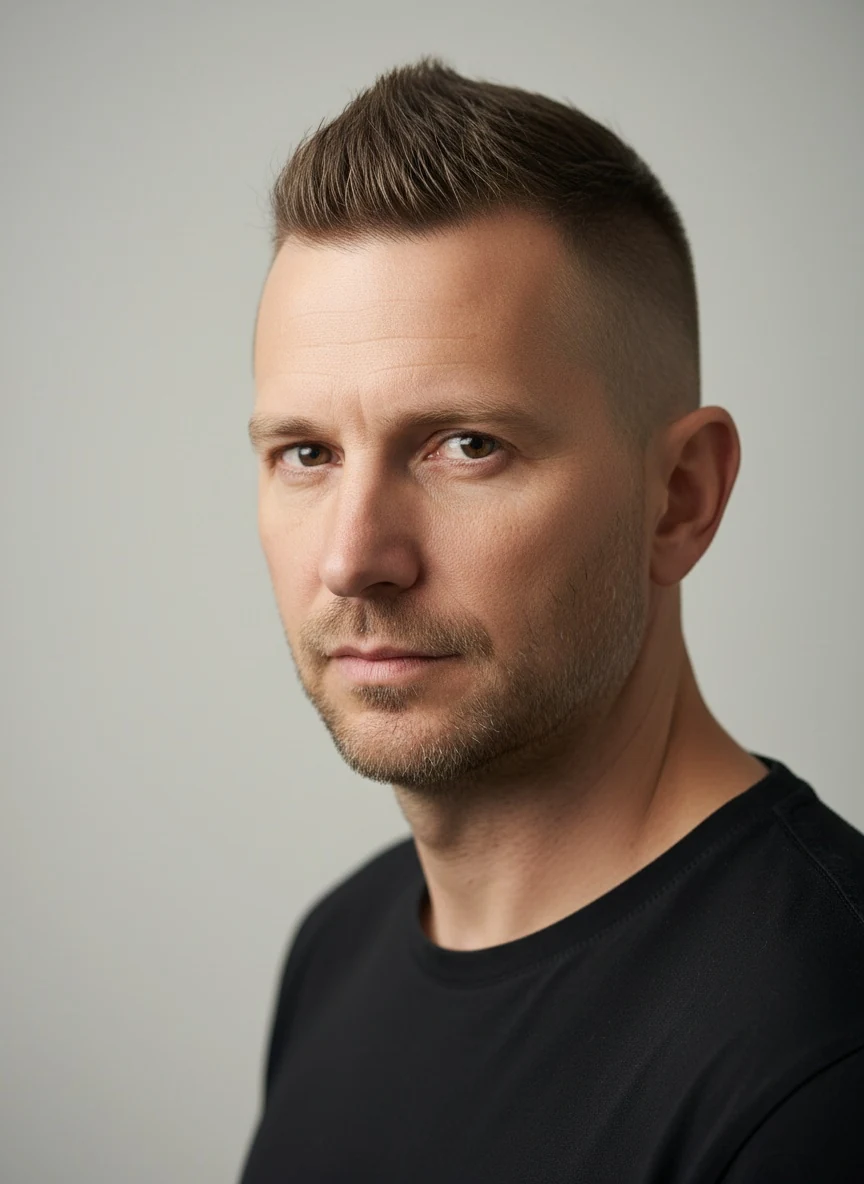
6. Buzz cut with a skin fade
A plain one-length buzz cut is the short cut most likely to backfire on a round face: it follows the shape of the head and adds no height anywhere. The version that works has a skin fade at the sides and a slightly longer guard on top, which adds contrast and a straight line where the fade meets the top. It works best with stubble or a short beard that gives the chin some definition. Ask for: a #3 or #4 guard on top, skin fade at the sides, sharp line-up at the forehead. Upkeep: every 2 weeks.
7. Crew cut with length at the front
A crew cut graduates from slightly longer at the front hairline to shorter at the crown. Asking for the front to be left a little longer lets you push it up into a small lift, which is all a round face needs from a short, low-maintenance cut. Ask for: a crew cut with 3–4 cm at the front, tapering shorter toward the crown, taper at the sides. Upkeep: every 3–4 weeks.
8. Brush up
The whole top is brushed straight up with texture rather than swept back or over. It is a halfway point between a crop and a quiff: more height than a crop, less styling than a pompadour. Thick, straight hair holds it best. Ask for: 5–7 cm on top, even length, textured, mid fade. Upkeep: every 3 weeks.
9. Ivy League
A longer crew cut, with enough length at the front to part to one side. The side parting adds a diagonal line and the short back and sides keep the outline narrow. It is the most conservative cut on this list, and one that works in almost any workplace. Ask for: 4–5 cm at the front, graduated shorter to the crown, side part, taper at the sides. Upkeep: every 3–4 weeks.
Medium-length hairstyles for round face men
Medium length gives more options, and more ways to add width by accident. The rule is the same: length on top can be anything, but the sides should stay shorter than the top or be controlled with product.
10. Messy textured top with a taper
Longer, loosely textured hair on top, worked up and to one side with matte product, and tapered sides. The movement breaks up the round outline, and keeping most of the volume on top rather than at the sides keeps the height reading. Ask for: 7–10 cm on top, layered for texture, mid taper. Upkeep: every 4–5 weeks.
11. Angular side-swept fringe
A longer fringe swept diagonally across the forehead, cut with a pointed or angled edge rather than a blunt one. A straight-across fringe shortens a round face; a diagonal one crosses the forehead at an angle and leaves part of it visible. Ask for: a long, point-cut fringe swept to one side, tapered sides. Upkeep: every 4 weeks, or the fringe falls into the eyes.
12. Slick back with volume
Hair on top combed back with lift at the front, rather than pressed flat to the head. A flat slick back shows the full round outline; the lift adds height and the exposed forehead lengthens the face. Keep the sides tapered or faded. Ask for: 8–12 cm on top, sides tapered, blow-dry back with volume at the roots. Upkeep: every 4 weeks.
13. Disconnected undercut
Very short sides and back with a hard line where the much longer top begins, and no blending between them. The line is a strong horizontal edge high on the head, and the long top can be combed back, over or up. It is one of the most effective cuts for narrowing a round head, and one of the most distinctive. Ask for: clippered sides at #1 or #2 up to the parietal ridge, disconnected, 10–12 cm on top. Upkeep: every 2–3 weeks for the sides.
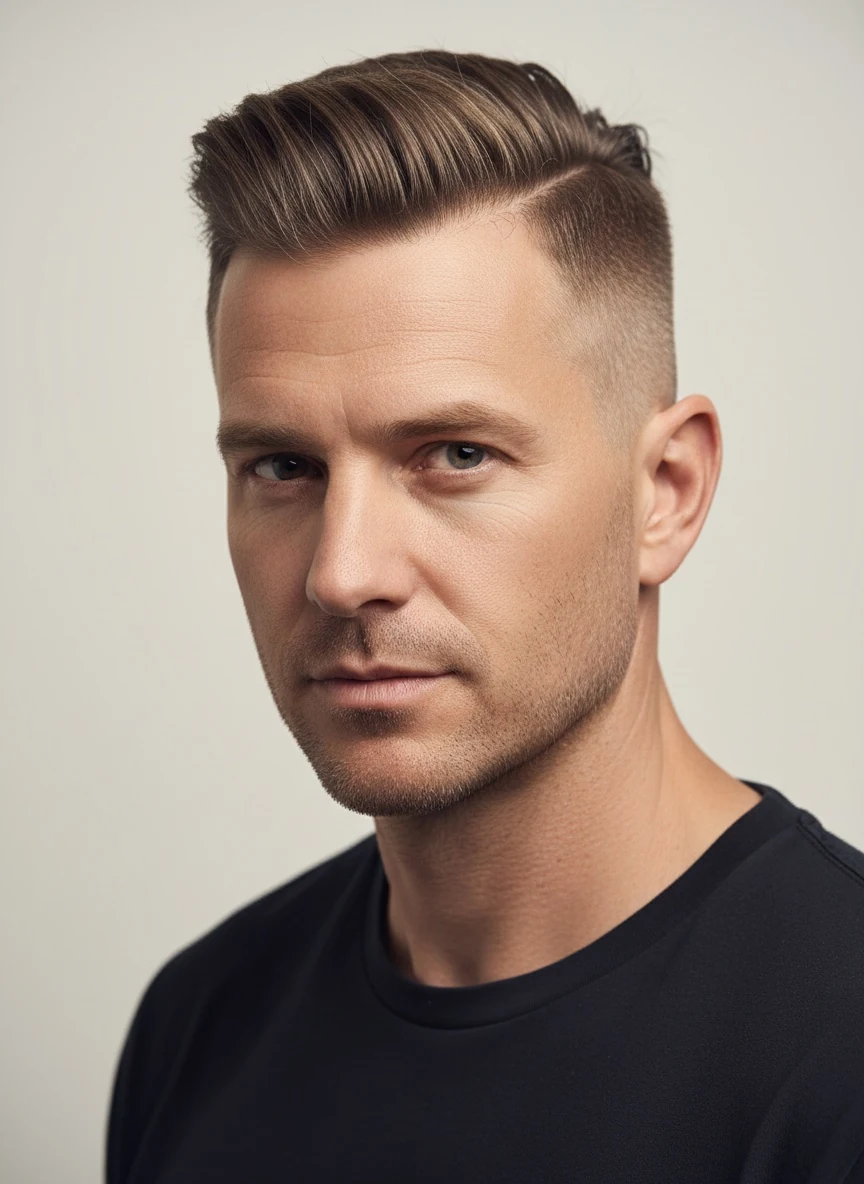
14. Comb over with a taper
Longer hair on top combed to one side from a natural or defined part, with lift at the front and tapered sides. It is a softer version of the hard side part that works with more length. Ask for: 6–8 cm on top, side part, mid taper, blow-dry with lift. Upkeep: every 3–4 weeks.
15. Two-block cut
A Korean-origin cut with short sides and back and a longer top that falls over them, so the short section is hidden at rest. On a round face, wear the top with some lift and an off-centre part rather than flat and forward, and keep the overhang from sitting at cheek level. Ask for: clippered sides and back, top 10–12 cm left long over them, textured, off-centre part. Upkeep: every 4 weeks.
16. Curtains with an off-centre part
Medium-length hair parted so the front falls in two sections away from the middle of the forehead. The gap down the centre adds a vertical line, and an off-centre part stops the look from becoming symmetrical and round. Keep the sides shorter than the curtains so the hair does not frame the widest part of the face. Ask for: 12–15 cm at the front, off-centre part, layered, tapered neckline and sides. Upkeep: every 5–6 weeks.

Long hairstyles for round face men
Long hair is harder on a round face because it hangs beside the cheeks, which is where the face is widest. It works when the length is layered, parted off-centre, or worn up.
17. Shoulder-length layers with an off-centre part
Hair past the jaw, layered so the shorter pieces start below the cheekbones, with an off-centre part. The length carries the eye below the jaw, and layers stop the hair from forming a solid block at the sides. Ask for: shoulder length, long layers starting below the cheekbone, off-centre part. Upkeep: a trim every 8–10 weeks.
18. Top knot with an undercut
Long hair on top tied up in a knot at the crown, with short or undercut sides. Pulling the hair up adds height and exposes the whole face, and the short sides remove width entirely. Ask for: undercut sides at #2, length on top kept long enough to tie. Upkeep: sides every 3 weeks; the top rarely.
19. Swept-back flow
Chin- to shoulder-length hair pushed back off the forehead, falling behind the ears. The forehead exposure lengthens the face and tucking the hair behind the ears keeps it from sitting at cheek level. Ask for: chin to shoulder length, layered at the back, longer on top than at the sides. Upkeep: every 6–8 weeks.
20. Long hair tucked behind the ears
The simplest adjustment for any long hair: tuck it behind the ears. Hair beside the cheeks adds width at the widest point; hair behind the ears removes it and shows a cleaner line from temple to jaw. Combined with a middle-to-side part, it turns an unflattering length into a workable one. Ask for: nothing; ask for thinning at the sides if the hair will not stay tucked.
All 20 cuts at a glance
| Cut | Length | Sides | Typical upkeep | Best hair types | Beard pairing |
|---|---|---|---|---|---|
| Textured crop, high fade | Short | High fade | 2–3 weeks | Straight, wavy, thick | Stubble or short, longer at the chin |
| Pompadour | Short | Taper | 3–4 weeks + styling | Thick, straight, wavy | Short boxed |
| Textured quiff | Short | Taper or fade | 3–4 weeks | Most, including fine | Short boxed or goatee |
| Hard side part | Short | Mid or high fade | 2–3 weeks | Straight, thick | Clean-shaven or short |
| Faux hawk | Short | Mid or high fade | 3 weeks | Straight, wavy, curly | Stubble |
| Buzz cut + skin fade | Very short | Skin fade | 2 weeks | All | Short beard with a defined edge |
| Crew cut, longer front | Short | Taper | 3–4 weeks | All | Any short style |
| Brush up | Short | Mid fade | 3 weeks | Thick, straight | Stubble |
| Ivy League | Short | Taper | 3–4 weeks | Straight, wavy | Clean-shaven or short |
| Messy textured top | Medium | Taper | 4–5 weeks | Wavy, thick | Short boxed |
| Angular side fringe | Medium | Taper | 4 weeks | Straight, fine | Stubble |
| Slick back with volume | Medium | Taper or fade | 4 weeks | Straight, wavy, thick | Short boxed, longer at the chin |
| Disconnected undercut | Medium | Clippered, disconnected | 2–3 weeks | Straight, thick | Van Dyke or goatee |
| Comb over, taper | Medium | Taper | 3–4 weeks | Straight, wavy | Short |
| Two-block cut | Medium | Clippered, hidden | 4 weeks | Straight, thick | Clean-shaven or stubble |
| Curtains, off-centre | Medium | Taper | 5–6 weeks | Straight, wavy | Clean-shaven or stubble |
| Shoulder-length layers | Long | Layered | 8–10 weeks | Wavy, curly | Short, longer at the chin |
| Top knot + undercut | Long | Undercut | 3 weeks (sides) | All long hair | Any; goatee adds length |
| Swept-back flow | Medium-long | Layered, behind ears | 6–8 weeks | Wavy, thick | Short boxed |
| Tucked behind the ears | Long | Behind the ears | 8–12 weeks | Straight, wavy | Short |
Round face hairstyles for men by hair type
| Hair type | Works | Watch out for | Two cuts to try |
|---|---|---|---|
| Straight | Holds height and sharp lines well | Lies flat without product, which removes the height | Hard side part, pompadour |
| Wavy | Adds movement on top without much styling | Waves that kick out at the sides of the head | Textured quiff, messy textured top |
| Curly | Builds height naturally | Curls growing out sideways into a round shape | Faux hawk with curls on top, shoulder-length layers |
| Coily / afro-textured | Height on top with short sides is easy to shape and holds | Even length all round, which forms a round silhouette | High-top fade, sponge twists with a skin fade |
| Fine | Short textured cuts hide the lack of density | Long tops that go flat and read wider | Textured crop with a high fade, crew cut |
| Thick | Supports height and long tops | Bulk building up above the ears | Disconnected undercut, brush up |
Coily and afro-textured hair gets one line in most round-face guides, but it is the texture that makes height easiest. A high-top fade, twists or a textured top with a skin fade all put volume above the forehead and none at the sides. The one thing to avoid is letting it grow evenly all round into a sphere, which repeats the round outline.
Beards for round face men
A beard does for the lower face what a haircut does for the top: it adds length or width wherever it grows. On a round face, you want length. Keep the cheeks short or faded, let the chin grow a little longer than the sides, and keep a clean neckline under the jaw so the beard does not merge into the neck. Goatees, Van Dykes and short boxed beards with a longer chin all work; full, rounded beards and mutton chops add width at the cheeks.
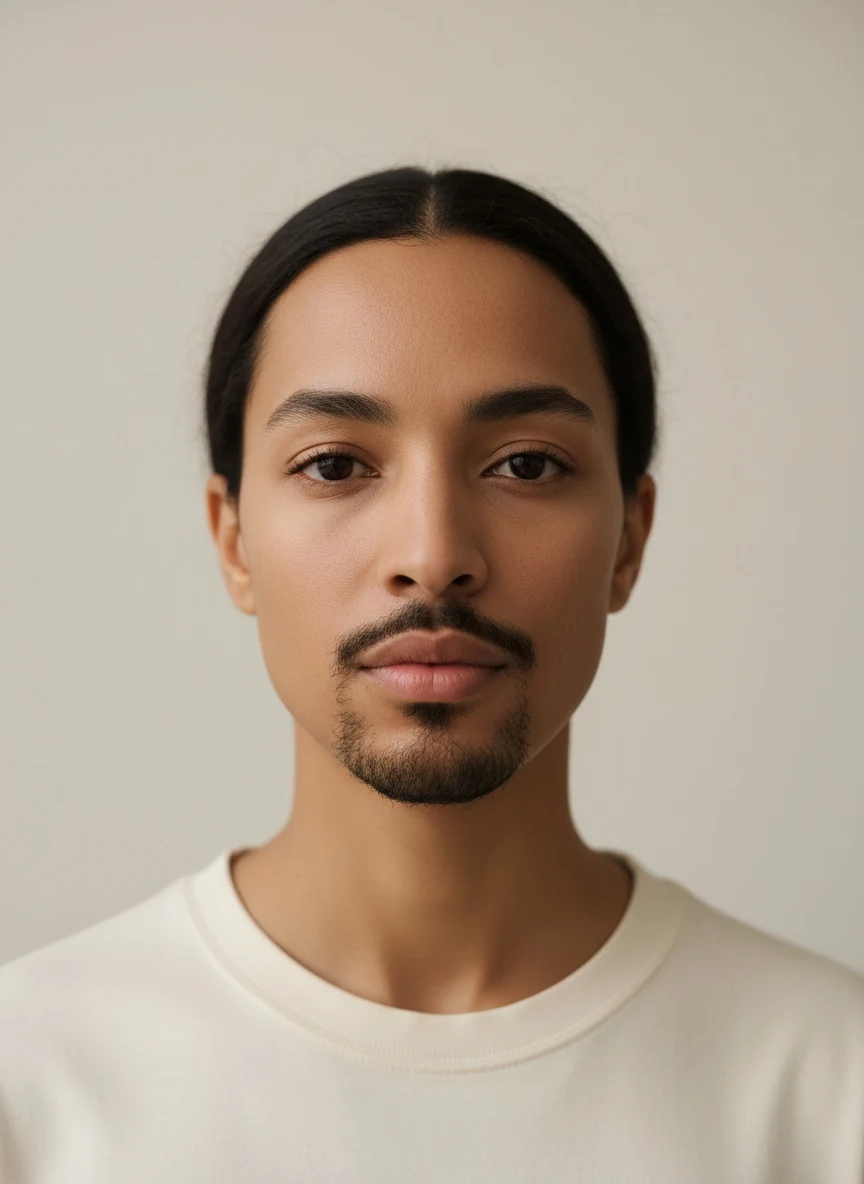
In research, beards consistently make men look older and of higher social status, and their effect on attractiveness is smaller and depends on the study. The beard styles for face shape guide covers the styles and the research in detail.
Haircuts that make a round face look rounder
- Bowl cut or heavy straight fringe. A blunt line across the forehead shortens the face and repeats a curved outline around the head.
- Uniform buzz with no fade. One length all over follows the shape of the head and adds no height.
- Grown-out sides. Hair at the sides that is as long as the top adds width at temple and cheek level.
- Flat top pressed down. A slick back or comb over with no lift shows the full round outline and removes the only source of height.
- Centre part with flat hair. A symmetrical parting and flat sides frame the face as a circle.
- Full, rounded beard. Fullness on the cheeks and a round bottom edge add width exactly where the face is widest.
How to ask your barber for a round-face haircut
Barbers work in guard numbers, centimetres on top and fade heights. Clipper guards are standard: a #1 leaves about 3 mm (1/8 inch), #2 about 6 mm (1/4 inch), #3 about 10 mm (3/8 inch) and #4 about 13 mm (1/2 inch). These three requests cover most of the cuts above.
Textured crop: high skin fade, blend into about 6 cm on top, point-cut for texture, front left long enough to push up, not a straight fringe.
Quiff or pompadour: mid taper at the sides, keep 8 to 10 cm at the front getting shorter toward the crown, finish it blow-dried up and back.
Side part: hard part line on my natural parting side, mid fade, about 5 cm on top combed over with some lift at the front.
Two more things help. Tell the barber you want to keep width off the sides and add height, because that tells them how to judge the blend. And bring a photo of the cut, not of a person with a different face, and ask how it will sit on your hair's growth pattern at the crown.
Jaw width against cheekbone width from one front photo, useful for deciding how much edge a beard should add. Measure clean-shaven or with a short beard.
See how your jaw compares with your cheekbonesFrequently asked questions
What haircut is best for round face men?
A cut with height on top and short sides: a textured crop or quiff with a high fade or taper is the most reliable. The height lengthens the silhouette and the short sides keep width off the head at cheek level. Pair it with a beard kept short on the cheeks and a little longer at the chin if you wear one.
Is a round face attractive for a male?
No study has ranked face shapes by attractiveness, for men or women. Research on attractiveness looks at traits such as averageness, symmetry and skin rather than shape labels, and a round face can score well on all of them. What a haircut and beard change is how the outline reads — longer or wider, softer or more defined — which is a styling choice, not a verdict on the face.
What haircut suits a round, chubby face?
The same cuts that suit a round face: height on top, short sides and a clean line under the jaw. Avoid anything that adds width at the sides of the head, like grown-out sides or a bowl shape. Fullness in the face often softens the jaw, so a beard with a defined neckline adds the edge that the outline lacks.
Is long hair good for a round face male?
It can be, when it adds length rather than width. Shoulder-length hair with an off-centre part and layers that start below the cheekbones works; so does long hair worn up in a top knot with short sides. Long hair that is the same length all round and puffs out at ear level makes a round face look wider.
Does a buzz cut suit a round face?
A uniform buzz cut on its own tends to repeat a round head and face outline, because there is no height anywhere. A buzz cut with a skin fade at the sides and a slightly longer guard on top works better: the fade adds contrast and a straight line, and a beard or stubble with a defined edge adds length at the chin.
Should men with round faces grow a beard?
A beard is one of the most effective changes for a round face if it is shaped to add length: short or faded on the cheeks, a little longer at the chin, with a clean neckline. A full, rounded beard grown out on the cheeks does the opposite and adds width. Beards also make men look older in research, which can suit a young-looking face.
Low fade or high fade for a round face?
Usually a mid or high fade. The higher the fade, the less hair there is at the sides of the head, so the silhouette narrows and the height on top reads more clearly. A low fade leaves more width at temple level. If you want a softer look, a mid taper is a good compromise.
How do I know if my face is round or square?
Both are about as wide as they are long. In a mirror, look at the corner of your jaw below the ear: a curve means round, a visible angle means square. A photo shows that corner poorly, so the face shape detector on this site separates them by length instead: a face no more than 1.16 times as long as its cheekbone width, with a wide jaw, is called round.
References
- Windhager, S., Patocka, K., & Schaefer, K. (2013). Body fat and facial shape are correlated in female adolescents. American Journal of Human Biology, 25(6), 847–850. PMID 24105760.
- Coetzee, V., Perrett, D. I., & Stephen, I. D. (2009). Facial adiposity: a cue to health? Perception, 38(11), 1700–1711. PMID 20120267.
- Dixson, B. J., & Vasey, P. L. (2012). Beards augment perceptions of men's age, social status, and aggressiveness, but not attractiveness. Behavioral Ecology, 23(3), 481–490. doi:10.1093/beheco/arr214.
- Langlois, J. H., & Roggman, L. A. (1990). Attractive faces are only average. Psychological Science, 1(2), 115–121. doi:10.1111/j.1467-9280.1990.tb00079.x.
Tools mentioned in this article

Measurements on this site are for information only. Nothing here is medical advice, and no result is a diagnosis. Talk to a qualified clinician before making any decision about a procedure.