Mewing before and after: does mewing work, and what actually changes in the photos
·14 min read
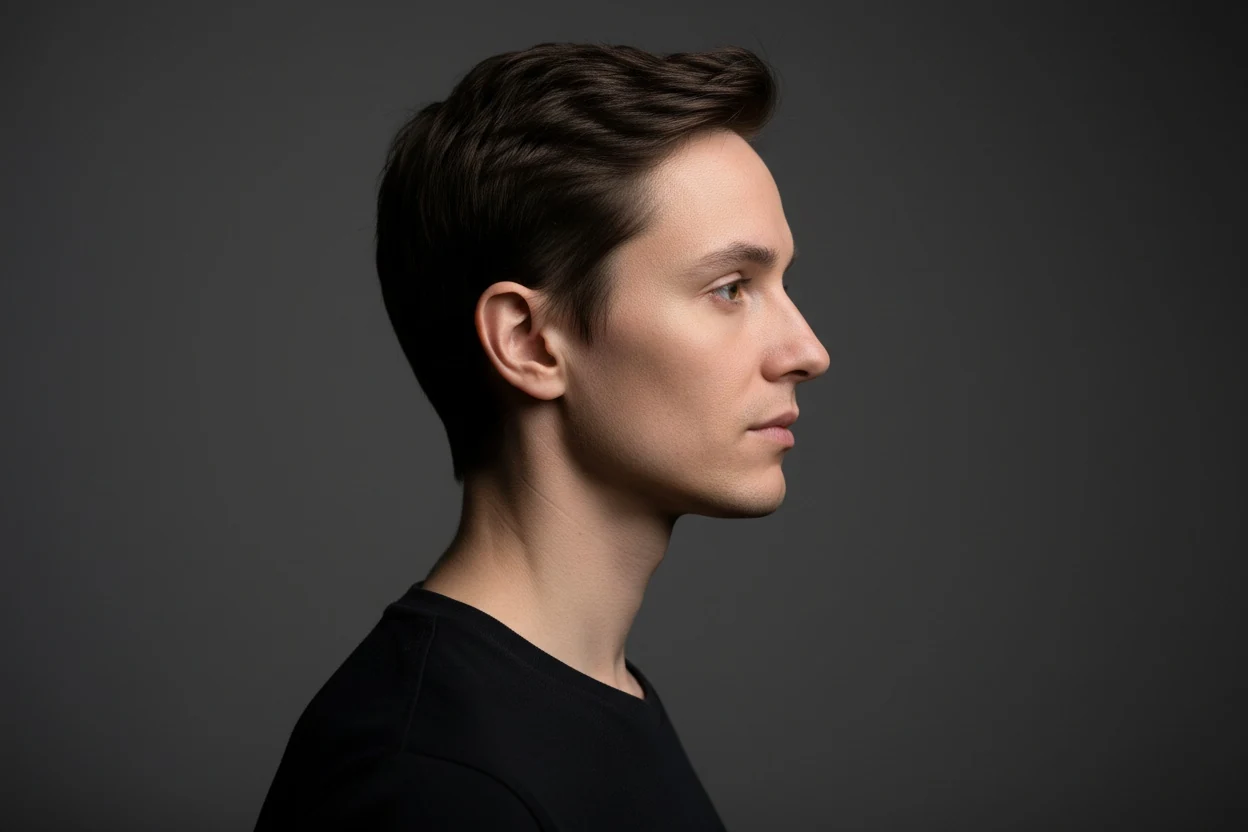
No controlled study has shown that mewing changes the bones of an adult face, and the American Association of Orthodontists says there is no current research showing a benefit to the jawline. Yet the before-and-after photos are real photographs, many of them striking. Both things are true because almost every mewing before and after can be reproduced in a minute without changing anything about the face.
This guide shows what changes in those photos, what the evidence on tongue posture does and does not cover, the one thing mewing can genuinely move — teeth — and how to take a before-and-after that means something.
Mewing before and after: six things that change the photo, not the face
1. Head and neck posture
With the head pushed forward, the skin and soft tissue under the chin fold, and the jaw line blurs into the neck. Pull the head back over the shoulders and that fold opens into a clean angle. Mewing guides tell people to do exactly this, so the "after" photo usually has better posture than the "before". The difference is real, and it is posture.
2. The tongue lifts the line under the chin, while you hold it
Pressing the tongue up against the palate pulls the muscles under the jaw upward, which tightens the area under the chin for as long as the tongue stays up. Relax the tongue and it returns. Many "after" photos are taken mid-mew, so they compare an active posture with a relaxed one.
3. Camera height and distance
A camera below the chin shows the underside of the jaw and neck and softens the jaw line; a camera at eye level shows the outline from the front. Distance matters too: a mathematical model of short-distance selfies showed that close photographs enlarge whatever is nearest the lens, usually the nose. The same perspective effect changes how the lower face sits against the neck. The photogenic guide goes through lens distance and camera height in detail.
4. Light
Hard light from the side or above draws the jaw edge with shadow; soft light from the front flattens it. Two photos taken in different rooms, or at different times of day, can show two different jawlines on the same face.
5. Weight
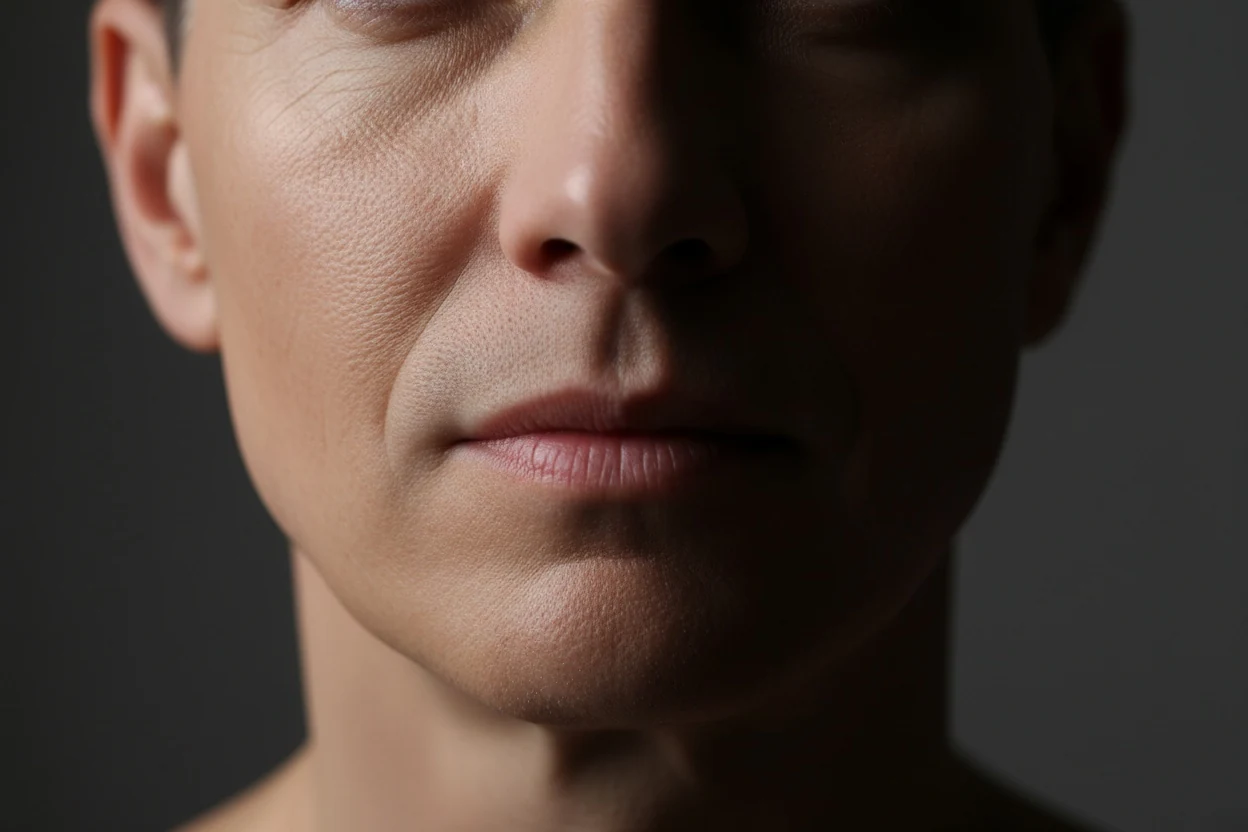
Fat under the chin and over the jaw changes the visible outline more than anything else in an adult. People who start mewing often start other routines at the same time — training, eating differently — and a face that has lost weight over a year will look more defined whatever the tongue did. Perceived weight in a face is also one of the cues that shifts how healthy and attractive it is rated.
6. Growing up
Many of the most convincing long-term mewing progress photos are of teenagers. Faces keep growing through adolescence: in a mixed-longitudinal study of 458 children and adolescents, mandibular length increased between 6 and 17 years, and most male measurements showed an adolescent growth spurt. A 15-year-old and the same person at 17 will look different whether or not they mewed.
| What changes the photo | What it does to the jawline | How to hold it constant |
|---|---|---|
| Head posture | Forward head folds the under-chin; head back sharpens it | Same stance: ears over shoulders, looking straight ahead |
| Tongue position at the moment of the photo | Tongue up tightens the under-chin while held | Relaxed tongue in every photo |
| Camera height and distance | Low camera softens the jaw; close lens distorts | Eye level, same distance every time |
| Light | Hard side or top light draws the jaw edge | Same room, same window, same time of day |
| Weight | Less fat under the chin sharpens the outline | Note your weight with each photo |
| Growth | Teenage faces keep growing | Treat any teenage comparison as growth first |
Does mewing work? What the evidence covers and what it does not
The real science behind it: tongue pressure affects teeth
Mewing borrows from a legitimate idea in orthodontics. In a classic review of what decides where teeth sit, the orthodontist William Proffit concluded that the major primary factors are the resting pressures of the tongue and lips, together with forces within the tissue that holds each tooth; breathing needs also influence head, jaw and tongue posture. In other words, sustained light pressure from the tongue and lips helps position teeth. That is a finding about teeth in their sockets, not about reshaping the bones of the face.
In children, posture and growth are linked
While the face is still growing, habits such as mouth breathing and tongue position can influence how the jaws develop, and orthodontists treat problems like these in growing children with appliances and, sometimes, therapy. That work is supervised and targeted at a diagnosed problem. It is not the same as a teenager pressing their tongue up after watching a video, and it does not transfer to adults whose growth has finished.
In adults, the jaw and palate are bone
The strongest mewing claim is that tongue pressure can widen the upper jaw, whose two halves meet at the midpalatal suture. Orthodontists widen the upper jaw with expanders, and how well that works depends on how far the suture has fused, which varies widely between people. A CBCT study that defined five stages of fusion found them spread across ages, with some adolescents already partly fused; a 2026 study of 488 scans found only 34% of 18- to 20-year-olds had complete fusion and concluded that age alone is an unreliable guide. So there is no single age at which the suture "closes". What those studies are for is deciding whether a standard expander will work or whether surgically assisted expansion is needed — that is, in people whose suture has fused, even a device built for the job is not enough on its own. No controlled study has shown tongue pressure alone widening an adult upper jaw.
What orthodontists' organisations say
The American Association of Orthodontists says the evidence for mewing's jaw-sculpting claims is thin, that there is no current research showing a benefit to the jawline or oral health, and that it does not recommend any attempt to move teeth or align jaws without appropriate supervision. The practice is named after Mike Mew, who with his father John Mew promoted a wider approach called orthotropics. In November 2024 the UK General Dental Council's Professional Conduct Committee erased Mike Mew from the dental register with immediate suspension; his appeal was dismissed by the High Court in May 2026.
Breathing and sleep apnea: a different treatment with real trials
Mewing content sometimes cites sleep apnea research. Those studies tested something else. In a randomised trial, 31 people with moderate obstructive sleep apnea did either sham therapy or about 30 minutes a day of oropharyngeal exercises — for the tongue, soft palate and throat — for three months; the exercise group's apnea-hypopnea index fell from 22.4 to 13.7 events an hour, with less snoring and daytime sleepiness. A meta-analysis of myofunctional therapy found the index roughly halved in adults. These are supervised exercise programmes for a diagnosed breathing disorder, measured by sleep studies. They are not evidence that resting the tongue on the palate reshapes a face, and anyone who snores heavily or stops breathing in their sleep should see a doctor rather than start a routine from the internet.
| Claim | Mechanism offered | What the evidence shows | Verdict |
|---|---|---|---|
| Reshapes an adult jaw | Tongue pressure remodels bone | No controlled study; orthodontists' organisations reject it | Not supported |
| Widens the upper jaw in adults | Tongue pushes the palate apart | Adult expansion usually needs appliances or surgery; no study of tongue pressure alone | Not supported |
| Lifts cheekbones | Upper jaw moves forward and up | No evidence; adult cheekbones have stopped growing | Not supported |
| Changes canthal tilt or eye area | Midface support rises | No evidence | Not supported |
| Sharpens the jaw in photos | Posture and tongue position | True while the posture is held | Real, temporary |
| Improves breathing or sleep apnea | Stronger airway muscles | Supervised oropharyngeal exercise programmes reduced apnea severity in trials; not the same as mewing | Different intervention |
| Moves teeth | Tongue pressure on teeth | Resting tongue and lip pressures help position teeth; uneven pressure can misalign them | Plausible — as a risk |
Mewing results timeline: one week, one month, six months, a year
| Timepoint | What people report | Likeliest explanation | Visible in a controlled photo? |
|---|---|---|---|
| 1 week | Sharper jawline, "face looks different" | Head posture and holding the tongue up when photographed; mirror checking | No |
| 1 month | Better definition under the chin | Posture habit, water retention, lighting, weight | Only if weight changed |
| 6 months | Jaw looks wider or more angular | Weight loss, masseter use from hard chewing, photo setup; growth in teenagers | Weight and growth changes, yes; bone, no |
| 1 year+ | Whole face looks different | Growth in teenagers, body composition, grooming and hair, ageing | Those changes, yes; mewing-driven bone change, not shown |
The honest summary: at no point should an adult expect bone to change from tongue posture. What does change is a posture habit, and posture is worth having. It shows immediately in how you stand and how you photograph.
How to mew correctly, if you do it at all
The defensible version of mewing is simply a neutral resting posture for the mouth. It is not an exercise, so the common question of how many hours a day to mew does not really apply; it is the position the mouth sits in when you are not talking or eating.
- Close your lips without straining.
- Let your teeth touch lightly or sit slightly apart; do not clench.
- Rest the tongue lightly against the roof of the mouth, just behind the front teeth, without pushing.
- Breathe through your nose.
- Keep your head balanced over your shoulders rather than pushed forward.
Mewing before and after teeth: the part that can actually move
The same principle that makes the jaw claims implausible makes the teeth claims worth taking seriously. Teeth sit where the forces around them balance, and the resting pressures of the tongue and lips are among the main forces. Change those pressures for long enough and teeth can move. The American Association of Orthodontists lists the ways that goes wrong with mewing: uneven pressure could push some teeth forward while others stay put, leading to crooked teeth or gaps; altered pressure can change how the teeth meet, causing a bite problem and, in some cases, speech difficulties; and correcting the result can make later orthodontic treatment more complex.
This matters most for anyone who has had orthodontic treatment. Teeth moved by braces are held in place by a retainer because they tend to drift; pushing the tongue against them works against exactly that. "Mewing before and after teeth" photos that show changed tooth positions are not a sign that the face is changing — they are a sign that teeth are moving, which is a reason to see an orthodontist.
What mewing does not change, and what it plausibly helps
What mewing does not change in an adult:
- The shape of the lower jaw or its angle — and a front photo cannot measure the true angle anyway, as the jawline rating page explains.
- The width of the upper jaw.
- Cheekbone height or projection; the high cheekbones guide covers what does.
- Canthal tilt or the eye area; the canthal tilt page covers what sets it.
- The nose, or how deep-set the eyes are.
What it plausibly helps:
- Awareness of lips-closed nose breathing during the day.
- Awareness of head and neck posture, which shows in photos and in how you stand.
- The line under the chin, for as long as you hold the posture.
The risks: hard mewing, mouth taping and bone smashing
- Hard mewing. Sustained force on the palate and teeth can move teeth and load the jaw joint. Stop if you notice jaw pain, clicking, headaches or changes in how your teeth meet.
- Mouth taping at night. Often recommended alongside mewing. Snoring and mouth breathing during sleep can be signs of a sleep breathing disorder that needs assessment, so talk to a doctor before taping your mouth shut, especially if you snore heavily or someone has noticed pauses in your breathing.
- Bone smashing. Deliberately striking the face in the hope that bone will remodel. It is injury: it can fracture facial bones and cause permanent asymmetry, and there is no evidence it produces the promised result. A 2026 analysis of looksmaxxing content found it spreading widely on social media, mostly among young men. There is no safe way to do it.
- Constant checking. Hours spent comparing jawline photos, or feeling that your face is a problem to be fixed, is worth talking about with a doctor or mental health professional. The preoccupation, not the jaw, is often what needs attention.
When to see a professional instead of trying a routine: a child who breathes through their mouth most of the time or snores regularly (a dentist, orthodontist or doctor), an adult with snoring and daytime sleepiness or witnessed pauses in breathing (a doctor), or jaw pain, locking or changes in the bite (a dentist).
How to run a mewing before and after that means something
If you want to know whether anything changed, the only useful before-and-after is one in which everything except time is held constant. Take the photos monthly, not daily, and always both front-on and in profile.
| Variable | Fix it at | Why |
|---|---|---|
| Camera distance | At least 1.5 m, zoomed in, or a fixed mark on the floor | Close lenses distort the lower face and nose |
| Camera height | Level with your eyes | A low camera softens the jaw |
| Light | Same window, same time of day, facing the light | Side and top light draw the jaw edge |
| Head posture | Ears over shoulders, looking straight ahead | A forward head folds the under-chin |
| Tongue | Relaxed, not mid-mew | An active tongue tightens the under-chin temporarily |
| Expression | Neutral, lips closed, teeth apart | Clenching bulges the masseter |
| Weight | Record it with each photo | Fat change explains most jawline change |
Even with a careful protocol, a front photo has limits. Most of what mewing claims to change is depth — how far the upper jaw and chin sit forward, the angle under the chin — and none of that is measurable from the front. A front photo can compare jaw width against cheekbone width, and the taper to the chin, between two dates. Angles are fragile: turn the head five degrees and a projected jaw angle changes while the real one does not. Expect most month-to-month differences to sit inside that noise.
Jaw width against cheekbones, taper and left–right balance from one front photo, measured in your browser with nothing uploaded. Repeat it under the same conditions; small differences are usually noise.
Take a baseline you can compare againstWhat does change an adult jaw and midface
| Option | What it moves | Evidence | Reversible? |
|---|---|---|---|
| Losing excess body fat | Soft tissue under the chin and over the jaw | Perceived facial fat shifts how faces are rated | Yes |
| Posture | The under-chin angle in photos and in person | Direct, visible immediately | Yes |
| Orthodontics | Teeth and the bite | Established treatment, supervised | Largely, with retention |
| Masseter toxin | Muscle bulk at the jaw corner | Clinical studies, pooled in a meta-analysis | Wears off |
| Chin or jaw filler | Chin projection, jaw outline | Clinical practice; vascular risks | Partly |
| Genioplasty, implants, jaw surgery | Bone contour and position | Surgical outcomes; significant recovery | No |
The jawline guide works through these layers in detail — bone, muscle, fat and skin — and why jaw exercises reach almost none of them. If you want to see what a change in chin position would look like on your own face before a consultation, the genioplasty simulation renders one as an AI illustration; it is not a surgical outcome, and the decision belongs with a qualified clinician.
Frequently asked questions
Does mewing really work?
Not for reshaping an adult face. No controlled study has shown that holding the tongue against the palate changes adult bone, and the American Association of Orthodontists says there is no current research showing a benefit to the jawline. What mewing can change is head and neck posture and, while you hold it, the line under the chin — which is what most before-and-after photos show.
Are mewing before and after photos real?
Most are real photographs, but they rarely compare like with like. Head posture, holding the tongue up at the moment of the photo, camera height and distance, lighting, weight change and, in teenagers, normal growth can each change how sharp a jawline looks. A photo pair that does not hold all of those constant cannot show what mewing did.
How long does it take to see mewing results?
Any change people see in the first days or weeks comes from posture and from holding the tongue up while photographed. Over months, weight change and, in teenagers, growth explain most visible differences. No timeframe has been shown in which tongue posture reshapes an adult jaw or cheekbones.
How many hours a day should you mew?
It is the wrong question. The defensible version of mewing is a resting posture — tongue lightly against the roof of the mouth, lips closed, breathing through the nose — not an exercise done for a number of hours. Pressing hard for long periods adds force to the teeth and jaw joint without any evidence of benefit.
How do you mew correctly?
If you do it at all, keep it gentle: the tongue rests lightly against the palate behind the front teeth, lips are closed, teeth are together lightly or slightly apart, and you breathe through your nose. No pushing, no clenching and no pressing the tongue against the front teeth. Anyone with braces, a retainer, jaw pain or trouble breathing through the nose should ask an orthodontist or dentist first.
Can mewing change your face shape as an adult?
There is no evidence that it can. Face shape in an adult is set by bone and soft tissue. Mewing does not change jaw width, jaw angle, cheekbones or the width of the upper jaw; body fat, posture and the way you are photographed change how the shape looks much more.
Can mewing move your teeth?
Yes, and that is the part of mewing with a real mechanism. The resting pressures of the tongue and lips are among the main forces that decide where teeth sit. The American Association of Orthodontists warns that uneven pressure from mewing could push some teeth forward, create gaps or crowding, and change the bite.
What do orthodontists think of mewing?
Orthodontists' organisations reject the jaw-reshaping claims. The American Association of Orthodontists says there is no current research showing mewing benefits the jawline or oral health, lists risks to tooth alignment, bite and speech, and advises against attempts to move teeth or align jaws without supervision.
References
- American Association of Orthodontists. Does mewing actually reshape your jaw? aaoinfo.org, published 25 March 2025, updated 29 June 2026.
- Proffit, W. R. (1978). Equilibrium theory revisited: factors influencing position of the teeth. The Angle Orthodontist, 48(3), 175–186. PMID 280125.
- Angelieri, F., Cevidanes, L. H., Franchi, L., Gonçalves, J. R., Benavides, E., & McNamara, J. A. Jr. (2013). Midpalatal suture maturation: classification method for individual assessment before rapid maxillary expansion. American Journal of Orthodontics and Dentofacial Orthopedics, 144(5), 759–769. PMID 24182592.
- Cesur Aydin, K., Tekin, A., & Gas, S. (2026). Midpalatal suture maturation in young individuals: cone-beam computed tomography evidence challenging age-based treatment decisions. Journal of Craniofacial Surgery. PMID 42274113.
- Arboleda, C., Buschang, P. H., Camacho, J. A., Botero, P., & Roldan, S. (2011). A mixed longitudinal anthropometric study of craniofacial growth of Colombian mestizos 6–17 years of age. European Journal of Orthodontics, 33(4), 441–449. PMID 21097992.
- Camacho, M., Certal, V., Abdullatif, J., Zaghi, S., Ruoff, C. M., Capasso, R., & Kushida, C. A. (2015). Myofunctional therapy to treat obstructive sleep apnea: a systematic review and meta-analysis. Sleep, 38(5), 669–675. PMID 25348130.
- Guimarães, K. C., Drager, L. F., Genta, P. R., Marcondes, B. F., & Lorenzi-Filho, G. (2009). Effects of oropharyngeal exercises on patients with moderate obstructive sleep apnea syndrome. American Journal of Respiratory and Critical Care Medicine, 179(10), 962–966. PMID 19234106.
- Ward, B., Ward, M., Fried, O., & Paskhover, B. (2018). Nasal distortion in short-distance photographs: the selfie effect. JAMA Facial Plastic Surgery, 20(4), 333–335. PMID 29494735.
- Coetzee, V., Perrett, D. I., & Stephen, I. D. (2009). Facial adiposity: a cue to health? Perception, 38(11), 1700–1711. PMID 20120267.
- Grillo, R., Fernandes, L. A., Rodrigues dos Santos, L. A., Lima, B. C., Brozoski, M. A., & Spagnol, G. (2026). Dangerous trends on social media related to facial esthetics: analysis of looksmaxxing and its softmaxxing and hardmaxxing practices. Journal of Stomatology, Oral and Maxillofacial Surgery, 127(5), 102971. PMID 42674114.
- General Dental Council, Professional Conduct Committee. MEW, Michael Gordon: hearing outcome, 6 November 2024 (erased and immediate suspension; appeal dismissed by the High Court 15 May 2026). dentalhearings.org.
- Machado, G. F., De Freitas, L. R., Ribeiro, L. F. S., et al. (2026). Efficacy of botulinum toxin for masseter muscle hypertrophy: a systematic review and meta-analysis. Journal of Plastic, Reconstructive & Aesthetic Surgery, 119, 212–225. PMID 42379083.
Tools mentioned in this article
- Jawline Rating TestJaw against cheekbones, taper and asymmetry — and why the gonial angle is not in there.
- Canthal Tilt TestYour tilt in degrees, each eye separately.
- Hunter Eyes TestThe three traits scored, and the fourth one a photo cannot read.
- Face Shape DetectorOval, round, square, heart, oblong, diamond or triangle.
Measurements on this site are for information only. Nothing here is medical advice, and no result is a diagnosis. Talk to a qualified clinician before making any decision about a procedure.