High cheekbones vs low cheekbones: what sets them, and what actually moves them
·22 min read
High cheekbones means the most prominent point of the cheekbone sits high on the face, close to the lower eyelid, rather than down near the level of the nostrils. Low cheekbones peak lower. That is the whole definition, and it is not a clinical one — there is no scale a doctor reads it off, and no landmark in anthropometry called "high cheekbone".
The trouble is that the phrase gets used for three different measurements at once: how high the peak sits, how wide the cheekbones are, and how far they project forward. They vary independently, they show up differently in a photo, and — the part almost every article skips — they respond to completely different things. This guide separates them, shows you how to tell which you have, and goes option by option through what each one actually moves.
What high cheekbones actually means
The cheekbone is mostly the zygomatic bone, joined at the front to the maxilla, the upper jaw. Run a finger from just below the outer corner of your eye back toward the top of your ear and you are tracing its body and then its arch. The most prominent part — the point that catches light and casts a shadow beneath it — is the malar eminence, and when people say someone has high cheekbones, they are describing where that point sits vertically.
Anthropometry, the science of measuring faces, does measure the cheekbones, but not as "high" or "low". It records bizygomatic width, the distance between the two widest points of the cheekbone arches (the zygion points), and it describes malar projection in profile. The everyday word blends both with height, which is why two people can look at the same face and disagree about whether its cheekbones are high.
High vs low cheekbones: height, width and projection
| Axis | What it describes | Visible in a front photo? | What changes how it looks |
|---|---|---|---|
| Height | Where the most prominent point sits: near the lower eyelid (high) or near the nostrils (low) | Yes, mostly through the shadow line | Lighting, smiling, fat under the cheekbone. Not the bone. |
| Width | Bizygomatic width — the distance between the widest points of the two arches | Yes, and it can be measured | Hair over the temples and cheeks, beard, the width of the jaw beside it |
| Projection | How far forward the cheekbone sits relative to the eyes and nose | No — needs a side or three-quarter view | Deep cheek fat, filler, implants, and bone changes with age |
The most common mix-up is low versus flat. A low cheekbone peaks further down the face; a flat cheekbone projects very little, wherever its peak sits. A face can have low but well-projected cheekbones — a strong curve that simply begins lower — or high cheekbones that are barely visible in profile. When someone says their cheekbones "disappear", they almost always mean projection or contrast, not height.
Width is the other impostor. A face that is widest at the cheekbones, narrowing toward both the forehead and the jaw, is what face-shape charts call a diamond face. Those cheekbones often *read* as high because the narrow temples above them exaggerate the curve, but diamond describes width against the rest of the face, and says nothing about where the peak sits.
How to tell if you have high or low cheekbones
You need about two minutes, a mirror and one light. Do it with your hair pulled back and no bronzer or contour on — makeup is designed to fake the exact line you are looking for.
- 1Find the bone. Place your fingertips just below the outer corner of each eye and press gently. Slide back toward your ears along the hard ridge; that ridge is the zygomatic arch.
- 2Find the peak. Move your fingers forward again until you reach the most prominent point, where the bone feels fullest. Keep a finger there.
- 3Compare it to two landmarks. Look in the mirror. If the peak is closer to your lower eyelid than to the base of your nose, your cheekbones are high. If it sits roughly level with your nostrils or below, they are low. Between the two is, unsurprisingly, the most common answer.
- 4Check with light. Stand under a single light directly above you — a ceiling light in a bathroom works — and look straight ahead. The shadow begins just under the most prominent part of the bone. A shadow that starts close under the eye confirms high cheekbones.
- 5Repeat smiling. Smile broadly and watch the shadow move. It rises because the cheek tissue bunches up, not because the bone moved — which is the next section's point, and the reason to judge from a neutral face.
What this test cannot tell you is projection, because a front view has no depth. For that, take a photo at three-quarters or in profile at eye level, with the camera at least an arm's length away. Close-up phone photos widen the middle of the face and flatten its depth, so a selfie taken at 30 centimetres is the worst possible evidence about your cheekbones.
What decides cheekbone height: the bone underneath
Cheekbone height is skeletal. It is set by the shape of the zygomatic bone and the maxilla and by how the midface grew, which is largely inherited. A mixed-longitudinal study of 458 Colombian children and adolescents aged 6 to 17 measured bizygomatic width among eight craniofacial dimensions: all of them increased over that period, and males were generally larger and grew faster. In boys, most measurements showed an adolescent growth spurt — facial width was the exception, its yearly growth slowing steadily with age.
Once growth is complete the bone does not enlarge in response to use. That settles most of the internet's questions before they start: exercises, massage, chewing and tongue posture act on muscle, fat and skin, not on the position of the cheekbone's peak. The only things that change the bone itself in an adult are surgery and, slowly, ageing — and ageing works in the wrong direction.
Do cheekbones differ by ancestry?
Facial proportions do vary between populations, and the widely cited evidence for this is an international study that measured 1,470 young adults from European, Middle Eastern, Asian and African-origin groups on 14 measurements and compared them with North American norms. It found horizontal measurements differed from those norms more often than vertical ones, and it described itself as preliminary, with small samples per group. It did not produce a ranking of which groups have "high cheekbones", and neither does this page — the lists circulating online are stereotypes with no measurement behind them. Within any group, individual faces span the whole range.
Why the same cheekbones can read high or flat: fat, skin and light
If height is bone, why does the same person's cheekbone look sharp in one photo and invisible in another? Because you never see bone. You see the soft tissue draped over it, and that tissue is layered, mobile and changeable.
Rohrich and Pessa's 2007 anatomical work showed that facial fat is not one continuous blanket but a set of separate compartments, divided by thin septa. In the cheek there are superficial compartments just under the skin, and deeper fat lying closer to the bone that helps push the front of the cheek forward. How much fat sits in each, and where, shapes the contour that people read as cheekbones.
| Layer | What it does to the look | Changes with age? | Changes with weight? |
|---|---|---|---|
| Skin | Thin, taut skin shows the edge of every structure beneath it | Yes — thins and loses elasticity | Stretches and slackens with large changes |
| Superficial cheek fat | Softens the transition between the cheekbone and the hollow below it | Yes — compartments migrate downward (CT evidence) | Yes |
| Deep cheek fat | Pushes the front of the cheek forward, adding apparent projection | Yes — volume redistributes | Yes |
| Buccal fat | Fills the lower cheek, below and behind the cheekbone | Tends to become more visible as tissue above descends | Yes, but less than superficial fat |
| Bone | Sets the height and basic width of the cheekbone | Yes — the maxilla loses projection | No |
Facial fat also changes how a face is judged overall, not just the cheekbones. Coetzee and colleagues showed in 2009 that perceived facial adiposity — how heavy a face looks — predicted how healthy and attractive it was rated, and was linked to measures of cardiovascular health and reported infections. That study was about apparent weight in the face, not about cheekbones specifically, but it explains why the hollow under the cheekbone carries so much visual weight.
Light is doing half the work
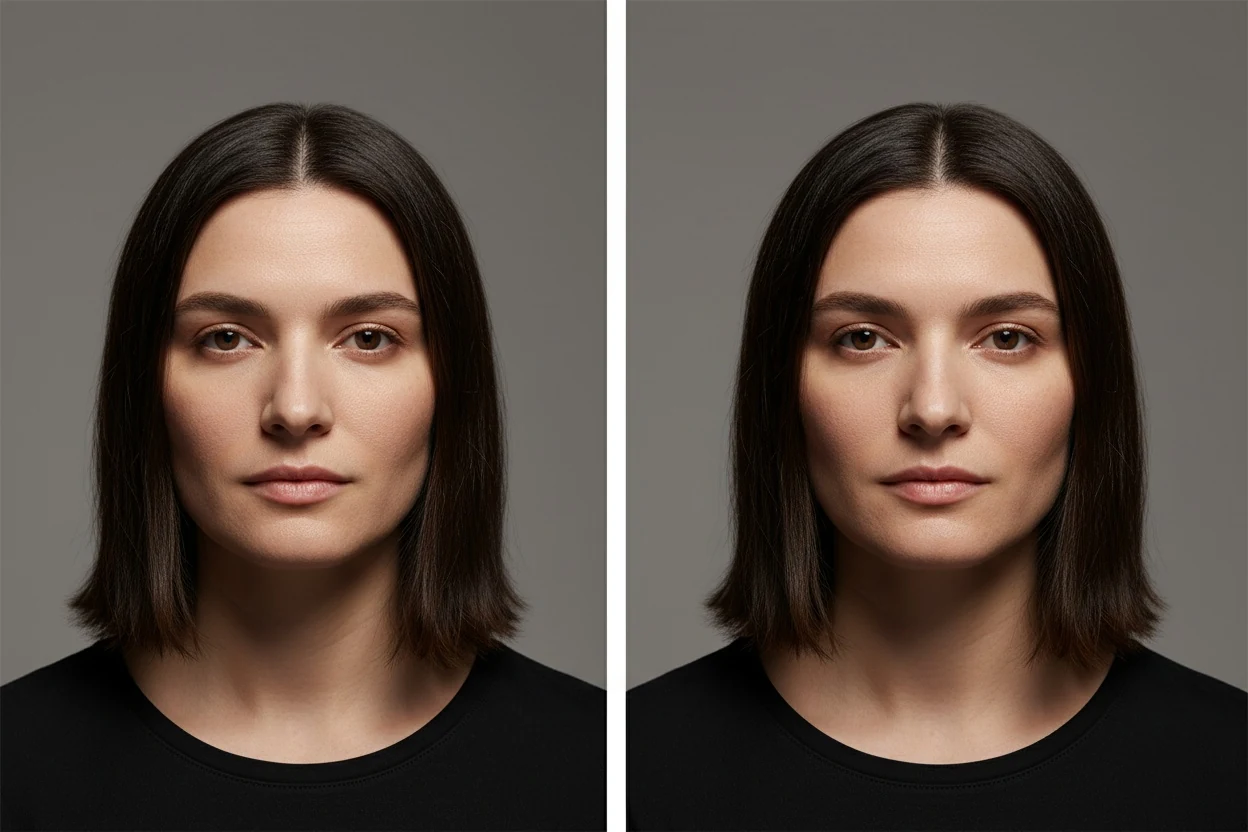
Cheekbones are perceived almost entirely through shadow. A single light above and slightly in front of the face drops a soft shadow just below the malar eminence, and that shadow edge is what the eye reads as a high cheekbone. Flat light from directly in front — a ring light, an on-camera flash, an overcast window facing you — fills that shadow in and makes any face look broader and flatter. None of this changes a measurement. It changes what the photo tells a viewer, and it is the reason nobody should judge their cheekbones from a single flash photo.
| Photo condition | Effect on how cheekbones look | Why |
|---|---|---|
| Single light above, slightly in front | Higher and more defined | Shadow forms under the most prominent point |
| Light from one side | Defined on one side, flat on the other | Shadow falls across the face rather than under the cheek |
| Flat front light (ring light, flash) | Flatter, wider | Shadows under the cheekbone are filled in |
| Camera below eye level | Lower and heavier | The lower face and jaw are foreshortened toward the lens |
| Phone held close (under 40 cm) | Wider midface, less depth | Short working distance exaggerates what is nearest the lens |
| Smiling | Higher and rounder | Cheek soft tissue bunches upward over the bone |
High cheekbones on men and women
It is common to read that wide cheekbones are a masculine signal, usually via the facial width-to-height ratio (fWHR): bizygomatic width divided by upper face height. The idea came from skulls, where men show a larger ratio. But Kramer, Jones and Ward tested it in living faces in 2012, across three White European samples, measuring the same people with 2D photographs, 3D scans and tape anthropometry. The three methods agreed closely with each other — and they found no sex difference in facial width-to-height ratio, despite enough statistical power to detect one. The ratio did track body mass index in both sexes.
So prominent cheekbones are not, on the evidence, a sex-specific trait. What differs between typical male and female faces is the frame around them — the jaw, the brow ridge, the lower face — and that frame changes how the same cheekbones read.
High cheekbones in men
In men the cheekbones sit in competition with the jaw. A wide jaw directly below them makes the face read as square and the cheekbones as less distinct; a jaw noticeably narrower than the cheekbones makes them the widest, most visible feature. A beard shifts this further: a full beard adds width at the jaw and hides the hollow below the cheekbone, while a beard kept short on the cheeks and fuller at the chin lets the cheekbones stand out. Short hair also removes the cue at the temples, which is why men with prominent cheekbones are often told they have an oval face when a tape measure says diamond.
Cunningham, Barbee and Pike's 1990 studies of male faces are the source most often cited here. Across three quasi-experiments, men with what the authors called mature features — prominent cheekbones and a large chin — were rated more attractive, along with men who had large eyes, a big smile and high-status clothing. It is one of the few studies to name cheekbones explicitly, and like most attractiveness research of its time it rested on photo ratings of a limited set of faces.
High cheekbones in women
In women the question is usually about makeup, because contour is designed to imitate exactly the shadow that high cheekbones produce. The logic follows from the anatomy above: shade goes just under the most prominent point of the bone, blended back toward the top of the ear rather than down toward the mouth; highlight goes on the top of the bone; and blush goes on the fullest part of the cheek or slightly above it. Placing contour too low draws a false cheekbone below your real one and makes the face look longer.
Is a high cheekbone a feminine feature? Not by any measurement cited above. It is a feature that many conventions of beauty photography and makeup emphasise in women, which is a different thing.
Are high cheekbones attractive? What the studies measured
The research does point in one direction, with limits. Beyond the 1990 male-face studies, Woo and colleagues in 2020 took 3D reconstructions of one young Chinese man and one young Chinese woman, both with average cheek projection, and digitally moved the cheekbone and the jaws 4 millimetres forward or back. Over a hundred dental students then rated the resulting faces. A neutral or forward cheekbone position was rated more attractive than a set-back one, in both faces, and the most attractive combination was a neutral cheekbone with the jaws set 4 millimetres back.
Notice what that study measured: projection, the axis a front photo cannot see, in two faces, rated by students training in a field that works on faces. It is careful, and it is narrow. It does not say high cheekbones make a face attractive; it says moving one face's cheekbones backward made it less so.
Faces are judged as wholes. Averageness — how close a face is to the population average — and even, healthy-looking skin were each found to predict attractiveness ratings on their own, and no single feature has been shown to outweigh them.— Summarised from Langlois & Roggman, 1990, and Fink, Grammer & Matts, 2006
The practical reading: prominent cheekbones are a plus in the studies that isolated them, but the studies isolated them precisely because in real faces they never appear alone. If you want to know how your features work together, measure them together — facial proportions covers what those measurements can and cannot say.
Why cheekbones look higher when you smile
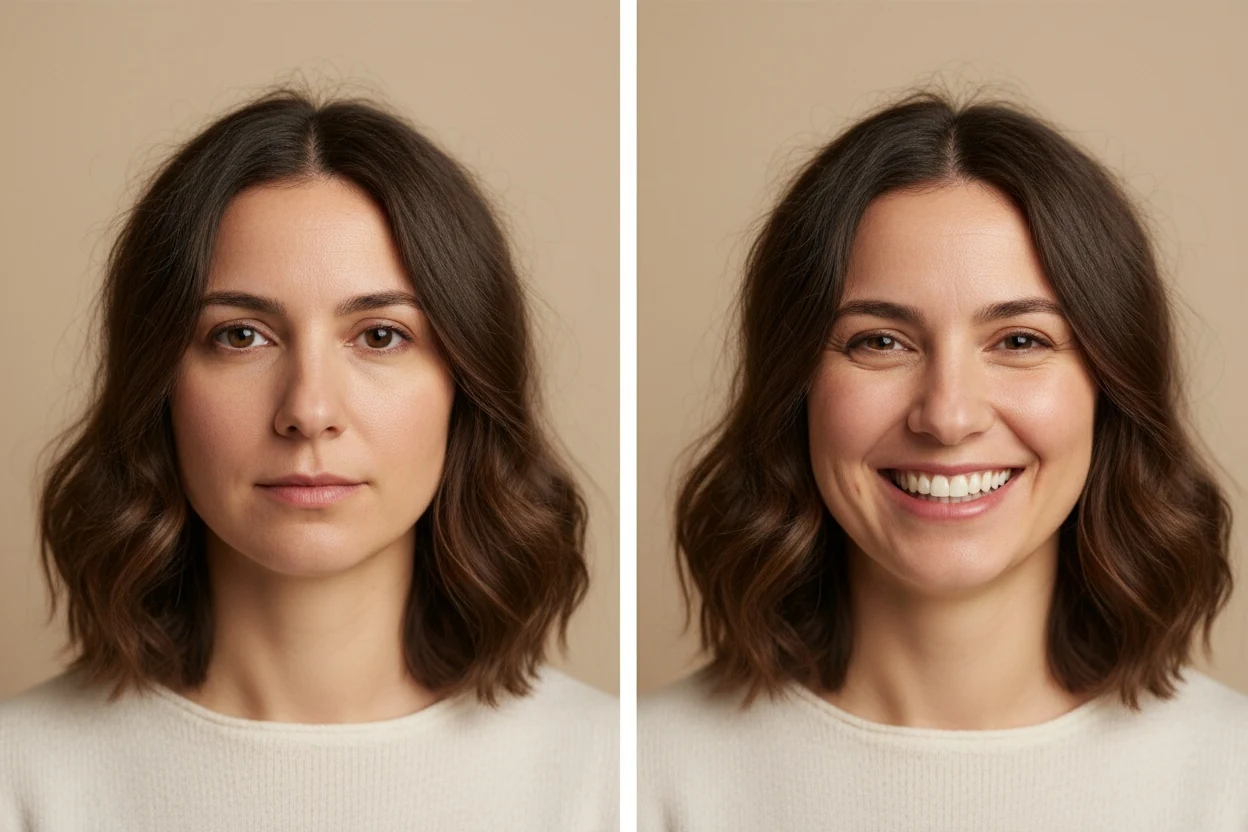
The zygomaticus major muscle runs from the cheekbone down to the corner of the mouth. When it contracts, it pulls the mouth corner up and back, and the soft tissue of the cheek has nowhere to go but up and outward, bunching over the bone into the rounded shape usually called the apples of the cheeks. A genuine smile recruits the muscle that circles the eye as well — the combination Ekman and colleagues studied as the Duchenne smile, which they found occurred more during enjoyment than other smiles.
The result: nearly everyone looks higher-cheekboned smiling than neutral. This is why comparing a smiling photo of someone else with your own passport photo is not a comparison of cheekbones, and it is also, bluntly, the cheapest cheekbone "treatment" that exists. If the goal is a photo, smile.
How high cheekbones age: bone, fat and the midface
The midface ages in two places at once. Shaw and Kahn's 2007 three-dimensional CT study of 60 people in three age groups found that the maxillary angle decreased significantly with age in both men and women — the upper jaw, which forms the front of the cheek, loses projection — while the opening around the nose widened. Mendelson and Wong's 2012 review described the same pattern of targeted bone resorption across the facial skeleton. In the soft tissue, Gierloff's 2012 CT study measured the cheek fat compartments shifting downward and redistributing with age.
Put together, that means the scaffold recedes while the tissue on it slides. A cheekbone that starts out high and well projected keeps holding tissue forward for longer, which is the mechanism behind the common observation that such faces age well. Nobody has run the direct comparison, though, so treat it as reasoning from anatomy rather than a finding. The same process drives the deepening of the fold beside the nose, covered in detail in nasolabial folds.
How to get higher cheekbones: what each option really moves
Start with the sentence nothing else on this topic will say plainly: no option short of surgery changes the height of the cheekbone. What the options below change is width, projection, or the contrast and shadow around the bone. That is not a reason to dismiss them — contrast is most of what people see — but it is the reason to know which axis you are paying for.
| Option | Height | Width | Projection | Contrast / shadow | Best evidence |
|---|---|---|---|---|---|
| Lower body fat | No | Slightly narrower soft tissue | Can decrease if cheek fat thins | More hollow under the bone | Facial adiposity perception (Coetzee 2009); no trial on cheekbones |
| Facial exercise | No | No | Possible small fullness change | Unclear | Uncontrolled pilot (Alam 2018); review found evidence insufficient |
| Gua sha, rollers | No | No | No | Temporary contour change | RCT on contour, 8 weeks (Ahn 2025) |
| Contour makeup, lighting | No | No | No | Yes — while it is there | None needed: it is optics |
| Hair and beard | No | Apparent width only | No | Frames or hides the hollow | None needed: it is framing |
| Hyaluronic acid filler | No | Slightly | Yes | Yes | Randomised trials in midface volume deficit (e.g. Jones 2021) |
| Fat grafting, implants | Apparent, via projection | Yes | Yes | Yes | Surgical case series; a clinician's decision |
| Buccal fat removal | No | No | No | More hollow below the bone | Low-quality evidence; 1 in 4 had a complication (Albuquerque 2025) |
| Mewing, bone smashing | No | No | No | No | No evidence; bone smashing is injury |
Body fat and the contrast under the cheekbone
Losing body fat is the one natural change that reliably alters how cheekbones look, because the superficial cheek fat and the buccal fat both shrink with weight loss and the hollow below the bone deepens. That is contrast, not height, and it has a ceiling: the deep cheek fat that holds the front of the cheek forward thins too, and in a lean or older face too much loss reads as gaunt rather than sculpted.
You will see specific body-fat percentages quoted for "visible cheekbones". They are not taken from any study, faces carry fat very differently at the same percentage, and chasing a number for your face is a reliable route to disordered eating. This page does not give one. If weight loss is a health goal for you, cheekbones are a side effect, not a target.
Facial exercises and cheek fullness
The study behind most exercise claims is Alam and colleagues' 2018 pilot in JAMA Dermatology: middle-aged women followed a 30-minute daily programme for eight weeks and then every other day for twelve more, and blinded dermatologists rating photographs scored upper and lower cheek fullness higher at the end. It had no control group and was a pilot. A 2014 systematic review of facial exercise for rejuvenation found the evidence insufficient to draw conclusions.
Read carefully, the most that evidence supports is a possible small change in how full the cheek looks. Fullness is not height, and a bigger muscle does not lift a bone. The full picture of what exercise has and has not shown is in facial asymmetry exercises.
Gua sha, rollers and microcurrent
The best evidence here is better than for exercise. In Ahn and colleagues' 2025 randomised trial, 34 women used a gua sha tool or a facial roller for ten minutes, five days a week, for eight weeks; both groups showed small reductions in measured facial surface distances, gua sha through muscle tone and the roller through skin elasticity. That is a contour effect, applied evenly, and it does not describe the cheekbone.
The claim that gua sha "increases microcirculation by 400%" comes from a different study: Nielsen and colleagues' 2007 pilot measured a fourfold increase in surface blood flow for the first 7.5 minutes after a single treatment — on the backs of 11 healthy staff volunteers, using the traditional scraping method that intentionally raises bruise-like marks. It was a study of pain relief. It says nothing about faces or cheekbones. Microcurrent devices are sold heavily in this space, and several of the pages ranking for these searches are written by device sellers; independent controlled evidence for cheekbone contour is thin.
Contour, hair and beard: changing where the shadow falls
These are free, instant and fully reversible, and they work on the axis people actually see. Contour places the shadow; highlight marks the peak; hair that falls at or just below the cheekbone frames it, while volume at the cheeks hides it; a beard kept short on the upper cheek shows the hollow. None of it changes a measurement. The face shape pages go through placement for each outline, because where contour belongs depends on whether your face is widest at the cheekbones or elsewhere.
Filler, fat grafting and implants
Injectable filler adds projection and volume over the cheekbone, and it is the most studied non-surgical option. In one randomised, evaluator-blind trial of 60 adults with moderate to severe midface volume deficit, a hyaluronic acid filler improved scores on a validated midface volume scale by almost two points at one month, whether placed by cannula or needle, with mostly mild injection-site reactions. That trial was run in age-related volume loss, and it compared two ways of injecting the same product rather than filler against no treatment.
Injection in the midface carries a small risk of filler entering a blood vessel, and serious complications, including to vision, have been reported after facial filler. The decision about product, depth and whether to do it at all belongs to a qualified clinician who has examined your face. Surgical options — fat grafting, malar implants, and osteotomies that reposition the zygoma — add projection more permanently. There is also the reverse: reduction malarplasty narrows a wide or prominent zygoma, and a 2023 meta-analysis of 29 studies and 6,611 patients compared its techniques and complication rates. If you want to see what added midface volume would look like on your own face before speaking to anyone, the cheek filler simulation renders it from a photo — as an illustration, not a prediction of any clinician's result.
Buccal fat removal: contrast, not height
Buccal fat removal is often sold as a cheekbone procedure. It is not one. It removes part of a fat pad that sits below and behind the cheekbone, which deepens the hollow under the bone and so increases contrast; the bone and its peak stay exactly where they were. It is also permanent.
The evidence is weaker than its popularity suggests. A 2021 systematic review found only four studies to include, called the evidence scarce and of low quality, and noted a lack of long-term follow-up. A 2025 meta-analysis of 12 studies and 308 patients found that one in four patients had some complication — mostly swelling, restricted mouth opening and pain, with asymmetry and rare facial nerve paralysis also recorded — and concluded the procedure should be recommended with caution. Because long-term data are missing, whether removal changes how a face ages is unknown. The buccal fat removal simulation shows the contrast effect on your own photo.
Mewing, "zygos" and bone smashing
In looksmaxxing communities the cheekbones are "zygos", and the promise is that tongue posture (mewing), hard chewing or pressure will make them grow. None of these has any evidence of changing the adult zygomatic bone, which has finished growing. The practice to name directly is bone smashing — deliberately striking the face to provoke bone to remodel. A 2026 analysis of looksmaxxing trends in an oral and maxillofacial surgery journal classed it among dangerous practices, and there is no clinical evidence it reshapes bone. It is injury, and facial fractures do not heal into better cheekbones; they heal into asymmetry.
What a photo can and cannot tell you about your cheekbones
A straight-on photo taken at arm's length, in even light, measures one cheekbone axis well: width, and how that width compares to the jaw and forehead. It measures height only indirectly, through shadow, which lighting controls. It cannot measure projection at all, and it cannot tell bone from fat — the two look identical from the front.
That is exactly what our tool reports and does not report. Jawline Rating measures bigonial width — across the jaw corners — against the widest point of your face at the cheekbones, and shows the ratio. The cheekbone point it uses is the widest point of the face outline in the photo, which approximates the anthropometric zygion rather than locating it on bone. It does not report cheekbone height or projection, and neither does any other tool on this site.
One front photo gives you your jaw-to-cheekbone width ratio, the taper to your chin and your lower-face height. It runs in your browser, with no upload and no account.
Measure your jaw against your cheekbonesThe cheekbone claims, checked
| Claim | Where it comes from | What that source measured |
|---|---|---|
| "Gua sha increases microcirculation by 400%" | Nielsen et al., 2007 | Surface blood flow for 7.5 minutes after one scraping session on the back, in 11 people |
| "Face yoga builds your cheekbones" | Alam et al., 2018 | Rated cheek fullness in an uncontrolled pilot; not bone, not height |
| "You need X% body fat for visible cheekbones" | No study | Nothing — the figures are not sourced |
| "Mewing lifts the cheekbones" | No study | No evidence of changing adult bone |
| "Buccal fat removal gives you cheekbones" | Clinic marketing | Reviews measured cheek volume removed and satisfaction, not cheekbone height |
| "Wide cheekbones are a masculine signal" | Skull studies | In living faces, a three-method study found no sex difference in width-to-height ratio |
Cheekbones in the context of your whole face
Cheekbones matter mostly in relation to what surrounds them. The same bizygomatic width reads as dramatic above a narrow jaw and ordinary above a wide one; the same peak looks high under a narrow temple and unremarkable under a full one. That relationship is what face shape describes: a face widest at the cheekbones with a narrower forehead and jaw is a diamond, one that steps down gently is oval, and one widest at the forehead is heart-shaped.
If you have followed the tests above, you already know more about your cheekbones than a single score could tell you: where the peak sits, whether the contrast is bone or fat, and which of the options would move anything at all. The last useful number is how your cheekbone width sits against the rest of your face.
Face shape is decided by comparing forehead, cheekbone and jaw widths with face length. One photo, in your browser.
Find your face shapeFrequently asked questions
What does it mean to have high cheekbones?
It means the most prominent point of your cheekbone sits high on the midface, close to the lower eyelid, rather than lower down near the level of your nostrils. It is an everyday description, not a clinical measurement. People also use the phrase for cheekbones that are wide or that project forward, which are different things — a cheekbone can be high but flat, or low but prominent.
How do I know if I have high or low cheekbones?
Press your fingertips along the bone under your eye and follow it back toward your ear, then note where the most prominent point sits. If it is closer to your lower eyelid than to the base of your nose, it is high; if it lines up nearer the nostrils, it is low. Then take one photo with a single light above you: the line where the shadow starts under the cheek confirms what your fingers found.
Are high cheekbones attractive?
In the studies that measured it, prominent cheekbones went with higher attractiveness ratings — Cunningham's 1990 work on male faces is the classic example, and a 2020 study using 3D-reconstructed faces found a neutral or forward cheek position was rated more attractive than a set-back one in both a man and a woman. Both used small face sets and photo ratings. No study shows cheekbones outweighing skin, averageness or expression in how a whole face is judged.
Can you get higher cheekbones naturally?
Not in the literal sense. The height of the cheekbone is set by the zygomatic bone and maxilla, and no exercise, massage or posture moves bone in an adult. What natural changes can do is alter the contrast under the cheekbone — mainly through facial fat, which changes with body weight — and the way light hits it. Makeup and lighting change where the shadow falls for as long as they are there.
Do high cheekbones age well?
A well-projected cheekbone gives the soft tissue over it more support, and the shift of fat and bone that makes midfaces look older happens in everyone. Imaging studies show the maxilla loses projection with age and the cheek fat compartments migrate downward. There is no study comparing how high-cheekboned and low-cheekboned faces age, so the fair summary is a mechanism, not a promise.
Do cheekbones actually move when you smile?
The bone does not. When the zygomaticus major muscle pulls the corners of the mouth up and back, it bunches the soft tissue of the cheek upward and outward into the rounded shape people call the apples. That is why a smiling photo makes almost anyone look higher-cheekboned than a neutral one.
Can zygos grow in adults?
No. "Zygos" is internet shorthand for the zygomatic bones. Facial width grows through childhood and adolescence and then stops; there is no evidence that mewing, chewing, pressure or massage makes the adult zygoma larger. Deliberately striking the face to remodel bone — promoted online as bone smashing — is injury, and can cause fractures and permanent asymmetry.
Are high cheekbones a feminine or masculine trait?
Neither, strictly. Prominent cheekbones are rated attractive in both male and female faces, and a careful 2012 study of White European faces, using photographs, 3D scans and tape measurements, found no sex difference in facial width relative to height. What differs is the frame around them: jaw width, brow and beard change how the same cheekbones read.
References
- Rohrich, R. J., & Pessa, J. E. (2007). The fat compartments of the face: anatomy and clinical implications for cosmetic surgery. Plastic and Reconstructive Surgery, 119(7), 2219–2227. PMID 17519724.
- Gierloff, M., Stöhring, C., Buder, T., Gassling, V., Açil, Y., & Wiltfang, J. (2012). Aging changes of the midfacial fat compartments: a computed tomographic study. Plastic and Reconstructive Surgery, 129(1), 263–273. PMID 21915077.
- Mendelson, B., & Wong, C. H. (2012). Changes in the facial skeleton with aging: implications and clinical applications in facial rejuvenation. Aesthetic Plastic Surgery, 36(4), 753–760. PMID 22580543.
- Shaw, R. B., Jr., & Kahn, D. M. (2007). Aging of the midface bony elements: a three-dimensional computed tomographic study. Plastic and Reconstructive Surgery, 119(2), 675–681. PMID 17230106.
- Cunningham, M. R., Barbee, A. P., & Pike, C. L. (1990). What do women want? Facialmetric assessment of multiple motives in the perception of male facial physical attractiveness. Journal of Personality and Social Psychology, 59(1), 61–72. PMID 2213490.
- Woo, H. K., Ajmera, D. H., Singh, P., Li, K. Y., Bornstein, M. M., Tse, K. L., Yang, Y., & Gu, M. (2020). Evaluation of the relationship between malar projection and lower facial convexity in terms of perceived attractiveness in 3-dimensional reconstructed images. Head & Face Medicine, 16(1), 8. PMID 32345357.
- Kramer, R. S., Jones, A. L., & Ward, R. (2012). A lack of sexual dimorphism in width-to-height ratio in white European faces using 2D photographs, 3D scans, and anthropometry. PLoS ONE, 7(8), e42705. PMID 22880088.
- Coetzee, V., Perrett, D. I., & Stephen, I. D. (2009). Facial adiposity: a cue to health? Perception, 38(11), 1700–1711. PMID 20120267.
- Farkas, L. G., Katic, M. J., Forrest, C. R., et al. (2005). International anthropometric study of facial morphology in various ethnic groups/races. Journal of Craniofacial Surgery, 16(4), 615–646. PMID 16077306.
- Arboleda, C., Buschang, P. H., Camacho, J. A., Botero, P., & Roldan, S. (2011). A mixed longitudinal anthropometric study of craniofacial growth of Colombian mestizos 6–17 years of age. European Journal of Orthodontics, 33(4), 441–449. PMID 21097992.
- Ekman, P., Davidson, R. J., & Friesen, W. V. (1990). The Duchenne smile: emotional expression and brain physiology II. Journal of Personality and Social Psychology, 58(2), 342–353. PMID 2319446.
- Alam, M., Walter, A. J., Geisler, A., Roongpisuthipong, W., Sikorski, G., Tung, R., & Poon, E. (2018). Association of facial exercise with the appearance of aging. JAMA Dermatology, 154(3), 365–367. PMID 29299598.
- Van Borsel, J., De Vos, M. C., Bastiaansen, K., Welvaert, J., & Lambert, J. (2014). The effectiveness of facial exercises for facial rejuvenation: a systematic review. Aesthetic Surgery Journal, 34(1), 22–27. PMID 24327764.
- Ahn, S. H., Hwang, U. J., Han, H. S., Kim, J. H., Lee, H. J., Jeon, Y. R., Lee, H. H., & Hwang, A. H. (2025). Comparative effects of facial roller and gua sha massage on facial contour, muscle tone, and skin elasticity: randomized controlled trial. Journal of Cosmetic Dermatology, 24(6), e70236. PMID 40439289.
- Nielsen, A., Knoblauch, N. T., Dobos, G. J., Michalsen, A., & Kaptchuk, T. J. (2007). The effect of Gua Sha treatment on the microcirculation of surface tissue: a pilot study in healthy subjects. Explore, 3(5), 456–466. PMID 17905355.
- Jones, D., Palm, M., Cox, S. E., McDermott, M., Sartor, M., & Chawla, S. (2021). Safety and effectiveness of hyaluronic acid filler, VYC-20L, via cannula for cheek augmentation: a randomized, single-blind, controlled study. Dermatologic Surgery, 47(12), 1590–1594. PMID 34743118.
- Traboulsi-Garet, B., Camps-Font, O., Traboulsi-Garet, M., & Gay-Escoda, C. (2021). Buccal fat pad excision for cheek refinement: a systematic review. Medicina Oral, Patología Oral y Cirugía Bucal, 26(4), e474–e481. PMID 34023838.
- Albuquerque, M. C., Arruda, K. A. R., Xavier Junior, G. F., Cerqueira, A. C. D. S. G., Massignan, C., & Rocha, F. S. (2025). Prevalence of complications of buccal fat removal: a systematic review and meta-analysis. Journal of Cranio-Maxillo-Facial Surgery, 53(4), 363–369. PMID 39809616.
- Zhang, J., Liu, H., Liu, Y., Liu, S., He, Z., Chen, G., & Luo, E. (2023). A systematic review and meta-analysis of complications among various reduction malarplasty. Aesthetic Plastic Surgery, 47(3), 1018–1038. PMID 36261745.
- Beleznay, K., Carruthers, J. D., Humphrey, S., & Jones, D. (2015). Avoiding and treating blindness from fillers: a review of the world literature. Dermatologic Surgery, 41(10), 1097–1117. PMID 26356847.
- Grillo, R., Fernandes, L. A., Rodrigues dos Santos, L. A., Lima, B. C., Brozoski, M. A., & Spagnol, G. (2026). Dangerous trends on social media related to facial esthetics: analysis of looksmaxxing and its softmaxxing and hardmaxxing practices. Journal of Stomatology, Oral and Maxillofacial Surgery, 127(5), 102971. PMID 42674114.
- Langlois, J. H., & Roggman, L. A. (1990). Attractive faces are only average. Psychological Science, 1(2), 115–121. doi:10.1111/j.1467-9280.1990.tb00079.x.
- Fink, B., Grammer, K., & Matts, P. J. (2006). Visible skin color distribution plays a role in the perception of age, attractiveness, and health in female faces. Evolution and Human Behavior, 27(6), 433–442. doi:10.1016/j.evolhumbehav.2006.08.007.
Tools mentioned in this article
Measurements on this site are for information only. Nothing here is medical advice, and no result is a diagnosis. Talk to a qualified clinician before making any decision about a procedure.