The gonial angle: typical values, what "ideal" really means, and how to measure yours
·16 min read
The gonial angle is the angle at the corner of your lower jaw, between the back edge of the ramus — the part rising toward your ear — and the lower border of the jaw body. It is measured from the side, properly on an X-ray, and in adults it is obtuse: in one 2025 study of young orthodontic patients it averaged about 126 to 127 degrees. A front photo cannot measure it.
That last sentence is the one most gonial angle content leaves out, and it is why so many numbers people quote about their own jaws are not gonial angles at all. This guide sets out what the angle is, what studies have actually measured in real jaws, what the two published surveys on the "ideal" jaw angle found and how narrow they were, how to estimate yours honestly, and which things change the bone as opposed to the corner you see in the mirror.
What the gonial angle is
Draw a straight line along the back edge of the ramus, from just below the jaw joint down to the corner. Draw a second along the lower border of the mandible, from the corner toward the chin. The angle between them, opening toward the front of the face, is the gonial angle. The smaller the number, the more the jaw corner turns like a right angle; the larger it is, the more the ramus and the jaw body run into each other as one sloping line.
Where the gonion is
The gonion is the point at the jaw corner where those two lines meet, or more precisely the most outward point on the curve of the corner. On a skull it is easy to find. On a living face it is covered by the masseter muscle, fat and skin, and it usually sits a little higher and further back than the visible edge of the jaw line — which is the first reason photo estimates drift.
Gonial angle vs jaw angle vs mandibular plane angle
| Term | What it means | Measured from |
|---|---|---|
| Gonial angle | Angle between the ramus tangent and the lower border of the mandible | The side: lateral cephalogram, panoramic X-ray, CT |
| Angle of the mandible / jaw angle | The anatomical corner region itself; often used loosely for the gonial angle | Anatomy texts; in everyday use, any view |
| Mandibular plane angle | Tilt of the lower border of the jaw against a reference line of the skull | Lateral cephalogram |
| Projected jaw angle | The angle a front photo shows at the jaw corner | A front photograph — not comparable to the three above |
The mandibular plane angle matters here because it travels with the gonial angle. It describes how steeply the jaw slopes, and orthodontists use it to sort faces into low-angle and high-angle growth patterns, which the next sections come back to.
What gonial angle values studies measured
You will see ranges such as "110 to 130" or "120 to 130" quoted as normal. Neither is usually attached to a source, and published values depend on who was measured, how, and on what image. So rather than a single range, here is what specific studies found:
| Study | Who was measured | Method | What it found |
|---|---|---|---|
| Popa et al., 2025 | 78 orthodontic patients, mean age 23 | Panoramic X-ray, AI-assisted tracing | Average gonial angle 126.3° right and 127.1° left; no significant sex or side difference |
| Radhakrishnan et al., 2017 | 50 adults with a normal bite relationship | Lateral cephalogram vs panoramic X-ray | No significant difference between the two methods, or between men and women |
| Upadhyay et al., 2012 | 185 people in five age groups | Cephalogram and anthropometry | No correlation with sex; about 6° larger in people with no teeth |
| Hutchinson et al., 2015 | 498 skeletal mandibles, ages 20–80 | Measurements on bone | Fully toothless jaws had gonial angles about 4° larger |
| Chalazoniti et al., 2024 | 100 adults (50 men, 50 women) | 3D shape analysis of CT scans | Men's mandibles larger, with a more pronounced gonial angle and wider jaw corners; age effect not significant |
Gonial angle in men vs women
The honest summary is that the studies disagree. Three of the studies above found no meaningful sex difference in the gonial angle itself. A detailed 3D analysis of whole mandibles did find sex differences in shape, describing male jaws as larger, with a higher ramus, a more pronounced angle and wider jaw corners, and could tell male from female mandibles with about 91% accuracy from overall shape. The consistent finding is that male jaws are bigger; whether the angle itself differs depends on the sample and the method.
How the gonial angle changes with age
During growth it closes. Chung and Mongiovi followed untreated children from the Bolton-Brush and Burlington growth studies with cephalograms at 9 and 18 and found the gonial angle decreased over that period in every group, as the lower jaw rotated forward. In adulthood the evidence is mixed. A CT study of 120 adults who still had their teeth found the mandibular angle increased significantly with age in both sexes, while the ramus and jaw body shortened; the 3D shape study above, by contrast, found no significant age effect on overall mandible shape. Tooth loss adds to it: jaws with no teeth show larger angles, by about 4 degrees in one skeletal study and about 6 in a clinical one.
What a high or low gonial angle says about facial growth
In orthodontics, faces are described as hypodivergent (low mandibular plane angle, a more horizontal growth pattern) or hyperdivergent (a steep plane, more vertical growth). A 3D CT study comparing the two groups found they differed in gonial angle, ramus height, condyle width and jaw length, and the growth study above found high-angle children already had larger gonial angles and longer lower faces at age 9. That is description, not diagnosis: both patterns are common, and either can sit in a face that looks entirely ordinary. The proportion of the lower face that goes with a steep angle is the kind of thing facial thirds measures from the front.
Ideal gonial angle: what surveys of real raters found
The word "ideal" is doing a lot of work in this search, so it is worth being exact about where numbers come from. There are two published surveys on attractive jaw angles, both by the same Belgian maxillofacial surgeon, both designed to help shape custom jaw implants. They are useful and they are narrow.
| Survey | What raters saw | Preferred profile angle | Other preferred features | Limits |
|---|---|---|---|---|
| Mommaerts, 2016 — male jaws | Black-and-white photos of celebrities and non-celebrities, rated on simplified Likert scales | 130° | Jaw width similar to face width; corner level with the mouth corners, not below the lower lip; curve visible from earlobe to chin, not pointy | One survey, photos, panel not described in the abstract |
| Mommaerts & Cleymaet, 2023 — female jaws | Photos of white women, celebrities and laypeople, 3-point Likert | 125.5° (142° in front view) | Jaw width 0.83 of cheekbone width; corner level with the lips | Features counted only with ≥80% agreement; white faces only |
The male jaw angle survey
The 2016 survey's preferred male jaw had a 130-degree angle in profile, a width between the jaw corners similar to the width of the face, and a corner sitting at the level of the mouth corners. It also described the jaw line in the front view as running nearly parallel to a line from the outer eye corner to the side of the nose, and a curve at the corner that was visible but not pointed. Notably, the preferred angle is more open than many forum claims — the "sharpest possible" jaw was not what this panel chose.
The female jaw angle survey
The 2023 survey's attractive female jaw had a 125.5-degree angle in profile and a jaw width of 0.83 times the width across the cheekbones. That width ratio is the same measurement the jawline rating reports from a front photo, and 0.83 sits inside the band that tool reads as average. The same survey gave the angle in front view as 142 degrees — the same jaws, looked at from the front, showed an angle over 16 degrees wider. That gap is the whole reason a front photo cannot stand in for a profile measurement.
Why a forum number is not a finding
Numbers such as "115 is ideal" circulate in looksmaxxing spaces with no study behind them, often measured by drawing lines on celebrity photos taken at unknown angles. The two surveys above at least used a stated method, and they still describe one panel's preferences for one population in still photographs. None of this says a jaw outside those numbers is unattractive, and faces are rated as wholes: a review of attractiveness research identifies averageness, symmetry and sexual dimorphism across the whole face, not any single angle, as the recurring factors.
High vs low gonial angle: what each looks like
| Gonial angle (profile) | How the jaw corner tends to read | Often seen with |
|---|---|---|
| Around 115° | A distinct, near-square corner below the ear | Horizontal growth pattern, taller ramus, shorter lower face |
| Around 120° | A clearly defined corner | More acute than the survey preferences for either sex |
| Around 125–130° | A defined corner with a gentle curve | The span of the averages measured and of both survey preferences |
| Around 135° and above | Ramus and jaw line flow into one slope; the corner is less distinct | Vertical growth pattern, longer lower face; toothless jaws |
People search for a "bad" gonial angle, but there is no such category in any of the literature above. A higher angle goes with a particular growth pattern and a longer lower face; a lower angle with a squarer corner. Both are normal. What people usually mean by a bad angle is a soft visible corner, and that is often soft tissue rather than bone — a point the section on what changes it returns to.
How to measure your gonial angle
| Method | What it measures | Accuracy | Who can do it |
|---|---|---|---|
| Lateral cephalogram | The true angle on bone, both sides superimposed | The traditional standard | Orthodontist, dentist, radiographer |
| Panoramic X-ray | Each side separately | Agreed with cephalograms in one study; differed in another with 448 adults | Dentist |
| CT / cone-beam CT | The mandible in three dimensions | Most complete | Clinic, when clinically needed |
| Side-profile photo | An estimate through soft tissue | Several degrees of error; depends on locating the corner | You |
| Front photo | A projection of the corner, not the gonial angle | Not comparable to the above | Any app |
On a radiograph: how clinicians do it
On a lateral cephalogram, a clinician draws the ramus plane along the back edge of the ramus and the mandibular plane along the lower border, and measures the angle at their intersection. On a panoramic X-ray the same two tangents are drawn on each side. Radhakrishnan and colleagues found no significant difference between the two methods in 50 adults, while a larger 2024 study of 448 young adults did find a statistically significant difference, with panoramic images better at distinguishing growth patterns. The practical takeaway is that even on X-rays, the method moves the number by a little.
From a side-profile photo: a step-by-step estimate
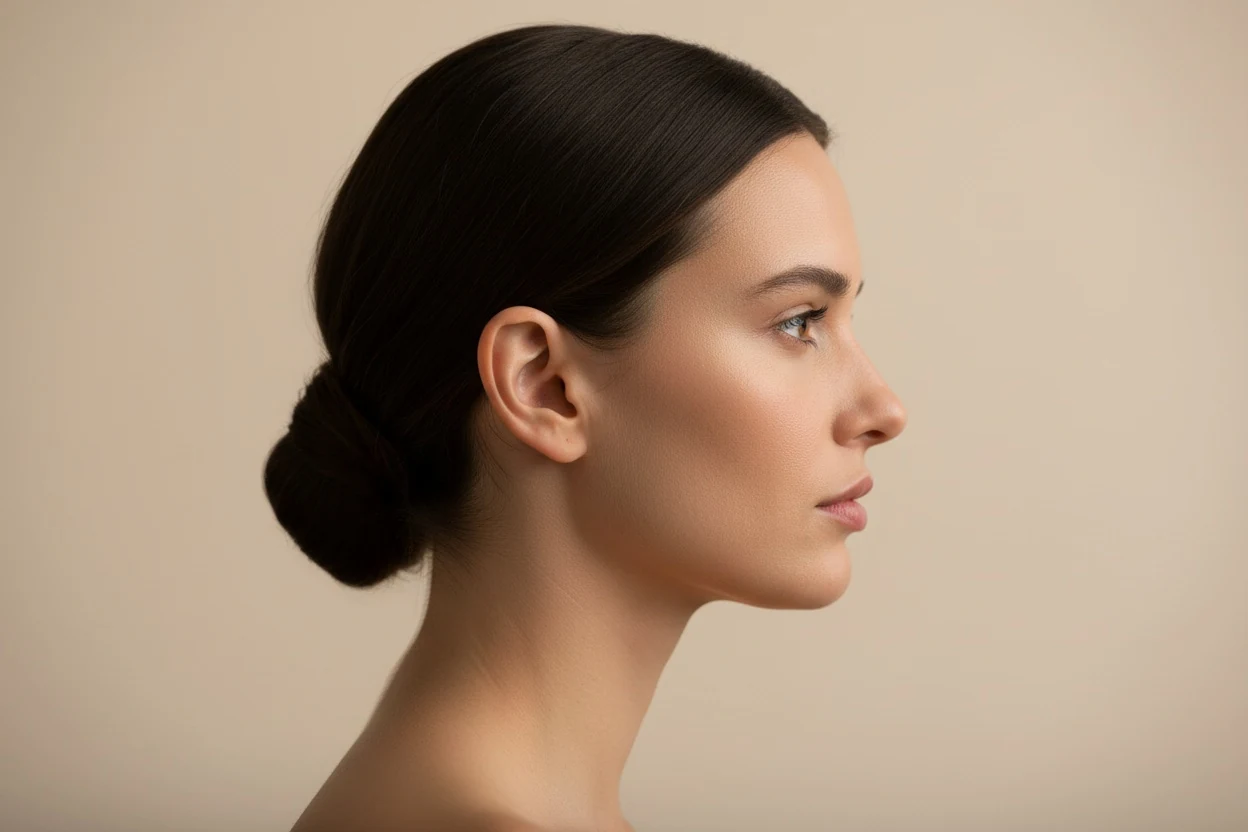
- 1Set up the camera at ear height, about two metres away, zoomed in so your head fills the frame. Distance plus zoom flattens lens distortion; a phone held close exaggerates whatever is nearest.
- 2Stand exactly side-on. If you can see any of your far eye, you are turned. Keep your head level, as if looking at the horizon.
- 3Relax your jaw, teeth lightly together, not clenched — clenching bulks the masseter and blurs the corner. Tuck hair behind your ear.
- 4Use even light from the front of the face, not from above or behind, so no shadow runs along the jaw.
- 5Draw two lines in any photo editor or protractor app: one along the back edge of the jaw from below the earlobe down to the corner, one along the lower border of the jaw from the corner toward the chin.
- 6Read the angle where they meet, then repeat on two more photos. If the three readings disagree by more than a few degrees, your pose or line placement is the variable.
Treat the result as a range rather than a number. The bony corner sits under muscle and fat, and on most people you are placing the lines on skin that follows the bone only approximately. Two people with the same bone can get readings several degrees apart because one carries more tissue at the corner.
Why a front photo can't give you a gonial angle
The gonial angle lies in a plane that runs from the front of your head to the back. A camera facing you records the plane at right angles to that one. What it sees at the jaw corner is the ramus rising and the jaw line running inward toward the chin — a projection that depends on jaw width and chin width as much as on the angle, and one that shifts every time your head turns a few degrees. The female jaw survey shows the size of the gap in the same faces: 125.5 degrees in profile, 142 from the front.
Is there a gonial angle calculator?
Not one that works from a front photo, whatever it is called. Tools that give you a gonial angle from a selfie are reporting a projection. Ours says so: the jawline rating labels its number a projected jaw angle, reports left and right separately so you can see when your head was turned, and puts next to it three measurements a front photo genuinely can carry — jaw width against cheekbone width, the taper from jaw to chin, and how evenly the two jaw corners sit around your midline.
Jaw width against cheekbones, taper to the chin and jaw-corner asymmetry from one photo, plus the projected angle clearly labelled. In your browser, no upload.
Measure what a front photo canWhat can and can't change your gonial angle
There are two different things in play: the bone angle, and the corner you see. They are easy to confuse because the second is what everyone looks at, and almost everything sold as changing the first actually acts on the second.
| Intervention | Changes the bone angle? | Changes the visible corner? | Evidence |
|---|---|---|---|
| Losing body fat | No | Yes — less tissue over the corner | Consistent with anatomy; no trial on jaw angle |
| Chewing gum, jaw exercisers | No | No measurable change | 6-month RCT: bite force up, jaw shape and masseter thickness unchanged (Jung 2024) |
| Mewing (adults) | No evidence | No evidence | Influences growth in children only |
| Masseter toxin | No | Yes, slims the corner for a period | Meta-analysis of 5 RCTs: short-term reduction in masseter prominence (Machado 2026) |
| Jaw angle implants | Adds to the corner's shape | Yes | Case series; mean 4.6 mm angle expansion in 18 patients (Rios 2025) |
| Orthognathic surgery | Yes, as part of moving the jaw | Yes | Planned by a surgical team for bite and skeletal problems |
| Tooth loss | Opens it by a few degrees | Yes | Skeletal and clinical studies (Hutchinson 2015, Upadhyay 2012) |
Body fat and the visible jaw corner
The corner of the jaw is covered by the masseter, the parotid gland region, fat and skin, and the lower border by the fat under the chin. Less fat there makes the corner and the line toward the chin easier to see, which is why the same person can appear to have a sharper angle after weight loss. The bone has not moved; the outline has got closer to it.
Masseter size: chewing, clenching and toxin
The masseter sits directly over the jaw corner, so its bulk changes the width and roundness of the lower face seen from the front and softens the corner in profile. Gum chewing does not enlarge it measurably in the trial above. Botulinum toxin injected into it reduces it: a 2026 meta-analysis of five placebo-controlled trials with 536 participants found short-term improvement in masseter prominence and thickness, with results varying widely between studies. A separate review found a roughly 6% reduction in cortical bone thickness in parts of the human mandible after injections, with no change in bone volume or density, and called for longer-term studies. It is a medical treatment, and the decision sits with a qualified clinician.
Mewing and tongue posture
In children, tongue and lip posture influence how the jaws grow, which is uncontroversial in orthodontics. In adults there is no evidence that mewing changes the gonial angle, and the related claim that hard chewing reshapes the jaw was tested directly and failed. People who start mewing often lose weight, sleep better or stop clenching at the same time, and the visible jaw line changes for those reasons.
Jaw angle implants and surgery
Only surgery changes the bony corner. Custom jaw angle implants add definition and width at the corner; a 2025 series of 18 patients having jaw surgery with patient-specific titanium angle implants measured an average expansion of 4.6 mm at the angle on 3D photographs. Implant surgery carries risks including infection, which a 2021 comparison of stock and custom implants recorded in both groups. Orthognathic surgery repositions the jaws for bite and skeletal problems, and the angle changes as part of that. All of these are decisions for a maxillofacial surgeon after examination and imaging. To see a wider or slimmer lower face on your own photo first, the jaw reduction simulation and masseter botox simulation render it — as an illustration, not a surgical outcome.
How much the gonial angle matters to how a face looks
Less than the search volume suggests. The angle is one feature of one part of the face, and it is mostly visible in profile, which is not the view people see you in most. The surveys above found preferences clustered in the mid-to-high 120s and around 130 degrees in profile — not at the sharpest extreme — and they found jaw width, the height of the corner and a smooth curve mattered alongside the angle. From the front, what reads as a defined jaw is largely the relationship between jaw width and cheekbone width, and how much soft tissue sits on the line.
If the question behind the search is whether your jaw works with the rest of your face, a single angle will not answer it. Face shape describes how your jaw width sits against your forehead and cheekbones, which is what people are actually seeing when they call a jaw strong or soft.
Face shape compares forehead, cheekbone and jaw widths with face length. One photo, in your browser.
See how your jaw fits your face shapeFrequently asked questions
What is a normal gonial angle?
There is no single agreed range, and figures quoted online rarely name a source. As one measured example, a 2025 study of 78 young orthodontic patients found average gonial angles of 126.3 degrees on the right and 127.1 on the left, with no significant difference between men and women. Values vary with how the face grew, the population studied, the imaging method and whether teeth have been lost.
What is the ideal gonial angle for men?
In an Internet survey that asked people to rate photographs of male jaws, the preferred angle was 130 degrees in profile, with the jaw about as wide as the face and the corner sitting level with the mouth corners. It is one survey of black-and-white photos, designed to guide implant shaping, and "preferred by that panel" is the most it can mean.
What is the ideal gonial angle for a woman?
A 2023 online survey of attractive white female jaws put it at 125.5 degrees in profile and 142 degrees seen from the front, with jaw width about 0.83 of cheekbone width and the corner level with the lips. Features counted only if at least 80% of raters agreed. It describes one panel's consensus, not a target.
Is 120 a good gonial angle?
"Good" is not a clinical category for it. 120 degrees is within the span of values seen in adult jaws, and slightly more acute than the averages in the studies cited here and than the profile angles preferred in the two jaw-angle surveys (125.5 degrees for women, 130 for men). If the number comes from a front photo, it is not a gonial angle at all.
What causes a high gonial angle?
Mainly the way the face grew. People whose lower jaw rotated downward and backward during growth — a steep mandibular plane, often with a longer lower face — tend to have larger gonial angles, and imaging studies confirm the angle differs between these growth patterns. Tooth loss also opens it by a few degrees in adulthood. None of these is a disorder in itself.
Can you fix your gonial angle?
The bone angle changes only with surgery: implants that build out the jaw corner, or jaw surgery. What non-surgical options change is the visible corner — body fat over the jaw, and the bulk of the masseter muscle, which toxin can reduce for a period. Those change how the angle looks, not what it measures.
Does mewing change your gonial angle?
There is no evidence that it does in adults. Tongue and lip posture influence jaw growth in children, which is why myofunctional therapy exists, but an adult mandible is bone that has finished growing. Even hard chewing does not reshape it: in a six-month randomised trial, chewing gum three times a day raised bite force without changing jaw shape or masseter thickness.
How can I measure my gonial angle at home?
Only approximately, from a strict side-profile photo. Stand side-on to a camera at ear height, a couple of metres away with the lens zoomed in, head level and jaw relaxed, hair behind your ear. Draw one line along the back edge of your jaw below the ear and one along its lower border, and read the angle where they meet. Soft tissue hides where the bone corner actually is, so treat the result as an estimate within several degrees.
What does a 90 degree gonial angle mean?
On bone, it would be far more acute than the averages measured in adult jaws, which sit in the mid-120s in the studies cited here. A "90 degree jaw" in photos is almost always soft tissue, a beard line or a shadow drawn along the jaw, measured from a front or three-quarter view rather than a true profile.
References
- Popa, A., Stăncioiu, A. A., Motofelea, A. C., Câlniceanu, H., Catalina, A., Galuscan, A., Oancea, R., Luca, M. M., Nikolajevic-Stoican, A. N., Brad, S., & Szuhanek, C. (2025). Digital orthodontic assessment of mandibular morphology using orthopantomograms: correlation and symmetry analysis of bilateral gonial angles, bigonial width, and bilateral ramus heights. Journal of Clinical Medicine, 14(22), 8099. PMID 41303135.
- Radhakrishnan, P. D., Sapna Varma, N. K., & Ajith, V. V. (2017). Dilemma of gonial angle measurement: panoramic radiograph or lateral cephalogram. Imaging Science in Dentistry, 47(2), 93–97. PMID 28680845.
- Chalazoniti, A., Lattanzi, W., & Halazonetis, D. J. (2024). Shape variation and sex differences of the adult human mandible evaluated by geometric morphometrics. Scientific Reports, 14(1), 8546. PMID 38609399.
- Upadhyay, R. B., Upadhyay, J., Agrawal, P., & Rao, N. N. (2012). Analysis of gonial angle in relation to age, gender, and dentition status by radiological and anthropometric methods. Journal of Forensic Dental Sciences, 4(1), 29–33. PMID 23087579.
- Hutchinson, E. F., Farella, M., & Kramer, B. (2015). Importance of teeth in maintaining the morphology of the adult mandible in humans. European Journal of Oral Sciences, 123(5), 341–349. PMID 26287722.
- Shaw, R. B., Jr., Katzel, E. B., Koltz, P. F., Kahn, D. M., Girotto, J. A., & Langstein, H. N. (2010). Aging of the mandible and its aesthetic implications. Plastic and Reconstructive Surgery, 125(1), 332–342. PMID 20048624.
- Chung, C. H., & Mongiovi, V. D. (2003). Craniofacial growth in untreated skeletal Class I subjects with low, average, and high MP-SN angles: a longitudinal study. American Journal of Orthodontics and Dentofacial Orthopedics, 124(6), 670–678. PMID 14666080.
- Reis, A. S., Copello, F. M., de Castro, A. C. R., Cevidanes, L. H. S., do Rego, M. V., Visconti, M. A., & Ruellas, A. C. O. (2023). 3D analysis of maxillomandibular morphology in hyperdivergent and hypodivergent individuals: a cross-sectional study. Orthodontics & Craniofacial Research, 26(4), 687–694. PMID 37246594.
- Mommaerts, M. Y. (2016). The ideal male jaw angle — an Internet survey. Journal of Cranio-Maxillo-Facial Surgery, 44(4), 381–391. PMID 26888465.
- Mommaerts, M. Y., & Cleymaet, R. (2023). The ideal shape of the female jaw angle: an online survey. Journal of Cranio-Maxillo-Facial Surgery, 51(10), 597–602. PMID 37813771.
- Jung, H. J., Hwangbo, N. K., Park, Y., & Ahn, H. J. (2024). Effects of gum chewing training on occlusal force, masseter muscle thickness and mandibular shape: a randomised controlled clinical trial. Journal of Oral Rehabilitation, 51(12), 2529–2536. PMID 39215439.
- Machado, G. F., De Freitas, L. R., Ribeiro, L. F. S., et al. (2026). Efficacy of botulinum toxin for masseter muscle hypertrophy: a systematic review and meta-analysis. Journal of Plastic, Reconstructive & Aesthetic Surgery, 119, 212–225. PMID 42379083.
- Moussa, M. S., Bachour, D., & Komarova, S. V. (2024). Adverse effect of botulinum toxin-A injections on mandibular bone: a systematic review and meta-analysis. Journal of Oral Rehabilitation, 51(2), 404–415. PMID 37668276.
- Rios, O., Pradel, R., Pradel, J., Lerhe, B., & Savoldelli, C. (2025). Jawline improvement using patient-specific angle implants with virtual planning in orthognathic surgery. Journal of Cranio-Maxillo-Facial Surgery, 53(5), 507–515. PMID 39875225.
- Proffit, W. R., Fields, H. W., Larson, B. E., & Sarver, D. M. (2019). Contemporary Orthodontics (6th ed.). Elsevier.
- Farkas, L. G. (1994). Anthropometry of the Head and Face (2nd ed.). Raven Press.
- Rhodes, G. (2006). The evolutionary psychology of facial beauty. Annual Review of Psychology, 57, 199–226. PMID 16318594.
Tools mentioned in this article
Jawline Rating Test
Jaw against cheekbones, taper and asymmetry — and why the gonial angle is not in there.
Face Shape Detector
Oval, round, square, heart, oblong, diamond or triangle.
Facial Thirds Calculator
Upper, middle and lower thirds as percentages — and which one not to trust.
Symmetry Checker
Left against right across six landmark pairs.
Measurements on this site are for information only. Nothing here is medical advice, and no result is a diagnosis. Talk to a qualified clinician before making any decision about a procedure.