How to be prettier (naturally): the changes other people actually notice
·12 min read
Being prettier, in the research, is mostly not about features. People respond to rested eyes, even skin tone, contrast around the eyes and lips, framing and expression — and in controlled studies each of those changed how faces were rated without changing the face itself.
Most advice on how to be pretty comes as a list of twenty tips that mixes sunscreen with shopping, or as a forum thread about bone structure. This guide is neither. It goes through what observers actually react to when they look at a face, what each study measured, and how quickly each change shows. Nobody here is being told they need to be prettier. This is what the evidence says moves the needle if you want to.
How to be prettier without changing your face: what people respond to
Rhodes' 2006 review of facial attractiveness research is the standard summary: averageness, symmetry and sexual dimorphism all contribute, with modest effect sizes. Those are mostly fixed. But a face is also read through a surface layer that changes day to day and month to month — skin colour and evenness, signs of tiredness, the contrast of the features, the hair around it, and expression — and that layer has been measured to move ratings on its own.
| Change | What it acts on | Evidence | How fast | Cost |
|---|---|---|---|---|
| Sleep | Eyelids, under-eye darkness, skin pallor, mouth corners | Controlled experiments | 1–2 nights | Free |
| Smiling | How attractive and happy a face reads | Controlled experiments | Seconds | Free |
| Brows and lashes | Contrast and framing around the eyes | Perception studies | Same day | Low |
| Even skin tone (sunscreen, retinol) | Skin evenness, perceived age and health | Randomised trials + perception studies | Months to years | Low |
| Fruit and vegetables | Skin colour | Within-person study | About 6 weeks | Low |
| Makeup (optional) | Facial contrast and evenness | Perception studies | Minutes | Varies |
| Haircut for your face shape | Where width and length read | Styling practice | Same day | Moderate |
| Colours near your face | How even and bright skin looks | Styling practice | Same day | Low |
| Light and camera | How any face photographs | Optics | Instantly | Free |
If you want these as a day-by-day plan — a week, a month, 90 days — how to glow up lays them out that way. This guide is about why each one works.
Rested eyes: what sleep changes in how your face looks
Sleep is the change with the most direct evidence. Sundelin and colleagues photographed ten people after normal sleep and after a night of five hours followed by 31 hours awake, and had 40 observers rate specific features. Sleep-deprived faces were rated as having more hanging eyelids, redder and more swollen eyes, darker circles under the eyes, paler skin, more fine lines and more droopy mouth corners — and they looked sadder. Rash or tense lips did not change. Separate studies by the same group found the same faces rated less attractive after sleep loss, including after just two nights of restricted sleep.
That list is useful because it tells you exactly where the signals are: the eyes, the skin and the corners of the mouth. It is also why concealer, eye drops and a smile are the things people reach for after a bad night — they cover the same cues. The cheaper fix is the night itself.
Even skin tone: why skin does work people credit to features
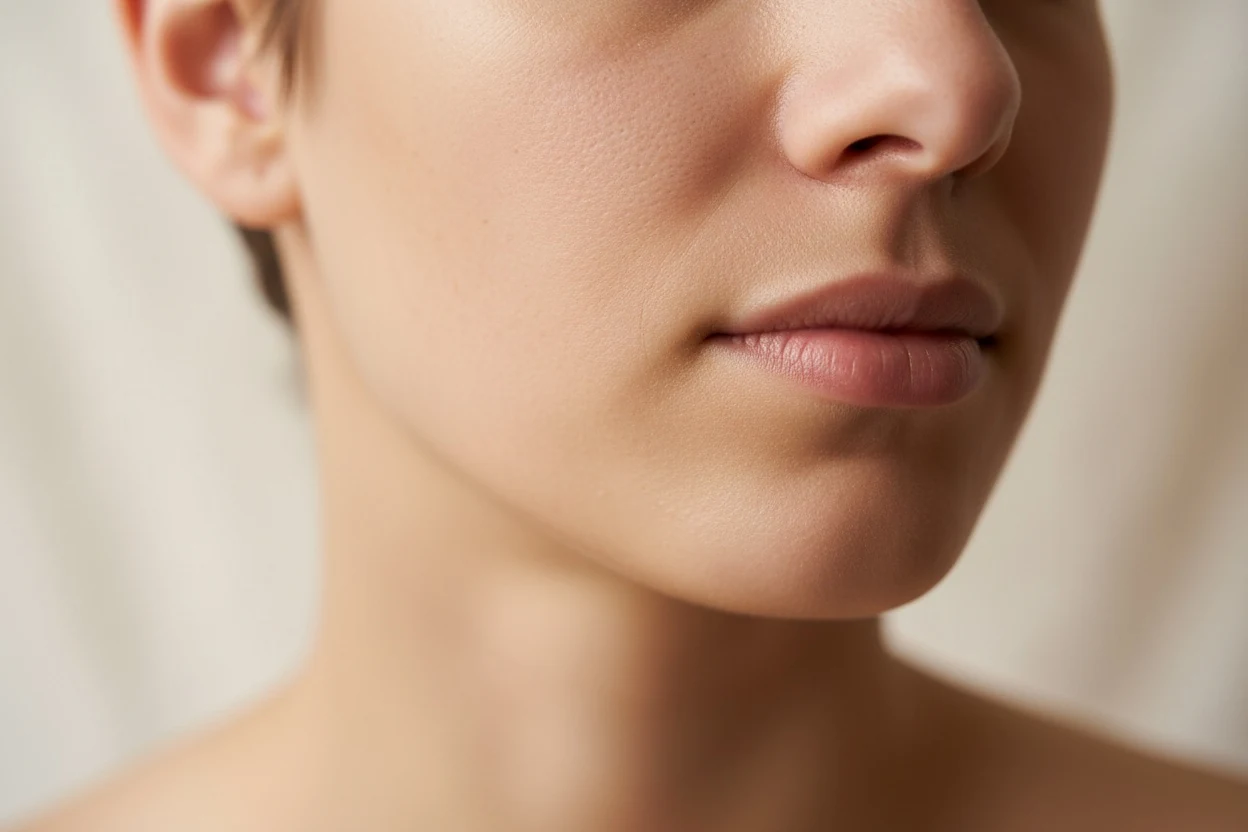
When Matts and colleagues showed 353 people cropped patches of cheek skin from 170 girls and women, with no features at all, the more even the skin colour, the more attractive, healthy and youthful the skin was rated. Fink's earlier work found the same with whole faces. Much of what people describe as a pretty face is, when measured, an even-toned one.
Three things act on evenness with evidence behind them. Daily broad-spectrum sunscreen prevented measurable skin ageing over four and a half years in a randomised trial. Topical retinol improved fine wrinkles after 24 weeks in a randomised, vehicle-controlled trial in elderly adults. And eating more fruit and vegetables shifted skin colour measurably within six weeks. If you are under 18, sunscreen and moisturiser are enough; retinoids are for adults, should be avoided in pregnancy, and anything prescription-strength is for a dermatologist.
How to be prettier naturally: the fruit and vegetable finding
The diet study is the one most people have not heard of. Whitehead and colleagues measured skin colour in 35 people over six weeks while recording what they ate. Changes in fruit and vegetable intake tracked changes in skin redness and yellowness, matching the colour of carotenoid pigments; and the change from roughly three extra portions a day was enough to make skin look perceptibly healthier and more attractive. It was a small study, funded by Unilever, in Caucasian skin — but it is a natural change you can make, and the result is visible rather than theoretical.
Facial contrast: why brows, lashes and makeup work
This is the mechanism most beauty advice skips. Russell measured carefully controlled photographs and found female faces had greater luminance contrast between the eyes, lips and surrounding skin than male faces; turning the contrast up made an androgynous face look female, and turning it down made it look male. Makeup consistently increased that contrast. A follow-up by Jones, Russell and Ward in a larger set of faces found the pattern was specific: women had higher contrast around the eyes and lower contrast at the brows than men, and cosmetics exaggerated both.
Contrast also carries age. Porcheron and colleagues found that aspects of facial contrast decrease with age and that faces look younger when contrast is increased and older when it is decreased — first in Caucasian women, then across Chinese, Latin American and Black South African women rated by French and Chinese participants. The eyes, brows and lips fade slightly relative to skin over the years, and people read that as age.
Brows: the framing change you can make in one appointment
Brows are the easiest place to change contrast and framing without makeup. Groomed, filled-in brows add definition around the eyes; over-plucked ones remove it, and can take months to grow back. As for shape, there is no single ideal: when Feser and colleagues showed 357 people aged 12 to 85 the same female portraits with three brow variations, people under 30 preferred lower brows peaking toward the outer third and ruled out arched brows, while people over 50 preferred the opposite. Shape your brows to suit your face and your taste; any claim of one perfect brow is a trend.
How to be prettier without makeup
If contrast and evenness are what makeup works on, you can move both without it. Sleep lightens under-eye darkness and reduces redness in the eyes. Sunscreen and diet help skin evenness over time. Brushed, groomed brows and clean lashes define the eye area. Lip balm keeps lips smooth and their edge clear. Hair colour and the colours you wear near your face change how much your features stand out against your skin.
If you do wear makeup: it depends on your age
Makeup does work in studies. Etcoff and colleagues found faces with makeup, from natural to dramatic, were rated more attractive and more competent at a glance; the study was funded by a cosmetics company. But one finding matters especially for younger readers: Russell and colleagues showed that makeup made women in their 40s and 50s look younger, made women around 30 look no different — and made women around 20 look older. People associate makeup with adulthood. If you are young, less is not only allowed; it may read better.
Hair and colour: the frame around your face
A haircut that suits your face shape
Hair is the frame a face is seen in, and a cut adds visual width or length exactly where it falls. Width at the sides balances a longer face; length and a diagonal line balance a rounder one; softness at the forehead and jaw suits a face that is widest at the cheekbones. The face shape pages list cuts to try and avoid for each shape, with the reasoning. Knowing your shape before a haircut is the difference between a cut that suits you and a cut that suited the person in the photo.
Compares your forehead, cheekbone and jaw widths with face length from one photo. Measured in your browser, with no upload.
Find your face shape before your next cutColours that suit your colouring
Colour seasons are a styling practice rather than a science with trials, and it is fairer to say so. But the idea connects directly to contrast: the colours closest to your face either work with the natural contrast between your hair, eyes and skin or fight it. Our colour analysis reads those three colours from a photo, corrects for the light using the whites of your eyes, and uses the contrast between hair and skin as part of placing you between bright and soft colouring.
Skin, eye and hair colour from one photo, corrected for the light, placed on the warm–cool, light–deep and bright–soft axes. In your browser.
Find the colours that suit youExpression: how to look prettier in the next five seconds
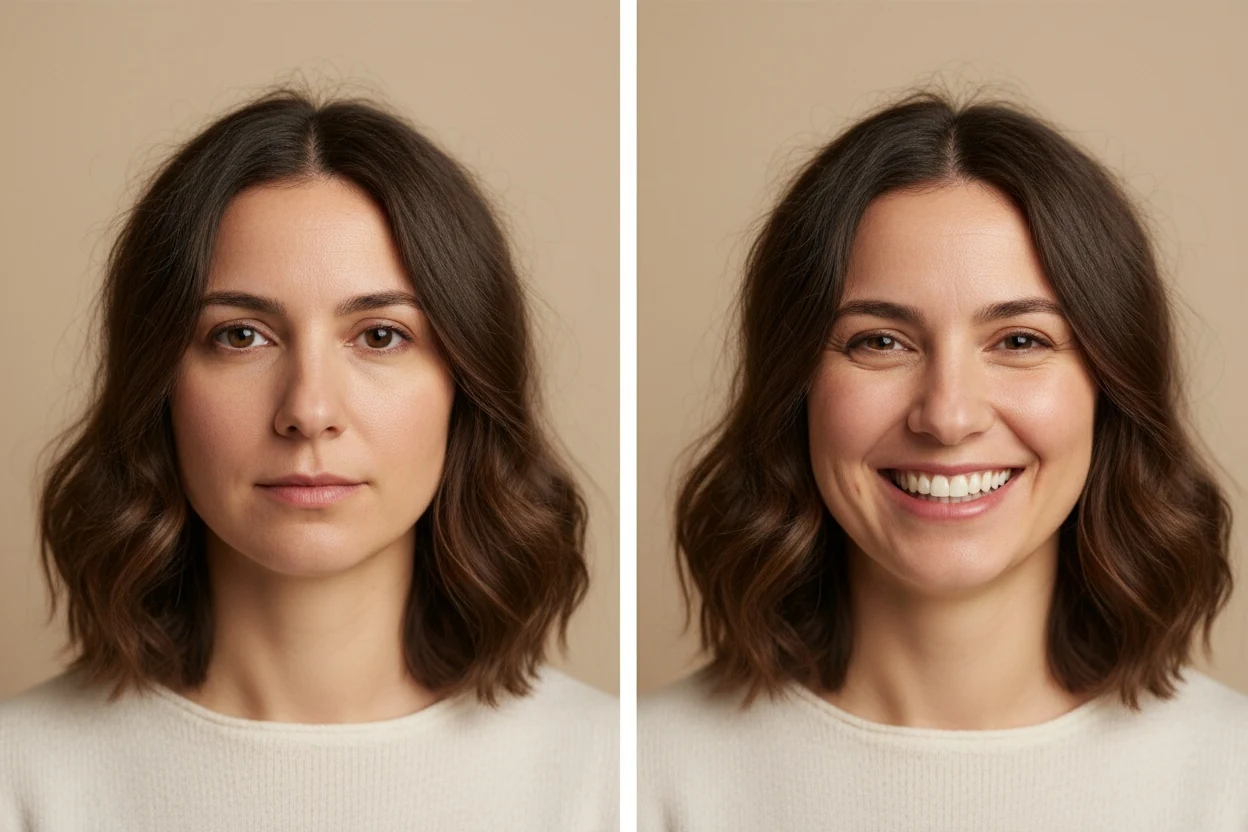
Golle and colleagues asked people to choose the more attractive of two faces that varied in both attractiveness and how much they smiled. The strength of the smile strongly influenced the choice, and a happy expression could even compensate for a face being rated less attractive. The effect ran the other way too: more attractive faces were judged happier. It is the cheapest change on this page, and it works in person, in photos and on video. A genuine smile — one that reaches the eyes — also lifts the cheeks, which is why smiling photos flatter almost everyone.
What makes you look less pretty than you are
Many people searching how to be prettier have just seen a photo of themselves they hated. Before changing anything, it is worth knowing how many things make a face read worse without having anything to do with the face.
| Condition | What it does | Fix |
|---|---|---|
| A bad night's sleep | Hanging eyelids, redder eyes, dark circles, paler skin, droopy mouth corners | Sleep; the cues fade within a night or two |
| Overhead light | Shadows under the eyes, brows and cheekbones | Face a window; light from in front |
| Phone held close | Enlarges the nose and middle of the face, shrinks the ears | Arm's length or further, zoom slightly |
| Camera below the face | Heavier jaw and neck | Camera at or slightly above eye level |
| Unflipped photo | Looks subtly wrong because you know the mirror version | Compare photos with photos, not with the mirror |
| Neutral, tense face | Reads less attractive than a relaxed smile | Relax the jaw, breathe out, smile |
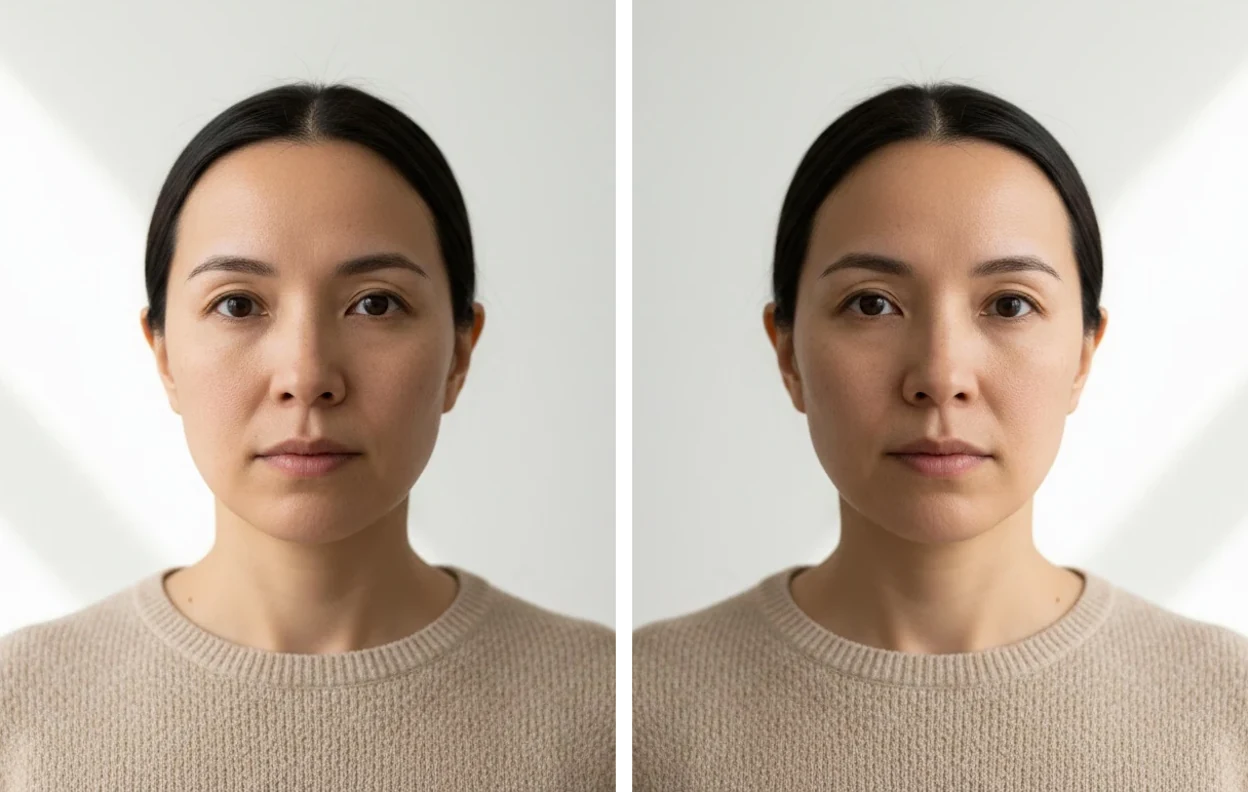
The mirror effect is real and measurable. Because every face is slightly asymmetrical, the face you see in the mirror is genuinely a different image from the one in a photo, and familiarity makes the mirror version feel right. In a study of 214 women, 73% preferred a mirror-reversed photo of themselves to the standard one. How to be photogenic goes through light and lens distance in detail.
Prettier-face advice you can skip
| Advice | What it claims | What the evidence says |
|---|---|---|
| Facial exercises and face yoga | A slimmer, lifted, prettier face | A systematic review found no controlled trials for facial rejuvenation |
| Mewing | Reshaping the jaw and cheekbones | No evidence it changes an adult face |
| Face rollers and gua sha | Sculpting | An 8-week trial found small contour changes of 2–3 mm; attractiveness was not measured |
| "Get a little Botox" | An easy beauty tip | A medical procedure and a clinical decision, not a tip |
| Beauty scores from face-scanner apps | Tracking whether you got prettier | Geometry scores cannot see skin, sleep, contrast or expression |
| 50-point "flaw" checklists | Finding what to fix | They treat normal variation as defects; no evidence behind the list |
What exercise, rollers and chewing can and cannot reach is covered in facial asymmetry exercises. The short version for this guide: none of it changes the things observers were shown to respond to above.
Can you measure whether you got prettier?
Not with a geometry score, including the tools on this site. Am I Pretty and the attractiveness test measure the fixed layer — symmetry and proportions from facial landmarks. Nothing in this guide moves a landmark. Better sleep, more even skin, groomed brows, higher facial contrast and a smile will leave those scores exactly where they were, even when the difference is obvious in a photo. That does not mean the changes failed. It means the gains are in the layer geometry cannot see.
What those scores are useful for is a different worry: whether your proportions or symmetry are unusual. For almost everyone they are within the normal range, and a number can quieten a fear that a mirror feeds. If what you want to know is whether you look better, use photos taken in identical conditions — same window, distance, height and expression — a few weeks apart. How to know if you are attractive goes into what can and cannot be measured.
When wanting to be prettier stops being about looks
Wanting to look your best is ordinary. But if comparing, checking mirrors or retaking photos is taking up hours of your day, if you avoid being seen or photographed, or if nothing you change ever feels like enough, that is not something another routine will fix, and it is worth talking to a doctor, counsellor or someone you trust. For everything else: sleep, look after your skin, frame your face, and smile. The research is surprisingly consistent that those are the things people notice.
Frequently asked questions
How can I be prettier naturally?
Work on the things observers respond to that are not your bone structure: sleep, which changes how your eyes, skin and mouth corners look; even skin tone, helped by daily sunscreen and diet; tidy brows that frame your eyes; a haircut and colours that suit you; and expression. Each has been measured in studies to change how faces are rated, and none requires a product or procedure.
How can I look prettier without makeup?
Makeup mainly works by evening out skin and increasing contrast between your eyes, brows and lips and the skin around them. Without makeup you can move the same signals: sleep reduces dark circles and redness, sunscreen and diet help skin evenness, groomed brows and lashes add definition around the eyes, lip balm keeps lips defined, and colours near your face that suit your colouring stop your skin looking washed out.
How long does it take to look prettier?
A smile works in seconds. The effects of sleep show within one or two nights. A change in skin colour from eating more fruit and vegetables was measurable after six weeks in one study. Retinol's effect on fine lines was measured at 24 weeks in adults, and sunscreen's effect on skin ageing over years. A new haircut, colours and brows change things the same day.
Can I change my face shape to look prettier?
Not the bone. Exercises, mewing and massage do not reshape an adult face. What you can change is how the shape reads: a haircut adds width or length where it sits, and brows and contrast draw attention to the eyes and lips rather than the outline. Face shape itself is normal variation, not a problem to fix.
What makes you look less attractive than you are?
Mostly temporary conditions. Poor sleep adds hanging eyelids, redder eyes, darker circles and paler skin. Overhead light casts shadows under the eyes. A phone held close enlarges whatever is nearest the lens. And a photo shows you the unflipped version of your face, which feels wrong because you are used to the mirror. None of these is your face.
Am I uglier than I think?
Almost certainly not in the way the question means. The version of your face you judge most harshly is usually a close-up, badly lit, unflipped photo, examined for longer than anyone else ever looks at you. People also tend to prefer the mirror version of their own face; in one study 73% of women chose a mirror-reversed photo of themselves over the standard one. If this worry takes over your day, that is worth talking to someone about.
Is there a way to measure if I am getting prettier?
Not with facial geometry tools, including ours. Sleep, skin, brows, contrast and expression do not move facial landmarks, so symmetry and proportion scores stay the same even when you look noticeably better. The honest way to track it is a set of photos taken in identical conditions — same light, distance, height and expression — every few weeks.
What is the single most effective change?
For free and fast, sleep: it changed how faces were rated after just two nights of restriction. For a product, daily broad-spectrum sunscreen, which has a long randomised trial behind it. For the next five seconds, a genuine smile.
References
- Rhodes, G. (2006). The evolutionary psychology of facial beauty. Annual Review of Psychology, 57, 199–226. PMID 16318594.
- Langlois, J. H., & Roggman, L. A. (1990). Attractive faces are only average. Psychological Science, 1(2), 115–121. doi:10.1111/j.1467-9280.1990.tb00079.x.
- Sundelin, T., Lekander, M., Kecklund, G., Van Someren, E. J., Olsson, A., & Axelsson, J. (2013). Cues of fatigue: effects of sleep deprivation on facial appearance. Sleep, 36(9), 1355–1360. PMID 23997369.
- Axelsson, J., Sundelin, T., Ingre, M., Van Someren, E. J., Olsson, A., & Lekander, M. (2010). Beauty sleep: experimental study on the perceived health and attractiveness of sleep deprived people. BMJ, 341, c6614. PMID 21156746.
- Sundelin, T., Lekander, M., Sorjonen, K., & Axelsson, J. (2017). Negative effects of restricted sleep on facial appearance and social appeal. Royal Society Open Science, 4(5), 160918. PMID 28572989.
- Matts, P. J., Fink, B., Grammer, K., & Burquest, M. (2007). Color homogeneity and visual perception of age, health, and attractiveness of female facial skin. Journal of the American Academy of Dermatology, 57(6), 977–984. PMID 17719127.
- Fink, B., Grammer, K., & Matts, P. J. (2006). Visible skin color distribution plays a role in the perception of age, attractiveness, and health in female faces. Evolution and Human Behavior, 27(6), 433–442. doi:10.1016/j.evolhumbehav.2006.08.007.
- Whitehead, R. D., Re, D., Xiao, D., Ozakinci, G., & Perrett, D. I. (2012). You are what you eat: within-subject increases in fruit and vegetable consumption confer beneficial skin-color changes. PLoS ONE, 7(3), e32988. PMID 22412966.
- Hughes, M. C. B., Williams, G. M., Baker, P., & Green, A. C. (2013). Sunscreen and prevention of skin aging: a randomized trial. Annals of Internal Medicine, 158(11), 781–790. PMID 23732711.
- Kafi, R., Kwak, H. S. R., Schumacher, W. E., Cho, S., Hanft, V. N., Hamilton, T. A., … Kang, S. (2007). Improvement of naturally aged skin with vitamin A (retinol). Archives of Dermatology, 143(5), 606–612. PMID 17515510.
- Russell, R. (2009). A sex difference in facial contrast and its exaggeration by cosmetics. Perception, 38(8), 1211–1219. PMID 19817153.
- Jones, A. L., Russell, R., & Ward, R. (2015). Cosmetics alter biologically-based factors of beauty: evidence from facial contrast. Evolutionary Psychology, 13(1), 210–229. PMID 25725411.
- Porcheron, A., Mauger, E., & Russell, R. (2013). Aspects of facial contrast decrease with age and are cues for age perception. PLoS ONE, 8(3), e57985. PMID 23483959.
- Porcheron, A., Mauger, E., Soppelsa, F., Liu, Y., Ge, L., Pascalis, O., Russell, R., & Morizot, F. (2017). Facial contrast is a cross-cultural cue for perceiving age. Frontiers in Psychology, 8, 1208. PMID 28790941.
- Etcoff, N. L., Stock, S., Haley, L. E., Vickery, S. A., & House, D. M. (2011). Cosmetics as a feature of the extended human phenotype: modulation of the perception of biologically important facial signals. PLoS ONE, 6(10), e25656. PMID 21991328.
- Russell, R., Batres, C., Courrèges, S., Kaminski, G., Soppelsa, F., Morizot, F., & Porcheron, A. (2019). Differential effects of makeup on perceived age. British Journal of Psychology, 110(1), 87–100. PMID 30073658.
- Feser, D. K., Gründl, M., Eisenmann-Klein, M., & Prantl, L. (2007). Attractiveness of eyebrow position and shape in females depends on the age of the beholder. Aesthetic Plastic Surgery, 31(2), 154–160. PMID 17235461.
- Golle, J., Mast, F. W., & Lobmaier, J. S. (2014). Something to smile about: the interrelationship between attractiveness and emotional expression. Cognition and Emotion, 28(2), 298–310. PMID 23875865.
- de Runz, A., Boccara, D., Chaouat, M., Locatelli, K., Bertheuil, N., Claudot, F., Bekara, F., & Mimoun, M. (2016). Female plastic surgery patients prefer mirror-reversed photographs of themselves: a prospective study. Journal of Plastic, Reconstructive & Aesthetic Surgery, 69(1), 122–127. PMID 26428387.
- Van Borsel, J., De Vos, M. C., Bastiaansen, K., Welvaert, J., & Lambert, J. (2014). The effectiveness of facial exercises for facial rejuvenation: a systematic review. Aesthetic Surgery Journal, 34(1), 22–27. PMID 24327764.
- Ahn, S. H., Hwang, U. J., Han, H. S., Kim, J. H., Lee, H. J., Jeon, Y. R., Lee, H. H., & Hwang, A. H. (2025). Comparative effects of facial roller and gua sha massage on facial contour, muscle tone, and skin elasticity: randomized controlled trial. Journal of Cosmetic Dermatology, 24(6), e70236. PMID 40439289.
Tools mentioned in this article
Seasonal Color Analysis
Your season from the colours in your photo, corrected for the light it was taken in.
Face Shape Detector
Oval, round, square, heart, oblong, diamond or triangle.
Am I Pretty?
A measured answer instead of an opinion.
Attractiveness Test
Your score out of ten, with every measurement behind it.
Measurements on this site are for information only. Nothing here is medical advice, and no result is a diagnosis. Talk to a qualified clinician before making any decision about a procedure.