How to glow up: the tips that show this week, and the ones that take three months
·16 min read
A glow up is a visible change in how you look and carry yourself over weeks to months. The fastest parts — posture, grooming, a haircut, expression — show today. Sleep shows within days. Skin colour shifts over about six weeks, finer skin changes take months, and nothing on any glow up list changes bone.
Most glow up tips lists put all of that in one column: sunscreen next to affirmations, lymphatic drainage next to sleep, with no way to tell which items have evidence or when you should expect to see anything. This guide sorts every common glow up tip by the clock it runs on — tonight, this week, this month, 90 days — marks the evidence behind each one, and ends with the popular tips that do not work the way they are sold.
How to glow up: the clocks every tip runs on
Every change in how a face looks runs on one of a few clocks. Some work instantly because they change how the face is presented — posture, light, expression, grooming. Some take days because they act on the surface through the body — sleep, fluid, the flush and colour of skin. Some take months because they depend on skin renewing itself or habits accumulating. The underlying structure of the face, the bone, is not on any of them, which is the single most useful thing to know before you start.
| Glow up tip | First visible | What it changes | Evidence | Cost |
|---|---|---|---|---|
| Posture and head position | Instantly | Neck length, jaw line, how open the face looks | Optics | Free |
| Smiling and expression | Instantly | How attractive and approachable you are rated | Controlled experiments | Free |
| Grooming: brows, hair, nails, lips | Same day | How cared-for you read | Styling practice | Low |
| Haircut for your face shape | Same day | Where the eye reads width and length | Styling practice | Moderate |
| Colours near your face | Same day | Apparent evenness and brightness of skin | Styling practice | Low |
| Consistent sleep | 2 nights | Tired look, rated health and attractiveness | Controlled experiments | Free |
| Daily sunscreen | Prevents change over years | Photoageing | Randomised trial | Low |
| More fruit and vegetables | About 6 weeks | Skin yellowness and redness | Within-person study | Low |
| Topical retinol (adults) | About 24 weeks | Fine wrinkles | Randomised trial | Moderate |
| Not smoking | Years | Skin ageing | Twin study | Saves money |
| Facial exercise | Unclear | Possibly cheek fullness | No controlled trials | Free |
| Mewing (adults) | Never shown | Nothing measured | None | Free |
Start your glow up with a photo you can compare against
Most glow up transformations on social media are, in large part, a change of lighting, camera distance and camera height. A photo taken under a ceiling light at 30 centimetres and one taken facing a window at arm's length can look like two different faces. If you do not fix those variables at the start, you will end up comparing setups rather than yourself — and either miss real progress or see progress that is not there.
- 1Same place and light. Stand facing the same window at the same time of day. Daylight from in front is even and repeatable.
- 2Same distance and height. Camera at eye level, at arm's length or on a shelf; a timer helps. Close phones widen the middle of the face.
- 3Same face. Relaxed and neutral, mouth closed, looking into the lens. Then one smiling photo, the same way.
- 4Same framing. Hair pulled back, no makeup for the reference set, head level.
- 5Same schedule. Retake on day 7, day 30 and day 90 and compare side by side, never against the mirror.
Glow up tips that work tonight
Posture and head position
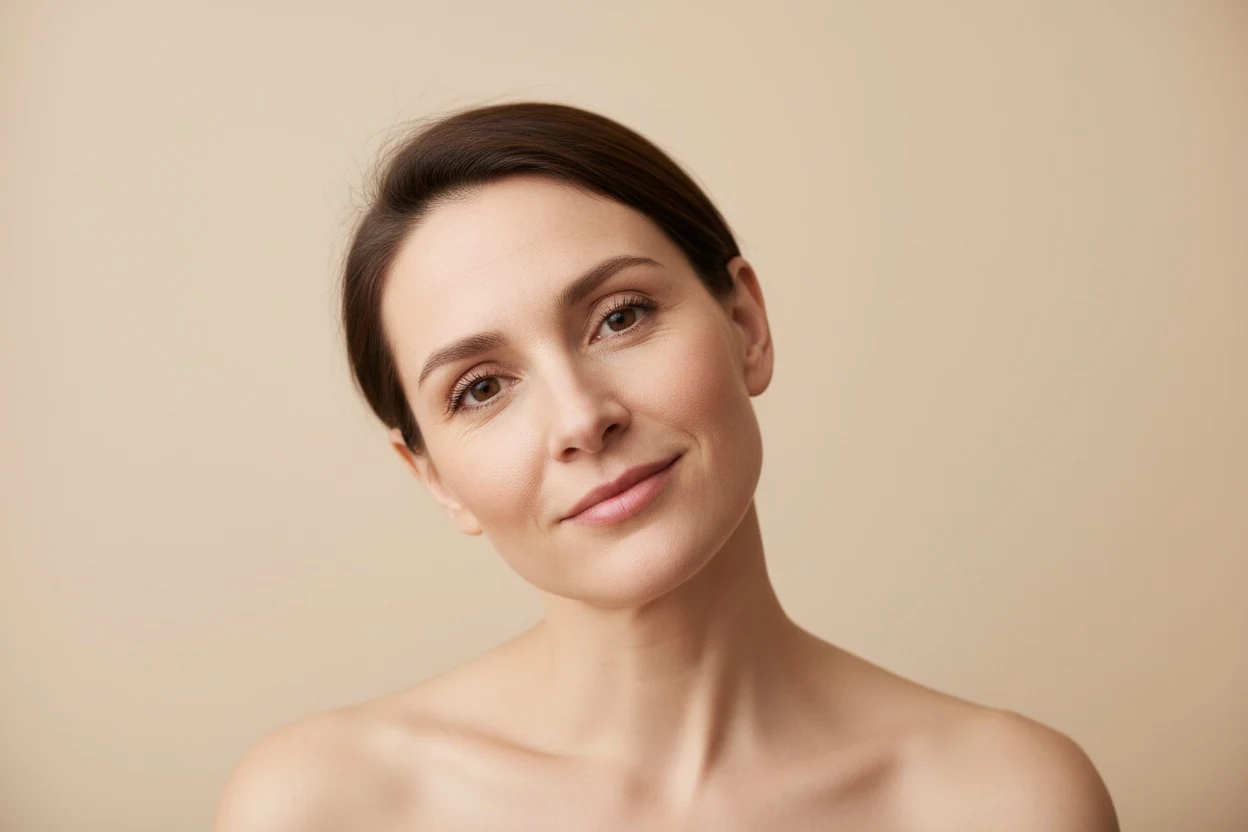
A head carried forward shortens the neck, softens the line under the jaw and, in photos, adds a shadow under the chin. The simplest check needs a side-on mirror or a friend: your ear should sit roughly over your shoulder, not in front of it. This is not a structural change and it does not need an exercise programme to start; it is the fastest free change in how your face and jaw line read, and it applies in every photo and every conversation.
Expression
Golle and colleagues showed people pairs of faces that varied in attractiveness and in how much they smiled, and asked them to pick the more attractive one. The intensity of a smile strongly influenced the choice, and a happy expression could compensate for a face being rated less attractive. It worked the other way as well: attractive faces were read as happier. No glow up tip is cheaper, and it is the one most glow up photos quietly rely on.
Grooming basics
Tidy brows, trimmed hair ends, clean nails, moisturised lips and, for anyone with facial hair, a clean neckline. None of these has a trial behind it, and none needs one: they change whether you read as cared-for, and they are all done tonight.
Light and camera
Face a window rather than having it behind or beside you, hold the camera at eye level and step back. Light from in front evens out skin; overhead light carves shadows under the eyes and cheekbones. That is a glow up only in photos, but it is also the reason your own before-and-after photos need fixed conditions.
How to glow up in a week
Seven days is enough for the fast clocks: sleep, grooming, a haircut, colours and posture. It is not enough for skin texture, fitness or anything structural. Here is a realistic glow up checklist for the week:
| Day | Do | Why it shows by day 7 |
|---|---|---|
| 1 | Take your reference photos. Set a fixed bedtime and wake time for the week. | Sleep effects on appearance appeared after two nights in one study |
| 2 | Tidy brows and trim nails; start sunscreen every morning as a habit. | Brows frame the eyes immediately; sunscreen is a habit to lock in now |
| 3 | Find your face shape and book a haircut chosen for it, not for a trend. | A cut changes where width and length read |
| 4 | Find your colour season and move the colours that suit you nearest your face. | Colours next to the face change how even skin looks |
| 5 | Add fruit and vegetables to every meal. | Starts the six-week skin colour clock |
| 6 | Posture check morning and evening; take a walk in daylight. | Head carriage shows in every photo |
| 7 | Retake the reference photos in the same conditions and compare. | You are comparing you, not the lighting |
Seven nights of sleep
Sleep has the best experimental evidence of anything on this page. In Axelsson and colleagues' 2010 study in the BMJ, 23 young adults were photographed after a normal night's sleep and again after sleep deprivation — 31 hours awake after a short night — and 65 observers rated the photos in random order. Sleep-deprived faces were rated less healthy, more tired and less attractive. A 2017 follow-up by Sundelin and colleagues used a more ordinary scenario, two days of restricted sleep, and 122 raters: restricted-sleep faces were again rated less attractive, less healthy and sleepier, and raters were less willing to socialise with them. The effect is not large, but it appears within days and it costs nothing.
A haircut chosen for your face shape, not a trend
A haircut is the biggest same-day change most people can make, and the most common mistake is choosing it from a photo of someone with a different face shape. The principle is simple: hair adds visual width or length where it sits. A long face looks better with width at the sides; a round face with length and a diagonal line; a face widest at the cheekbones with softness at the forehead and jaw. The face shape pages list cuts to try and avoid for each shape, with the reasoning — for all genders, not only long-haired styles.
Face shape is decided by comparing your forehead, cheekbone and jaw widths with face length. One photo, measured in your browser, no upload.
Find your face shape before the cutColours near your face
Seasonal colour analysis is a styling practice rather than a science with trials behind it, and it is worth saying so. What it does rest on is measurable: the colour of your skin, eyes and hair, and how much contrast there is between them. Colours near the face that work with those make skin look more even; colours that fight them make shadows and redness stand out. Our colour analysis reads those three colours from a photo and corrects for the light using the whites of your eyes — and says so when it cannot correct it, rather than guessing a season.
Skin, eye and hair colour read from one photo, corrected for the light, placed on the warm–cool, light–deep and bright–soft axes. In your browser.
Find your colour seasonHow to glow up in a month
Thirty days is where the first body-driven change becomes visible, and where habits start to show up in photos rather than only in how you feel. Brows grow back into a shape, sleep has had time to settle, and diet starts to show in skin colour.
Fruit, vegetables and skin colour
Whitehead and colleagues tracked diet and measured skin colour with a spectrophotometer in 35 people at the start, at three weeks and at six weeks. Changes in fruit and vegetable intake over six weeks were significantly linked to changes in skin redness and yellowness, and the colour change matched the absorption pattern of carotenoids, the pigments in those foods, not melanin. In a second part of the study, the colour change from roughly three extra portions a day was enough for skin to look perceptibly healthier and more attractive. The study was funded by Unilever and measured Caucasian skin only.
A 30-day glow up challenge that measures itself
Glow up challenges fail in two ways: they pile everything onto day one, and they never check whether anything changed. This one adds one change per week and ends each week with the same photo.
| Week | Add this | Keep doing | Check at the end of the week |
|---|---|---|---|
| 1 | Fixed sleep schedule, reference photos, sunscreen every morning | — | Do you look less tired in the day-7 photo? |
| 2 | Fruit or vegetables with every meal; brows and haircut sorted | Sleep, sunscreen | Has the haircut changed how your face shape reads? |
| 3 | A daily walk or other movement you will actually keep; posture checks | Sleep, sunscreen, diet | Head carriage in the side-on photo |
| 4 | Cut back alcohol on weeknights; colours that suit you near the face | All of the above | Day-30 photos against day 1, same conditions |
The 90-day glow up: skin, habits and the slow levers
The skincare routine with trials behind it
A glow up skincare routine does not need ten steps. It needs the steps that have been tested, done consistently:
| Step | Tested outcome | Trial | Not tested for |
|---|---|---|---|
| Broad-spectrum sunscreen every morning | Less skin ageing over 4.5 years | Hughes et al., 2013: 903 adults, randomised | Instant glow; it is prevention |
| Retinol at night (adults) | Fewer fine wrinkles after 24 weeks | Kafi et al., 2007: randomised, double-blind, vehicle-controlled | Young skin: participants' average age was 87, on the arm |
| Moisturiser | Comfort and barrier; supports tolerance of actives | Standard dermatology practice | Changing texture on its own |
Hughes and colleagues randomised adults in Queensland to daily or discretionary sunscreen for four and a half years; the daily group showed no detectable increase in skin ageing over the period, and 24% less than the discretionary group. Kafi and colleagues' retinol trial is the other half: 0.4% retinol three times a week for 24 weeks improved fine wrinkling against a placebo lotion — in very elderly participants, on the arm. If you are under 18, sunscreen and a moisturiser are enough; retinoids are for adults, should be avoided in pregnancy, and anything stronger is a conversation with a dermatologist. Layering several actives at once mainly buys irritation.
Even skin tone does more than features
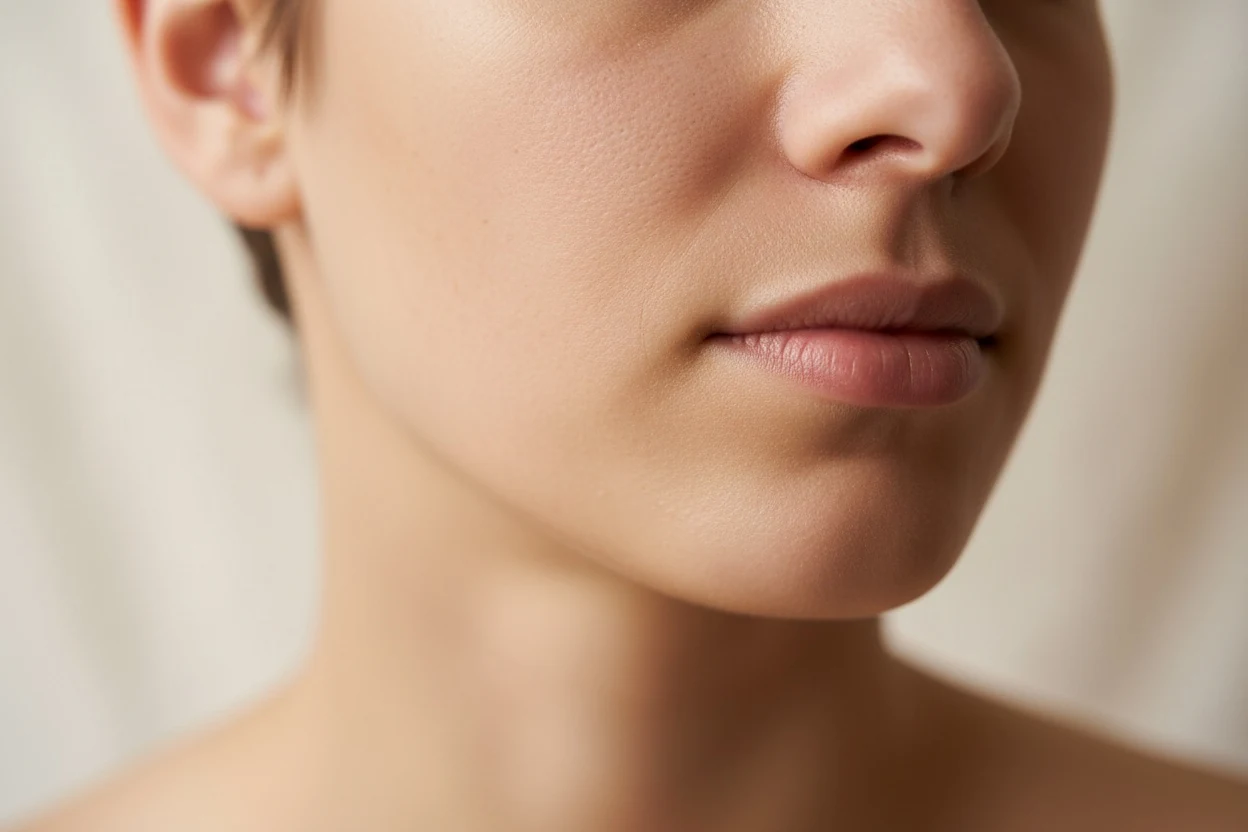
Matts and colleagues cropped cheek skin images from 170 girls and women aged 11 to 76, removing every facial feature, and had 353 people rate them. The more even the skin colour, the more attractive, healthy and youthful it was rated (all correlations above 0.40), and the younger it was judged. Earlier work by Fink and colleagues found the same with whole faces. That is why sleep, sun protection and diet — which all act on evenness and colour — belong at the top of a glow up rather than at the bottom.
Movement, alcohol and smoking
Regular movement improves sleep and posture, both of which show. This page gives no body fat or weight targets: they are not supported as appearance goals, faces carry fat very differently, and chasing a number is a well-worn route to disordered eating. Alcohol before bed disrupts sleep, which then shows. Smoking is the one habit with long-term visual evidence: in a study of 79 pairs of identical twins, the twin who smoked, or had smoked at least five years longer, was graded worse on signs of ageing across the middle and lower face.
What about collagen supplements?
A 2025 meta-analysis of 23 randomised trials with 1,474 participants found collagen supplements improved skin hydration, elasticity and wrinkles overall — but when the trials were split by funding, the ones not funded by industry showed no effect, and neither did the high-quality ones. The authors concluded there is no clinical evidence to support using them for skin ageing. None of the trials measured a glow, and none measured the face's shape.
Glow up tips that do not work the way they are sold
| Tip | What it is sold as | What was actually measured |
|---|---|---|
| Mewing | Reshaping the jaw and cheekbones | No evidence of changing adult bone; jaw posture only influences growth in children |
| Facial exercises and face yoga | A natural facelift | A 2014 systematic review found no controlled trials; a 2018 pilot with no control group reported fuller cheeks |
| Jaw exercisers and gum chewing | A bigger, sharper jaw | Six months of gum chewing raised bite force but did not change jaw shape or chewing muscle thickness (randomised trial) |
| Face rollers and gua sha | Sculpting and symmetry | An 8-week randomised trial found small contour changes of 2–3 mm, applied to both sides; nothing about symmetry |
| Switching your chewing side | Fixing an uneven face | A 748-person 3D study found chewing side had no significant effect on facial asymmetry |
| Lymphatic drainage massage | Lasting de-puffing and contour | No controlled evidence found for lasting facial change |
| Affirmations and manifesting | A glow up from the inside | No measured effect on appearance; no harm either |
| Collagen supplements | Glowing skin | No effect in independently funded trials (2025 meta-analysis) |
Two of those are worth a sentence more because they are repeated so often. The chewing-side claim runs backwards: in the large study, what predicted which side people chewed on was missing teeth, not the other way round. And rollers do something measurable — just not what they are sold for, and not permanently. The details, and what exercise can and cannot reach, are in facial asymmetry exercises. If your glow up goal is really a jaw or cheekbones, high cheekbones and gonial angle explain what actually moves each one.
The mental side of a glow up, without the slogans
Half the glow up advice online is about mindset, and much of it is slogans. The parts with evidence are narrower and more useful. Expression changes how you are seen, as the smile experiments above show. And the feed you scroll can work against you: in Fardouly and colleagues' experiment, 112 young women spent ten minutes on Facebook, a fashion magazine website or a neutral site. Those on Facebook reported a more negative mood than the control group, and women who tend to compare their appearance reported more concerns about their face, hair and skin after Facebook than after the neutral site.
So one of the most effective mental glow up tips is to notice which accounts leave you feeling worse about your face and mute them, especially glow up "before and after" content, which is routinely filtered, relit or both. Journalling, setting boundaries and routines that make you feel good are worth doing because they make you feel good; they do not need a claim about your appearance to justify them. If worry about how you look is taking up hours of your day or stopping you doing things, that is worth talking to a doctor or counsellor about, not fixing with another routine.
Glow up for guys: the same clocks, different defaults
- Beard and neckline. A defined neckline and cheek line is the grooming change with the biggest visual return. Keep the line above the Adam's apple rather than on the jaw.
- Brows. Tidy the gap between them and any stray hairs; do not reshape them.
- Haircut. Chosen for your face shape, like anyone else's. A longer face suits more width at the sides; a round face suits height and shorter sides.
- Sunscreen. The skincare step with a four-and-a-half-year randomised trial behind it, every morning, not only on sunny days.
- Sleep, diet, posture. Identical evidence, identical clocks.
- No body fat targets. Numbers for a "visible jaw" are not taken from any study.
How long does a glow up take? Tracking it honestly
| By | What you can expect to see | What you cannot expect yet |
|---|---|---|
| Tonight | Posture, expression, grooming, better photo light | Any change in the face itself |
| Day 7 | Less tired look with consistent sleep; new haircut and colours | Skin colour or texture change |
| Day 30 | Brows grown in; habits visible in photos; early skin colour change | Retinol effects; fitness changes in the face |
| Day 90 | Skin colour from diet; habits established; photos that compare fairly | Bone changes, from anything |
One honest note about measurement. The facial geometry tools on this site — face shape, symmetry, proportions — will give you almost exactly the same numbers on day 90 as on day 1, because sleep, skin, brows and colour do not move facial landmarks. That is not a failure of the glow up. Most of a glow up happens in the layer a landmark cannot see: light, skin, grooming and expression. The comparison that shows it is your own photo series in fixed conditions. The two tools that do feed a glow up are the ones that inform choices — face shape for a haircut, colour analysis for what to wear near your face.
Why each of these changes how a face is seen — facial contrast, skin evenness, tiredness cues — is covered in how to be prettier, and what can and cannot be measured about a face in how to know if you are attractive. The short version for a glow up: the bone was never the variable. Sleep, skin, hair, colour, posture and expression are, and they are the ones you can change.
Frequently asked questions
How do I start my glow up?
With a reference photo and a bedtime. Take one photo in fixed conditions — same window, same distance, same time of day, neutral face, hair back — so you can compare later against something real. Then fix your sleep, because it is the fastest change with experimental evidence behind it. Add one change per week after that, rather than twenty on day one.
How long does it take to glow up?
It depends on the change. Posture, grooming, a new haircut and expression show immediately; a run of good sleep shows within days; skin colour from eating more fruit and vegetables changed measurably within six weeks in one study; retinol's effect on fine lines was measured at 24 weeks; sunscreen's protective effect was measured over years. A realistic visible glow up is a 90-day project, not a weekend one.
How can I glow up in a week?
Focus on what can show in seven days: sleep on a fixed schedule, tidy brows, a haircut chosen for your face shape, colours near your face that suit your colouring, daily sunscreen started as a habit, and posture. Skin texture, fitness and anything involving bone cannot change in a week, and anything that promises they will is selling something.
What are the glow up tips that actually work?
Ranked by evidence: sleep (rated appearance changed after just two nights of restriction in a controlled study), even skin tone (skin colour evenness alone shifted ratings of age, health and attractiveness), fruit and vegetables for skin colour (measurable within six weeks), daily sunscreen (a four-and-a-half-year randomised trial), smiling (a happy expression compensated for lower rated attractiveness in experiments), and a haircut and colours that suit you.
Can you glow up without makeup?
Yes. In one study of makeup looks from minimal to dramatic, each look worked partly by increasing the contrast between the features and the surrounding skin, and even minimal makeup raised ratings. Sleep, sun protection and diet act on the skin side of that contrast — its evenness and colour — without any product on the face. Makeup is a tool you can use or not; it is not a requirement of a glow up.
Does mewing help a glow up?
There is no evidence that mewing changes the face of an adult. Tongue posture influences jaw growth in children, but an adult jaw has finished growing, and even six months of daily gum chewing in a randomised trial did not change jaw shape or the size of the chewing muscle. Posture of the head and neck, by contrast, changes how the jaw line looks immediately.
Is a glow up physical or mental?
Both, and they are linked in ways that can be measured. Expression changes how attractive a face is rated. Mood and how you see your own appearance can be pushed down by just ten minutes of social media for people prone to appearance comparison. A glow up that makes you more anxious about your face is not working, whatever the photos show.
How do I glow up as a guy?
The same clocks apply. The defaults differ: beard shape and neckline, brow tidying rather than shaping, a haircut chosen for your face shape, and daily sunscreen. Skip body fat targets; they have no evidence base for appearance and are a poor thing to chase.
References
- Axelsson, J., Sundelin, T., Ingre, M., Van Someren, E. J., Olsson, A., & Lekander, M. (2010). Beauty sleep: experimental study on the perceived health and attractiveness of sleep deprived people. BMJ, 341, c6614. PMID 21156746.
- Sundelin, T., Lekander, M., Sorjonen, K., & Axelsson, J. (2017). Negative effects of restricted sleep on facial appearance and social appeal. Royal Society Open Science, 4(5), 160918. PMID 28572989.
- Whitehead, R. D., Re, D., Xiao, D., Ozakinci, G., & Perrett, D. I. (2012). You are what you eat: within-subject increases in fruit and vegetable consumption confer beneficial skin-color changes. PLoS ONE, 7(3), e32988. PMID 22412966.
- Matts, P. J., Fink, B., Grammer, K., & Burquest, M. (2007). Color homogeneity and visual perception of age, health, and attractiveness of female facial skin. Journal of the American Academy of Dermatology, 57(6), 977–984. PMID 17719127.
- Fink, B., Grammer, K., & Matts, P. J. (2006). Visible skin color distribution plays a role in the perception of age, attractiveness, and health in female faces. Evolution and Human Behavior, 27(6), 433–442. doi:10.1016/j.evolhumbehav.2006.08.007.
- Golle, J., Mast, F. W., & Lobmaier, J. S. (2014). Something to smile about: the interrelationship between attractiveness and emotional expression. Cognition and Emotion, 28(2), 298–310. PMID 23875865.
- Etcoff, N. L., Stock, S., Haley, L. E., Vickery, S. A., & House, D. M. (2011). Cosmetics as a feature of the extended human phenotype: modulation of the perception of biologically important facial signals. PLoS ONE, 6(10), e25656. PMID 21991328.
- Hughes, M. C. B., Williams, G. M., Baker, P., & Green, A. C. (2013). Sunscreen and prevention of skin aging: a randomized trial. Annals of Internal Medicine, 158(11), 781–790. PMID 23732711.
- Kafi, R., Kwak, H. S. R., Schumacher, W. E., Cho, S., Hanft, V. N., Hamilton, T. A., … Kang, S. (2007). Improvement of naturally aged skin with vitamin A (retinol). Archives of Dermatology, 143(5), 606–612. PMID 17515510.
- Okada, H. C., Alleyne, B., Varghai, K., Kinder, K., & Guyuron, B. (2013). Facial changes caused by smoking: a comparison between smoking and nonsmoking identical twins. Plastic and Reconstructive Surgery, 132(5), 1085–1092. PMID 23924651.
- Myung, S. K., & Park, Y. (2025). Effects of collagen supplements on skin aging: a systematic review and meta-analysis of randomized controlled trials. The American Journal of Medicine, 138(9), 1264–1277. PMID 40324552.
- Van Borsel, J., De Vos, M. C., Bastiaansen, K., Welvaert, J., & Lambert, J. (2014). The effectiveness of facial exercises for facial rejuvenation: a systematic review. Aesthetic Surgery Journal, 34(1), 22–27. PMID 24327764.
- Alam, M., Walter, A. J., Geisler, A., Roongpisuthipong, W., Sikorski, G., Tung, R., & Poon, E. (2018). Association of facial exercise with the appearance of aging. JAMA Dermatology, 154(3), 365–367. PMID 29299598.
- Ahn, S. H., Hwang, U. J., Han, H. S., Kim, J. H., Lee, H. J., Jeon, Y. R., Lee, H. H., & Hwang, A. H. (2025). Comparative effects of facial roller and gua sha massage on facial contour, muscle tone, and skin elasticity: randomized controlled trial. Journal of Cosmetic Dermatology, 24(6), e70236. PMID 40439289.
- Jung, H. J., Hwangbo, N. K., Park, Y., & Ahn, H. J. (2024). Effects of gum chewing training on occlusal force, masseter muscle thickness and mandibular shape: a randomised controlled clinical trial. Journal of Oral Rehabilitation, 51(12), 2529–2536. PMID 39215439.
- Heikkinen, E. V., Vuollo, V., Heikkinen, T., & Harila, V. (2024). Chewing side preference, facial asymmetry and related factors in the Northern Finland Birth Cohort 1986. Acta Odontologica Scandinavica, 83, 500–506. PMID 39291747.
- Fardouly, J., Diedrichs, P. C., Vartanian, L. R., & Halliwell, E. (2015). Social comparisons on social media: the impact of Facebook on young women's body image concerns and mood. Body Image, 13, 38–45. PMID 25615425.
Tools mentioned in this article
Face Shape Detector
Oval, round, square, heart, oblong, diamond or triangle.
Seasonal Color Analysis
Your season from the colours in your photo, corrected for the light it was taken in.
Attractiveness Test
Your score out of ten, with every measurement behind it.
Symmetry Checker
Left against right across six landmark pairs.
Measurements on this site are for information only. Nothing here is medical advice, and no result is a diagnosis. Talk to a qualified clinician before making any decision about a procedure.