Hairstyles for every face shape, and why each one works
·23 min read
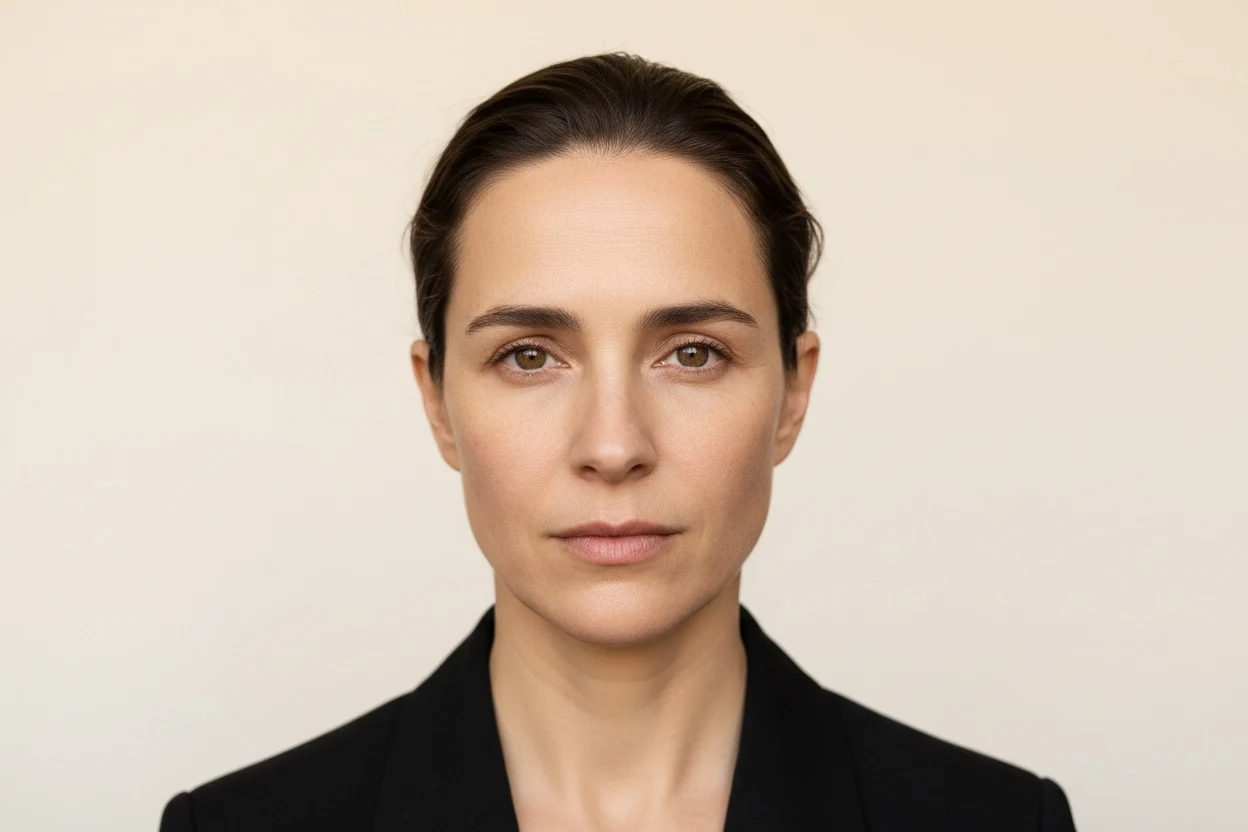
Every guide to hairstyles for face shape ends up saying the same thing in different words, and it is worth saying plainly: a haircut is a way of adding volume and lines to an outline. Height adds length. Fullness at the sides adds width. A fringe removes visible length. A blunt edge draws a horizontal line wherever it stops. Once you know which part of your face is widest and which is narrowest, the right cut is mostly geometry.
This guide covers all seven face shapes, including triangle, for women and men, with a table by hair type and a table for results that fall between two shapes. It also includes something the other guides do not: a test of whether hair over the forehead or cheeks changes what a face shape detector measures. It does, and the numbers are below.
Forehead, cheekbone and jaw widths and face length from one straight-on photo. Pull your hair back first. Runs in your browser; the photo is not uploaded.
Measure your face shape firstHow a haircut changes the way a face shape reads
Three levers decide almost every recommendation in this guide. Vertical lines — height at the crown, lengths falling past the jaw, a centre gap in curtain bangs — make a face read longer. Horizontal lines and side volume — a blunt edge, waves at cheek level, fuller sides on a man's cut — make it read wider at the height where they sit. Coverage — a fringe, a side sweep, hair falling over the cheeks — hides part of the outline, so the eye measures what is left.
The same lever helps one shape and hurts another. Height at the crown is the first recommendation for a round or triangle face and the first thing to avoid on an oblong or heart face. A blunt bob at the jaw is the classic mistake on a square face and one of the best cuts for a heart face. That is why generic lists of flattering haircuts disagree with each other: they are written for different outlines.
What a haircut can and cannot change
A haircut cannot change the width of your jaw, the height of your cheekbones or the length of your face. It changes three other things: which parts of the outline are visible, where extra volume sits beside the face, and which lines the eye follows. Those are real effects on how a face looks, and they are also the limit.
Find your face shape before choosing a haircut
Face shape comes from four measurements: forehead width, cheekbone width, jaw width and face length. Take them with your hair pulled back, facing a mirror or a camera straight on.
- Forehead: across the widest part of the forehead, roughly at the temples.
- Cheekbones: across the most prominent points of the cheekbones, usually just below the outer corners of the eyes.
- Jaw: from the corner of the jaw on one side to the other, below the ears.
- Length: from the top of the forehead down to the bottom of the chin.
Then compare. If length is close to the cheekbone width and the jaw is soft, the face is round; if it is close and the jaw is angular with similar widths all the way down, square. If length clearly exceeds width with the three widths similar, oblong. Widest at the forehead and narrowing to the chin is heart; widest at the cheekbones with a narrow forehead and jaw is diamond; widest at the jaw is triangle. A balanced face that is longer than it is wide and tapers gently to the chin is oval. The face shape pages go through each one with a chart.
Tape measure vs face shape detector: where length starts
Face shape charts written for a tape measure take face length from the hairline to the chin. A photo tool built on a face landmark model, including the detector on this site, cannot see a hairline: the model maps the skin of the face, not the hair, and its top point sits on the upper forehead, below where the hair starts. So the two methods produce different length-to-width ratios for the same face, and the cut-off numbers from a tape measure chart do not apply to a detector's output. That is not an error in either method, only a different starting line. It matters for hair in two ways: a high or receding hairline makes a face measure longer on a tape but not on the detector, and hair covering the forehead moves the detector's starting line — which is the test below.
If your result sits between two shapes
Many faces sit close to a boundary, and tape measurements and photo tools can both land on either side of it from one day to the next. Rather than pick a label, look at the measurement that separates the two shapes and follow the advice both share.
| Between | The measurement that separates them | Hair advice to follow |
|---|---|---|
| Round and oval | Face length against cheekbone width | Height on top and lengths past the jaw help both; skip very tall styles if your face is at the longer end |
| Round and square | In a mirror, the jaw corner (a curve or a visible angle); on the detector, face length, because a photo reads the corner poorly | Height on top suits both; add softness below the jaw only if the corner is visibly angular |
| Oval and oblong | Face length against width | If much of the length is forehead, a fringe or curtain bangs; otherwise treat it as oval |
| Oblong and square | Face length, with an angular jaw on both | Oblong advice (fringe, width at the cheeks), with waves or layers around the jaw rather than a blunt edge at it |
| Heart and diamond | Forehead width against cheekbone width | Volume at the jaw suits both; add width at the temples only if the forehead is narrower than the cheekbones |
| Heart and oval | How much the jaw narrows toward the chin | Chin-length and jaw-level volume suit both; keep height at the crown modest |
| Square and triangle | Forehead width against jaw width | Keep volume off the jaw either way; add height and temple width if the forehead is the narrower one |
If two photos give two neighbouring labels, you are near a boundary — follow the shared advice in the table above.
Check your face shape again, hair backHairstyles for every face shape at a glance
| Face shape | What sets it apart | Add volume | Keep volume off | Fringe | Lengths that work | Avoid |
|---|---|---|---|---|---|---|
| Round | Length close to width, soft jaw | Crown; long vertical lengths | Cheeks, ear level | Curtain or side-swept, not blunt | Past the collarbone, or short with height | Blunt bob at the cheek, flat centre part |
| Oval | Longer than wide, gentle taper | Sides, if anywhere | Very tall crown | Any | Any | Heavy height at the crown |
| Square | Similar widths, angular jaw | Below the jaw (to soften) | At the jaw corner | Side-swept | Past the jaw | Blunt bob exactly at the jaw |
| Oblong | Clearly longer than wide, similar widths | Cheek level, sides | Crown | Blunt, curtain or side-swept — the key change | Chin to collarbone | Long, straight, one-length hair; high crown |
| Heart | Wide forehead, narrow chin | Jaw and chin level | Crown, temples | Side-swept | Chin to shoulder | Height at the crown, slicked back |
| Diamond | Widest at cheekbones, narrow forehead and jaw | Forehead and jaw | Cheekbone level | Fringe or curtain bangs | Chin to just past the jaw | Volume at the cheekbones, slicked back |
| Triangle | Jaw wider than forehead | Crown and temples | Jaw level | Side-swept | Short to medium, ending above the jaw | Blunt edge at the jaw, flat top |
Hairstyles for a round face
A round face is close to as long as it is wide, with full cheeks and a jaw without a visible corner. The two jobs a haircut can do are adding vertical line and keeping width off the cheeks, and the best cuts do both at once. The round face shape page has the full cut list by hair type.
- Long layers that start below the cheekbone. The length draws the eye down, and starting the layers lower keeps their volume away from the widest part of the face.
- An angled lob, longer at the front. A short cut without a horizontal line at the cheek: the front edge runs diagonally down toward the chin.
- A deep side part with lift at the root. No cut needed. The part cuts diagonally across the forehead and the lift adds height.
- Men: a quiff or pompadour with tapered sides. Height above the forehead with close sides changes a wide silhouette into a tall one.
- Men: a textured crop with a high fade. The fade takes width off the sides of the head; texture on top adds some height.
- Men: a hard side part. A straight line on a face built of curves, with the sides kept short.
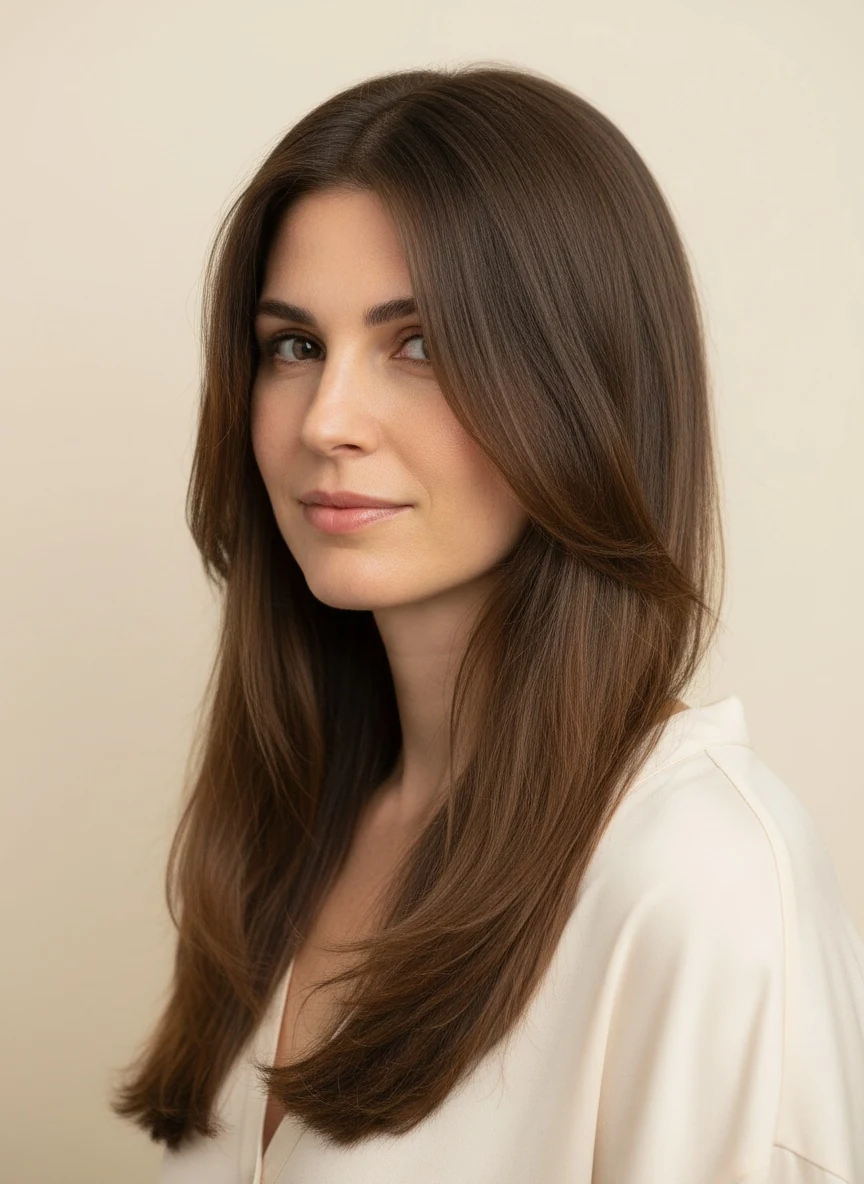
Chubby face or round face?
Round is a proportion, not a weight. A slim person can have a round face, and a full face can be oval or square underneath. Soft tissue does change the outline, though — full cheeks and a soft jaw line push a face toward reading round — so the haircut advice for a face that looks full is the same as for a round face: vertical lines, no volume at the cheeks, and a clean line under the jaw if you have a beard.
Short or long hair on a round face
Both work, and the deciding factor is where the lines end. Long hair works when it falls past the collarbone and does not flare at ear level. Short hair works when it builds height and keeps the sides close: a textured pixie with lift, or a men's quiff. The length to be careful with is the one that ends at the cheeks or just below them, like a one-length chin bob, because the edge sits exactly where the face is widest.
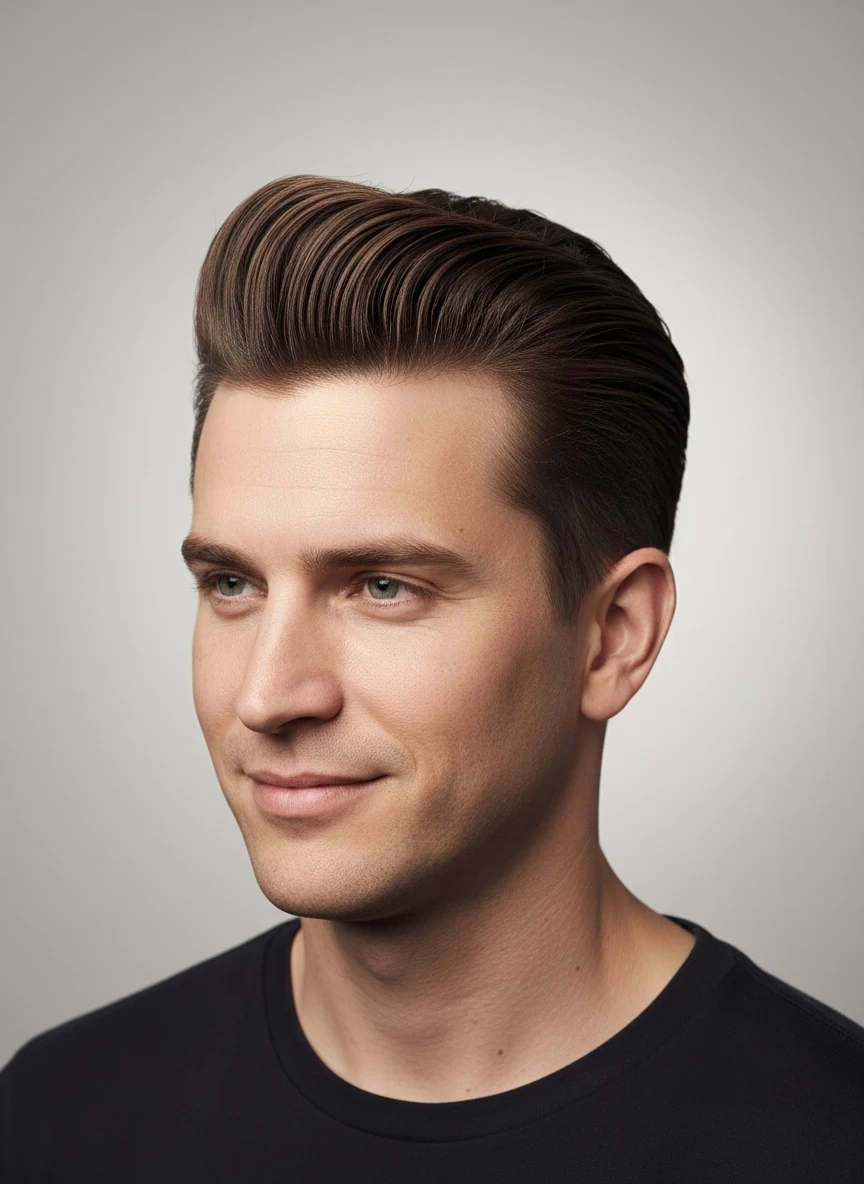
Hairstyles for an oval face
An oval face is longer than it is wide and narrows gently from the cheekbones to the chin. There is no imbalance for a haircut to correct, so the honest answer is that most cuts work. The one direction an oval face can overshoot in is length: a very tall crown or long, flat, one-length hair makes it read longer. A blunt cut at the collarbone, shoulder-length waves, a jaw-length bob and a pixie all suit it. For men, a textured crop, a side part or a very short cut all work, and a beard is best kept short and even.
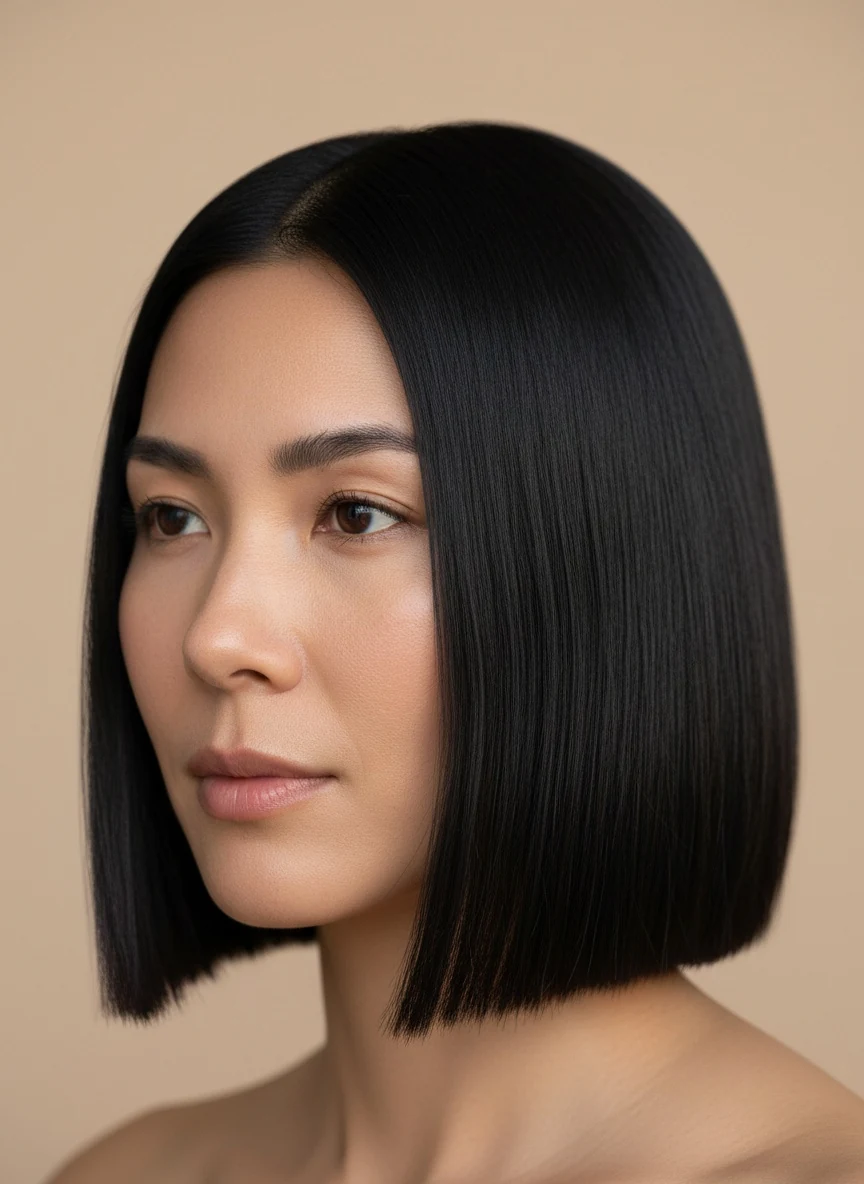
Why so many results say oval
Oval is the shape people are most often told they have, and part of the reason is how classification works. Oval is defined by the absence of anything extreme: not especially long, not especially wide at the jaw, not especially narrow at the forehead. On the detector on this site it is the label a face gets when none of the other six rules match. So if your result is oval but close to a boundary, check your measurements against the neighbouring shape in the borderline table above — the advice for that shape may suit you better.
Hairstyles for a square face
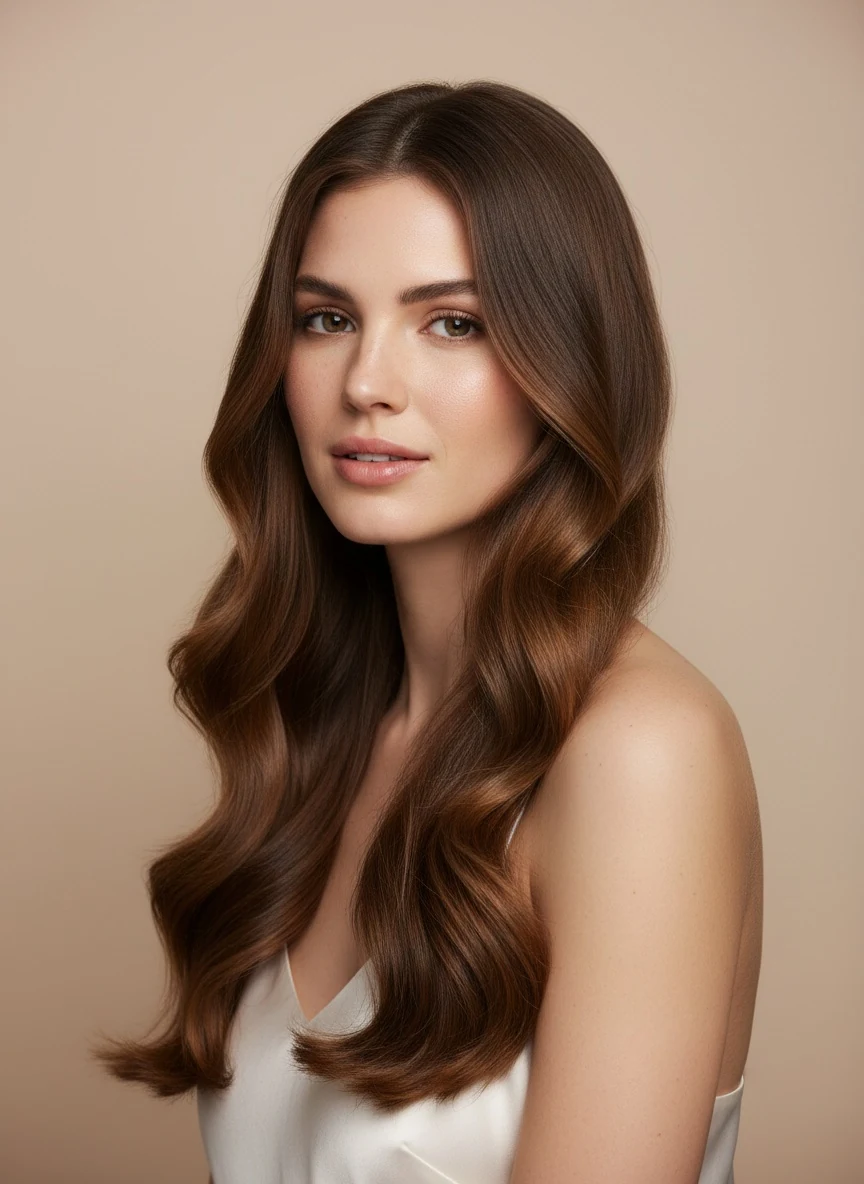
A square face has similar widths at the forehead, cheekbones and jaw, a strong jaw corner and a length close to its width. Many people want exactly that jaw, so the advice here is a choice. To soften the angles, use curves that fall around or below the jaw: long soft waves that start below the jaw, a side-swept fringe that breaks the straight line of the forehead, long layers that remove weight at the corner, or a textured lob that ends past the jaw rather than at it. The one cut that works against a square face either way is a blunt bob ending exactly at the jaw corner.
Cuts that keep the jaw on show
If the jaw is the point, do the opposite: expose it. A sleek middle part with long straight hair, a slicked-back style or a high ponytail all leave the corner visible. For men, short back and sides with some length on top and a short, sharply lined beard follow the angle rather than hiding it. Squareness is not a flaw to be fixed; the haircut decides only whether it is emphasised.
Hairstyles for a heart-shaped face
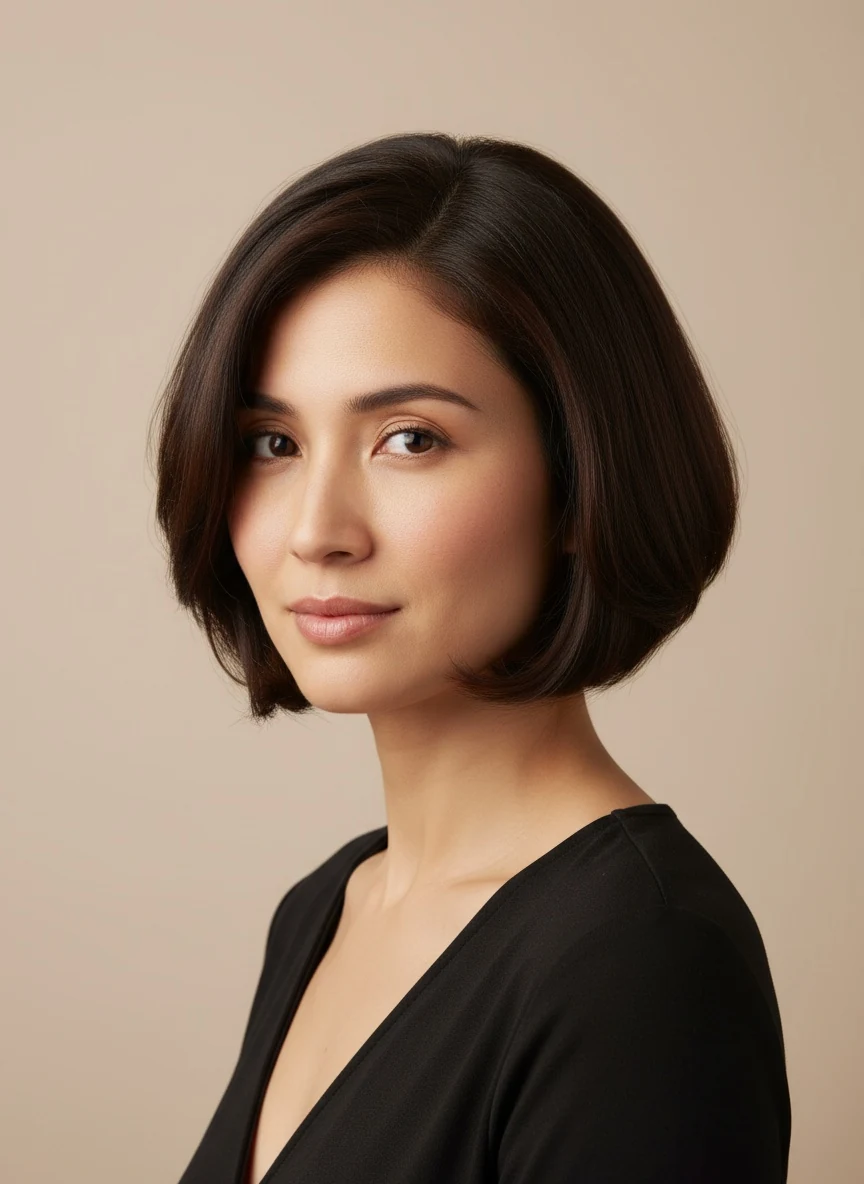
A heart-shaped face is widest at the forehead and narrows to a smaller chin. Every useful cut moves weight down toward the jaw and chin, and keeps height and width off the top. A chin- or jaw-length bob that bends in at the ends puts fullness exactly where the face narrows. Layers that start at the jaw, waves concentrated at the ends and a side-swept fringe that covers part of the forehead diagonally all work. For men, medium length with fullness toward the jaw, a textured fringe worn forward, and a beard kept fuller along the jaw do the same job.
Heart vs diamond: the forehead decides
Heart and diamond faces are both narrow at the chin, so they are easy to confuse, and they need opposite things at the top. A heart face is already widest at the forehead, so width at the temples makes it more top-heavy. A diamond face has a narrow forehead, so width at the temples is exactly what it lacks. Both use a fringe, for opposite reasons: on a heart face a side-swept fringe covers forehead width; on a diamond face a fringe adds width across a narrow forehead. If you are not sure which you are, compare forehead width with cheekbone width.
Hairstyles for a diamond face
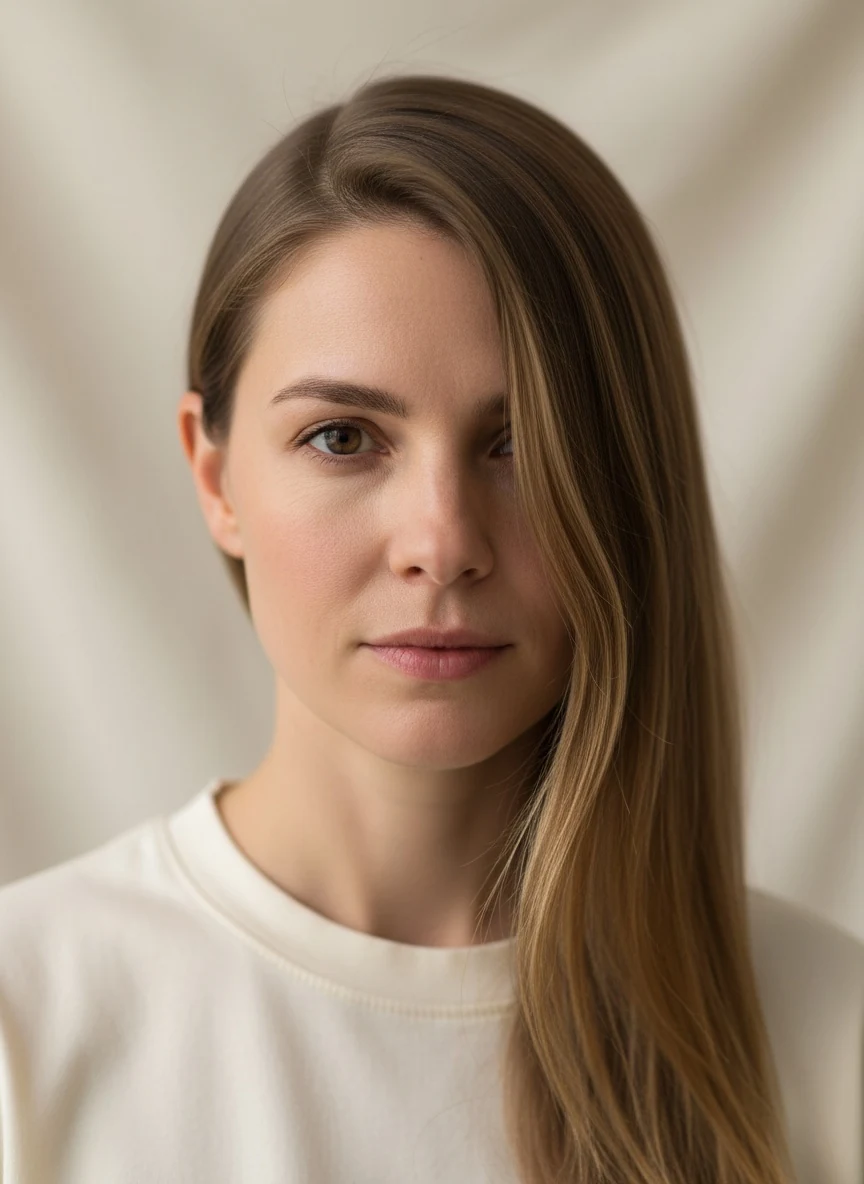
On a diamond face the cheekbones are the widest measurement, and both the forehead and the jaw come in narrower. The aim is to add width at the top and bottom and none in the middle. A fringe or curtain bangs widen the forehead; a chin-length cut with volume at the jaw, or a soft bob that ends just past the jaw, fills out the lower face. Start layers below the cheekbone rather than at it. For men, fullness at the temples, a textured fringe, hair kept longer over the ears and a beard with some width at the jaw all help. The main thing to avoid is volume at cheekbone level, and slicked-back hair, which shows the narrow forehead and wide cheekbones together.
Hairstyles for an oblong face
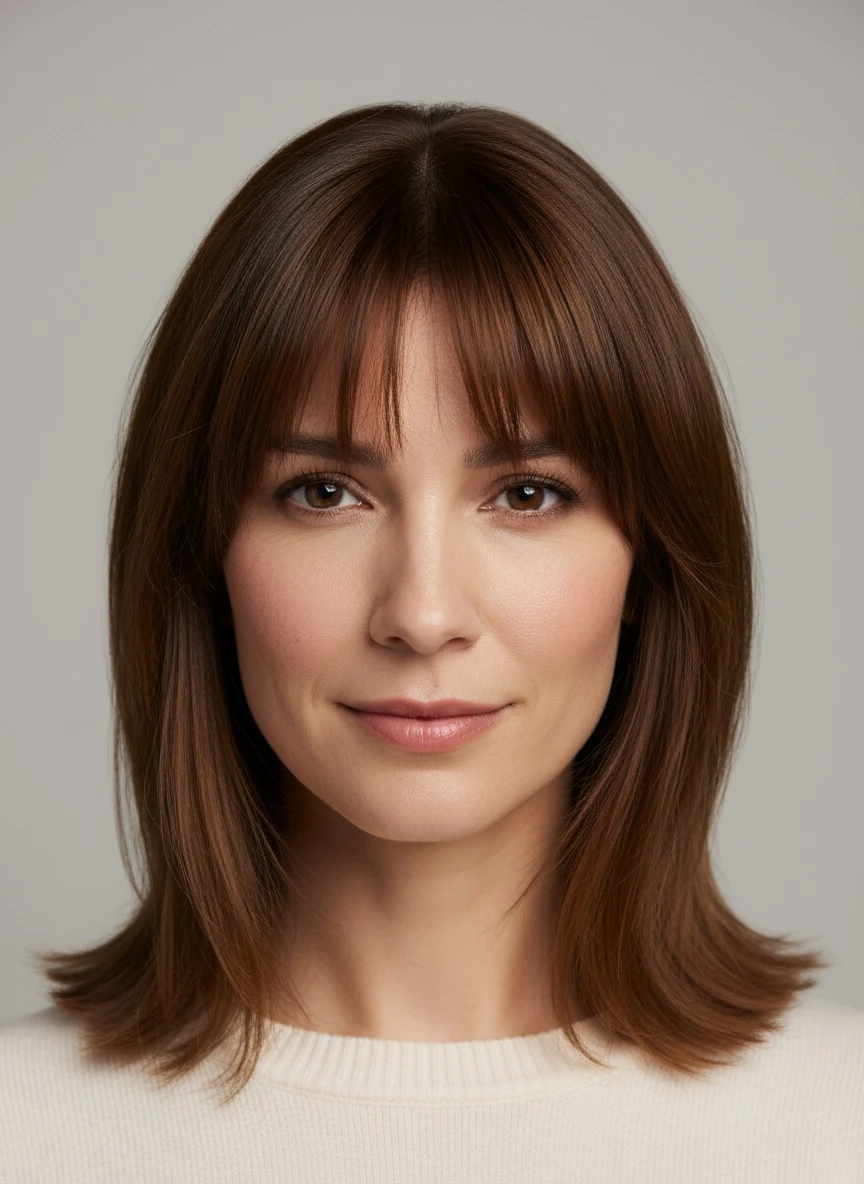
An oblong face is clearly longer than it is wide, with forehead, cheekbones and jaw measuring close to the same. It needs the opposite of a round face: less visible length and more width. A fringe is the most effective single change, because it hides forehead and so removes visible length directly. Width at cheek level — waves, layers that start at the cheekbone, a bob that bends in at the jaw — adds the horizontal measure the face lacks. Height at the crown and long, straight, one-length hair both work against it. For men: a fringe worn forward, a low taper that keeps hair at the sides, and a flat, textured top.
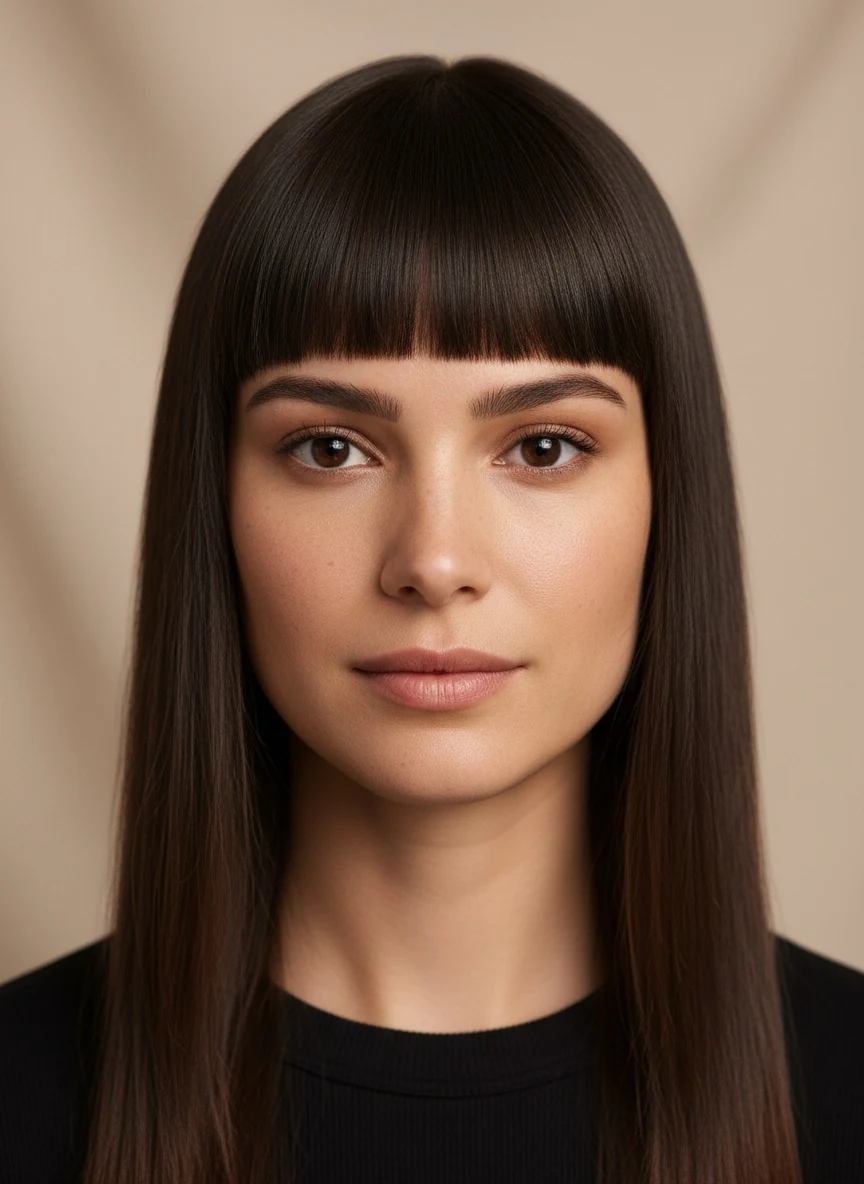
The oblong face hairstyles guide works through fringes, short, medium and long cuts, fade heights and a worked example of how much a fringe changes the visible ratio.
Hairstyles for a triangle face
A triangle face — sometimes called pear — is widest at the jaw and narrowest at the forehead. Most guides skip it, and it is the mirror image of a heart face: add at the top, keep volume off the jaw. Crown volume, which is a warning for almost every other shape, is the first recommendation here. A textured pixie with height, a short bob whose fullest part sits at cheekbone level, layers that end above the chin and a side-swept fringe that widens the forehead all work. For men, a pompadour or quiff, a textured top with tapered sides, a side part with lift and a beard kept close to the jaw. Avoid long straight hair that hangs beside the jaw and blunt edges that stop at jaw level.
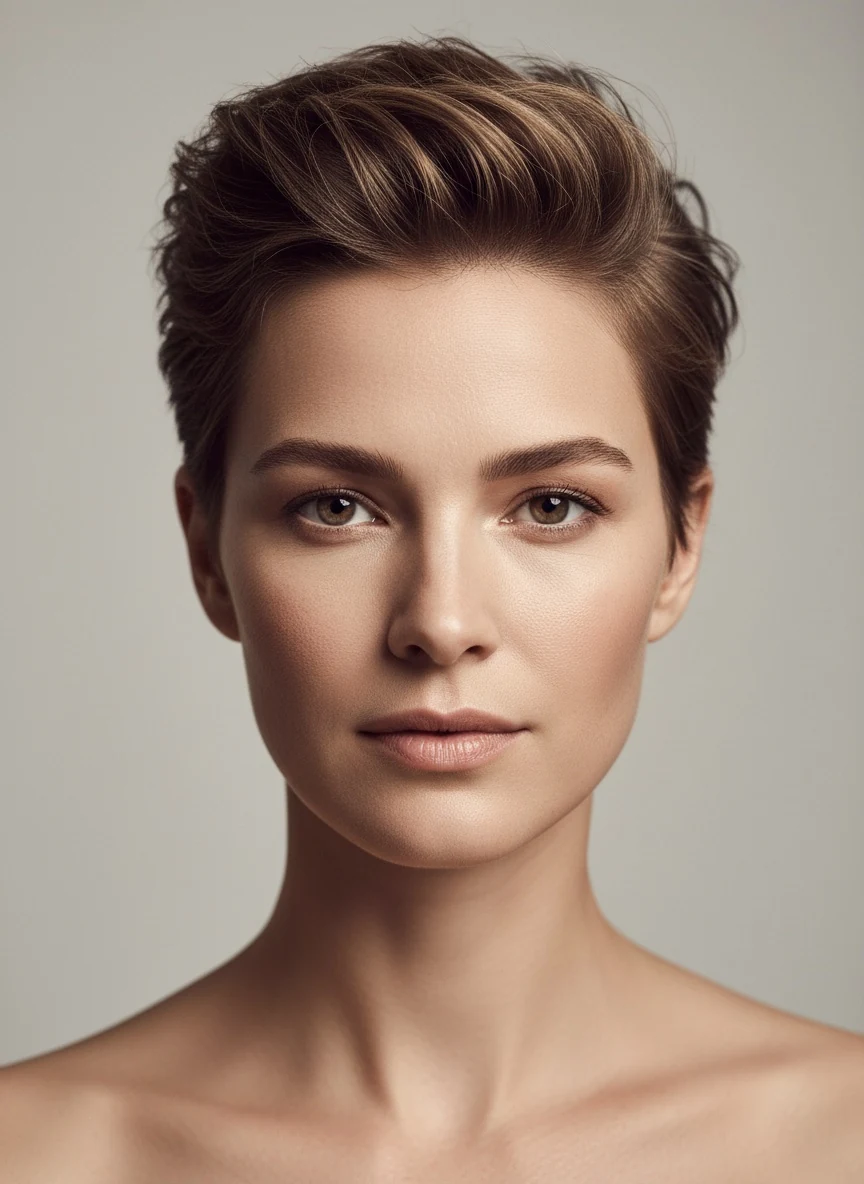
Haircuts for face shape: men
Men's haircuts usually control three things: height on top, how high the sides are faded, and whether the forehead is covered. A beard adds a fourth. The principle is the same as for women — volume at the narrow part — but the tools differ.
| Face shape | Top | Sides | Fringe | Beard direction |
|---|---|---|---|---|
| Round | Height and texture (quiff, pompadour) | Short; high fade or taper | Off the forehead | Length at the chin, short at the cheeks |
| Oval | Moderate, any texture | Any fade height | Optional, light | Short and even |
| Square | Medium length with texture | Short back and sides, or a low taper | Optional | Rounded to soften, sharp boxed to emphasise |
| Oblong | Flat, textured, low height | Low taper; keep hair at the sides | Worn forward | Fuller at the sides, short at the chin |
| Heart | Moderate volume, not tall | Medium length, fuller toward the jaw | Textured, worn forward | Fuller along the jaw |
| Diamond | Medium, with fullness at the temples | Longer over the ears; avoid high fades | Textured | Width at the jaw, short at the cheeks |
| Triangle | Height (quiff, pompadour) | Tapered | Side part with lift | Close stubble, tight at the jaw |
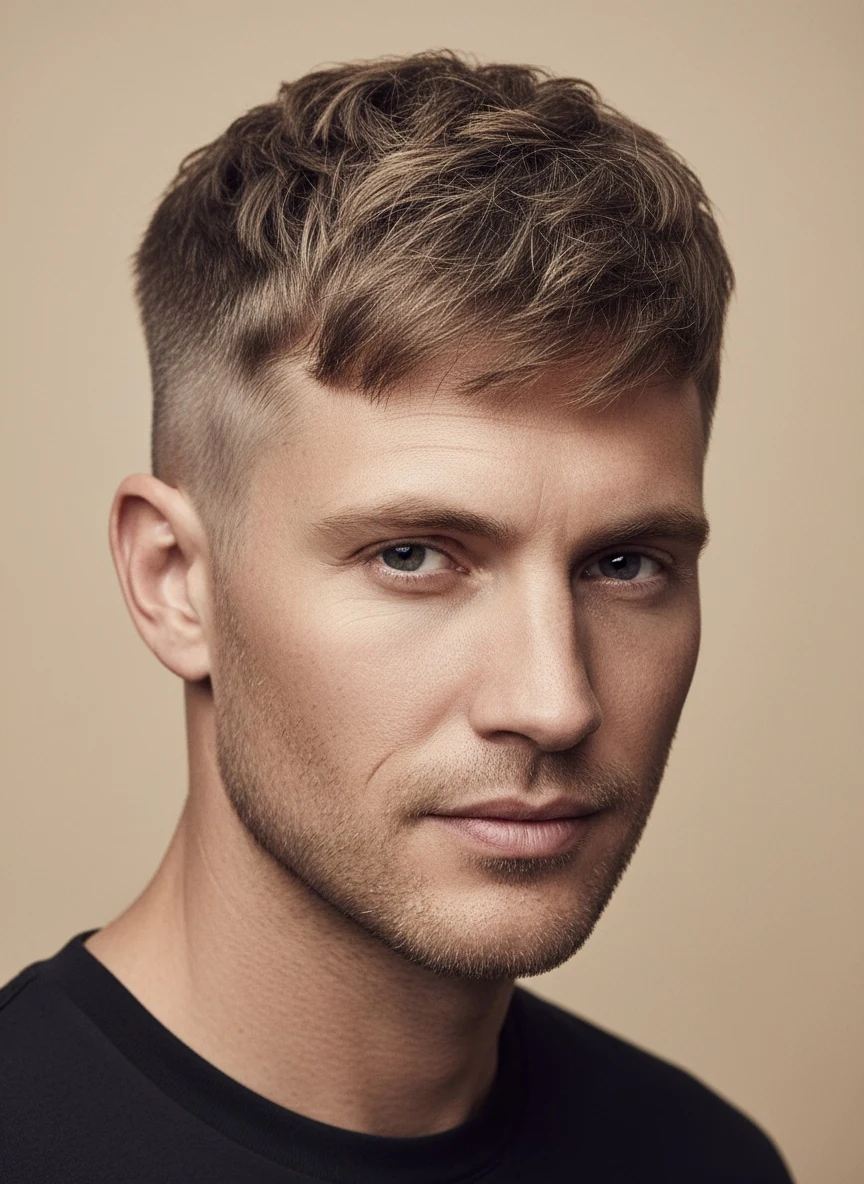
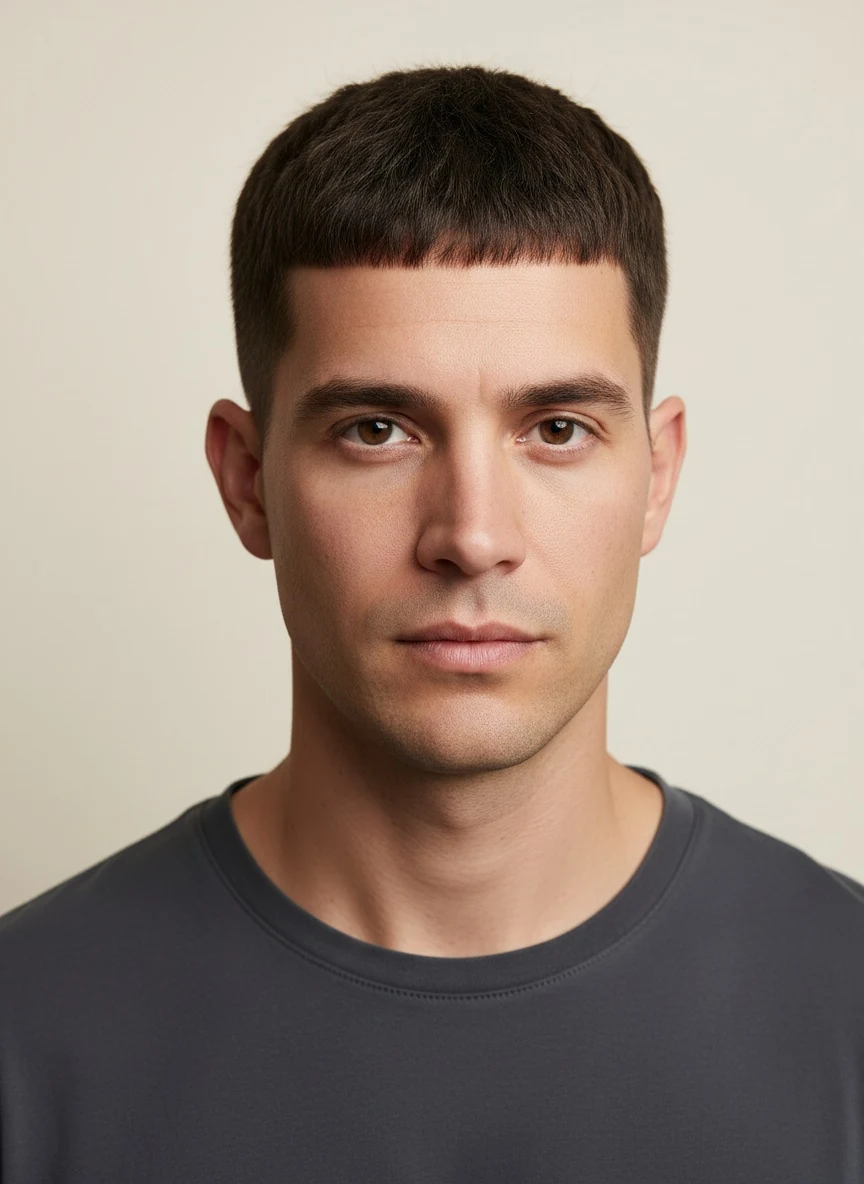
Fade height by face shape
Fade height is the easiest lever for men to change at the next barber visit. A high fade removes hair from most of the side of the head, which narrows the silhouette and makes height on top more obvious — useful on round and triangle faces. A low taper keeps hair above and around the ears, so the sides still hold some width — useful on oblong and diamond faces, which need it. Square and oval faces can wear either; the choice is about how sharp you want the outline.
Where a beard fits in
A beard adds length at the chin or width at the sides, so it should push in the same direction as the haircut. On a round face, height on top and length at the chin both lengthen. On an oblong face that pairing doubles the problem, and fuller sides with a short chin work instead. The beard styles for face shape guide covers all seven shapes. One practical note: a full beard also changes the outline a photo tool reads at the jaw, so measure your face shape clean-shaven or with a short trim.
Receding hairline and face shape
A receding hairline makes a face measure longer on a tape measure, because tape charts start at the hairline. A face landmark model is fitted to the skin of the face, not to the hair, so a receding hairline should matter far less to the detector than to a tape — although, as the test below shows, hair falling over the forehead does move its top point. For the haircut, a receding hairline adds visible forehead, which pushes a face toward reading oblong: a short textured crop worn forward covers some of it, while slicked-back styles show all of it. The Norwood scale guide explains the stages.
Hairstyles by hair type and face shape
Texture changes the advice because it changes where hair puts its own volume. Straight hair lies flat and draws vertical lines. Wavy hair breaks those lines. Curly hair grows outward. Fine hair gives little volume anywhere, and thick hair builds it quickly.
| Face shape | Straight | Wavy | Curly | Fine | Thick |
|---|---|---|---|---|---|
| Round | Needs root lift; a side part does a lot | Keep waves from flaring at ear level | Build height; weigh or taper the sides | Texture and root lift over length | Internal layers remove width at the cheeks |
| Oval | Anything; a fringe if the face is long | Let waves fall where they fall | Wear at full volume | Blunt ends, chin to collarbone | Long is fine; watch crown height |
| Square | Soften with layers or a side part | Let the wave fall around the jaw | Keep volume off jaw level | Layers and waves matter most | Thin out bulk at the jaw corner |
| Oblong | A fringe and blunt ends | Encourage the wave at cheek level | The best texture for the shape | Shorter than feels natural; a fringe | Keep bulk at the sides, not the crown |
| Heart | A blunt jaw-length line | Start the wave below the cheekbone | Less at the crown, full from the jaw down | Blunt line at the jaw, side fringe | Keep the bulk low |
| Diamond | Fringe and jaw-length weight | Keep the wave low | Enough length to settle below the cheekbone | Blunt line at the jaw, a fringe | Thin at the cheeks |
| Triangle | Root lift and a side part | Keep waves above the jaw | Height on top; not to the jaw | Texturising product, short to medium | Keep the bulk high |
Does hair change what a face shape detector says?
Every face shape tool, ours included, tells you to pull your hair back. We wanted to know whether that matters or is just caution, so we tested it. We took six portrait photos, measured each with the same face landmark model the detector on this site uses, and then painted solid hair-coloured bands onto copies: a fringe band from the top of the image down to just above the eyebrows, a shorter band covering only the upper half of the forehead, and bands over the outer edges of the face from the temples to the jaw. Each copy was measured again and classified with the site's face shape rules. The portraits are not shown; only the numbers are.
| Face | Hair back | Fringe to the brows | Upper-forehead fringe | Hair over the sides |
|---|---|---|---|---|
| A | Diamond | Oval | Oval | Oval |
| B | Oblong | Oblong | Oblong | Oval |
| C | Oblong | Square | Oval | Square |
| D | Oblong | Oblong | Oblong | Oblong |
| E | Oblong | Triangle | Square | Oblong |
| F | Oblong | Oval | Oval | Oval |
What a fringe did to the measurements
The fringe band changed the label on four of six faces; the other two are long enough to stay oblong. On all six, the model's top point on the forehead moved down, by 2.2% to 4.5% of face length, so the measured face got 1.9% to 4.1% shorter. Less expected, the jaw also measured wider on all six, by 3.4% to 4.0%, even though the band did not touch it. A face landmark model fits the whole face at once, so covering one area can move points elsewhere. Together, a shorter face and a wider jaw pushed every changed result toward shorter or heavier-jawed labels: oval, square or triangle. The band covering only the upper half of the forehead did almost the same: four of six labels changed, in the same direction.
What hair at the sides did
Bands over the edges of the face changed the label on four of six faces, mostly toward oval. The model did not treat the covered edge as a narrower face. On four faces it read the cheekbones wider, by 3.2% to 7.4%, and on three it read the temples wider, by 5.7% to 7.3%. A small change in the widths is enough, because the rules that separate the shapes compare widths and lengths that differ by only a few percent.
What the test does not show
- Painted bands are not real hair. Real hair has texture, shadow and gaps, and a model may handle it better or worse than a solid band.
- Six faces is a small sample. The direction was consistent — every fringe band shortened the measured face — but the exact sizes will vary.
- It measures the tool, not how people see you. Whether a fringe makes a face look shorter to a person is the styling argument above, not something this test measured.
The practical conclusion is clear: pull all your hair back, including a fringe, before measuring your face shape, and only then use the result to choose a haircut. A label measured with a fringe down describes the haircut as much as the face.
One straight-on photo, hair pulled back including any fringe, camera at eye level. Runs in your browser; the photo is not uploaded.
Measure with your hair backWhat research says about hair and faces
No study we could find tested face shape against haircut. A few have measured how hair changes the way faces are judged, and they are useful for knowing how much a haircut can do.
- Hair changes how a face is rated, even when people try to ignore it. Saegusa and colleagues asked people to rate the attractiveness of a face while ignoring the hair around it. The hair still affected the face ratings — unless the same person had already rated that hairstyle on its own. The face, in turn, affected ratings of the hair.
- Medium and long hair raised women's ratings in one study. Mesko and Bereczkei compared six hairstyles with the same faces shown without visible hair. Only long and medium-length hair significantly raised attractiveness ratings, and the largest change was in how healthy the women looked. Men rated longer-haired women as healthier, especially the less attractive faces.
- Hair length had only a weak effect in another. Swami and colleagues used line drawings varying skin tone, hair colour and hair length. Hair colour explained the most variance, and hair length only a weak effect on attractiveness — though the authors note line drawings are a limitation.
- Proportions are judged against the face's length and width. Pallett and colleagues found attractiveness was highest when the eye-to-mouth distance was about 36% of face length and the distance between the eyes about 46% of face width, ratios that match an average face. The study moved features, not hair, so it says nothing about which haircut to choose; but both ratios depend on how much length and width a viewer sees, which is what a fringe or side volume changes.
Put together: hair clearly changes how a face is perceived, and the effect is not something people can simply switch off. How much a particular cut helps a particular face shape is still styling practice. The same holds for averageness, one of the most replicated findings in face research: computer-averaged composite faces are rated more attractive than most of the individual faces that make them up. No haircut makes a face average, but it can make the outline read closer to balanced, which is all the recommendations above aim to do.
What to ask your stylist or barber
"Something that suits my face shape" leaves the decision to the stylist's guess about your shape. Describing where you want volume is more precise, and a good stylist will understand it immediately.
- Say where the widest and narrowest parts of your face are. "My cheekbones are the widest point and my jaw is narrow" tells a stylist more than a label.
- Say where layers should start. "Layers starting below the cheekbone" or "at the jaw" decides where volume sits.
- For a fringe, say how much forehead to cover. A fringe at brow level, one that covers the upper half of the forehead, and curtain bangs that leave a gap all do different things.
- Say where the ends should fall relative to your jaw. Above, at or below the jaw is the difference between a cut that helps and one that draws a line at the wrong place.
- For men, say the fade height and what the top should do. "Low taper, keep weight at the sides, flat textured top" and "high fade, height on top" are opposite cuts.
Bring a photo of the cut, not of the person wearing it, and ask how it would fall on your face specifically. A stylist can see how your hair grows at the crown and hairline, which no face shape chart can.
Each face shape page has the full list of haircuts by hair type, glasses frames and the measurements that define the shape.
See all seven face shapesFrequently asked questions
What hairstyle is best for my face shape?
The one that adds volume where your face is narrow and keeps it off where your face is widest. Round faces suit height on top and lengths that fall past the jaw; oblong faces a fringe and width at cheek level; heart faces volume at the jaw; diamond faces width at the forehead and jaw; triangle faces height and width on top; square faces softness below the jaw if you want it; oval faces most cuts.
How can I find out which hairstyle suits my face?
Measure your face shape first, with your hair pulled back: forehead width, cheekbone width, jaw width and face length. A tape measure works, or a face shape detector can take the four measurements from one straight-on photo. Then find the widest and narrowest part of your face and choose a cut that puts volume at the narrow part.
What are the 7 face shapes?
Round, oval, square, oblong (also called long or rectangle), heart, diamond and triangle. They are defined by four measurements: the widths of the forehead, cheekbones and jaw, and the length of the face. Triangle is sometimes called pear, and it is the shape most hairstyle guides leave out.
Which haircut suits a chubby face?
A face that looks full usually reads as round: close to as wide as it is long, with a soft jaw. The cuts that help add vertical line and keep volume off the cheeks — long layers starting below the cheekbone, an angled lob that is longer at the front, a deep side part with some lift, and for men height on top with shorter sides. Avoid volume at ear level and blunt lines that end at the cheek.
Do round faces look better with short or long hair?
Either can work; where the lines fall matters more than the length. Long hair suits a round face when it falls past the collarbone with layers below the cheekbone. Short hair suits it when it adds height on top and keeps the sides close, like a textured pixie or, for men, a quiff with tapered sides. The length to avoid is one that ends at the cheeks, where the face is widest.
Do hairstyle rules differ for men and women?
The principle is the same — volume where the face is narrow — but men usually control it through height on top, fade height at the sides and beard shape, while women more often use length, layers, fringes and partings. A high fade does for a round face roughly what long vertical layers do; a beard can add the jaw width that a chin-length bob adds.
Can a haircut change my face shape?
Not your bone structure, but it changes the outline people see and it can change what a photo tool measures. In our test, painting a fringe band over the forehead of six portraits made the face shape detector read a shorter face on all six and changed the label on four. Measure with your hair back; choose the haircut afterwards.
What if my face is between two shapes?
Look at the one measurement that separates the two, and follow the advice both shapes share. Between round and oval, height on top helps both. Between heart and diamond, volume at the jaw suits both, and the forehead decides whether to add width at the temples. Between square and triangle, keep volume off the jaw either way.
References
- Mesko, N., & Bereczkei, T. (2004). Hairstyle as an adaptive means of displaying phenotypic quality. Human Nature, 15(3), 251–270. PMID 26190549.
- Saegusa, C., Intoy, J., & Shimojo, S. (2015). Visual attractiveness is leaky: the asymmetrical relationship between face and hair. Frontiers in Psychology, 6, 377. PMID 25914656.
- Swami, V., Furnham, A., & Joshi, K. (2008). The influence of skin tone, hair length, and hair colour on ratings of women's physical attractiveness, health and fertility. Scandinavian Journal of Psychology, 49(5), 429–437. PMID 18452501.
- Pallett, P. M., Link, S., & Lee, K. (2010). New “golden” ratios for facial beauty. Vision Research, 50(2), 149–154. PMID 19896961.
- Langlois, J. H., & Roggman, L. A. (1990). Attractive faces are only average. Psychological Science, 1(2), 115–121. doi:10.1111/j.1467-9280.1990.tb00079.x.
- Farkas, L. G. (1994). Anthropometry of the Head and Face (2nd ed.). Raven Press.
Tools mentioned in this article
Measurements on this site are for information only. Nothing here is medical advice, and no result is a diagnosis. Talk to a qualified clinician before making any decision about a procedure.