Sanpaku eyes: what the "three whites" are, where the folklore came from, and when white shows for a medical reason
·16 min read
Sanpaku eyes are eyes where white shows below or above the iris when you look straight ahead. The Japanese word means "three whites": the usual white on the left and right of the iris, plus a third patch underneath it (yin sanpaku) or above it (yang sanpaku). The idea entered English through macrobiotic writing in the 1960s, which read it as a sign of ill health or bad fate. That part is folklore. The visible white itself is real, measurable, and in most people completely ordinary.
Two things are worth separating, and most pages about sanpaku eyes do not separate them. White below the iris is common, and it moves with your gaze, your head angle and the camera. White above the iris at rest is not common, and when it is new it can be a medical sign. This guide covers both, and it says plainly where the folklore ends and the anatomy starts.

What are sanpaku eyes?
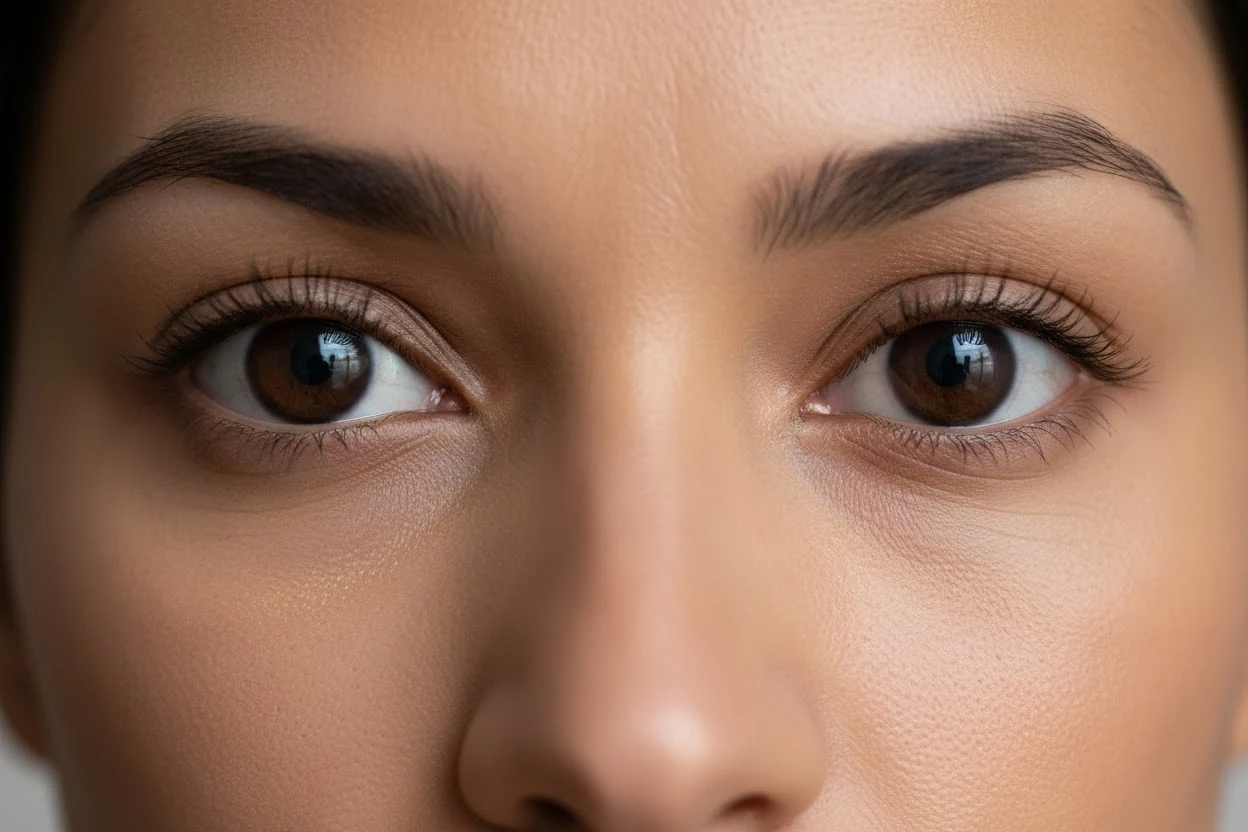
Look at an eye from the front and it has three visible zones: the iris in the middle and a triangle of white, the sclera, on each side. In many eyes the upper lid covers a sliver of the top of the iris and the lower lid sits close to its bottom edge, so no white shows above or below. Sanpaku describes the arrangement where it does.
| Pattern | Where the extra white shows | What the folklore said | What anatomy says |
|---|---|---|---|
| Typical eye | Only left and right of the iris | Balance | The common arrangement when looking straight ahead |
| Yin sanpaku | Below the iris | Physical imbalance, exhaustion | Common; increases with head tilt, upward gaze and widened eyes |
| Yang sanpaku | Above the iris | Anger, violence, danger | Normally absent at rest; most often a sign of upper-lid retraction or a bulging eye |
| White all round the iris | Above and below | Not usually distinguished | Seen in fear and surprise expressions, and in marked eye prominence |
The medical name for the visible white is scleral show, and clinicians describe it by position: inferior scleral show below the iris, superior scleral show above it. Those terms carry no judgement about character or fate. They are simply a description of where the lid margin sits relative to the edge of the iris.
There is a reason this is so easy to see in humans in particular. Kobayashi and Kohshima compared the external eye shape of nearly half of all living primate species and found that the human eye stands out in three ways: the exposed sclera is unpigmented and white, humans show the largest proportion of exposed sclera within the eye outline, and the eye outline is unusually stretched horizontally. Their reading was that white sclera evolved to make gaze direction easy for others to follow. Every small shift in where the white shows is visible to the people looking at you, which is part of why people notice sanpaku at all.
Sanpaku eyes meaning: where the idea came from
The word reached most English speakers through one book. In 1965 University Books in New York published You Are All Sanpaku, a collection of writing by Nyoiti Sakurazawa, better known as George Ohsawa, adapted by William Dufty. Ohsawa was the founder of macrobiotics, a diet and philosophy built on balancing yin and yang through food, with brown rice at its centre.
In that framework the eye was a diagnostic surface. White below the iris was read as a sign that the body was out of balance, and white above it as something more dangerous. The remedy offered was dietary. The book is a document of a belief system, not a medical text, and nothing in it was tested in the way a clinical sign would be.
Reading character from the face is much older than macrobiotics. Physiognomy, the practice of inferring temperament from facial features, appears in many traditions, Japanese among them, and sanpaku belongs to that family. What all of them share is the direction of the reasoning: a visible feature is assigned a meaning first, and examples are collected afterward. That is the opposite of how a medical sign earns its place, which is by being measured in people whose outcomes are then followed.
Yin vs yang sanpaku eyes: white below and white above
The folklore splits sanpaku into two kinds, and by accident it splits along a line that also matters anatomically. The difference between white below and white above the iris is the most useful thing on this page.
Yin sanpaku: white below the iris
This is the common one. The lower lid is a soft, mobile structure that sits roughly at the bottom of the iris, and small changes in head position or gaze move the iris relative to it. When you look up, the eye rotates and the iris rises, exposing white beneath it. When you tip your chin down and look at the camera, the same thing happens. When you widen your eyes, the lower lid drops slightly. Each of these produces yin sanpaku in a face that does not have it at rest.
In the folklore yin sanpaku signalled physical depletion. In clinical terms it is usually just inferior scleral show, which, as the next section shows, has been measured as a normal finding.
Yang sanpaku: white above the iris
This one is different. MedlinePlus, the US National Library of Medicine's consumer reference, states that there should normally be no visible white between the top of the iris and the upper eyelid, and that seeing white there is most often a sign that the eye is bulging. A face can show it briefly in surprise or fear, when the upper lids lift. Showing it at rest, all the time, is not the ordinary arrangement.
The folklore attached its darkest meanings to yang sanpaku. The real meaning is less dramatic and more practical: persistent white above the iris is one of the few eye appearances that is worth having examined, especially if it is new. The section on medical causes below explains why.
Sanpaku eyes vs normal eyes: how much white is ordinary
The clearest measurement comes from plastic surgery, where lower-lid position matters before and after eyelid operations. Mackinnon and colleagues measured scleral show in 100 people in 1987, using a headband goniometer referenced to the Frankfort plane, the standard horizontal line through the ear canal and the lower rim of the eye socket. Participants fixed their gaze on a point while their head was tilted through angles from 0 to 35 degrees.
- Scleral show below the iris was a normal finding in this population, not an abnormality.
- It increased as the head was inclined away from the Frankfort plane, so the amount you see depends on head position.
- There was no difference between men and women, and no increase with age in the group studied.
Two limits belong next to that result. The study measured 100 white participants, so it does not tell us how scleral show varies across ancestries, and it measured the lower lid only. It is still the most direct answer to "sanpaku eyes vs normal": a band of white below the iris is within the normal range, and how much of it shows is partly a property of the pose.
| What you see | Usual explanation | Worth a check? |
|---|---|---|
| Thin white band below the iris, both eyes, always been there | Lower-lid position within the normal range | No |
| White below the iris only in some photos | Gaze, head tilt, camera height or widened eyes | No |
| White below the iris that has increased with age, lid turning outward | Lower-lid laxity; ectropion becomes more common with age | Yes, if the eye is watery, red or irritated |
| White below the iris after lower-eyelid surgery | Lid malposition, a recognised complication | Yes, with the surgeon |
| White above the iris at rest | Upper-lid retraction or a bulging eye | Yes |
| One eye showing more white than it used to | Asymmetric lid retraction or eye prominence | Yes, promptly |
Why sanpaku eyes show up in photos and not in the mirror
A lot of people discover sanpaku in a single photograph and then cannot find it in the mirror. That is expected, because a camera catches the eye at whatever angle the head and gaze happened to be in, and small changes produce large differences in the visible white.
Vaca and colleagues photographed 12 women with the head tilted between 15 degrees down and 15 degrees up and measured the eye at each angle. As the head tilted downward, the distance from the centre of the pupil to the lower lid margin, called MRD2, increased steadily, while the upper-lid measurement stayed the same. In plain terms, tipping the chin down lifts the iris away from the lower lid in the photo. That is the yin sanpaku look, produced by posture.
| Condition | Effect on white below the iris | Why |
|---|---|---|
| Chin tipped down, eyes to the camera | More | The iris sits higher relative to the lower lid; MRD2 increases with downward head tilt |
| Looking up | More | The eye rotates upward and lifts the iris toward the upper lid |
| Camera held above eye level | More | You look up to meet the lens, which is the same as looking up |
| Eyes widened, surprised or alert expression | More, sometimes above too | The lids pull apart; fear expressions widen the eye opening |
| Genuine smile | Less | A genuine (Duchenne) smile contracts the muscle around the eye and lifts the cheek and lower lid |
| Level head, camera at eye height, relaxed face | Least, and most honest | The neutral position the clinical measurements use |
This is also why lists of famous people with sanpaku eyes prove very little. Press photos are taken from below, above and the side, mid-blink and mid-expression. A frame where someone looks up or looks startled will show white beneath the iris, and a frame of the same person from eye level a minute later may not. Choosing the frames that fit is what turns ordinary anatomy into a list.
Sanpaku eyes psychology: does the white say anything about personality?
The honest answer to the personality question is that nobody has found a link, and we did not find a study that looked for one with a credible design. What the research does show is something narrower and more interesting: visible eye white strongly shapes how a face is read by others, regardless of who the person is.
Whalen and colleagues showed people images of eye whites alone, masked so that participants were not aware of what they had seen. The amygdala, a brain region involved in threat detection, responded more strongly to the larger eye whites typical of fearful faces than to the smaller ones typical of happy faces. Susskind and colleagues approached the same expression from the other side and found that posing fear actually widened the subjective visual field and sped up eye movements. Widened eyes are a functional part of the fear expression, and other people's brains are tuned to notice them.
Put those together and the folklore has a plausible origin. A face that shows more white at rest can read as startled, intense or uneasy, because that is what extra eye white usually means in an expression. The impression is real. The inference from impression to character is the part with no support. It is the same mistake people make with resting facial expressions in general.
The white of the eye is a signal about where someone is looking and how wide their eyes are at that moment. It is not a signal about who they are.
When white showing above or below the iris is medical
Most people searching sanpaku eyes have nothing medical going on. A small number do, and the useful distinction is between a feature you have always had and a change. The four causes below are the ones an eye doctor would think about first.
Thyroid eye disease and eye bulging
Thyroid eye disease, also called Graves' ophthalmopathy, is the classic cause of new white above the iris. In a community cohort of 120 people diagnosed in Olmsted County, Minnesota, eyelid retraction was present at some point in 108 of them, about 90%, which made it the most common sign of the condition. Bulging of the eye, exophthalmos, was recorded in about 62%. MedlinePlus lists hyperthyroidism, particularly Graves disease, as the most common medical cause of bulging eyes and notes that family members often miss the change because it develops slowly, while photographs tend to draw attention to it.
Lower-lid laxity with age
The lower lid is held against the eye by tendons at each corner, and those loosen over decades. The extreme form is ectropion, where the lid margin turns outward away from the eye. The Blue Mountains Eye Study examined 3,654 Australians aged 49 to 97 and found ectropion in 0.3% of people under 60, 1.2% at 60 to 69, 6.7% at 70 to 79 and 16.7% of those aged 80 or older. Increasing white below the iris in later life, together with watering or irritation, is a reason to have the lid checked.
After eyelid surgery
Lower-lid malposition is a recognised complication of lower blepharoplasty. In one surgeon's ten-year series of 264 patients who had transcutaneous lower blepharoplasty with routine support of the outer corner, nine people, 3.5%, needed another operation to correct the lid position. New white below the iris after eyelid surgery is something to raise with the operating surgeon rather than wait out.
A prominent eye you were born with
Some people simply have eyes that sit further forward in the socket, which exposes more white. MedlinePlus makes the same distinction: prominent eyes can be a family trait, and prominent is not the same as bulging. The protruding eyes page covers this lifelong version and why it cannot be measured from a front-facing photo.
How to check for sanpaku eyes yourself
Because the visible white moves with posture, the check only means something under controlled conditions. This is the setup the clinical measurements approximate.
- Stand in even, frontal light facing a mirror or a camera set at exactly eye height.
- Level your head. Imagine a line from the top of your ear to the bottom of your eye socket and keep it horizontal. Do not tuck your chin.
- Look straight ahead into your own pupils in the mirror, or straight into the lens.
- Relax your face. No raised brows, no widened eyes, no smile.
- Note where each lower lid sits against the bottom of the iris: covering its edge, touching it, or leaving a band of white. Do the same for the upper lid.
- Compare both eyes and compare with older photos taken in similar conditions. Symmetry and stability matter more than the presence of white.
If you see a thin band of white below both irises and it has always been there, that is the common finding described above. If you see white above the iris, or a difference between the eyes that you did not have before, that is the finding that deserves a professional look.
The eye shape detector measures what a front photo can support: how tall your eye opening is relative to its width, your canthal tilt in degrees, how much upper lid shows and the spacing between your eyes. It does not measure scleral show, and it does not detect sanpaku. A taller opening often comes with more visible white, but the two are not the same measurement. The photo is analysed in your browser and is not uploaded.
Measure your eye opening and tiltSanpaku eyes compared with round, prey and hunter eyes
Sanpaku overlaps with several other eye labels, and the overlap causes confusion. Each of them describes something slightly different.
| Label | What it describes | Relation to sanpaku |
|---|---|---|
| Round eyes | An opening nearly as tall as it is wide | Round eyes often show some white above or below the iris, so they overlap with sanpaku without being the same thing |
| Protruding eyes | An eye sitting forward in the socket | More white tends to show, sometimes above the iris; the lifelong version is anatomy, a new one is medical |
| Prey eyes | A looksmaxxing term: neutral or negative tilt, visible lid, rounder opening | Prey-eye descriptions often include visible white; the term carries a ranking that sanpaku folklore does not |
| Doe eyes | A beauty term: large, open, rounder eyes with a soft, level outer corner | Doe-eye descriptions often include white beside the iris and sometimes a little below; the term is a compliment, not a reading of character |
| Hunter eyes | Positive tilt, little visible lid, a long narrow opening | The near-opposite configuration; less white shows above or below |
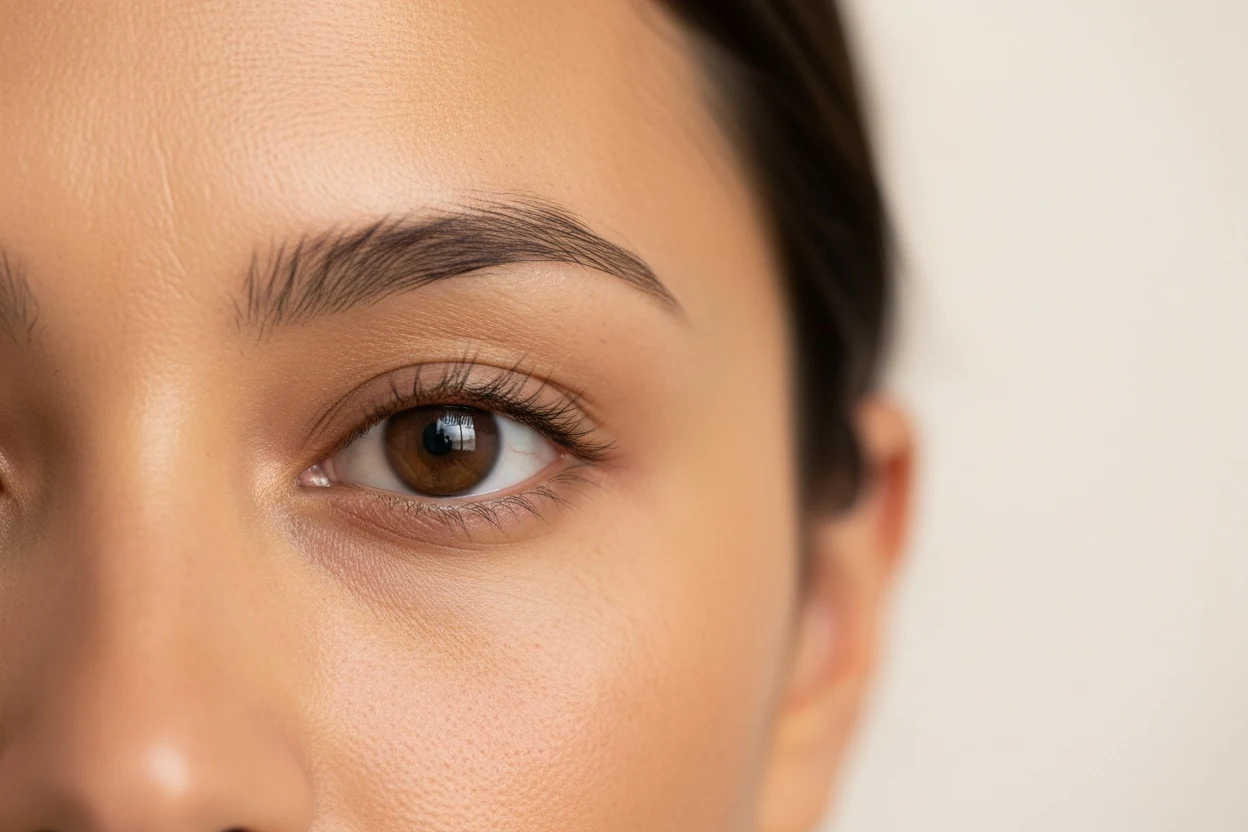
The overlap with canthal tilt is worth one sentence. A downturned outer corner pulls the lower lid down at the outer side of the eye and can expose more white there, which is why sanpaku and negative tilt are often mentioned together. They are still separate measurements, and the tilt test reports the angle on its own.
Can sanpaku eyes be changed?
If the white below your iris is the normal kind, there is nothing to correct. What changes how it reads is mostly presentation.
- Photo setup. Camera at eye height, level head and a relaxed face reduce visible white more than anything else on this list.
- Makeup. A soft, darker line along the lower lash line visually closes the gap between lid and iris; white or nude liner on the lower waterline and bright inner-corner highlight do the opposite.
- Expression. A genuine smile lifts the lower lid. Habitually widening the eyes for the camera, which many people do without noticing, exposes more white.
Where scleral show has a medical cause, the cause is treated, and that is a decision made with an ophthalmologist or oculoplastic surgeon after an examination. Thyroid eye disease in particular is managed as a medical condition first. Eyelid surgery done only to remove ordinary white below the iris carries the malposition risk described above, and nothing in this guide is a recommendation to have it.
The last point is the one the folklore gets most wrong. A band of white below your iris is not a verdict on your health or your character. It is a lid sitting a millimetre or two lower than someone else's, seen from a particular angle, in a species whose eyes evolved to make exactly that kind of detail easy to notice.
Frequently asked questions
What does sanpaku mean?
Sanpaku is Japanese for "three whites". Looking at an eye straight on, you normally see white on two sides of the iris, left and right. Sanpaku describes a third patch of white, either below the iris or above it. The word reached English readers through a 1965 book on macrobiotics by George Ohsawa, which treated the sign as a mark of poor health. That reading is folklore; the visible white itself is ordinary anatomy in most people.
Is having sanpaku eyes bad?
Not in the way the folklore claims. White showing below the iris is common, and a study of 100 people with no eye disease found it to be a normal finding that grows as the head tips back. Nobody has shown that it predicts personality, luck or lifespan. The one version that deserves attention is white above the iris, or white that has appeared recently or on one side only, because that can be a sign of eye bulging or eyelid retraction.
What is the difference between yin and yang sanpaku?
In the folklore, yin sanpaku is white below the iris and was said to signal physical imbalance or exhaustion; yang sanpaku is white above the iris and was said to signal anger or danger. Anatomically the two are very different. White below is common and changes with gaze and head angle. White above the iris is normally absent at rest, and when it appears it is most often a sign that the upper lid has pulled up or the eye has moved forward.
Can you get sanpaku eyes from being tired?
The folklore says so, but no study has measured scleral show against sleep or fatigue. What tiredness reliably changes is the upper lid, which tends to sit lower, and the overall expression. Photos taken while you look upward, tilt your chin down or widen your eyes will show more white below the iris than a relaxed, level mirror view, and that is the more likely explanation when it seems to come and go.
Are sanpaku eyes rare?
No. A thin band of white below the iris is common enough that a 1987 plastic surgery study described it as a normal finding in the population it measured. How often you see it depends heavily on how the photo was taken: head tilt, gaze direction and camera height all move the lower lid relative to the iris.
Do sanpaku eyes mean you will die young?
No. That idea comes from 1960s macrobiotic writing and later celebrity lists, not from any study. Nothing in the medical literature links scleral show to lifespan. If white has started showing above your iris, or one eye looks more prominent than it used to, that is a reason for an eye examination, not a prediction.
Is scleral show the same as sanpaku?
They describe the same visible thing from two different traditions. Scleral show is the clinical term for white visible between the iris and the eyelid, described by position: inferior below the iris, superior above it. Sanpaku is the macrobiotic and physiognomy term for the same appearance, with a meaning attached. The clinical term carries no judgement; the folklore term does.
Can makeup hide white below the iris?
It changes how the white reads, not where the lid sits. Darker liner along the lower lash line and keeping lower-lid highlight away from the eye make the band of white less prominent. Bright inner-corner highlight and white liner on the lower waterline do the opposite, which is why they are used for wide-eyed looks.
References
- Sakurazawa, N. [Ohsawa, G.] (1965). You Are All Sanpaku (W. Dufty, Trans.). New Hyde Park, NY: University Books.
- Mackinnon, S. E., Fielding, J. C., Dellon, A. L., & Fisher, D. M. (1987). The incidence and degree of scleral show in the normal population. Plastic and Reconstructive Surgery, 80(1), 15–20. PMID 3602156.
- Kobayashi, H., & Kohshima, S. (2001). Unique morphology of the human eye and its adaptive meaning: comparative studies on external morphology of the primate eye. Journal of Human Evolution, 40(5), 419–435. PMID 11322803.
- Vaca, E. E., Bricker, J. T., Mioton, L. M., Fagien, S., & Alghoul, M. S. (2022). The influence of sagittal head tilt on periorbital appearance: implications for clinical photography and the evaluation of postoperative results. Aesthetic Surgery Journal Open Forum, 4, ojab043. PMID 35156018.
- Whalen, P. J., Kagan, J., Cook, R. G., Davis, F. C., Kim, H., Polis, S., McLaren, D. G., Somerville, L. H., McLean, A. A., Maxwell, J. S., & Johnstone, T. (2004). Human amygdala responsivity to masked fearful eye whites. Science, 306(5704), 2061. PMID 15604401.
- Susskind, J. M., Lee, D. H., Cusi, A., Feiman, R., Grabski, W., & Anderson, A. K. (2008). Expressing fear enhances sensory acquisition. Nature Neuroscience, 11(7), 843–850. PMID 18552843.
- MedlinePlus Medical Encyclopedia. Eyes — bulging. U.S. National Library of Medicine, reviewed 1 January 2025.
- Bartley, G. B., Fatourechi, V., Kadrmas, E. F., Jacobsen, S. J., Ilstrup, D. M., Garrity, J. A., & Gorman, C. A. (1996). Clinical features of Graves' ophthalmopathy in an incidence cohort. American Journal of Ophthalmology, 121(3), 284–290. PMID 8597271.
- Mitchell, P., Hinchcliffe, P., Wang, J. J., Rochtchina, E., & Foran, S. (2001). Prevalence and associations with ectropion in an older population: the Blue Mountains Eye Study. Clinical & Experimental Ophthalmology, 29(3), 108–110. PMID 11446446.
- Codner, M. A., Wolfli, J. N., & Anzarut, A. (2008). Primary transcutaneous lower blepharoplasty with routine lateral canthal support: a comprehensive 10-year review. Plastic and Reconstructive Surgery, 121(1), 241–250. PMID 18176227.
- Ekman, P., Davidson, R. J., & Friesen, W. V. (1990). The Duchenne smile: emotional expression and brain physiology II. Journal of Personality and Social Psychology, 58(2), 342–353. PMID 2319446.
Tools mentioned in this article
Each runs free in your browser from one photo; the free AI face analysis runs them together.
- Eye Shape DetectorThe tool-intent entry to the eye cluster.
- Eye Shape TestLid space, canthal tilt in degrees, aperture and spacing — all ten types.

- Canthal Tilt TestYour tilt in degrees, each eye separately.
- Prey Eyes vs Hunter EyesThe same three measurements, read from the other end.
- Hunter Eyes TestThe three traits scored, and the fourth one a photo cannot read.
Measurements on this site are for information only. Nothing here is medical advice, and no result is a diagnosis. Talk to a qualified clinician before making any decision about a procedure.