Doe eyes: what the term means in measurable features, and how doe eyes differ from siren, almond and round eyes
·12 min read
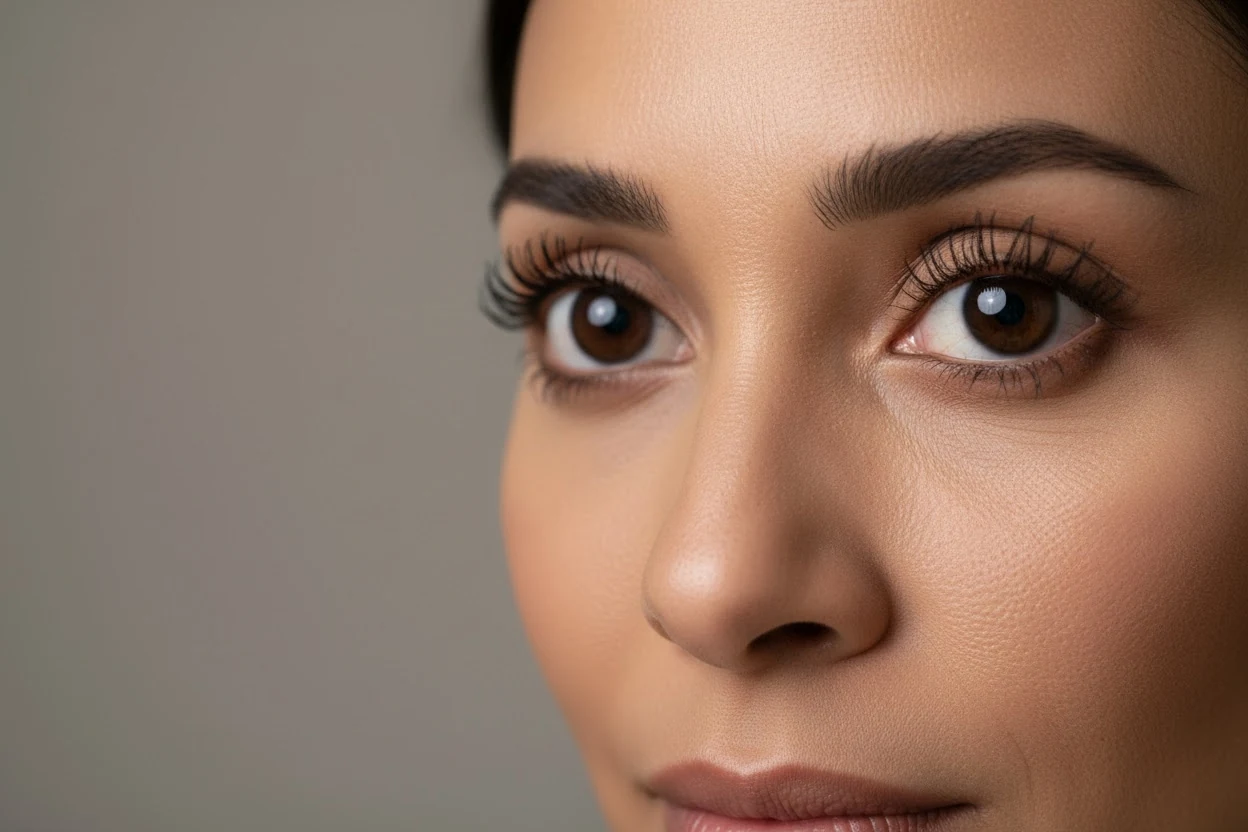
Doe eyes are large, rounded, open-looking eyes with outer corners that sit level rather than lifted, giving the face a soft, gentle expression. The name comes from the eyes of a female deer. It is a beauty description, not an anatomical category, so no clinic or textbook defines a cut-off. What it describes, though, can be translated into features you can actually check: how tall the eye opening is compared with its width, the angle of the outer corner, how much iris is visible, and the lashes and colour framing it.
That translation is the useful part, because it is what separates doe eyes from the labels it is constantly mixed up with: round eyes, prey eyes, almond eyes and the makeup look called siren eyes. This guide sets out what each of those means, which features overlap, and what makeup or a camera angle can and cannot change.
Doe eyes meaning: where the phrase comes from
A doe is a female deer, and deer have large, dark, glossy eyes set in a calm face. Applied to people, the Oxford Advanced Learner's Dictionary defines doe-eyed as having large, usually dark eyes, suggesting somebody with a gentle and innocent nature. Two parts of that definition are about the eye and one is about the impression it gives, which is a fair summary of how the phrase is used today.
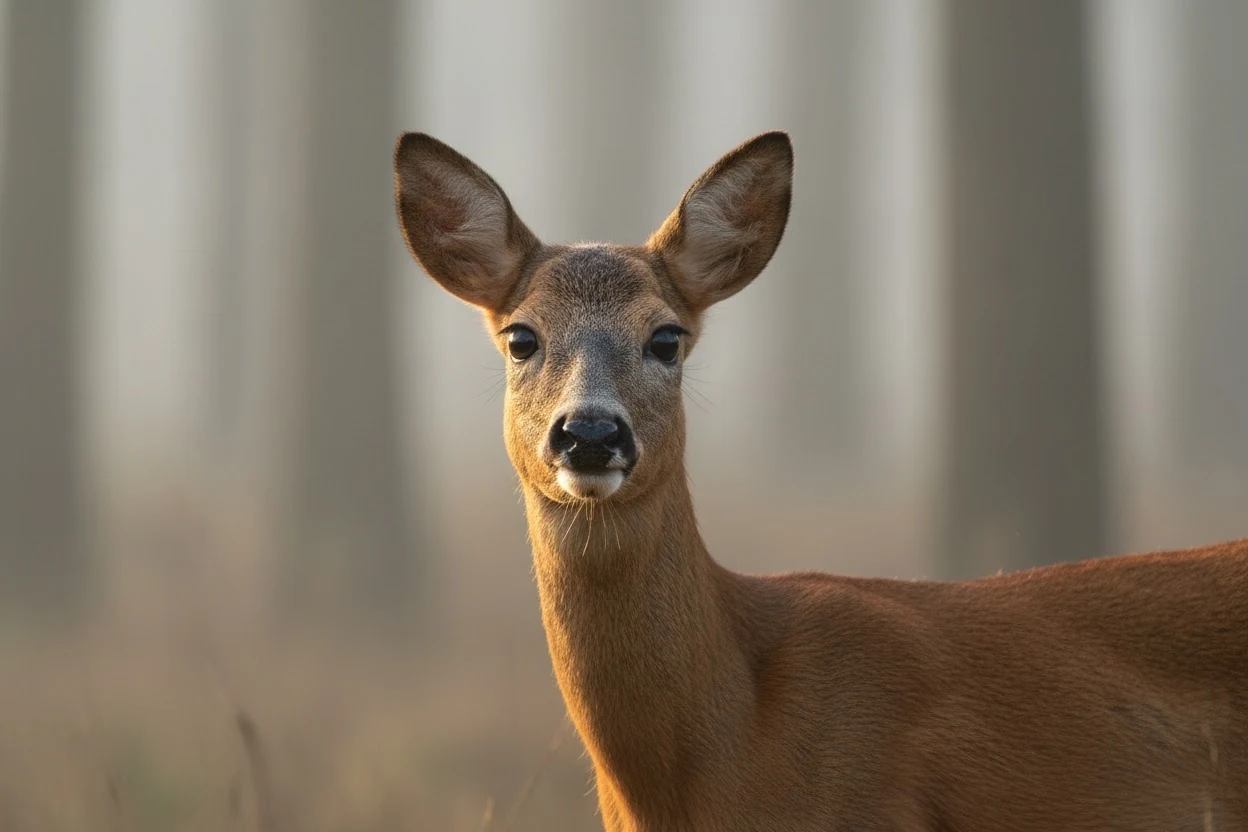
That last point matters more than it seems. Deer eyes show very little white. Human eyes are the opposite: comparing nearly half of all living primate species, Kobayashi and Kohshima found that humans have the largest proportion of exposed sclera within the eye outline and an unusually horizontal, elongated eye shape. So a doe-eyed human does not look like a deer. The phrase borrows the impression, large and dark and gentle, and applies it to an eye that works quite differently.
Deer eyes is used interchangeably with doe eyes in searches and on social media. The meaning is the same; doe is simply the older and more established English form.
What doe eyes look like in measurements
Because doe eyes has no formal definition, any measurement-based description is a translation, and this one is ours. It uses the features the phrase is consistently applied to, and it marks which of them a photograph can measure.
| Feature | What doe eyes usually show | Measurable from a front photo? |
|---|---|---|
| Eye opening (height ÷ width) | Tall relative to width; rounder than almond. On our eye shape scale, an opening ratio around 0.36 or above reads as round | Yes — the aperture ratio |
| Canthal tilt | Level or slightly downturned outer corners, not a strong upward lift | Yes — in degrees |
| Visible upper lid | Usually some lid visible between lashes and crease, which keeps the eye looking open | Yes — as a ratio, with limits |
| White beside the iris | Some white visible on both sides, sometimes a little below, which makes the iris look framed | Not measured by our engine |
| Iris size and colour | A large-looking, often dark iris with a well-defined edge | Not measured by our engine |
| Lashes | Long, full lashes, especially at the centre of the eye | No |
On tilt, it helps to know what ordinary looks like. In a 102-adult research set measured with this test, the middle 80% of faces sat between +1.3° and +6.0° (median +3.7°). Hunter-eye and fox-eye descriptions sit above that range, at a clear upward tilt of +5° or more. Doe eyes usually sit in the lower part of the ordinary range: level corners, which is a large part of why the eye reads as soft rather than sharp.
Doe eyes vs round eyes vs prey eyes
These three overlap heavily, and they are often used as if they meant the same thing. They do not, because each comes from a different vocabulary.
| Label | Vocabulary | What it describes | Carries a judgement? |
|---|---|---|---|
| Doe eyes | Beauty and fashion | An overall impression: large, round, dark, gentle | Usually positive |
| Round eyes | Eye shape | One ratio: an opening nearly as tall as it is wide, often with white visible above or below the iris | No |
| Sanpaku eyes | Macrobiotic folklore | White visible below (or above) the iris, read as a sign of health or fate | Yes, in the folklore |
| Prey eyes | Looksmaxxing | Neutral or negative tilt, visible upper lid and a rounder opening, defined by contrast with hunter eyes | Usually negative |
The awkward fact is that a face described as doe-eyed in a magazine and as prey-eyed on a looksmaxxing forum may be measuring almost identically. The prey eyes page explains how that term ranks the same features that fashion writing praises. Neither ranking is a finding about faces; both are conventions of the communities that use them.
Round eyes is the most neutral of the three. It describes a single ratio, and the round eyes page gives the measurement and a mirror test. Most doe eyes are round eyes by that definition. Not every round eye reads as doe-like, though: a small round eye with pale irises and short lashes is round without being doe-eyed, which is why colour and lashes appear in the table above.
Doe eyes vs almond eyes
This is the comparison people most often get stuck on, partly because many eyes sit near the boundary. The difference is height against width and what happens at the outer corner.
| Doe eyes | Almond eyes | |
|---|---|---|
| Opening | Tall relative to width, rounder | Longer than tall, tapering |
| Outer corner | Curved, level or slightly down | Tapers to a point, often level or lifted |
| Iris and lids | White often visible on both sides and sometimes below | Lids usually touch the iris top and bottom |
| Typical impression | Open, soft, gentle | Balanced, elongated |
If you are trying to work out which yours are, the almond eyes page and the round eyes page use the same ratio, and the eye shape detector reports the number rather than only the label. An almond eye with dark irises and full lashes can still be described as doe-like in casual speech, which is another reminder that doe eyes is about impression as much as shape.
Doe eyes vs siren eyes (and fox eyes)
Doe eyes describes a natural eye. Siren eyes and fox eyes are mainly makeup looks that spread on TikTok, and the comparison is popular because the looks pull in opposite directions.
| Doe eyes look | Siren eyes look | Fox eyes look | |
|---|---|---|---|
| Goal | Rounder, more open | Longer, sharper, more sultry | Lifted and slanted |
| Liner | Light liner on the lower waterline, little or no wing | Elongated wing, liner pulled into the inner corner | Strong upward wing, often brows lifted too |
| Shadow | Soft, rounded, centred over the iris | Concentrated at the outer third | Swept up and out |
| Lashes | Fullest at the centre | Fullest at the outer corner | Fullest at the outer corner |
| Effect on apparent tilt | Neutral or slightly down | Neutral to slightly up | Strongly up |
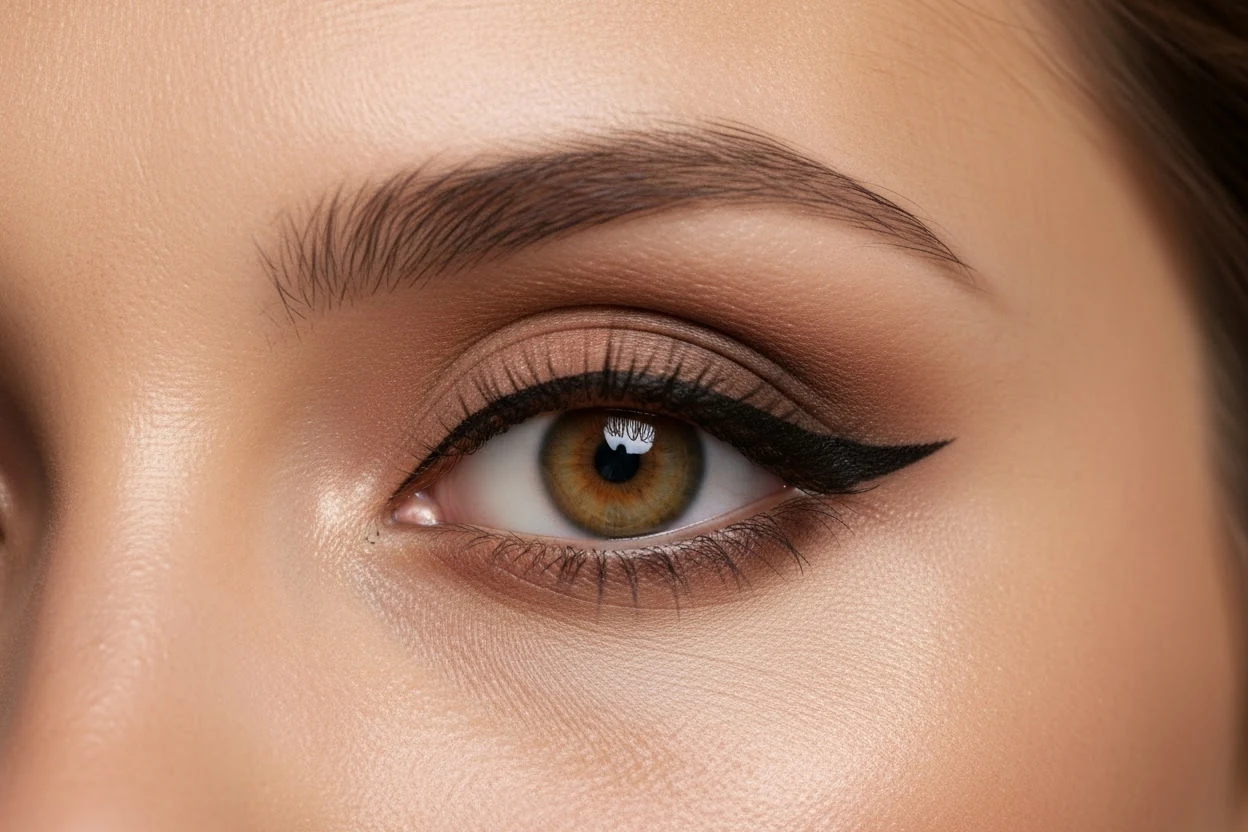
These trends have drawn criticism worth knowing about. A 2022 Refinery29 piece on TikTok's eye-shape trends described fox-eye makeup as distorting the eyes and brows into a slanted look and reported that it faded after being criticised for fetishising East Asian features, with similar questions later raised about siren eyes. The same piece argued that cycling through eye-shape trends can leave people feeling their own eyes are the wrong shape. It is a fair point to keep in mind: a trend label describes a makeup technique, not a standard your eyes should meet.
Why big doe eyes read as attractive
There is genuine research behind the appeal, and it is more specific than "big eyes are pretty". Four findings are relevant.
- Baby schema. Konrad Lorenz proposed that infant features, including a large head, round face and big eyes, are perceived as cute and prompt caretaking. Glocker and colleagues tested this with real infant photographs edited to strengthen or weaken those features; 122 adults rated the high-baby-schema faces as cuter and more worth caring for. Doe eyes borrow some of that signal, which is why the word innocent keeps appearing in the definition.
- Eye size in adult faces. Esté Jaloveckas and Granero showed 63 participants women's faces with eyes digitally made 15% smaller or 15% larger. Faces with smaller eyes were rated less attractive than both the unchanged and the enlarged versions, and larger eyes made expressions read as more intense.
- Iris size. Kuraguchi and colleagues enlarged only the iris, or the whole eye, in photographs of Japanese and Chinese women. Larger irides raised ratings of attractiveness, youthfulness and friendliness, even when the iris was dark to begin with.
- The limbal ring. The dark ring where the iris meets the white tends to fade with age. Peshek and colleagues found that faces with a dark, distinct limbal ring were rated more attractive than otherwise identical faces without one. It is one reason a dark, well-defined iris reads as part of the doe look.
The caveats are as important as the findings. All four studies edited photographs and asked people for ratings, which measures a perception in a lab rather than anything about real life. The effects are averages across raters, not rules. And beauty research on eyes is not uniform across populations: Rhee and colleagues compared composite faces of different ancestries and found that what made eyes look attractive differed by group, including in the preferred slant of the eye. Doe eyes is one description of an attractive eye, not the template for all of them.
One more finding helps explain why an inner corner matters. Bashour and Geist edited female faces to accentuate the tilt at the inner corner of the eye, and the edited versions were preferred 93% of the time in a forced choice. That study changed the inner corner rather than the outer one, which is a different feature from the canthal tilt most people talk about, but it shows how small details at the corners shape how an eye reads.
Doe eyes in men
Doe eyes are written about mostly for women, but the features that produce the look are not sex-specific. A tall opening, level corners, a large visible iris and long lashes occur in men just as often.
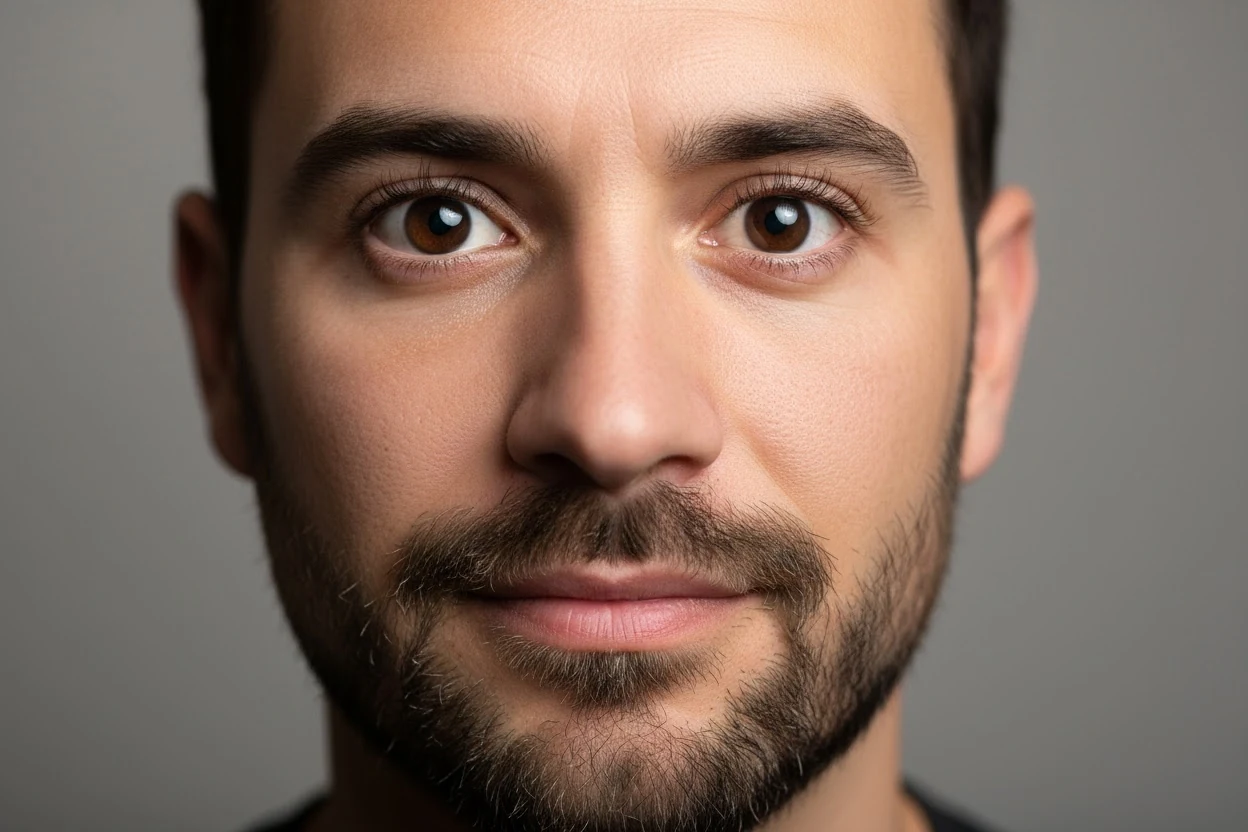
What changes is how the look is framed. In men, the same eyes are more often described as soft, kind or expressive, and in looksmaxxing spaces they are often labelled prey eyes and treated as a flaw. The measurements do not change with the vocabulary. Heavier brows sitting closer to the eye also change the read: Morikawa and colleagues found that eyebrows positioned lower and closer to the eyes made the eyes themselves look larger, an illusion that works on any face.
How to get doe eyes with makeup and photos
Nothing non-surgical changes the shape of your eye opening, and nothing on this page recommends changing it surgically. What makeup and photography can change is how open, round and large the eye reads, and some of that is backed by research rather than just tutorials.
Makeup for a doe-eye look
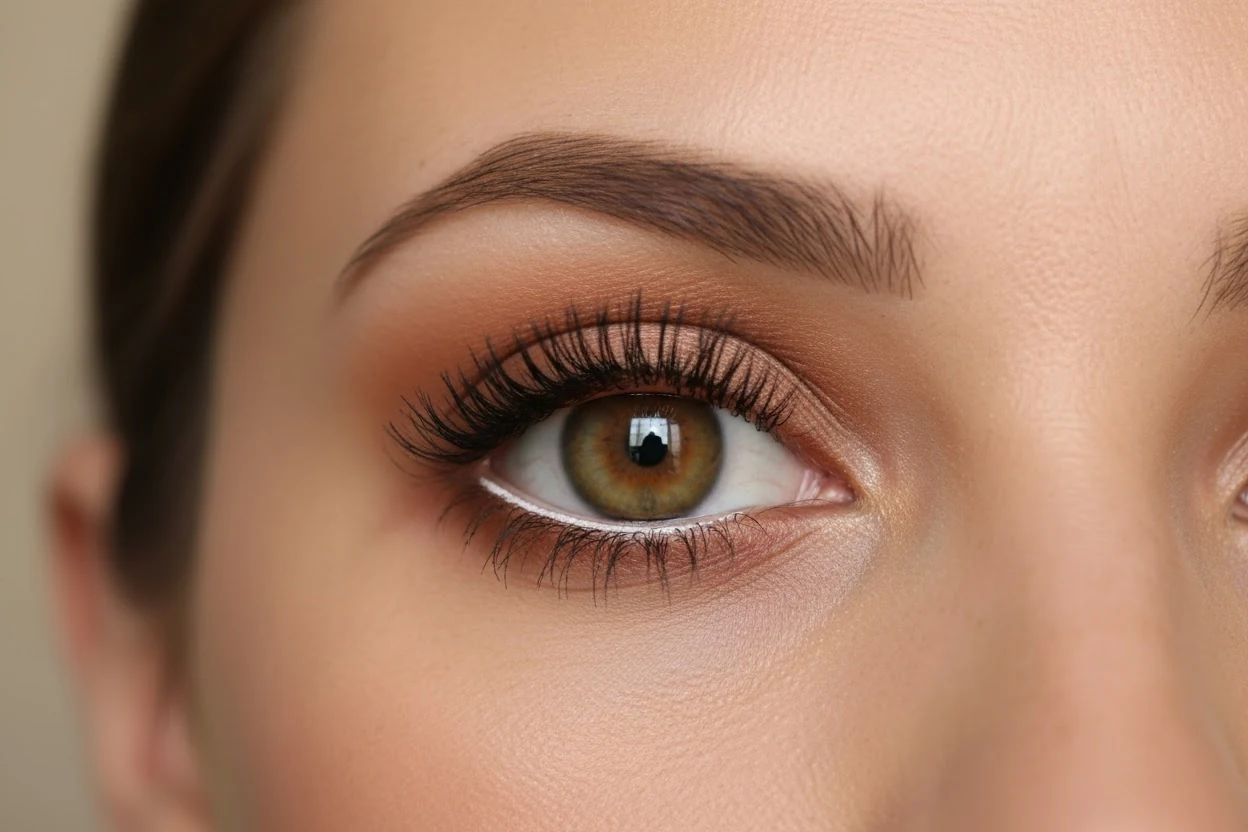
- Light liner on the lower waterline. Nude or white liner makes the visible opening look taller, which is the single most doe-like change.
- Mascara concentrated at the centre lashes. This lifts the middle of the eye and rounds the shape, where a winged look lengthens it.
- Soft, rounded shadow centred over the iris. Morikawa and colleagues found that eye shadow made eyes appear larger, especially viewed from a distance, through the same assimilation effect that makes the Delboeuf illusion work.
- Skip the sharp wing. A long, upswept wing does the opposite of what you want here and moves the look toward fox or siren eyes.
- A touch of light at the inner corner. It opens the inner end of the eye without lengthening the outer end.
Photos that keep eyes looking open
Head angle changes the eye more than most people realise. Vaca and colleagues photographed the same women with the head tilted up and down by up to 15 degrees and found that tilting the head down made the eye look more angular and increased the outer-corner tilt, while visible upper-lid space shrank. For a doe-eye look you generally want the opposite of the classic "chin down" model pose: level head, camera at or just above eye height, relaxed brows and no squint.
How to get doe eyes naturally
The honest list is short. Sleep and hydration make the lids look less puffy, which keeps the opening looking larger. Groomed brows that sit naturally rather than over-plucked high arches keep the eye area framed, which matters given the eyebrow finding above. Beyond that, the shape of your opening and the colour of your irises are set by anatomy. Exercises sold as making eyes bigger or rounder have no evidence behind them.
Do I have doe eyes? A quick check
Use a mirror or a photo taken at eye level with a relaxed face, then go through the features in order.
- Opening. Is your eye nearly as tall as it is wide, with a curved rather than pointed outer corner? That is the round end of the scale.
- Tilt. Hold a pen horizontally across both inner corners. Do the outer corners sit level with it or slightly below, rather than clearly above?
- Iris and white. Looking straight ahead, does white show on both sides of the iris, and does the iris look large and well defined?
- Framing. Do your lashes and brows frame the eye rather than crowd it?
Yes to the first two and most of the rest is what people usually mean by doe eyes. Yes to only one or two is the common case, and it is still just a description, not a result.
The eye shape detector measures the geometry under the doe-eyes description: your opening ratio, canthal tilt in degrees, visible lid space and eye spacing. It does not output a doe-eyes label and does not measure iris size or colour. The photo is analysed in your browser and is not uploaded.
Measure your eye opening and tiltIf it is the tilt you want on its own, the canthal tilt test gives the angle for each eye separately. And if you landed here from the other side of the vocabulary, the hunter eyes page covers the configuration most unlike doe eyes: a positive tilt, a compact lid and a long, narrow opening.
Frequently asked questions
What are doe eyes?
Doe eyes are large, rounded, open-looking eyes that give a face a soft or innocent expression, named after the eyes of a female deer. It is a beauty description rather than an anatomical category. In measurable terms it usually means an eye opening that is tall relative to its width, outer corners that sit level rather than lifted, plenty of visible iris, and often dark eyes and long lashes.
What does doe-eyed mean when describing a person?
The Oxford Advanced Learner's Dictionary defines doe-eyed as having large, usually dark eyes, suggesting someone with a gentle and innocent nature. In everyday use it can be a compliment about appearance or, depending on tone, a gentle jab at someone seen as naive.
Are doe eyes rare?
The individual features are common. A rounder eye opening, a near-level canthal tilt and dark eyes are all ordinary. Having all of them strongly together is less common than having some of them, which is the same pattern seen with any multi-feature label.
Can men have doe eyes?
Yes. The features that make eyes read as doe-like, a tall opening, level corners and a large visible iris, occur in men as often as in women. The phrase is simply used less often about men, and when it is, it usually means a softer, more open-looking eye area.
Are doe eyes and deer eyes the same?
In everyday use, yes. Deer eyes and doe eyes are searched and used interchangeably for large, round, dark, gentle-looking human eyes. Doe is the more established form in English, as in doe-eyed.
Do doe eyes have a positive or negative canthal tilt?
Usually neutral, sometimes slightly negative. The look depends on the outer corner not being strongly lifted. In a 102-adult research set measured with this test, the middle 80% of faces sat between +1.3° and +6.0° (median +3.7°), so a doe-eyed appearance generally sits in the lower part of that ordinary range rather than outside it.
How can I make my eyes look like doe eyes?
With makeup: nude or white liner on the lower waterline, mascara concentrated on the centre lashes, soft rounded shadow without a sharp wing and a little light at the inner corner. With photos: camera at or slightly above eye level and a relaxed brow. None of these change the eye itself; they change how open it reads.
Can a face shape tool tell me if I have doe eyes?
Not directly, because doe eyes is not a defined measurement. Our eye shape detector reports the measurements underneath it, mainly how tall your eye opening is relative to its width and your canthal tilt, and you can compare those with the description on this page. It does not output a doe-eyes label.
References
- Oxford Advanced Learner's Dictionary. doe-eyed (adjective). Oxford University Press, accessed 18 November 2026.
- Kobayashi, H., & Kohshima, S. (2001). Unique morphology of the human eye and its adaptive meaning: comparative studies on external morphology of the primate eye. Journal of Human Evolution, 40(5), 419–435. PMID 11322803.
- Glocker, M. L., Langleben, D. D., Ruparel, K., Loughead, J. W., Gur, R. C., & Sachser, N. (2009). Baby schema in infant faces induces cuteness perception and motivation for caretaking in adults. Ethology, 115(3), 257–263. PMID 22267884.
- Esté Jaloveckas, A., & Granero, R. (2024). The eyes as the exclamation mark of the face: exploring the relationship between eye size, intensity of female facial expressions and attractiveness in a range of emotions. Frontiers in Psychology, 15, 1421707. PMID 39176051.
- Kuraguchi, K., Tanabe-Ishibashi, A., & Ashida, H. (2022). Large irides enhance the facial attractiveness of Japanese and Chinese women. Acta Psychologica, 228, 103663. PMID 35816868.
- Peshek, D., Semmaknejad, N., Hoffman, D., & Foley, P. (2011). Preliminary evidence that the limbal ring influences facial attractiveness. Evolutionary Psychology, 9(2), 137–146. PMID 22947961.
- Morikawa, K., Matsushita, S., Tomita, A., & Yamanami, H. (2015). A real-life illusion of assimilation in the human face: eye size illusion caused by eyebrows and eye shadow. Frontiers in Human Neuroscience, 9, 139. PMID 25852522.
- Bashour, M., & Geist, C. (2007). Is medial canthal tilt a powerful cue for facial attractiveness? Ophthalmic Plastic and Reconstructive Surgery, 23(1), 52–56. PMID 17237692.
- Rhee, S. C., Woo, K. S., & Kwon, B. (2012). Biometric study of eyelid shape and dimensions of different races with references to beauty. Aesthetic Plastic Surgery, 36(5), 1236–1245. PMID 22810555.
- Vaca, E. E., Bricker, J. T., Mioton, L. M., Fagien, S., & Alghoul, M. S. (2022). The influence of sagittal head tilt on periorbital appearance: implications for clinical photography and the evaluation of postoperative results. Aesthetic Surgery Journal Open Forum, 4, ojab043. PMID 35156018.
- Ogao, E. (2022). Is TikTok's obsession with eye shapes harmless? Refinery29, updated 8 August 2022.
Tools mentioned in this article
Each runs free in your browser from one photo; the free AI face analysis runs them together.
- Eye Shape DetectorThe tool-intent entry to the eye cluster.
- Eye Shape TestLid space, canthal tilt in degrees, aperture and spacing — all ten types.
- Canthal Tilt TestYour tilt in degrees, each eye separately.
- Prey Eyes vs Hunter EyesThe same three measurements, read from the other end.
- Hunter Eyes TestThe three traits scored, and the fourth one a photo cannot read.
Measurements on this site are for information only. Nothing here is medical advice, and no result is a diagnosis. Talk to a qualified clinician before making any decision about a procedure.