Widow's peak: what it is, where the name comes from, and what the genetics actually show
·13 min read
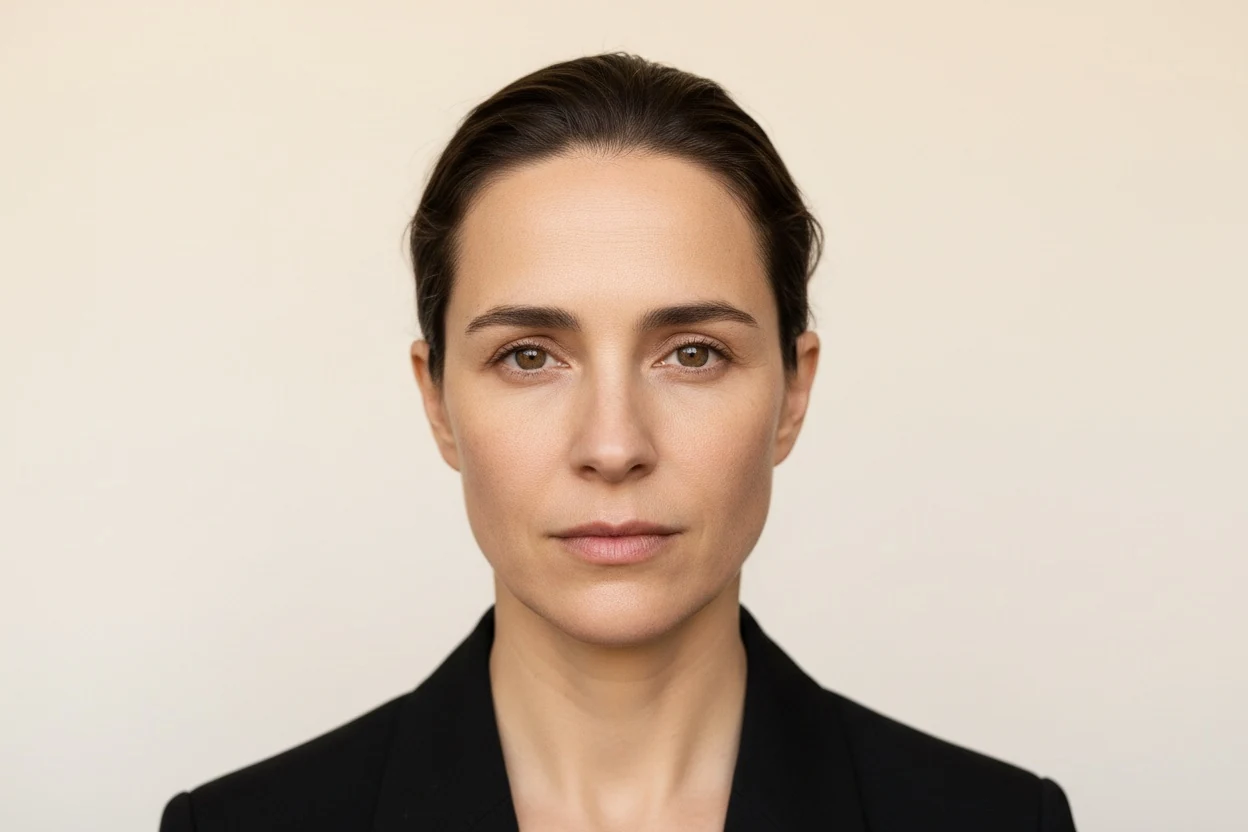
A widow's peak is a V-shaped point in the middle of the front hairline: the hairline dips toward the forehead in the centre and rises on either side. It is a shape, not a stage of hair loss. How common it is depends on the definition: one study counted it in 81% of 360 women, another in about 3% of 1,039 male medical students. And the classroom claim that it is a simple dominant gene has no evidence behind it; the one genome-wide study found several genetic regions and a partly inherited trait.
Most pages about the widow's peak either sell hair products or repeat the same three facts without sources. This guide covers what the shape is and how to tell it from other hairlines, where the name comes from, what the genetics actually show, how common it is in women and men, how to tell a widow's peak from a receding hairline, the rare cases where it is a medical sign, and how to style it.
Widow's peak: what the hairline shape looks like
Look at the front hairline straight on with your hair pulled back. If the line comes down to a point in the middle of the forehead and slopes upward toward each temple, that point is a widow's peak. It can be sharp and deep, or a shallow dip that only shows when the hair is slicked back. Either way it describes the outline of where hair grows, not how much of it there is.

Two details help when you are unsure. First, a widow's peak is about the middle of the hairline, while recession is about the corners at the temples. Second, hair at the point is usually as thick as the rest of the hairline. If the hairs along the edge are finer and shorter than the hair behind them, that is a different question, covered below.
Widow's peak hairline vs straight, rounded and M-shaped hairlines
The Norwood scale guide lists six hairline shapes and why none of them is a stage of hair loss. For a widow's peak the useful question is narrower: which of the other shapes is it most often confused with, and what separates them?
| Compared with | What the two share | What tells them apart |
|---|---|---|
| Straight hairline | Both can sit at the same height above the brows | A straight line has no low point in the middle; the edge runs level from temple to temple |
| Rounded hairline | Both curve down toward the sides | A rounded line is highest in the middle; a widow's peak is lowest in the middle |
| M-shaped hairline | Both have a forward middle and higher sides | In an M-shape the temples are notched back; in a widow's peak the corners can be full and only the centre dips |
| Early temple recession | The middle looks prominent because the sides are higher | Recession changes over months and years, and the hairs at the corners turn finer; a peak stays the same |
Widow's peak meaning: where the name comes from
The usual explanation is mourning dress. Writers on the phrase connect it to widows' hoods and caps that came to a point over the middle of the forehead, and a hairline with the same point took the name. The lexicographer Michael Quinion traces the phrase to Nathan Bailey's English dictionary of 1721, which links it to a pointed headdress that was already old-fashioned by then. An older relative, the "widow's lock" (a lock of hair growing apart from the rest), appears from around 1540.
Folklore did the rest. In Britain, Ireland and North America the shape was read as an omen that a woman would outlive her husband. That is the whole of the "widow's peak meaning" people search for, including the spiritual one: a resemblance to mourning clothes that turned into a superstition. It is a superstition about clothing, not an observation about the people who have the hairline.
Widow's peak genetics: not a simple dominant trait
Many biology classes teach the widow's peak as a single-gene trait: one dominant allele gives you the peak, two recessive ones a straight hairline. It is a tidy example, and there is no evidence for it. The biologist John McDonald, in *Myths of Human Genetics*, looked for family or twin studies of the trait in the general population and found none. His conclusion: the widow's peak should not be used to demonstrate simple genetics. The same book reaches the same verdict on the cleft chin.
Since then, one large study has looked. In 2022 a team in China ran a genome-wide association study on five facial traits, including the widow's peak, with 11,946 participants answering the widow's peak question. They found two genetic regions associated with it, near the genes GMDS-AS1 and SPRED2, and estimated that common genetic variants explain about 30% of the variation in the trait. The authors described it as the first published genetic study of the widow's peak.
| Claim | What the evidence shows |
|---|---|
| "A widow's peak is a dominant gene" | No family or twin study shows single-gene inheritance (McDonald, 2011) |
| "It's not genetic at all" | Also wrong: a genome-wide study found two associated regions and a SNP heritability of about 0.30 (Wang et al., 2022) |
| "Two parents without one can't have a child with one" | That rule only holds for a simple recessive trait, which this is not |
| "It's a reliable classroom example" | No: the trait is hard to define, and the inheritance is polygenic |
Two limits are worth knowing. The 2022 study relied on self-reported hairlines, with illustrations, rather than photographs, so some answers will be wrong in both directions. And it studied one population; whether the same regions matter elsewhere is untested. The honest summary: partly inherited, through many genes, and not predictable from your parents' hairlines.
How common a widow's peak is: two studies, two answers
The two studies that counted widow's peaks in the general population disagree by a factor of about 25, and that tells you more about definitions than about hairlines.
| Study | Who was examined | Share with a widow's peak |
|---|---|---|
| Smith & Cohen, 1973 | 1,039 male medical students, from photographs | About 3% with a slight but noticeable peak (as summarised by McDonald) |
| Nusbaum & Fuentefria, 2009 | 360 women in hair salons, measured in person | 81% |
Neither study set out a precise threshold for how deep a point has to be to count. A survey that counts any central dip finds most people have one; a survey that counts only a sharp V finds few. There is also an age effect in men: the temples tend to recede before the middle, so an adult man's peak can be partly the hairline he was born with and partly the corners moving back. That is why "is a widow's peak rare?" has no single answer. A pronounced V is uncommon; a gentle point is ordinary.
Widow's peak in women: the female hairline
The most detailed measurements of the widow's peak come from a study of women, done to help hair transplant surgeons design hairlines that look natural. Nusbaum and Fuentefria examined 360 women and found a widow's peak in 81%. They also found small forward bulges of hair on either side of the peak, which they called lateral mounds, in 98%, and temple recessions shaped as concave triangles or ovals in 87%.
- Widow's peak: present in 81% of the women examined.
- Lateral mounds: present in 98%; on average about 3.7 to 4 cm from the midpoint of the hairline.
- Forehead height: the mean distance from the middle of the eyebrows to the midpoint of the hairline was 5.5 cm.
The practical point: a soft central point is part of a typical female hairline, not an oddity. A perfectly straight line is the less natural shape, which is why surgeons designing hairlines for women build the peak and the mounds in rather than drawing a straight edge. If you have searched "widow peak hairline female" because yours looks different in photos than in the mirror, the cause is more often the angle and parting than the hairline itself.
Widow's peak or receding hairline?
This is the question most men are really asking. A widow's peak can look like recession at a glance, because the sides of the hairline sit higher than the middle. And recession can create something that looks like a peak, because the temples tend to move back before the centre does. One photo rarely settles it.
| Sign | Widow's peak | Receding hairline |
|---|---|---|
| Where the change is | The middle sits lower than the sides | The corners at the temples move back |
| Over time | Stable across photos a year apart | Further back in each photo in a series |
| Hair at the edge | As thick as the rest | Finer, shorter hairs along the corners |
| Since when | Visible in childhood photos | Developed in the late teens or adulthood |
| Crown | Unaffected | May thin at the same time |
The most useful test is your own photo history. If childhood and teenage photos show the same point, it is your hairline shape. If the corners have moved since, that is recession, and the Norwood scale describes where you are and how to photograph it consistently. Pattern hair loss is common: in a community study of American men aged 18 to 49, 42% had moderate to extensive loss. A widow's peak does not cause it, and does not protect against it.
Widow's peak and face shape
The widow's peak is often attached to the heart-shaped face, and many face shape charts draw one on the heart outline. That is a styling convention. A heart face is defined by a forehead wider than the jaw and a narrow chin, and plenty of heart-shaped faces have a straight hairline; the heart face shape page explains how it is measured. We found no study linking the two.
What a widow's peak does change is the outline people see. A point in the middle draws the eye to the centre of the forehead, and the higher sides can make the forehead look slightly broader at the temples. It is also why hair matters when you measure your face shape: pull your hair back so the forehead width you measure is the forehead, not the hairline. The face shape detector measures forehead width at the temples from landmarks on the skin, so a peak does not decide its result.
When a widow's peak is a medical sign
On its own, almost never. In 1973 David Smith and Michael Cohen described the widow's peak in relation to ocular hypertelorism, meaning eyes set unusually far apart, and it appears in the list of facial features of several rare genetic conditions. Two examples from the GeneReviews clinical summaries: Aarskog-Scott syndrome (FGD1-related faciogenital dysplasia) and Opitz G/BBB syndrome (MID1-related).
In those conditions the widow's peak is one feature among many. The others include widely spaced eyes and, depending on the condition, short stature, skeletal differences, or genital and airway anomalies; a clinician looks at the whole pattern, not one feature. A widow's peak in an otherwise typical face is a hairline shape and nothing more. If a child has several unusual features together, that is a question for a paediatrician, not for a hairline.
Widow's peak hairstyles: show it or soften it
There is no evidence base for haircuts; what follows is barbering and styling convention, and it is presented as that. The basic choice is whether to frame the point or cover it.
- Show it: hair back. Slicked-back, swept-back and pushed-back styles make the peak part of the look. They work best when the corners at the temples are full; if the temples are receding, a swept-back style puts the recession on display as well.
- Show it: short and textured. A short crop with the front left a little longer keeps the outline visible without drawing a sharp line around it.
- Soften it: side part. A part on one side sweeps hair diagonally across the point, so the V reads as part of the line rather than its centre.
- Cover it: fringe. A fringe, curtain bangs or a textured crop worn forward hides the middle of the hairline completely.
- Avoid if you dislike the point: a severe centre part pulled tight, which makes the peak the vertical axis of the face.

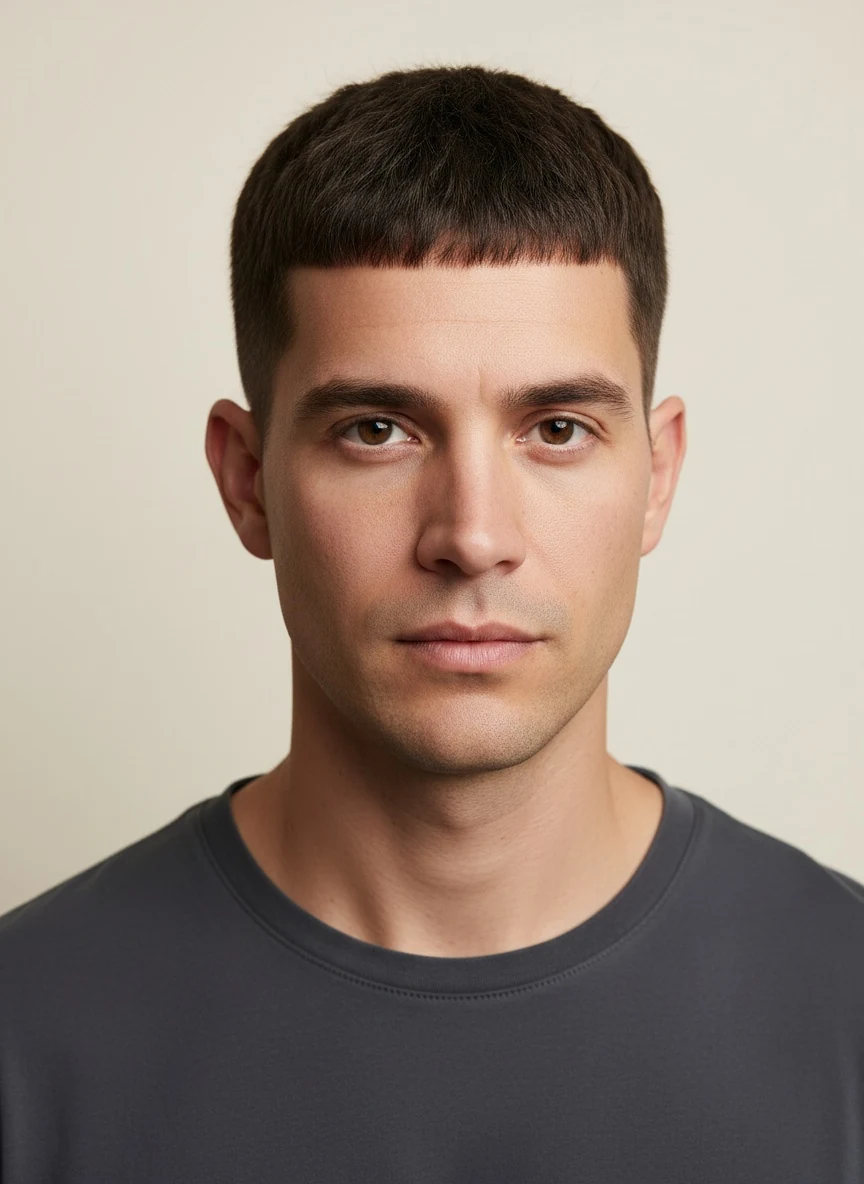
For a cut by face shape rather than by hairline, the hairstyles for face shape guide covers all seven shapes for women and men; the peak only decides whether the front goes back or forward.
Changing or hiding a widow's peak
Hiding it is easy; removing it is either temporary or surgical.
| Option | What it does | What to know |
|---|---|---|
| Fringe, side part, styling | Covers or breaks up the point | Free and reversible |
| Trimming or shaving the tip | Removes the hairs at the point | Temporary: they grow back, and the edge can look harsh as they do |
| Hair transplant | Moves follicles to fill the sides and straighten the line | Surgery; transplanted hair takes months to grow, and the donor supply is limited |
| Hairline lowering surgery | Removes a strip of forehead skin and brings the whole hairline forward | Surgery with a scar at the hairline; it moves the peak down rather than removing it |
If you want to see a different hairline on your own photo before talking to anyone, the hair transplant simulation and the hairline lowering simulation each render one. They are AI illustrations, not predictions of a surgical result, and a surgeon will tell you what your scalp, donor hair and hair loss history actually allow.
What a face photo can and cannot tell you about your hairline
Face analysis tools, including the ones here, are built on face landmark models. The model on this site places 478 points on the skin of the face; its highest point is its estimate of the top of the forehead, not your hairline. It cannot see hair, so it cannot tell a widow's peak from a straight line, measure how deep the point is, or notice that the temples have moved back.
That has a knock-on effect on any measurement that starts at the hairline. The classical facial thirds run from hairline to brow, brow to the base of the nose, and nose to chin. The facial thirds tool measures them from one photo and tells you plainly that the upper band, the one a hairline sets, is the least reliable. Read the middle-to-lower ratio it gives alongside, which does not depend on hair at all.
Upper, middle and lower thirds from one photo, with a plain warning that the upper third depends on your hairline. Runs in your browser, no upload.
Measure your facial thirdsForehead, cheekbone and jaw widths against face length. Pull your hair back first so the forehead width is your forehead, not your hairline.
Find your face shapeFrequently asked questions
What is a widow's peak?
A widow's peak is a V-shaped point in the middle of the front hairline, where the hairline dips down toward the forehead and rises on either side of it. It is a hairline shape, like a straight or rounded hairline, not a sign of hair loss on its own.
Is a widow's peak dominant or recessive?
Neither, in the simple sense school textbooks use. There are no family or twin studies showing single-gene inheritance, and the biologist John McDonald lists it as a myth of human genetics. A 2022 genome-wide study of self-reported hairlines in a large Chinese cohort found two genetic regions linked to a widow's peak and estimated that common variants explain about 30% of the variation. That points to many genes with small effects, plus non-genetic factors.
Is a widow's peak rare?
It depends on how strictly you define it. In a study of 360 women in hair salons, 81% had a widow's peak by the researchers' criteria. An older study of 1,039 male medical students counted a noticeable peak in only about 3%. Neither study published a definition the other could reuse, so there is no reliable single figure. A pronounced, sharp V is uncommon; a slight central point is very common, especially in women.
Why is it called a widow's peak?
The usual explanation is old mourning dress: widows' hoods and caps that came to a point over the middle of the forehead, and a hairline with the same point was linked to them. Folklore then turned the resemblance into a superstition that a woman with this hairline would outlive her husband. The phrase is recorded in Nathan Bailey's dictionary of 1721.
Does a widow's peak mean you are going bald?
No. A widow's peak is a shape you can have from childhood. In men, though, the temples often recede faster than the middle, which can make a central point stand out more with age. If the corners at your temples are moving back over a series of photos, that is recession, and the Norwood scale describes it; the peak itself is not the warning sign.
Can women have a widow's peak?
Yes, and by one measure most do. The study that examined 360 women found a widow's peak in 81% of them, along with small 'lateral mounds' of hair on either side in 98%. It was done to help surgeons design natural-looking hairlines for women, which is why it measured the shape so closely.
What does a widow's peak mean spiritually?
Nothing that can be tested. The traditional superstition, recorded in Britain, Ireland and North America, held that a woman with a widow's peak would be widowed early. It grew out of a resemblance to mourning headwear, not out of any observation about the people who have the hairline.
Can you get rid of a widow's peak?
You can hide it or change it. A fringe or a side part covers the point; some people trim or shave the hairs at the tip, which grow back. Permanent changes are surgical: a hair transplant can fill the sides to straighten the line, and hairline lowering surgery moves the whole hairline. Both are elective procedures with costs and scars, so they are worth a consultation rather than a quick decision.
Can a face analysis app detect a widow's peak?
Not the one on this site. The face landmark model behind our tools maps the face and stops at its estimate of the top of the forehead; it does not map hair, so it cannot see the shape of your hairline. Your own eyes and a mirror are more reliable for this.
References
- McDonald, J. H. (2011). Myths of Human Genetics (pp. 67–68: Widow's peak). Sparky House Publishing.
- Wang, P., Sun, X., Miao, Q., Mi, H., Cao, M., Zhao, S., Wang, Y., Shu, Y., Li, W., Xu, H., Bai, D., & Zhang, Y. (2022). Novel genetic associations with five aesthetic facial traits: a genome-wide association study in the Chinese population. Frontiers in Genetics, 13, 967684. doi:10.3389/fgene.2022.967684. PMID 36035146.
- Nusbaum, B. P., & Fuentefria, S. (2009). Naturally occurring female hairline patterns. Dermatologic Surgery, 35(6), 907–913. doi:10.1111/j.1524-4725.2009.01154.x. PMID 19397668.
- Smith, D. W., & Cohen, M. M. Jr. (1973). Widow's peak scalp-hair anomaly and its relation to ocular hypertelorism. The Lancet, 2(7838), 1127–1128. doi:10.1016/s0140-6736(73)90939-2. PMID 4128017.
- Jeanne, M. FGD1-related faciogenital dysplasia (Aarskog-Scott syndrome). In M. P. Adam et al. (Eds.), GeneReviews. University of Washington, Seattle; 1993–2026. PMID 41704117.
- Meroni, G. MID1-related Opitz G/BBB syndrome. In M. P. Adam et al. (Eds.), GeneReviews. University of Washington, Seattle; 1993–2026. PMID 20301502.
- Quinion, M. Widow's peak. World Wide Words.
- Norwood, O. T. (1975). Male pattern baldness: classification and incidence. Southern Medical Journal, 68(11), 1359–1365. PMID 1188424.
- Rhodes, T., Girman, C. J., Savin, R. C., Kaufman, K. D., Guo, S., Lilly, F. R., Siervogel, R. M., & Chumlea, W. C. (1998). Prevalence of male pattern hair loss in 18–49 year old men. Dermatologic Surgery, 24(12), 1330–1332. PMID 9865198.
Tools mentioned in this article
Each runs free in your browser from one photo; the free AI face analysis runs them together.
Measurements on this site are for information only. Nothing here is medical advice, and no result is a diagnosis. Talk to a qualified clinician before making any decision about a procedure.