Looksmax AI: how the rating apps work, what they cost, and what the score can't tell you
·12 min read
"Looksmax AI" is not one app. It is the name for a category of phone apps that take a selfie and return a score out of 10, feature ratings and improvement tips — the best known being Umax and LooksMax AI, which are made by different companies. None of them publishes exactly how its score is calculated.
What "looksmax AI" actually refers to
Search for looksmax AI and you will find several different products using the same few words. That matters more than it sounds: advice, prices and privacy terms for one "Umax" do not apply to another. These are the apps you are most likely to meet:
| App (store name) | Developer | Input | Price model (US, 14 Sep 2026) | Age rating |
|---|---|---|---|---|
| Umax – Become Hot | Improvement Tech LLC | Selfie | Free download; weekly and monthly premium, one-off items | 18+ |
| LooksMax AI | Mnkybrain Labs, Inc. | Photos | Free download; weekly/pro plan and add-on packs | 13+ |
| Umax AI: Face Scan & PSL Rating | An individual developer | Face scan | Free download; weekly, monthly and yearly plans | 4+ |
| Areum: Facial Aesthetics Scan | Bounty Studio, Inc. | Guided 3D face scan | Free download; subscriptions and report packs | 4+ |
How a looksmax AI app turns a selfie into a score
Apps in this category do not explain their scoring in detail, but there are only two basic ways to turn a photo into a number, and most products use one or a mix of both.
Landmark geometry: the arithmetic part
A face-landmark model places points on the photo — the corners of the eyes, the edges of the nose and mouth, the outline of the jaw — and the app calculates distances, angles and ratios from them: symmetry, facial thirds, eye spacing, canthal tilt, jaw width. This part is ordinary arithmetic and it is repeatable: the same photo gives the same measurements. Our own attractiveness test is built this way: 478 landmarks, symmetry weighted at 40% and three proportion ratios at 20% each, computed in your browser. The weights are a choice, and saying so is the honest part.
Learned ratings: a model's opinion of your face
The other approach trains a model on faces that people have already rated, so it learns to predict the rating a face would get. Areum, for example, describes a model "trained on millions of real human comparisons" and a calibration step where you choose between AI-generated faces. A learned score captures whatever the training ratings rewarded — which may include lighting, grooming, expression and the demographics of the raters — and it cannot tell you which of those it is responding to.
Where the photo goes
Most of these apps analyse your photo on their servers, which means it leaves your phone. That is not unusual for an app, but it matters for a face: Umax's privacy policy lists biometric data among the sensitive information it processes, and LooksMax AI's says face data is kept for 30 days and then deleted. The tools on this site run the landmark model in your browser instead, so the photo never leaves your device — a design choice with trade-offs, but it removes the need to trust a retention policy.
Umax: what it is, what it costs, what it scores
"Umax – Become Hot" is published by Improvement Tech LLC, a company registered in Pennsylvania. Its App Store description calls it "the looksmax AI tool", and the flow is simple: take a selfie, get an analysis, follow improvement tips. On Google Play it showed more than ten million downloads and a store listing last updated in April 2024. On the App Store it is rated 18+.
Is Umax free to use?
The download is free. Umax's terms describe a three-day free trial for new users, with the account charged for the chosen subscription when the trial ends. The in-app purchases listed on the US App Store were weekly premium at $3.99, $4.99, $6.99 and $9.99, monthly premium at $9.99, $12.99 and $24.99, a $3.99 "Supercharge" and a $6.99 item called "You as a 10/10". Several prices appear under the same plan name, so the price offered to you may differ.
How much Umax costs over a year
| Plan price (US App Store) | If kept for a year |
|---|---|
| $3.99 per week | About $207 |
| $9.99 per week | About $519 |
| $9.99 per month | About $120 |
| $24.99 per month | About $300 |
How to cancel a Umax subscription
Subscriptions bought through the App Store or Google Play are cancelled in the store, not by deleting the app: on iPhone, Settings → your name → Subscriptions; on Android, Play Store → profile → Payments & subscriptions → Subscriptions. Umax's terms say cancellation takes effect at the end of the current paid term and that all purchases are non-refundable, so cancel before a trial ends if you do not want to be charged.
LooksMax AI: the other app with the name
LooksMax AI is a separate app from Mnkybrain Labs, Inc., rated 13+ on the App Store. You upload photos, it analyses your traits and returns a rating and personalised advice. Its US in-app purchases on 14 September 2026 included LooksMax Pro at $3.99, a weekly plan at $3.99, a $4.99 Hairstyles Pack, packs of "boosts" from $2.99 to $5.99 and a $0.99 "Chad Pack". Its privacy policy says it collects the photos you upload plus age, gender and location, keeps face data for 30 days before automatic deletion, and does not share face data with third parties unless required by law.
Other looksmax AI apps you will see in the results
Umax AI: Face Scan & PSL Rating is a different app from a different developer that shares the Umax name; it offers a face scan with a "PSL score" and plans from $4.99 a week to $34.99 a year. Several other apps on both stores use "Umax" or "Looksmax" in their titles. If you are reading reviews or advice, check the developer name to be sure it is the app you actually have.
Areum: a 3D scan and a learned rating
Areum, from Bounty Studio, Inc., works differently: a guided 3D face scan with the phone camera, and a report from a model the developer says was trained on millions of human comparisons. It says your scan is never used to train its model. Its in-app purchases ranged from $4.99 to $99.99 on the US App Store, and its privacy label listed photos and sensitive information among the data collected.
Is looksmax AI accurate? Why two apps give you two scores
The measurements are real, and fragile
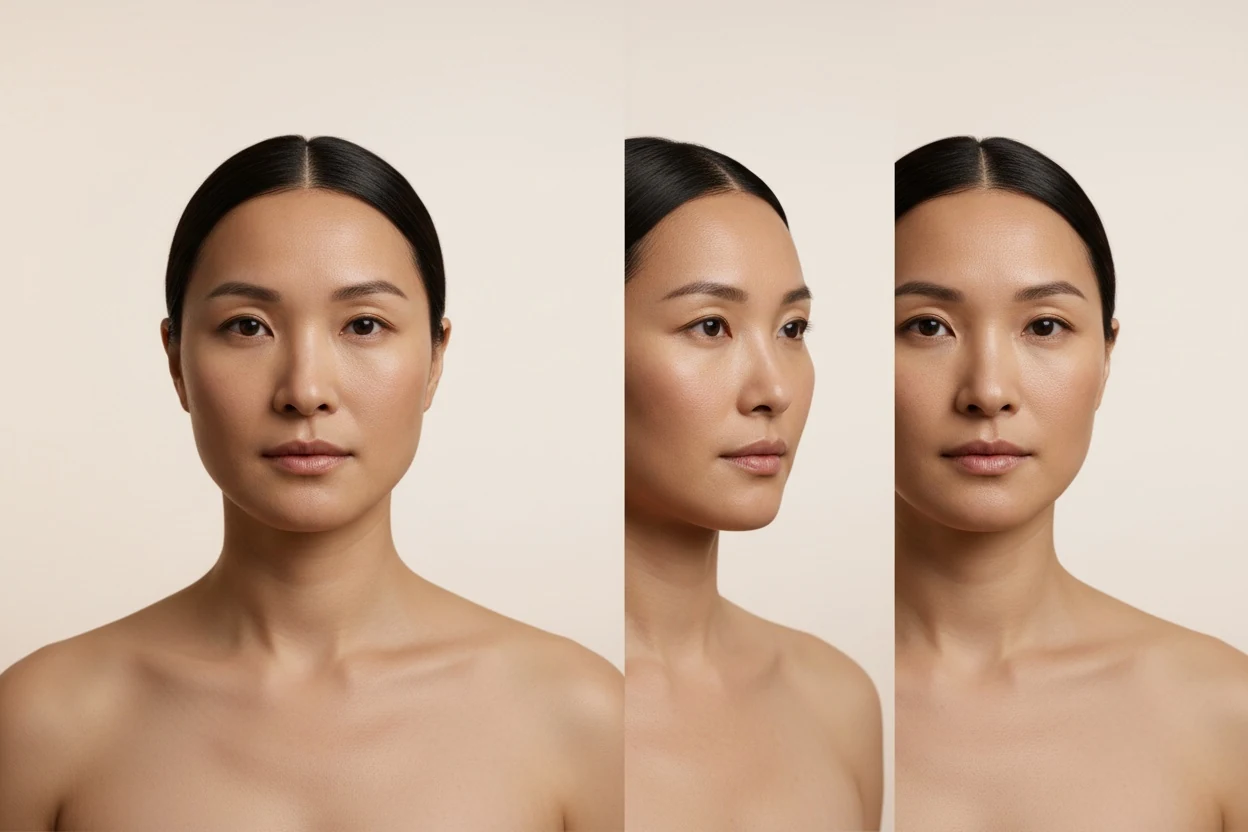
Landmark measurements from a photo are real, but they depend on the photo. A few degrees of head turn changes every horizontal distance; a phone held close widens the middle of the face; light from one side shifts where a model places the edge of a feature. Two selfies taken a minute apart can produce noticeably different numbers. That is why a score is most useful as a consistent index of the same setup over time, not as a verdict on a face.
The score is a weighting somebody chose
Even with identical measurements, turning them into one number means deciding what counts and how much. One app might weight symmetry heavily; another might reward a particular jaw ratio or canthal tilt; a learned model weights whatever its training ratings rewarded. None of the looksmax AI apps above publishes that weighting, so there is no way to check it — and no reason two apps should agree. Research on facial attractiveness supports modest effects of averageness, symmetry and sexual dimorphism, not a single formula; and the popular golden-ratio "mask" was criticised for resting on fashion models rather than measured populations.
Is a 6.5 out of 10 attractive?
A score out of 10 only means something inside the app that produced it. Different apps use different scales and weightings, and subscriptions are sold on the promise of raising the number. A 6.5 in one app is not comparable to a 6.5 in another, or to a rating from a person.
Can ChatGPT rate attractiveness?
A general chatbot can describe a photo and will give a number if pushed, but it is not measuring anything: it has no calibrated scale, it does not compute facial geometry, and the same photo can get a different answer on a different day or with a different prompt. If you want measurements, use a tool that computes them; if you want an opinion, a chatbot's is no more authoritative than a stranger's.
Is looksmax AI safe? Your photo, your data and your age
| Umax – Become Hot | LooksMax AI | This site's tools | |
|---|---|---|---|
| Where the photo is analysed | On the developer's servers | On the developer's servers | In your browser; not uploaded |
| What the policy says about face data | Processes biometric data; providers may retain data up to one year | Face data deleted after 30 days; not shared | Nothing stored |
| Tracking listed on App Store label | Usage data | Usage data | — |
| Age rating / stated age | 18+; says not for under-18s | 13+ | Terms: adults; no photos of anyone under 18 |
| Refunds | All purchases non-refundable (terms) | Via store policies | Free measurements |
Age is the part worth underlining. Looksmaxxing content reaches teenagers, and a 2026 paper in Pediatrics described it as an emerging concern for children's health; another 2026 analysis in a maxillofacial surgery journal catalogued dangerous practices spreading through the same communities. A rating app is not the same as those practices, but a number out of 10 attached to a young person's face is a poor starting point. If you are under 18, the measurement tools on this site are not meant for you either.
Looksmax AI free alternatives: what you can get without a subscription
| What the apps sell | Free equivalent? |
|---|---|
| Symmetry measurement | Yes — face symmetry test |
| Canthal tilt | Yes — canthal tilt |
| Jaw width, taper and asymmetry | Yes — jawline rating |
| Proportion-based overall score | Yes — attractiveness test, with its weights stated |
| A learned "attractiveness" rating | No — and no app publishes how theirs is validated |
| Daily plans, streaks and coaching | No — this is mostly what subscriptions pay for |
| Hairstyle or "10/10" previews | Partly — simulations render specific changes on your photo |
478 landmarks, symmetry and three proportion ratios, with the weighting stated. No account, and the photo is not uploaded.
Measure the geometry free, in your browserWhat a looksmax AI score cannot tell you
- Anything in profile. The true gonial angle, chin projection and the line from under the chin to the neck need a side view; a selfie has no depth axis.
- Bone versus soft tissue. A defined jaw from bone and one from low body fat look the same from the front.
- Skin. Evenness of skin tone changes how faces are rated in studies, and geometry does not see it.
- Expression and presence. Smiling changes how attractive a face is rated; a neutral selfie score ignores it.
- How other people see you. Faces are judged as wholes, in motion and in context, not as a list of ratios.
The PSL scale that many of these apps borrow comes from forum culture rather than research, and a rating on it is a ranking system, not a measurement. The PSL scale page explains where it comes from and why this site treats it with caution.
Where the scale comes from, what its numbers claim, and what a measured score can and cannot say instead.
What the PSL scale isShould you pay for a looksmax AI app?
| If this is you | Then |
|---|---|
| You want your symmetry, ratios and tilt measured | Use a free measurement tool; you do not need a subscription for arithmetic |
| You want a daily routine and someone to check in | A coaching app might suit you — read the terms, start the trial deliberately, and set a reminder to cancel |
| You want to know whether you are attractive | No app can tell you; see how to know if you are attractive |
| You would not want your photo on a company's server | Choose tools that analyse on-device or in the browser |
| You are under 18 | Skip rating apps; most are not meant for you |
| Your score is making you feel worse about yourself | Delete the app; the number is one system's opinion of one photo |
If what you want is to look better rather than to score higher, the evidence points to changes a score barely registers — sleep, skin, grooming, hair and expression. How to be prettier and how to glow up go through what those studies measured.
Frequently asked questions
What is looksmax AI?
It is a category name rather than one product: mobile apps that take a selfie and return a score out of 10, feature-by-feature ratings and improvement tips, marketed to people interested in looksmaxxing. Several apps use the name or a close variant, including Umax ("Umax – Become Hot") and LooksMax AI, which are made by different companies.
Is Umax free?
Downloading it is free, and the terms describe a three-day free trial for new users, after which the chosen subscription is charged. On the US App Store on 14 September 2026 its in-app purchases included weekly premium options from $3.99 to $9.99 and monthly options from $9.99 to $24.99. Its terms state that all purchases are non-refundable.
How much does Umax cost?
It depends on the plan offered to you. The US App Store listing on 14 September 2026 showed weekly premium purchases at $3.99, $4.99, $6.99 and $9.99 and monthly premium at $9.99, $12.99 and $24.99, plus one-off items. A $3.99 weekly plan kept for a year comes to about $207; the cheapest monthly plan to about $120.
Is Umax legit?
It is a real app from a registered US company, Improvement Tech LLC, with over ten million Google Play downloads and a large number of App Store ratings. Legit is not the same as accurate, though: the app does not publish how its scores are calculated, and its privacy policy says it processes biometric data. Read the terms before starting a trial, because purchases are non-refundable.
Is looksmax AI accurate?
There is nothing to check it against. None of the main apps publishes how its score is computed or validated, a score out of 10 is not a standard unit, and the same face gets different numbers from different apps and different photos. The measurable parts of a face — symmetry, proportions — can be computed consistently from a photo, but combining them into an attractiveness number is a choice each app makes.
Is looksmax AI safe?
It depends on the app and what you are comfortable with. These apps upload your photo to their servers to analyse it. Umax's privacy policy says it processes biometric data and that service providers may keep data for up to a year; LooksMax AI's says face data is deleted after 30 days. Umax is rated 18+ and says it is not for under-18s. Check the privacy label and policy of the exact app you download.
Can AI judge my attractiveness?
It can reproduce patterns in the ratings it was trained on, or compute geometry from your face, but neither is a measurement of attractiveness. Research on facial attractiveness finds real but modest effects of things like averageness and symmetry, alongside skin, expression and context that a single photo score handles poorly. Treat any score as one system's opinion of one photo.
Why does my score differ between apps?
Because each app chooses what to measure, how to weight it and how to turn it into a number, and none of them publishes that recipe in full. Your photo also changes the inputs: head angle, lens distance and light all move facial measurements. Two apps, or two selfies, will not give the same number, and neither number is the true one.
Is there a free looksmax AI alternative?
For the measurement part, yes. Symmetry, facial thirds, canthal tilt and jaw ratios are geometry that can be computed free from a photo, and the tools on this site do it in your browser without uploading the photo. What a free tool does not replace is an app's coaching layer — streaks, plans and tips — which is what the subscriptions mainly charge for.
References
- Rhodes, G. (2006). The evolutionary psychology of facial beauty. Annual Review of Psychology, 57, 199–226. PMID 16318594.
- Langlois, J. H., & Roggman, L. A. (1990). Attractive faces are only average. Psychological Science, 1(2), 115–121. doi:10.1111/j.1467-9280.1990.tb00079.x.
- Holland, E. (2008). Marquardt's Phi mask: pitfalls of relying on fashion models and the golden ratio to describe a beautiful face. Aesthetic Plastic Surgery, 32(2), 200–208. PMID 18175168.
- Mekhail, J., Howard, C., & Milanaik, R. (2026). From mewing to peptides: looksmaxxing as an emerging pediatric concern. Pediatrics, 158(3), e2026077705. PMID 42580741.
- Grillo, R., Fernandes, L. A., Rodrigues dos Santos, L. A., Lima, B. C., Brozoski, M. A., & Spagnol, G. (2026). Dangerous trends on social media related to facial esthetics: analysis of looksmaxxing and its softmaxxing and hardmaxxing practices. Journal of Stomatology, Oral and Maxillofacial Surgery, 127(5), 102971. PMID 42674114.
Tools mentioned in this article
- Attractiveness TestAm I pretty? Your 1-10 score against 102 research faces, formula shown.
- PSL Scale TestYour measurements on the 1-10 axis, and what the scale actually is.

- Symmetry CheckerLeft against right across six landmark pairs.
- Jawline Rating TestJaw against cheekbones, taper and asymmetry — and why the gonial angle is not in there.
- Canthal Tilt TestYour tilt in degrees, each eye separately.
Measurements on this site are for information only. Nothing here is medical advice, and no result is a diagnosis. Talk to a qualified clinician before making any decision about a procedure.